
All Topics  
Side-scan sonar


   Email Print
   Bookmark   Link


Side-scan sonar


Side-scan sonar (also sometimes called side scan sonar, sidescan sonar, side looking sonar, side-looking sonar and bottom classification sonar) is a category of sonarSonar

SONAR  — or sonar — is a technique that uses sound propagation under water to navigate or to de...
 system that is used to create efficiently an image of large areas of the sea floor. This tool is used for mapping the seabed for a wide variety of purposes, including creation of nautical chartNautical chart Summary

A nautical chart is a graphic representation of a maritime area and adjacent coastal regions....
s and detection and identification of underwater objects and bathymetric features. It may be used to conduct surveys for maritime archaeologyMaritime archaeology

Maritime archaeology is a discipline that studies human interaction with the sea, lakes and rivers through the study of ves...
; in conjunction with seafloor samples it is able to provide an understanding of the differences in material and texture type of the seabed. Side-scan sonar imagery is also a commonly used tool to detect debris items and other obstructions on the seafloor that may be hazardous to shipping or to seafloor installations by the oil and gas industry. In addition, the status of pipelines and cables on the seafloor can be investigated using side-scan sonar. Side-scan data are frequently acquired along with bathymetric soundingsEcho sounding Overview

*Sounding line*Hydroacoustics*AUVExternal link...
 and sub-bottom profilerSonar

SONAR  — or sonar — is a technique that uses sound propagation under water to navigate or to de...
 data, thus providing a glimpse of the shallow structure of the seabed. Side-scan sonar is also used for fisheries research, dredging operations and environmental studies. It also has military applications including mine detection.

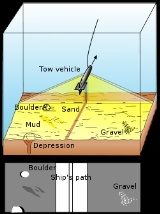
Side scan uses a sonar device that emits fan-shaped pulses down toward the seafloor across a wide angle perpendicular to the path of the sensor through the water, which may be towed from a surface vessel or submarineSubmarine

A submarine is a specialized watercraft that can operate underwater....
, or mounted on the ship's hullHull (watercraft)

A hull is the body of a ship or boat....
. The intensity of the acousticAcoustics Overview

Acoustics is a branch of physics that studies sound, namely mechanical waves in gases, liquids, and solids....
 reflections from the seafloor of this fan-shaped beamLight beam

A light beam or beam of light is a narrow cone of light energy radiating from a small source....
 is recorded in a series of cross-track slices. When stitched together along the direction of motion, these slices form an image of the sea bottom within the swath (coverage width) of the beam. The sound frequenciesFrequency

Frequency is the measurement of the number of times that a repeated event occurs per unit of time....
 used in side-scan sonar usually range from 100 to 500 kHz; higher frequencies yield better resolutionTemporal resolution

Temporal resolution refers to the precision of a measurement with respect to time....
 but less range.

One of the inventors of side-scan sonar was German scientist, Dr. Julius Hagemann, who was brought to the US after WW II and worked at the US Navy Mine Defense Laboratory, Panama City, FL from 1947 until his death in 1964. His work is documented in US Patent 4,197,591 which was first disclosed in Aug 1958, but remained classified by the US Navy until it was finally issued in 1980. Experimental side-scan sonar systems were made during the 1950s in laboratories including Scripps Institution of Oceanography and Hudson Laboratories and by Dr. Harold Edgerton at MIT.

Military side-scan sonars were made in the 1950s by Westinghouse. Advanced systems were later developed and built for special military purposes, such as to find H-Bombs lost at sea or to find a lost Russian submarine, at the Westinghouse facility in Annapolis up through the 1990s. This group also produced the first and only working Angle Look Sonar that could trace objects while looking under the vehicle.

The first commercial side-scan system was the Kelvin-Hughes "Transit Sonar", a converted echo-sounder with a single-channel, pole-mounted transducer introduced around 1960. In 1963 Dr. Harold Edgerton, Edward Curley, and John Yules used a side-scan sonar to find the sunken Vineyard Lightship in Buzzards Bay, Massachusetts. A team led by Martin KleinFacts About Martin Klein

Martin Klein may be:*Martin Klein , Estonian/Russian wrestler...
 at Edgerton, Germeshausen & Grier (later E.G. & G., Inc.) developed the first successful towed, dual-channel commercial side-scan sonar system from 1963 to 1966. In 1967, Edgerton used Klein's sonar to help Alexander McKeeAlexander McKee Overview

Alexander McKee,, was an agent in the British Indian Department during the American Revolutionary War and the Northwest Indi...
 find Henry VIII's flagship Mary RoseMary Rose

The Mary Rose was an English carrack and one of the first to be able to fire a full broadside of cannons....
. That same year Klein used the sonar to help archaeologist George Bass find a 2000 year old ship off the coast of Turkey. In 1968 Klein founded Klein Associates, Inc. and continued to work on improvements including the first commercial high frequency (500 kHz) systems and the first dual-frequency side-scan sonars. In 1985, Charles Mazel of Klein Associates produced the first commercial side-scan sonar training videos and the first Side Scan Sonar Training Manual.

For surveying large areas, the GLORIA sidescan sonarGLORIA sidescan sonar

The GLORIA sidescan sonar is a sidescan SONAR-based system for determining the depth of the ocean....
 was developed by Marconi Underwater Systems for NERC. This operated at relatively low frequencies to obtain long range. It was used by the US Geological Survey and the Institute of Oceanographics in the UK to obtain images of continental shelves world-wide.

Manufacturers of higher frequency side-scan sonar systems include RaytheonRaytheon

Raytheon Company is a major United States military contractor based in Waltham, Massachusetts....
, Northrop GrummanNorthrop Grumman Overview

Northrop Grumman Corporation is an aerospace and defense conglomerate that is the result of the 1994 purchase of Grumman by ...
 (formerly Westhinghouse), EdgeTech (formerly E.G. & G.), L-3/Klein Associates, J.W. Fishers Mfg. Inc., Imagenex Technology Corp., RESON A/S, Sonatech Inc., BenthosBenthos

In oceanography, marine geology and biology, benthos are the organisms and habitats of the sea floor; in freshwater biology ...
 (the sonar formerly produced by Datasonics), WESMAR, , , Geoacoustics, EDO Corp., Ultra ElectronicsUltra Electronics

Ultra Electronics is a British aerospace and defence company....
, and .

Up until the mid 1980s, commercial sidescan images were produced on paper records. The early paper records were produced with a sweeping plotter that burned the image into a scrolling paper record. Later plotters allowed for the simultaneous plotting of position and ship motion information onto the paper record. In the late 1980s, commercial systems using the newer, cheaper computer systems developed digital scan-converters that could mimic more cheaply the analog scan converters used by the military systems to produce TV and computer displayed images of the scan, and store them on video tape. Now data is stored on computer hard drives.

See also

  • aperture synthesisAperture synthesis

    Aperture synthesis is a type of interferometry that mixes signals from a collection of telescopes to produce images having t...
  • beamformingBeamforming

    Beamforming is a signal processing technique used with arrays of transmitters or receivers that controls the directionality ...
  • GLORIA sidescan sonarGLORIA sidescan sonar

    The GLORIA sidescan sonar is a sidescan SONAR-based system for determining the depth of the ocean....
  • phased arrayPhased array

    In telecommunication, a phased array is a group of antennas in which the relative phases of the respective signals feeding t...
  • sonarSonar

    SONAR  — or sonar — is a technique that uses sound propagation under water to navigate or to de...
  • Sonar 2087Sonar 2087

    Sonar 2087 is a new towed sonar system for Royal Navy Type 23 frigates manufactured by Thales Underwater Systems....
  • synthetic aperture sonarSynthetic aperture sonar

    Synthetic aperture sonar is a form of sonar in which sophisticated post-processing of sonar data are used in ways closely an...


External links

  • Pictures and description of sidescan sonar tow vehicle.
  • to make official US nautical charts
  • Examples of