
Home      Discussion      Topics      Dictionary      Almanac
Signup       Login
Shoelaces

Shoelaces

Overview
Discussion
Ask a question about 'Shoelaces'
Start a new discussion about 'Shoelaces'
Answer questions from other users
Full Discussion Forum
 
Recent Discussions
Encyclopedia
For the football player nicknamed Shoelace see Denard Robinson
Denard Robinson
Denard Xavier Robinson , nicknamed Shoelace, is an American football player who is playing his junior season for the 2011 Michigan Wolverines football team. He started at quarterback in all 13 games for the Michigan Wolverines football team in 2010...

.


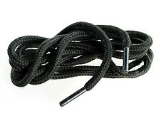
Shoelaces, which are also called shoe-strings, shoe laces, or boot laces, are a system commonly used to secure shoes, boot
Boot
A boot is a type of footwear but they are not shoes. Most boots mainly cover the foot and the ankle and extend up the leg, sometimes as far as the knee or even the hip. Most boots have a heel that is clearly distinguishable from the rest of the sole, even if the two are made of one piece....

s and other footwear
Footwear
Footwear consists of garments worn on the feet, for fashion, protection against the environment, and adornment. Being barefoot is commonly associated with poverty, but some cultures chose not to wear footwear at least in some situations....

. They typically consist of a pair of strings or cords, one for each shoe, finished off at both ends with stiff sections, known as aglets. Each shoelace typically passes through a series of holes, eyelets, loops or hooks on either side of the shoe. Loosening the lacing allows the shoe to open wide enough for the foot to be inserted or removed. Tightening the lacing and tying off the ends secures the foot within the shoe.

Shoelace construction


Traditional shoelaces were made of leather
Leather
Leather is a durable and flexible material created via the tanning of putrescible animal rawhide and skin, primarily cattlehide. It can be produced through different manufacturing processes, ranging from cottage industry to heavy industry.-Forms:...

, cotton
Cotton
Cotton is a soft, fluffy staple fiber that grows in a boll, or protective capsule, around the seeds of cotton plants of the genus Gossypium. The fiber is almost pure cellulose. The botanical purpose of cotton fiber is to aid in seed dispersal....

, jute
Jute
Jute is a long, soft, shiny vegetable fibre that can be spun into coarse, strong threads. It is produced from plants in the genus Corchorus, which has been classified in the family Tiliaceae, or more recently in Malvaceae....

, hemp
Hemp
Hemp is mostly used as a name for low tetrahydrocannabinol strains of the plant Cannabis sativa, of fiber and/or oilseed varieties. In modern times, hemp has been used for industrial purposes including paper, textiles, biodegradable plastics, construction, health food and fuel with modest...

, or other materials used in the manufacture of rope
Rope
A rope is a length of fibres, twisted or braided together to improve strength for pulling and connecting. It has tensile strength but is too flexible to provide compressive strength...

. Modern shoelaces often incorporate various synthetic fibers, which are generally more slippery and thus more prone to coming undone than those made from traditional fibers. On the other hand, smooth synthetic shoelaces generally have a less rough appearance, suffer less wear from friction, and are less susceptible to rotting from moisture. Specialized fibers like flame resistant nomex
Nomex
Nomex is a registered trademark for flame resistant meta-aramid material developed in the early 1960s by DuPont and first marketed in 1967.- Properties:...

 are applied in safety boots for firefighter
Firefighter
Firefighters are rescuers extensively trained primarily to put out hazardous fires that threaten civilian populations and property, to rescue people from car incidents, collapsed and burning buildings and other such situations...

s.

There are also various elasticized
Elastomer
An elastomer is a polymer with the property of viscoelasticity , generally having notably low Young's modulus and high yield strain compared with other materials. The term, which is derived from elastic polymer, is often used interchangeably with the term rubber, although the latter is preferred...

 shoelaces:
  1. Traditional "elastic" laces look identical to normal laces, and can simply be tied and untied as normal. They may also come with a permanent clip so they can be fastened invisibly.
  2. "Knotty" laces have a series of "fat" sections, which restrict movement through eyelets. These can be used to adjust tension throughout the lacing area. These laces can be tied or the ends can be left loose.
  3. "Twirly" laces are like a tight elastic helix, which can simply be pulled tight without requiring a knot.

Elastic laces both make the lacing more comfortable as well as allowing the shoe to be slipped on and off without tying or untying, which makes them a popular choice for children, the elderly and athletes.


The stiff section at each end of the shoelace, which both keeps the twine from unraveling and also makes it easier to hold the lace and feed it through the eyelets, is called an aglet
Aglet
An aglet is a small plastic or metal sheath typically used on each end of a shoelace, cord, or drawstring. An aglet keeps the fibers of the lace or cord from unraveling; its firmness and narrow profile make it easier to hold and easier to feed through the eyelets, lugs, or other lacing...

,
also spelled aiglet.

Shoelaces with a flat cross-section are generally easier to hold and stay tied more securely than those with a round cross-section. Very wide flat laces are often called "fat laces." Leather shoelaces with a square cross-section, which are very common on boat shoes, are notoriously prone to coming undone.

Shoelaces can be coated, either in the factory or with aftermarket products, to increase friction
Friction
Friction is the force resisting the relative motion of solid surfaces, fluid layers, and/or material elements sliding against each other. There are several types of friction:...

 and help them stay tied.

Shoelace tying


Common bow


Shoelaces are typically tied off at the top of the shoe using a simple bow knot. Besides securing the shoe, this also takes up the length of shoelace exposed after tightening. The common bow consists of two half knots tied one on top of the other, with the second half-knot looped in order to allow for quick untying. When required, the knot can be readily loosened by pulling one or both of the loose ends.

When tying the half-knots, a right-over-left half knot followed by a left-over-right half knot (or vice versa) forms a square or reef knot
Reef knot
The reef knot or square knot is an ancient and simple binding knot used to secure a rope or line around an object. Although the reef knot is often seen used for tying two ropes together, it is not recommended for this purpose due to potential instability of the knot.A reef knot is formed by tying...

, a fairly effective knot for the purpose of tying shoelaces. However, tying two consecutive right-over-left half knots (or two consecutive left-over-right half knots) forms the infamous granny knot
Granny knot
The granny knot is a binding knot, used to secure a rope or line around an object. It is considered inferior to the reef knot, which it superficially resembles. Neither of these knots should be used as a bend for attaching two ropes together....

, which is much less secure. Most people who use it will find themselves regularly retying their shoelaces.

If the loops lie across the shoe (left to right), the knot is probably a square knot. If they lie along the shoe (heel to toe), the knot is probably a granny knot.

Other more secure knots


There are several more secure alternatives to the common shoelace bow, with names such as Turquoise Turtle Shoelace Knot, or Shoemaker's Knot, Better Bow Shoelace Knot, Surgeon's Shoelace Knot, and Ian's Secure Shoelace Knot, or double slip knot. One such knot has been patented in 1999 under the title "Shoelace tying system". These are all variations of the same concept of looping the top part of the knot twice instead of once, which results in a finished bow of almost identical appearance but with the laces wrapped twice around the middle. This double-wrap holds the shoelaces more securely tied while still allowing them to be untied with a (slightly firmer) pull on the loose end(s).

Length


The proper length of a shoelace fitting it to a shoe varies according to the type of lacing used as well as the type of lace. However at a rough reference the following guide can be used.
No of holes Length/cm
2 45
3 65
4 75-85
5 85-90
6 100
7
8 120
9
10 130
11
12 150
13
14 180
15
16 200

Shoe lacing


This is the process of running the shoelaces through the holes, eyelets, loops, or hooks to hold together the sides of the shoe
Shoe
A shoe is an item of footwear intended to protect and comfort the human foot while doing various activities. Shoes are also used as an item of decoration. The design of shoes has varied enormously through time and from culture to culture, with appearance originally being tied to function...

. There are almost two trillion ways to lace a shoe with six pairs of eyelets.


The most common lacing method, termed criss-cross
Criss-Cross
Criss-Cross was an artist's cooperative that formed in Colorado in the early 1970s. Having evolved out of Drop City, the 1960s artists' community, C-C focused on issues surrounding "pattern and structure" and became associated with the 70's art movement "P&D" .In 1974, the five founders, Gene...

 lacing
, is also one of the strongest and most efficient, but is not so well suited to certain dress shoes, such as Oxfords, because the central shoelace crossovers prevent the sides of the shoe from coming together in the middle. For such shoes, methods such as straight lacing are better suited.

Many shoe lacing methods have been developed with specific functional benefits, such as being faster or easier to tighten or loosen, binding more tightly, being more comfortable, using up more lace or less lace, adjusting fit, preventing slippage, and suiting specific types of shoes. One such method, patented in 2003 as "Double helix shoe lacing process", runs in a double helix pattern and results in less friction and faster and easier tightening and loosening.

Many other lacing methods have been developed purely for appearance, often at the expense of functionality. One of the most popular decorative methods, checkerboard
Checkerboard
A checkerboard or chequerboard is a board of chequered pattern on which English draughts is played. It is an 8×8 board and the 64 squares are of alternating dark and light color, often red and black....

 lacing, is very difficult to tighten or loosen without destroying the pattern. Shoes with checkerboard lacing are generally treated as "slip-ons".

History


It is as difficult to determine the exact history of shoelaces as it is for shoes. Archaeological records of footwear are rare because shoes were generally made of materials that deteriorated readily. The Areni-1 shoe
Areni-1 shoe
The Areni-1 shoe is a 5,500-year-old leather shoe that was found in 2008 in excellent condition in the Areni-1 cave complex located in the Vayots Dzor province of Armenia. It is a one-piece leather-hide shoe that has been dated as a few hundred years older than the one found on Ötzi the Iceman,...

, which has been dated to around 3500 BC, is a simple leather "shoe" with leather "shoelaces" passing through slotted "eyelets" cut into the hide. The more complex shoes worn by Ötzi the Iceman
Ötzi the Iceman
Ötzi the Iceman , Similaun Man, and Man from Hauslabjoch are modern names for a well-preserved natural mummy of a man who lived about 5,300 years ago. The mummy was found in September 1991 in the Ötztal Alps, near Hauslabjoch on the border between Austria and Italy. The nickname comes from the...

, who lived around 3300 BC, were bound with "shoelaces" made of lime bark string.

As for shoelaces in the sense that we know them in modern times, the Museum of London
Museum of London
The Museum of London documents the history of London from the Prehistoric to the present day. The museum is located close to the Barbican Centre, as part of the striking Barbican complex of buildings created in the 1960s and 70s as an innovative approach to re-development within a bomb damaged...

 has documented examples of medieval footwear dating from as far back as the 12th century, which clearly show the lacing passing through a series of hooks or eyelets down the front or side of the shoe.

Myths


A popular myth states that Ghurka
Gurkha
Gurkha are people from Nepal who take their name from the Gorkha District. Gurkhas are best known for their history in the Indian Army's Gorkha regiments, the British Army's Brigade of Gurkhas and the Nepalese Army. Gurkha units are closely associated with the kukri, a forward-curving Nepalese knife...

 soldiers, fighting for Britain, crawled along the ground, feeling the laces of the soldiers they encountered. British soldiers employed straight- or bar-lacing, while Japanese troops employed a criss-cross pattern. Criss-cross laces could therefore mean the difference between life and death. The importance of correct lacing was thus emphasized to British troops.

Shoelace accessories


There are many shoelace accessories. There are hooks to help lace shoelaces tightly. They are especially useful for skates where tight lacing is important. Shoelace covers protect the laces, especially in wrestling. Shoelace charm
Charm
Charm, charms, charmed or charming may refer to:* A Spell or incantation** any "lucky charm" such as amulets , touch pieces and painted pebbles,*** Italian charm bracelet...

s are decorative, as are colored shoelaces. Some laces are colored using expensive dyes, other, more "personal" colors, are drawn-on with permanent marker
Permanent marker
A permanent marker is a type of marker pen that is used to create permanent writing on an object. Generally the liquid is water resistant, contains a solvent such as xylene, toluene, or alcohol and is capable of writing on a variety of surfaces from paper to metal to stone...

s. Some dress codes (especially high schools) will specifically exclude color laces and charms. Lace-locks hold laces together, eliminating the need for tying. There are shoelace tags, sometimes called deubré
Deubré
Deubré is a generic term, originating at Nike, Inc., for an ornamental shoelace tag. Typically, a deubré will have two holes through which a shoelace is threaded, like a bead on string. When the shoe is laced, the deubré is centered between the first two eyelets , with the shoelace passing through...

, with two holes or slots through which the shoelace is passed. These are worn on the section of shoelace closest to the toes, in other words the last lace, so that the image or writing on the tag is visible (as can be seen at right).

See also

  • Shoelace knot
    Shoelace knot
    The shoelace knot is a knot which is commonly used for tying shoelaces.The shoelace knot is designed for quick release and easily comes untied when either of the working ends is pulled. During the tying of the knot, the farther the loops are pulled, the shorter the working ends become...

    , a knot commonly used to tie shoelaces.
  • Drawstring
    Drawstring
    A drawstring is a string, cord, or rope used to "draw" or tie closed an opening in fabric or other material...

    , similar in concept.
  • Velcro hook-and-loop fasteners
    Velcro
    Velcro is the brand name of the first commercially marketed fabric hook-and-loop fastener, invented in 1948 by the Swiss electrical engineer George de Mestral...

    , another system sometimes used to secure footwear.

External links