

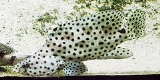
Serranidae

Overview
Serranidae is a large family
of fish
es, belonging to the order Perciformes
. The family contains about 450 species of serranids in 64 genera, including the sea basses
and the grouper
s (subfamily Epinephelinae). They range in size from the belted sandfish
(Serranus subligarius), which grows to 110 mm (4.33 in), up to the itajara (Epinephelus itajara), which grows to 2.4 m (94.5 in) and weighs up to 300 kg (661.4 lb).
Many serranid species are brightly colored, and many are caught commercially for food.
Family (biology)
In biological classification, family is* a taxonomic rank. Other well-known ranks are life, domain, kingdom, phylum, class, order, genus, and species, with family fitting between order and genus. As for the other well-known ranks, there is the option of an immediately lower rank, indicated by the...
of fish
Fish
Fish are a paraphyletic group of organisms that consist of all gill-bearing aquatic vertebrate animals that lack limbs with digits. Included in this definition are the living hagfish, lampreys, and cartilaginous and bony fish, as well as various extinct related groups...
es, belonging to the order Perciformes
Perciformes
The Perciformes, also called the Percomorphi or Acanthopteri, is one of the largest orders of vertebrates, containing about 40% of all bony fish. Perciformes means perch-like. They belong to the class of ray-finned fish and comprise over 7,000 species found in almost all aquatic environments...
. The family contains about 450 species of serranids in 64 genera, including the sea basses
Bass (fish)
Bass is a name shared by many different species of popular gamefish. The term encompasses both freshwater and marine species. All belong to the large order Perciformes, or perch-like fishes, and in fact the word bass comes from Middle English bars, meaning "perch."-Types of basses:*The temperate...
and the grouper
Grouper
Groupers are fish of any of a number of genera in the subfamily Epinephelinae of the family Serranidae, in the order Perciformes.Not all serranids are called groupers; the family also includes the sea basses. The common name grouper is usually given to fish in one of two large genera: Epinephelus...
s (subfamily Epinephelinae). They range in size from the belted sandfish
Belted sandfish
The belted sandfish, Serranus subligarius, is a member of the Serranidae family. It is hermaphroditic and inhabits primarily the Florida coast....
(Serranus subligarius), which grows to 110 mm (4.33 in), up to the itajara (Epinephelus itajara), which grows to 2.4 m (94.5 in) and weighs up to 300 kg (661.4 lb).
Many serranid species are brightly colored, and many are caught commercially for food.
