
Home      Discussion      Topics      Dictionary      Almanac
Signup       Login
Scipionyx

Scipionyx

Overview
{{italictitle}}
{{italictitle}}{{Taxobox
| name = Scipionyx
| fossil_range = Early Cretaceous
Early Cretaceous
The Early Cretaceous or the Lower Cretaceous , is the earlier or lower of the two major divisions of the Cretaceous...


| image = 9119 - Milano, Museo storia naturale - Scipionyx samniticus - Foto Giovanni Dall'Orto 22-Apr-2007.jpg
| image_width = 250px
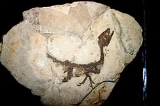
| image_caption = Scipionyx samniticus fossil at the Museo Civico di Storia Naturale, in Milan, Italy.
| regnum = Animal
Animal
Animals are a major group of mostly multicellular, eukaryotic organisms of the kingdom Animalia or Metazoa. Their body plan eventually becomes fixed as they develop, although some undergo a process of metamorphosis later on in their life. Most animals are motile, meaning they can move spontaneously...

ia
| phylum = Chordata
Chordate
Chordates are animals which are either vertebrates or one of several closely related invertebrates. They are united by having, for at least some period of their life cycle, a notochord, a hollow dorsal nerve cord, pharyngeal slits, an endostyle, and a post-anal tail...


| classis = Sauropsida
Reptile
Reptiles, or members of the class Reptilia, are air-breathing, generally "cold-blooded" amniotes that generally have skin covered in scales or scutes. They are tetrapods and lay amniote eggs, whose embryos are surrounded by the amnion membrane...


| superordo = Dinosaur
Dinosaur
{{Otheruses}}{{pp-semi-protected|small=yes}}{{Otheruses}}{{pp-semi-protected|small=yes}}{{Taxobox|name = Dinosaurs|fossil_range = {{Fossil range|230|65|earliest=230|latest=0|PS=
Descendant taxon Aves survives to present.}}|image = field_dinos_2.jpg...

ia
| ordo = Saurischia
Saurischia
Saurischia is one of the two orders, or basic divisions, of dinosaurs. In 1888, Harry Seeley classified dinosaurs into two orders, based on their hip structure...


| subordo = Theropoda
Theropoda
Theropods are a group of bipedal saurischian dinosaurs. Although they were primarily carnivorous, a number of theropod families evolved herbivory during the Cretaceous Period...


| unranked_familia = Coelurosauria
Coelurosauria
Coelurosauria is the clade containing all theropod dinosaurs more closely related to birds than to carnosaurs. It is a diverse group that includes tyrannosaurs, ornithomimosaurs, and maniraptors; Maniraptora includes birds, the only descendents of coelurosaurs alive today...


| genus = Scipionyx
| genus_authority= dal Sasso & Signore, 1998
|subdivision_ranks=Species
Species
In biology, a species is:* a taxonomic rank or* a unit at that rank ....


|subdivision=
  • S.
Discussion
Ask a question about 'Scipionyx'
Start a new discussion about 'Scipionyx'
Answer questions from other users
Full Discussion Forum
 
Encyclopedia
{{italictitle}}
{{italictitle}}{{Taxobox
| name = Scipionyx
| fossil_range = Early Cretaceous
Early Cretaceous
The Early Cretaceous or the Lower Cretaceous , is the earlier or lower of the two major divisions of the Cretaceous...


| image = 9119 - Milano, Museo storia naturale - Scipionyx samniticus - Foto Giovanni Dall'Orto 22-Apr-2007.jpg
| image_width = 250px
| image_caption = Scipionyx samniticus fossil at the Museo Civico di Storia Naturale, in Milan, Italy.
| regnum = Animal
Animal
Animals are a major group of mostly multicellular, eukaryotic organisms of the kingdom Animalia or Metazoa. Their body plan eventually becomes fixed as they develop, although some undergo a process of metamorphosis later on in their life. Most animals are motile, meaning they can move spontaneously...

ia
| phylum = Chordata
Chordate
Chordates are animals which are either vertebrates or one of several closely related invertebrates. They are united by having, for at least some period of their life cycle, a notochord, a hollow dorsal nerve cord, pharyngeal slits, an endostyle, and a post-anal tail...


| classis = Sauropsida
Reptile
Reptiles, or members of the class Reptilia, are air-breathing, generally "cold-blooded" amniotes that generally have skin covered in scales or scutes. They are tetrapods and lay amniote eggs, whose embryos are surrounded by the amnion membrane...


| superordo = Dinosaur
Dinosaur
{{Otheruses}}{{pp-semi-protected|small=yes}}{{Otheruses}}{{pp-semi-protected|small=yes}}{{Taxobox|name = Dinosaurs|fossil_range = {{Fossil range|230|65|earliest=230|latest=0|PS=
Descendant taxon Aves survives to present.}}|image = field_dinos_2.jpg...

ia
| ordo = Saurischia
Saurischia
Saurischia is one of the two orders, or basic divisions, of dinosaurs. In 1888, Harry Seeley classified dinosaurs into two orders, based on their hip structure...


| subordo = Theropoda
Theropoda
Theropods are a group of bipedal saurischian dinosaurs. Although they were primarily carnivorous, a number of theropod families evolved herbivory during the Cretaceous Period...


| unranked_familia = Coelurosauria
Coelurosauria
Coelurosauria is the clade containing all theropod dinosaurs more closely related to birds than to carnosaurs. It is a diverse group that includes tyrannosaurs, ornithomimosaurs, and maniraptors; Maniraptora includes birds, the only descendents of coelurosaurs alive today...


| genus = Scipionyx
| genus_authority= dal Sasso & Signore, 1998
|subdivision_ranks=Species
Species
In biology, a species is:* a taxonomic rank or* a unit at that rank ....


|subdivision=
  • S. samniticus dal Sasso & Signore, 1998 (type
    Type species
    In taxonomy, a type species is a technical phrase, involved in the application of formal names...

    )

}}
Scipionyx is a very small genus
Genus
In biology, a genus is a taxonomic unit used in the classification of living and fossil organisms. The term comes from Latin genus "descent, family, type, gender" , cognate with – genos, "race, stock, kin" ..In addition, genus is a taxonomic rank in the hierarchy In biology, a genus (plural:...

 of theropod dinosaur
Dinosaur
{{Otheruses}}{{pp-semi-protected|small=yes}}{{Otheruses}}{{pp-semi-protected|small=yes}}{{Taxobox|name = Dinosaurs|fossil_range = {{Fossil range|230|65|earliest=230|latest=0|PS=
Descendant taxon Aves survives to present.}}|image = field_dinos_2.jpg...

 from the Early Cretaceous
Cretaceous
The Cretaceous , Latin language for "chalky", usually abbreviated K for its German translation Kreide , is a geologic period and system from circa to million years ago . In the geologic timescale, the Cretaceous follows on the Jurassic period and is followed by the Paleogene period of the...

 of Italy
Italy
Italy , officially the Italian Republic , is a country located on the Italian Peninsula in Southern Europe and on the two largest islands in the Mediterranean Sea, Sicily and Sardinia. Italy shares its northern, Alpine boundary with France, Switzerland, Austria and Slovenia...

, around 113 million years ago
Mya (unit)
In astronomy, geology, and paleontology, mya or "m.y.a." is an abbreviation for "million years ago". Like the related unit bya, mya is traditionally written in lower case...

. There has been only one skeleton discovered, which is notable for the preservation of soft tissue and internal organs. It is the fossil
Fossil
Fossils are the preserved remains or traces of animals, plants, and other organisms from the remote past. The totality of fossils, both discovered and undiscovered, and their placement in fossiliferous rock formations and sedimentary layers is known as the fossil record...

 of a juvenile only a few inch
Inch
An inch is the name of a unit of length in a number of different systems, including Imperial units, and United States customary units. There are 36 inches in a yard and 12 inches in a foot...

es long. Adult size is estimated to be 2 metres (approx. 6 feet). The name Scipionyx comes from the Latin word Scipio and the Greek onyx, meaning "Scipio's claw", and for Scipione Breislak
Scipione Breislak
Scipione Breislak , Italian geologist of German parentage, was born in Rome in 1748. He distinguished himself as professor of mathematical and mechanical philosophy in the college of Ragusa; but after residing there for several years he returned to his native city, where he became a professor in...

, the geologist who wrote the first description of the formation in which the fossil was found. The specific name samniticus means "From the Samnium", the Latin name of the region around Pietraroja. The specimen is also popularly nicknamed "Skippy".

Scipionyx was discovered in the spring of 1981 by Giovanni Todesco, an amateur paleontologist
Paleontology
Paleontology from Greek: παλαιός "old, ancient", ὄν, ὀντ- "being, creature", and λόγος "speech, thought" is the study of prehistoric life, including organisms' evolution and interactions with each other and their environments...

, near Pietraroja
Pietraroja
Pietraroja is a mountain comune , rich of water sources, woods and healthy air, inthe province of Benevento in Campania, southern Italy. It is c. 50 km by car from Benevento, in direction north-west, 83 km from Naples in direction north-east and c...

, approximately 50 kilometers from Naples
Naples
Naples in Italy, is the capital of the region of Campania and of the province of Naples. The city is known for its rich history, art, culture, architecture, music and gastronomy, playing an important role throughout much of its existence; it is over 2,800 years old...

. The fossils were preserved in the Pietraroia limestone formation, well known for unusually well-preserved fossils. Todesco thought the remains belonged to that of a fossil bird. Unaware of the importance of his findings, he kept the strange fossil in the basement of his house until 1992 when he met two paleontologists, Cristiano dal Sasso of the Natural History Museum of Milan and Marco Signore of the University of Naples Federico II
University of Naples Federico II
The University of Naples Federico II is a university located in Naples, Italy. It was founded in 1224 and is organized into 13 faculties. It is the world's oldest state university and one of the oldest academic institutions in continuous operation...

, who identified it as the first Italian dinosaur. The magazine Oggi gave the tiny dinosaur the nickname Ciro, a typical Neapolitan
Naples
Naples in Italy, is the capital of the region of Campania and of the province of Naples. The city is known for its rich history, art, culture, architecture, music and gastronomy, playing an important role throughout much of its existence; it is over 2,800 years old...

 name. In 1998, Scipionyx made the front cover of Nature
Nature (journal)
Nature is a prominent British scientific journal, first published on 4 November 1869. Most scientific journals are now highly specialized, and Nature is among the few journals that still publish original research articles across a wide range of scientific...

.

Classification


Scipionyx is classified as a coelurosaur
Coelurosauria
Coelurosauria is the clade containing all theropod dinosaurs more closely related to birds than to carnosaurs. It is a diverse group that includes tyrannosaurs, ornithomimosaurs, and maniraptors; Maniraptora includes birds, the only descendents of coelurosaurs alive today...

ian theropod. Because the only remains recovered belong to that of a juvenile, it has not been possible to assign this dinosaur to a more specific group. Coelurosaur characteristics included a sacrum
Sacrum
The sacrum is a large, triangular bone at the base of the spine and at the upper and back part of the pelvic cavity, where it is inserted like a wedge between the two hip bones. Its upper part connects with the last lumbar vertebra, and bottom part with the coccyx...

 (a series of vertebrae that attach to the hips) longer than in other dinosaurs, a tail stiffened towards the tip, and a bowed ulna
Ulna
The ulna is a long bone, prismatic in form. In anatomical position the ulna is placed at the medial side of the forearm closest to the body, parallel with the radius on both arms.-Articulations:The ulna articulates with:...

 (lower arm bone). The tibia
Tibia
The tibia, shinbone, or shankbone is the larger and stronger of the two bones in the leg below the knee in vertebrates and connects the knee with the ankle bones.The tibia is named for the greek aulos flute, also known as a tibia.-In humans:...

 (lower leg bone) is also characteristically longer than the femur
Femur
The femur, or thigh bone, is the most proximal bone of the leg in vertebrates capable of walking or jumping, such as most land mammals, birds, many reptiles such as lizards, and amphibians such as frogs...

 (upper leg bone) in coelurosaurs. Fossil evidence indicates that most coelurosaurs were probably feather
Feather
Feathers are one of the epidermal growths that form the distinctive outer covering, or plumage, on birds. They are considered the most complex integumentary structures found in vertebrates. They are among the outstanding characteristics that distinguish the extant Aves from other living groups....

ed.

Paleobiology


Scipionyx is considered one of the most important fossil vertebrates ever discovered, after a long and painstaking "autopsy" revealed the unique fossilisation of portions of its internal organs. Parts of the windpipe
Vertebrate trachea
The trachea, or windpipe, is a tube that connects to the pharynx or larynx, allowing the passage of air to the lungs. It is lined with pseudostratified ciliated columnar epithelium cells with mucosal goblet cells which produce mucus...

, intestine
Intestine
In anatomy, the intestine is the segment of the alimentary canal extending from the stomach to the anus and, in humans and other mammals, consists of two segments, the small intestine and the large intestine...

s, liver
Liver
The liver is a vital organ present in vertebrates and some other animals; it has a wide range of functions, including detoxification, protein synthesis, and production of biochemicals necessary for digestion...

, and muscles were preserved in the fine limestone. The specimen's liver was so well preserved that it is thought it retains both the shape and color it had when the animal was alive. The find has implications because the relative positions of internal organs of dinosaurs could only be guessed before this discovery. The overall length of the intestines — shorter than what was expected — indicates Scipionyx could process food very efficiently.

It is believed Scipionyx lived in a region filled with shallow lagoon
Lagoon
A lagoon is a body of comparatively shallow salt or brackish water separated from the deeper sea by a shallow or exposed sandbank, coral reef, or similar feature. Thus, the enclosed body of water behind a barrier reef or barrier islands or enclosed by an atoll reef is called a lagoon. This...

s. These bodies of water were oxygen deficient, leading to the well-preserved Scipionyx specimen, much like the fine fossil preservation seen in Germany's Archaeopteryx
Archaeopteryx
Archaeopteryx, sometimes referred to by its German name Urvogel , is the earliest and most primitive bird known...

.

External links


{{Commonscat|Scipionyx samniticus}}

{{portalpar|Dinosaurs}}