


Santa Maria presso San Celso

Encyclopedia
Santa Maria dei Miracoli presso San Celso is a church and a sanctuary in Milan
, Lombardy
, northern Italy
.
and Giovanni Battagio
in 1493, to house a miraculous icon of the Madonna, initially on the central plan. The first part to be built was the octagonal dome, covered externally by a tambour
with a loggia and arcades decorated by twelve brickwork statues by Agostino De Fondulis
, designed in Lombard style by Giovanni Antonio Amadeo
(1494-1498).
 In 1506 to the original edifice a complex with nave and two aisles was added, the former covered by a monumental barrel vault
also by Amadeo; the presbytery received a polygonal ambulatory
inspired to that in the Duomo.
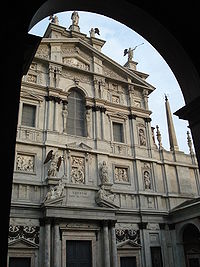
In the 16th century also the square portico
in classical style was added, perhaps designed by Cesare Cesariano
or Cristoforo Lombardo (il Lombardino). The massive façade was designed by Galeazzo Alessi
in the late 16th century and was realized by Martino Bassi; it is decorated by numerous statues and reliefs by Stoldo Lorenzi
and Annibale Fontana
.
and Giulio Cesare Procaccini
, Carlo Francesco Nuvolone
, Antonio Campi
, Bergognone, Callisto Piazza
and others. Notable are the Baptism of Jesus by Gaudenzio Ferrari
and Giovan Battista della Cerva
, the Fall of St. Paul by Moretto
and, on the altar of the right transept, an altarpiece by Paris Bordone
. The lectern of the choir is by Giuseppe Meda
.
 In the left transept, within an alter designed by Martino Bassi, is the venerated marble statue of the Assunta by Annibale Fontana
(1586) with two later angels by Giulio Cesare Procaccini.
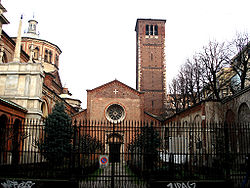
church of San Celso, dedicated to the martyr Saint Celsus
, which was largely demolished. It was founded in the 4th century and rebuilt in the 11th century.
The façade (remade in the 19th century) has a rose window
and a Romanesque portal with animal figures decoration. Also from the 11th century is the bell tower.
Milan
Milan is the second-largest city in Italy and the capital city of the region of Lombardy and of the province of Milan. The city proper has a population of about 1.3 million, while its urban area, roughly coinciding with its administrative province and the bordering Province of Monza and Brianza ,...
, Lombardy
Lombardy
Lombardy is one of the 20 regions of Italy. The capital is Milan. One-sixth of Italy's population lives in Lombardy and about one fifth of Italy's GDP is produced in this region, making it the most populous and richest region in the country and one of the richest in the whole of Europe...
, northern Italy
Italy
Italy , officially the Italian Republic languages]] under the European Charter for Regional or Minority Languages. In each of these, Italy's official name is as follows:;;;;;;;;), is a unitary parliamentary republic in South-Central Europe. To the north it borders France, Switzerland, Austria and...
.
History and overview
The construction was begun by Gian Giacomo DolcebuonoGian Giacomo Dolcebuono
Gian Giacomo Quadri, known as Dolcebuono was an Italian architect and sculptor.Born probably in Lugano, he was a relative of Giacomo Antonio Dolcebuono, who had provided one of the first projects for the façade of the Certosa di Pavia. Quadri apprenticed in the Milanese workshop of Giovanni and...
and Giovanni Battagio
Giovanni Battagio
Giovanni Battagio was an Italian sculptor and architect.A follower of Giovanni Antonio Amadeo, from 1483 he worked on Santa Maria presso San Satiro and other buildings in Milan. He designed the Sanctuary of Santa Maria della Croce in Crema, and the Tempio Civico dell'Incoronata in Lodi, one of the...
in 1493, to house a miraculous icon of the Madonna, initially on the central plan. The first part to be built was the octagonal dome, covered externally by a tambour
Tambour
In classical architecture, a tambour is the inverted bell of the Corinthian capital around which are carved acanthus leaves for decoration....
with a loggia and arcades decorated by twelve brickwork statues by Agostino De Fondulis
Agostino De Fondulis
Agostino de Fondulis was an Italian sculptor and architect active in Lombardy.He was probably born in Crema, where his family had a workshop. Later he moved to Padua....
, designed in Lombard style by Giovanni Antonio Amadeo
Giovanni Antonio Amadeo
thumb|260px|The Colleoni Chapel in Bergamo.Giovanni Antonio Amadeo was an Italian early Renaissance sculptor, architect, and engineer....
(1494-1498).
Barrel vault
A barrel vault, also known as a tunnel vault or a wagon vault, is an architectural element formed by the extrusion of a single curve along a given distance. The curves are typically circular in shape, lending a semi-cylindrical appearance to the total design...
also by Amadeo; the presbytery received a polygonal ambulatory
Ambulatory
The ambulatory is the covered passage around a cloister. The term is sometimes applied to the procession way around the east end of a cathedral or large church and behind the high altar....
inspired to that in the Duomo.
In the 16th century also the square portico
Portico
A portico is a porch leading to the entrance of a building, or extended as a colonnade, with a roof structure over a walkway, supported by columns or enclosed by walls...
in classical style was added, perhaps designed by Cesare Cesariano
Cesare Cesariano
right|thumbnail|A 1521 [[Italian language|Italian]] edition of [[Vitruvius]]' [[De architectura]], translated and illustrated by Cesare Cesariano....
or Cristoforo Lombardo (il Lombardino). The massive façade was designed by Galeazzo Alessi
Galeazzo Alessi
Galeazzo Alessi was an Italian architect from Perugia, known throughout Europe for his distinctive style based on his enthusiasm for ancient architecture. He studied drawing for civil and military architecture under the direction of Giovanni Battista Caporali.For a number of years he lived in Genoa...
in the late 16th century and was realized by Martino Bassi; it is decorated by numerous statues and reliefs by Stoldo Lorenzi
Stoldo Lorenzi
Stoldo Lorenzi was an Italian Mannerist sculptor.Born at Settignano, he studied in Florence and was influenced by artists such as Giambologna and Tribolo. Lorenzi mostly executed bronze sculptures. His masterwork in Florence is considered the Fountain of Neptune in the Boboli Gardens .Later he...
and Annibale Fontana
Annibale Fontana
Annibale Fontana was an Italian sculptor, medallist and crystal-worker.Fontana was born in Milan. His first known work is a crystal case, now in the Schatzkammer of Munich, for Albert V of Bavaria . In 1570–1572 he was in Palermo, working for viceroy Francesco Fernardo d'Avalos, of whom he made a...
.
Interior
The interior houses numerous works by Milanese Renaissance and Baroque artists: Giovan Battista Crespi (il Cerano), CamilloCamillo Procaccini
thumb|300px|Nativity by Camillo ProcacciniCamillo Procaccini was an Italian painter. He has been posthumously referred to as the Vasari of Lombardy, for his prolific Mannerist fresco decoration....
and Giulio Cesare Procaccini
Giulio Cesare Procaccini
Giulio Cesare Procaccini was an Italian painter and sculptor of the early Baroque era in Milan.-Biography:Born in Bologna he was son of the Mannerist painter Ercole Procaccini the Elder and brother of Camillo Procaccini and Carlo Antonio Procaccini...
, Carlo Francesco Nuvolone
Carlo Francesco Nuvolone
Carlo Francesco Nuvolone was an Italian painter of the Baroque period, active mainly in Lombardy.He was born in Milan to a Cremonese father and mannerist painter, Panfilo Nuvolone. After working with his father, he studied under Giovanni Battista Crespi in the Accademia Ambrosiana in Milan...
, Antonio Campi
Antonio Campi
Antonio Campi was an Italian painter of the Renaissance.He was born in Cremona. His style merges Lombard with Mannerist styles. In Cremona, his extended family were the main artistic produce. Giulio Campi and Antonio were reportedly half-brothers, while Vincenzo Campi was a full brother....
, Bergognone, Callisto Piazza
Callisto Piazza
Callisto Piazza was an Italian painter.-Biography:Callisto, a member of the Piazza family of painters, was born in Lodi, Lombardy....
and others. Notable are the Baptism of Jesus by Gaudenzio Ferrari
Gaudenzio Ferrari
Gaudenzio Ferrari was a Northern Italian painter and sculptor of the Renaissance.-Biography:Gaudenzio was born at Valduggia in the Valsesia in the Duchy of Milan. Valduggia is now in the Province of Vercelli in Piedmont. He is said to have first learned the art of painting at Vercelli from...
and Giovan Battista della Cerva
Giovan Battista della Cerva
Giovan Battista della Cerva was an Italian painter.Born in Novara, he was a pupil of Gaudenzio Ferrari, of whom he became the main assistant and collaborator during the last stage of his career...
, the Fall of St. Paul by Moretto
Moretto
Moretto is a surname, and may refer to:*Angie Moretto, NHL player*Enrico Moretto, Italian fighter ace*Graziella Moretto, actress*Marcelo Moretto de Souza, Brazilian footballer*Nelly Moretto, musician...
and, on the altar of the right transept, an altarpiece by Paris Bordone
Paris Bordone
Paris Bordon was an Italian painter of the Venetian Renaissance who, despite training with Titian, maintained a strand of mannerist complexity and provincial vigor.-Biography:...
. The lectern of the choir is by Giuseppe Meda
Giuseppe Meda
Giuseppe Meda was an Italian painter, architect and hydraulics engineer.Born in Milan, he apprenticed as painter under Bernardino Campi...
.
Annibale Fontana
Annibale Fontana was an Italian sculptor, medallist and crystal-worker.Fontana was born in Milan. His first known work is a crystal case, now in the Schatzkammer of Munich, for Albert V of Bavaria . In 1570–1572 he was in Palermo, working for viceroy Francesco Fernardo d'Avalos, of whom he made a...
(1586) with two later angels by Giulio Cesare Procaccini.
San Celso
Annexed to Santa Maria is the RomanesqueRomanesque architecture
Romanesque architecture is an architectural style of Medieval Europe characterised by semi-circular arches. There is no consensus for the beginning date of the Romanesque architecture, with proposals ranging from the 6th to the 10th century. It developed in the 12th century into the Gothic style,...
church of San Celso, dedicated to the martyr Saint Celsus
Nazarius and Celsus
Saints Nazarius and Celsus were two martyrs of whom nothing is known except the discovery of their bodies by Saint Ambrose.According to Paulinus the Deacon's Vita Ambrosii, Ambrose, at some time within the last three years of his life, after the death of the Emperor Theodosius Saints Nazarius and...
, which was largely demolished. It was founded in the 4th century and rebuilt in the 11th century.
The façade (remade in the 19th century) has a rose window
Rose window
A Rose window is often used as a generic term applied to a circular window, but is especially used for those found in churches of the Gothic architectural style and being divided into segments by stone mullions and tracery...
and a Romanesque portal with animal figures decoration. Also from the 11th century is the bell tower.