
All Topics  
Sand casting

 
Sand Casting

   Email Print
   Bookmark   Link


Sand casting


A sand casting or a sand molded casting is a cast part
Casting

In metalworking, casting involves pouring a liquid metal into a Mold_, which contains a hollow cavity of the desired shape, and then is allowed to solidify....
 produced by forming a mold from a sand mixture and pouring molten liquid metal into the cavity in the mold
Molding (process)

Molding or moulding is the process of manufacturing by shaping pliable raw material using a rigid frame or model called a pattern....
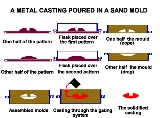
. The mold is then cooled until the metal has solidified. In the last stage the casting is separated from the mold. There are six steps in this process:

  1. Place a pattern in sand to create a mold.
  2. Incorporate a gating system.
  3. Remove the pattern.
  4. Fill the mold cavity with molten metal.
  5. Allow the metal to cool.
  6. Break away the sand mold and remove the casting.


There are two main types of sand used for molding.


Discussion
Ask a question about 'Sand casting'
Start a new discussion about 'Sand casting'
Answer questions from other users
Full Discussion Forum


Recent Posts


Encyclopedia


A sand casting or a sand molded casting is a cast part
Casting

In metalworking, casting involves pouring a liquid metal into a Mold_, which contains a hollow cavity of the desired shape, and then is allowed to solidify....
 produced by forming a mold from a sand mixture and pouring molten liquid metal into the cavity in the mold
Molding (process)

Molding or moulding is the process of manufacturing by shaping pliable raw material using a rigid frame or model called a pattern....
. The mold is then cooled until the metal has solidified. In the last stage the casting is separated from the mold. There are six steps in this process:

  1. Place a pattern in sand to create a mold.
  2. Incorporate a gating system.
  3. Remove the pattern.
  4. Fill the mold cavity with molten metal.
  5. Allow the metal to cool.
  6. Break away the sand mold and remove the casting.


There are two main types of sand used for molding. "Green sand" is a mixture of silica sand, clay, moisture and other additives. The "air set" method uses dry sand bonded to materials other than clay, using a fast curing adhesive
Adhesive

Adhesive or glue is a compound in a liquid or semi-liquid state that adhesion or bonds items together. Adhesives may come from either natural or Chemical synthesis sources....
. When these are used, they are collectively called "air set" sand castings to distinguish these from "green sand" castings. Two types of molding sand are natural bonded (bank sand) and synthetic (lake sand), which is generally preferred due to its more consistent composition.

With both methods, the sand mixture is packed around a master "pattern" forming a mold cavity. If necessary, a temporary plug is placed to form a channel for pouring the fluid to be cast. Air-set molds often form a two-part mold having a top and bottom, termed Cope and drag
Cope and drag

In foundry work, the terms Cope and Drag refer respectively to the upper and lower parts of a two-part casting flask, used in sand casting....
. The sand mixture is tamped down as it is added, and the final mold assembly is sometimes vibrated to compact the sand and fill any unwanted voids in the mold. Then the pattern is removed with the channel plug, leaving the mold cavity. The casting liquid (typically molten metal) is then poured into the mold cavity. After the metal has solidified and cooled, the casting is separated from the sand mold. There is typically no mold release agent, and the mold is generally destroyed in the removal process.

The accuracy of the casting is limited by the type of sand and the molding process. Sand castings made from coarse green sand impart a rough texture on the surface of the casting, and this makes them easy to identify. Air-set molds can produce castings with much smoother surfaces. Surfaces can also be ground and polished, for example when making a large bell
Bell (instrument)

A bell is a simple sound-making device. The bell is a percussion instrument and an idiophone. Its form is usually an open-ended hollow drum which resonates upon being struck....
. After molding, the casting is covered in a residue of oxides, silicates and other compounds. This residue can be removed by various means, such as grinding, or shot blasting.

During casting, some of the components of the sand mixture are lost in the thermal casting process. Green sand can be reused after adjusting its composition to replenish the lost moisture and additives. The pattern itself can be reused indefinitely to produce new sand molds. The sand molding process has been used for many centuries to produce castings manually. Since 1950, partially-automated casting processes have been developed for production lines.

Simple manual sand casting process


Patterns

From the design, provided by an engineer or designer, a skilled pattern maker builds a pattern
Pattern (casting)

In casting, a pattern is a replica of the object to be cast, used to prepare the cavity into which molten material will be poured during the casting process....
 of the object to be produced, using wood, metal, or a plastic such as expanded polystyrene. Sand can be ground, swept or even strickled into shape. The metal to be cast will contract during solidification, and this may be non-uniform due to uneven cooling. Therefore, the pattern must be slightly larger than the finished product, a difference known as contraction allowance. Pattern-makers are able to produce suitable patterns using 'Contraction rules' (these are sometimes called "shrink allowance rulers" where the ruled markings are deliberately made to a larger spacing according to the percentage of extra length needed). Different scaled rules are used for different metals because each metal and alloy contracts by an amount distinct from all others. Patterns also have core prints that create registers within the molds into which are placed sand cores. Such cores, sometimes reinforced by wires, are used to create under cut profiles and cavities which cannot be molded with the cope and drag, such as the interior passages of valves or cooling passages in engine blocks.

Paths for the entrance of metal into the mold cavity constitute the runner system and include the sprue, various feeders which maintain a good metal 'feed', and in-gates which attach the runner system to the casting cavity. Gas and steam generated during casting exit through the permeable sand or via risers
Riser (casting)

A riser or feeder is a wiktionary:Reservoir built into a metal casting molding to prevent wikt:cavities due to Shrinkage . Most metals are less dense as a liquid than as a solid so castings shrink upon cooling, which can leave a void at the last point to solidify....
, which are added either in the pattern itself, or as separate pieces.
Sandmoldcopedragcores

Molding box and materials

A multi-part molding box (known as a casting flask, the top and bottom halves of which are known respectively as the cope and drag
Cope and drag

In foundry work, the terms Cope and Drag refer respectively to the upper and lower parts of a two-part casting flask, used in sand casting....
) is prepared to receive the pattern. Molding boxes are made in segments that may be latched to each other and to end closures. For a simple object—flat on one side—the lower portion of the box, closed at the bottom, will be filled with prepared casting sand
Molding sand

Molding sand, foundry sand, or green sand is sand that when moistened or oiled tends to pack well and hold its shape. It is used in the process of sand casting....
 or green sand
Molding sand

Molding sand, foundry sand, or green sand is sand that when moistened or oiled tends to pack well and hold its shape. It is used in the process of sand casting....
—a slightly moist mixture of sand and clay. The sand is packed in through a vibratory process called ramming and, in this case, periodically screeded level. The surface of the sand may then be stabilized with a sizing compound. The pattern is placed on the sand and another molding box segment is added. Additional sand is rammed over and around the pattern. Finally a cover is placed on the box and it is turned and unlatched, so that the halves of the mold may be parted and the pattern with its sprue and vent patterns removed. Additional sizing may be added and any defects introduced by the removal of the pattern are corrected. The box is closed again. This forms a "green" mold which must be dried to receive the hot metal. If the mold is not sufficiently dried a steam explosion can occur that can throw molten metal about. In some cases, the sand may be oiled instead of moistened, which makes possible casting without waiting for the sand to dry. Sand may also be bonded by chemical binders, such as furane resins or amine-hardened resins.

Chills

To control the solidification and metallurgical structure of the metal, it is possible to place metal plates—
chills
Chill (foundry)

A chill is an object used to promote solidification in a specific portion of a metal casting mold . Normally the metal in the mold cools at a certain rate relative to thickness of the casting....
— in the mold. The associated rapid local cooling will form a finer-grained structure and may form a somewhat harder metal at these locations. In ferrous castings the effect is similar to quench
Quench

A quench refers to a rapid cooling. In polymer chemistry and materials science, quenching is used to prevent low-temperature processes such as phase transformations from occurring by only providing a narrow window of time in which the reaction is both thermodynamically favorable and kinetically accessible....
ing metals in forge
Forge

A forge is the workplace of a smith or a blacksmith. A forge is sometimes referred to as a smithy.The basic smithy contains a forge, also known as a hearth, for heating metals....
 work. The inner diameter of an engine cylinder is made hard by a chilling core. In other metals chills may be used to promote directional solidification
Directional solidification

Directional solidification is a series of measures applied to control the feeding of castings. As most metals and alloys solidify, changing from the liquid state to the solid state they will undergo an appreciable volume contraction....
 of the casting. In controlling the way a casting freezes it is possible to prevent internal voids or porosity inside castings.

Cores

To produce cavities within the casting—such as for liquid cooling in engine
Internal combustion engine

The internal combustion engine is an engine in which the combustion of a fuel occurs in a combustion chamber inside and integral to the engine. In an internal combustion engine it is always the expansion of the high temperature and pressure gases that are produced by the combustion which apply force to the movable component of the engine, such as...
 blocks and cylinder head
Cylinder head

In an internal combustion engine, the cylinder head sits above the Cylinder and consists of a platform containing part of the combustion chamber and the location of the poppet valves and spark plugs....
s—negative forms are used to produce
cores. Usually sand-molded, cores are inserted into the casting box after removal of the pattern. Whenever possible, designs are made that avoid the use of cores, due to the additional set-up time and thus greater cost.
Sandmoldbronzealuminium
With a completed mold at the appropriate moisture content, the box containing the sand mold is then positioned for filling with molten metal—typically iron
Iron

Iron is a chemical element with the symbol Fe and atomic number 26. Iron is a Group 8 element and period 4 element. Iron is lustrous and silvery in color....
, steel
Steel

Steel is an alloy consisting mostly of iron, with a carbon content between 0.2% and 2.14% by weight , depending on grade. Carbon is the most cost-effective alloying material for iron, but various other alloying elements are used such as manganese, chromium, vanadium, and tungsten....
, bronze
Bronze

Bronze is a metal alloy consisting primarily of copper, usually with tin as the main additive, but sometimes with other chemical element such as phosphorus, manganese, aluminium, or silicon....
, brass
Brass

Brass is any alloy of copper and zinc; the proportions of zinc and copper can be varied to create a range of brasses with varying properties. In comparison, bronze is principally an alloy of copper and tin....
, aluminium
Aluminium

Aluminium or aluminum is a silvery white and ductile member of the boron group of chemical elements. It has the symbol Al; its atomic number is 13....
, magnesium
Magnesium

Magnesium is a chemical element with the symbol Mg, atomic number 12, atomic weight 24.3050 and common oxidation number +2.Magnesium, an alkaline earth metal, is the ninth most abundance of the chemical elements in the universe by mass....
 alloys, or various pot metal
Pot metal

Pot metal is a slang term that refers to alloys that consist of inexpensive, low-melting point metals used to make fast, inexpensive castings. There is no scientific metallurgical standard for pot metal; common metals in pot metal include zinc, lead, copper, tin, magnesium, aluminium, iron, and cadmium....
 alloys, which often include lead
Lead

Lead is a main-group Chemical element with symbol Pb and atomic number 82. Lead is a soft, malleable poor metal, also considered to be one of the heavy metal ....
, tin
Tin

Tin is a chemical element with the symbol Sn and atomic number 50. Tin is obtained chiefly from the mineral cassiterite, where it occurs as an oxide, SnO2....
, and zinc
Zinc

Zinc is a metallic chemical element with the symbol Zn and atomic number 30. It is a first-row transition metal of the group 12 element of the periodic table....
. After filling with liquid metal the box is set aside until the metal is sufficiently cool to be strong. The sand is then removed revealing a rough casting that, in the case of iron or steel, may still be glowing red. When casting with metals like iron or lead, which are significantly heavier than the casting sand, the casting flask is often covered with a heavy plate to prevent a problem known as
floating the mold. Floating the mold occurs when the pressure of the metal pushes the sand above the mold cavity out of shape, causing the casting to fail.
Coreboxpatterncorecasting
After casting, the cores are broken up by rods or shot and removed from the casting. The metal from the sprue and risers is cut from the rough casting. Various heat treatment
Heat treatment

Heat treatment is a method used to alter the physical property, and sometimes chemical property, properties of a material. The most common application is metallurgy....
s may be applied to relieve stresses from the initial cooling and to add hardness—in the case of steel or iron, by quenching in water or oil. The casting may be further strengthened by surface compression treatment—like shot peening
Shot peening

Shot peening is a process used to produce a compressive Stress #Residual_stress layer and modify mechanical properties of metals. It entails impacting a surface with shot with force sufficient to create plastic deformation....
—that adds resistance to tensile cracking and smooths the rough surface.

Design requirements

The part to be made and its pattern must be designed to accommodate each stage of the process, as it must be possible to remove the pattern without disturbing the molding sand and to have proper locations to receive and position the cores. A slight taper, known as draft
Draft angle

A draft angle describes the amount of taper for molding or casting parts perpendicular to the parting line.Consider the fabrication of a hollow plastic box, without lid....
, must be used on surfaces perpendicular to the parting line, in order to be able to remove the pattern from the mold. This requirement also applies to cores, as they must be removed from the core box in which they are formed. The sprue and risers must be arranged to allow a proper flow of metal and gasses within the mold in order to avoid an incomplete casting. Should a piece of core or mold become dislodged it may be embedded in the final casting, forming a
sand pit, which may render the casting unusable. Gas pockets can cause internal voids. These may be immediately visible or may only be revealed after extensive machining has been performed. For critical applications, or where the cost of wasted effort is a factor, non-destructive testing methods may be applied before further work is performed.

Types of molds


Green sand

These molds are made of wet sands that are used to make the mold's shape. The name comes from the fact that wet sands are used in the molding process.

Cold box

Uses organic and inorganic binders that strengthen the mold by chemically adhering to the sand. This type of mold gets its name from not being baked in an oven like other sand mold types. This type of mold is more accurate dimensionally than green-sand molds but are more expensive.

No bake molds

No bake molding is a type of molding used for the casting of molten metals. Like sand casting it is an expendable mold that is made up of sand. The primary difference is that it keeps its form from having a liquid resin
Resin

Resin is a hydrocarbon secretion of many plants, particularly Pinophyta. It is valued for its chemical constituents and uses, such as varnishes and adhesives, as an important source of raw materials for organic synthesis, or for incense and perfume....
 mixed with the sand at room temperature to help keep its form. Because no heat is involved it called a cold-setting processes. This type of molding also produces a better surface finish than other types of sand molds, and due to the binder does not need to be baked in an oven. Common flask
FLASK

The Flux Advanced Security Kernel is an operating system security architecture that provides flexible support for security policies.FLASK is a core framework in Security_focused_operating_system operating systems such as National_Security_Agency's Security-Enhanced Linux , OpenSolaris FMAC and FreeBSD#TrustedBSD....
 materials that are used are wood, metal, or plastic. Common metals cast into no bake molds are brass
Brass

Brass is any alloy of copper and zinc; the proportions of zinc and copper can be varied to create a range of brasses with varying properties. In comparison, bronze is principally an alloy of copper and tin....
, ferric
Ferric

Ferric is a term that means containing or having to do with iron, derived from the Latin word ferrum, meaning "iron". In chemistry the term is reserved for iron with an oxidation number of +3, denoted iron or Fe3+, whereas ferrous indicates that it has oxidation number of +2 and is denoted iron or Fe2+....
, and aluminium alloys.

Essential improvements of the foundry technology


In 1924 the Ford automobile company set a record by producing 1 million cars, in the process consuming one-third of the total casting production in the U.S. As the automobile industry grew the need for increased casting efficiency grew. The increasing demand for castings in the growing car and machine
Machine

A machine is any device that uses energy to perform some activity. In common usage, the meaning is that of a device having parts that perform or assist in performing any type of work....
 building industry during and after World War I
World War I

World War I, or the First World War , was a global military conflict which involved the Great powers, organized into two opposing military alliances: the Allies of World War I and the Central Powers....
 and World War II
World War II

World War II, or the Second World War , was a global military conflict which involved a Participants in World War II, including all of the great powers, organised into two opposing military alliances: the Allies of World War II and the Axis powers....
, stimulated new inventions in mechanization
Mechanization

Mechanization or mechanisation is providing human operators with machinery to assist them with the physical requirements of work. It can also refer to the use of machines to replace manual labor or animals....
 and later automation
Automation

Automation or industrial automation or numerical control is the use of control systems such as computers to control industry machinery and industrial processes, reducing the need for human intervention....
 of the sand casting process technology
Technology

Technology is a broad concept that deals with an animal species' usage and knowledge of tools and crafts, and how it affects an animal species' ability to control and adapt to its Natural environment....
.

There was not one bottleneck
Bottleneck

Bottleneck literally refers to the top narrow part of a bottle. Figuratively, it may also refer:* Bottleneck * Bottleneck * Bottleneck * Bottleneck guitar, also known as slide guitar...
 to faster casting production but rather several. Improvements were made in molding speed, molding sand preparation, sand mixing
Mixing (process engineering)

In industrial process engineering, mixing is a unit operation that involves manipulating a heterogeneous physical system, with the intent to make it more wiktionary:Homogeneous....
, core
Core

Core may refer to:...
 manufacturing processes, and the slow metal melting
Melting

Melting is a process that results in the phase change of a substance from a solid to a liquid. The internal energy of a solid substance is increased to a specific temperature at which it changes to the liquid phase....
 rate in cupola furnace
Cupola furnace

A Cupola or Cupola furnace is a melting device used in foundries that can be used to melt cast iron, ni-resist iron and some bronze. The cupola can be made almost any practical size....
s. In 1912 the sand slinger was invented by the American
United States

The United States of America is a Federal government constitutional republic comprising U.S. state and a federal district. The country is situated mostly in central North America, where its Contiguous United States and Washington, D.C., the Capital districts and territories, lie between the Pacific Ocean and Atlantic Oceans, Borders of the U...
 company Birdsley & Piper. In 1912 the first sand mixer with individually mounted revolving plows was marketed by the Simpson Company. In 1915 the first experiments started with bentonite
Bentonite

Bentonite is an absorbent aluminium Silicate minerals, generally impure clay consisting mostly of montmorillonite. There are a few types of bentonites and their names depend on the dominant elements, such as K, Na, Ca, and Al....
 clay instead of simple fire clay as the bonding additive to the molding sand. This increased tremendously the green and dry strength of the molds. In 1918 the first fully automated foundry for fabricating hand grenades for the U.S. Army went into production. In the 1930s the first high-frequency coreless electric furnace
Furnace

File:Piec krepa.JPGA furnace is a device used for heating. The name derives from Latin fornax, oven. The earliest furnace was excavated at Balakot, a site of the Indus Valley Civilization, dating back to its mature phase ....
 was installed in the U.S. In 1943 ductile iron
Ductile iron

Ductile iron, also called ductile cast iron, spheroidal graphite iron, or nodular cast iron, is a type of cast iron invented in 1943 by Keith Millis....
 was invented by adding magnesium
Magnesium

Magnesium is a chemical element with the symbol Mg, atomic number 12, atomic weight 24.3050 and common oxidation number +2.Magnesium, an alkaline earth metal, is the ninth most abundance of the chemical elements in the universe by mass....
 to the widely used grey iron. In 1940 thermal sand reclamation
Reclamation

Reclamation is the process of reclaiming something from loss or from a less useful condition. It is generally used of water reclamation, which, a century ago meant damming streams , and now has come to be used to describe wastewater reclamation....
 was applied for molding and core sands. In 1952 the "D-process" was developed for making shell molds with fine, pre-coated sand. In 1953 the hotbox core sand process in which the cores are thermally cured was invented. In 1954 a new core binder - water glass hardened with CO2 from the ambient air, was applied.

Fast molding & sand casting processes


With the fast development of the car and machine building industry the casting consuming areas called for steady higher productivity
Productivity

Productivity in economics refers to metrics and measures of output from production processes, per unit of input. Labor productivity, for example, is typically measured as a ratio of output per labor-hour, an input....
. The basic process stages of the mechanical molding and casting process are similar to those described under the manual sand casting process. The technical and mental development however was so rapid and profound that the character of the sand casting process changed radically.

Mechanized sand molding


The first mechanized molding lines consisted of sand slingers and/or jolt-squeeze devices that compacted the sand in the flasks. Subsequent mould handling was mechanical using cranes, hoists and straps. After core setting the copes and drags were coupled using guide pins and clamped for closer accuracy. The moulds were manually pushed off on a roller conveyor for casting
Casting

In metalworking, casting involves pouring a liquid metal into a Mold_, which contains a hollow cavity of the desired shape, and then is allowed to solidify....
 and cooling
Cooling

Cooling is the Heat transfer of thermal energy via thermal radiation, heat conduction or convection. It may also refer to:...
.

Automatic high pressure sand molding lines


Increasing quality
Quality

Quality may refer to:Concepts:* Quality * Quality , an attribute or a property* Quality , which has separate meanings in thermodynamics and harmonics...
 requirements made it necessary to increase the mould stability by applying steadily higher squeeze pressure and modern compaction methods for the sand in the flasks. In early fifties the high pressure
High pressure

High pressure science and engineering is studying the effects of high pressure on materials and the design and construction of devices, such as a diamond anvil cell, which can create high pressure....
 molding was developed and applied in mechanical and later automatic flask lines. The first lines were using jolting and vibrations to precompact the sand in the flasks and compressed air
Compressed air

Compressed air is air which is kept under a certain pressure, usually greater than that of the atmosphere. In Europe 10 % of all electricity used by industry is used to produce compressed air....
 powered pistons to compact the molds.

Horizontal sand flask molding
In the first automatic horizontal flask lines the sand was shot or slung down on the pattern in a flask and squeezed with hydraulic pressure of up to 140 bars
Bar (unit)

The bar , decibar and the millibar are units of pressure. They are not SI units, nor are they cgs units, but they are accepted for use with the SI....
. The subsequent mould handling including turn-over, assembling, pushing-out on a conveyor were accomplished either manually or automatically. In the late fifties hydraulically
Hydraulics

Hydraulics is a topic of science and engineering dealing with the mechanical properties of liquids. Hydraulics is part of the more general discipline of fluid power....
 powered pistons or multi-piston systems were used for the sand compaction in the flasks. This method produced much more stable and accurate molds than it was possible manually or pneumatically
Pneumatics

Pneumatics is the use of pressurized gas to affect mechanical motion.Pneumatic power is used in industry, where factory machines are commonly plumbed for compressed air; other compressed inert gases can also be used....
. In the late sixties mold compaction by fast air pressure or gas pressure drop over the pre-compacted sand mold was developed (sand-impulse and gas-impact). The general working principle for most of the horizontal flask line systems is shown on the sketch below. Today there are many manufacturers of the automatic horizontal flask molding lines. The major disadvantages of these systems is high spare parts consumption due to multitude of movable parts, need of storing, transporting and maintaining the flasks and productivity
Productivity

Productivity in economics refers to metrics and measures of output from production processes, per unit of input. Labor productivity, for example, is typically measured as a ratio of output per labor-hour, an input....
 limited to approximately 90 –120 molds/hour per molding unit.

Vertical sand flaskless molding
In the end of the fifties foundry industry, as all the others, called constantly for reduction of the labor costs, higher productivity casting quality and improved dimensional accuracy. Due to constantly increasing wages reduction of the human labor became important. This required automation
Automation

Automation or industrial automation or numerical control is the use of control systems such as computers to control industry machinery and industrial processes, reducing the need for human intervention....
. In 1962 Danish
Denmark

Denmark is a Scandinavian country in northern Europe and the senior member of the Kingdom of Denmark. It is the southernmost of the Nordic countries....
 company Dansk Industri Syndikat A/S (DISA) implemented an ingenious idea of molding without flasks applying vertically parted and poured moulds. The first automatic DISA molding line could produce up to 240 complete sand molds per hour. Today a modern DISA molding line can achieve a molding rate of 550 sand molds per hour (one complete mold for each 6.5 seconds) and requires only one monitoring operator
Operator

In mathematics, an operator is a function which operates on another function. Often, an "operator" is a function which acts on functions to produce other functions ; or it may be a generalization of such a function, as in linear algebra, where some of the terminology reflects the origin of the subject in operations on the functions which ar...
. Maximal mismatch of two half’s of the castings made on the DISA lines does not exceed 0.1 mm. Apart from the high productivity, low labor requirement and dimensional castings accuracy DISA vertical flaskless moulding lines are very reliable
Reliability

In general, reliability is the ability of a person or system to perform and maintain its functions in routine circumstances, as well as hostile or unexpected circumstances....
 (up to 98% in efficiency
Efficiency

Efficiency may refer to:...
]. Virtually there are no other serious manufacturers of the vertical flaskless molding lines but the Danish DISA Industries.

Matchplate sand molding
The principle of the matchplate, meaning pattern plates with two patterns on each side of the same plate, was developed and patented in 1910, fostering the perspectives for future sand molding improvements. However first in the early sixties the American company Hunter Automated Machinery Corporation launched its first automatic flaskless, horizontal molding line applying the matchplate technology. The method alike to the DISA's vertical moulding is flaskless, however horizontal. It has been improved by several producers.The main suppliers are the DISA Industries, Hunter Automated Machinery and Heinrich Wagner Sinto. The matchplate molding technology is today used widely, particularly in the U.S., China and India. Its great advantage is inexpensive pattern tooling, easiness of changing the molding tooling, thus suitability for manufacturing castings in short series so typical for the jobbing foundries. Modern matchplate molding machine is capable of high molding quality, less casting shift due to machine-mold mismatch (in some cases even 0.15 mm or less), consistently stable molds for less grinding and improved parting line definition. In addition, the machines are enclosed for a cleaner, quieter working environment with reduced operator exposure to safety risks or service-related problems.

Decorative use of wood patterns

Some collectors seek obsolete hardwood patterns, once used to make molds for casting machine parts, to use as interior decorations. These are valued due to the fine woodworking involved, sometimes interesting sculptural shapes of decorative embelishments, and the display of the grain of the wood.

Alternative casting methods


As a supplement to the sand casting other casting methods were successfully applied.

  • Modern casting production methods can manufacture thin and accurate molds—of a material superficially resembling papier-mâché, such as is used in egg cartons, but that is refractory in nature—that are then supported by some means, such as dry sand surrounded by a box, during the casting process. Due to the higher accuracy it is possible to make thinner and hence lighter castings, because extra metal need not be present to allow for variations in the molds. These thin-mold casting methods have been used since the 1960s in the manufacture of cast-iron engine blocks and cylinder heads for automotive applications.


  • Increasingly in modern production, various automotive components are frequently made of aluminium, which for appropriately shaped components may be made either by sand casting or by die casting
    Die casting

    Die casting is the process of forcing molten metal under high pressure into mold cavities . Most die castings are made from non-ferrous metals, specifically zinc, copper, aluminium, magnesium, lead, and tin based alloys, although ferrous metal die castings are possible....
    , the latter an accurate process that greatly reduces both materials use and machining and finishing costs. While the material and the processing setup is more expensive than the use of iron this is one of the most straightforward ways to reduce weight in a vehicle, important as a contributor to both fuel economy and acceleration performance. For front engine vehicles with rear wheel drive the improvement in weight distribution can improve both handling and traction. For all configurations weight saved in the engine is multiplied in that this enables use of lighter suspension components which in turn improves suspension response by reducing unsprung weight
    Unsprung weight

    In a ground vehicle with a suspension , the unsprung weight is the mass of the suspension, wheels or Caterpillar tracks , and other components directly connected to them, rather than supported by the suspension....


  • Starting in the early 1980s, some castings such as automotive engine blocks have been made using a sand casting technique conceptually similar to the lost wax process, known as the lost foam process. In this process, the pattern is made of polystyrene
    Polystyrene

    Polystyrene , sometimes abbreviated PS, is an Aromaticity polymer made from the aromatic monomer styrene, a liquid hydrocarbon that is commercially manufactured from petroleum by the chemical industry....
     foam, around which the sand is packed, leaving the foam in place. When the metal is poured into the mold, the heat of the metal vaporizes the foam a short distance away from the surface of the metal, leaving the molding cavity into which the metal flows. The lost-foam process supports the sand much better than conventional sand casting, allowing greater flexibility in the design of the cast parts, with less need for machining to finish the casting. This technique was developed for the green sand
    Molding sand

    Molding sand, foundry sand, or green sand is sand that when moistened or oiled tends to pack well and hold its shape. It is used in the process of sand casting....
     mold casting of sculpture and was first adopted for large quantity commercial production by the Saturn Corporation.
  • Vacuum molding process, popularly known as V-process, is a sand molding process, in which unbonded sand is held in place in the mold by a vacuum
    Vacuum

    A vacuum is a volume of space that is essentially empty of matter, such that its gaseous pressure is much less than atmospheric pressure. The word comes from the Latin term for "empty," but in reality, no volume of space can ever be perfectly empty....
    . In this process the pattern
    Pattern

    A pattern, from the French language patron, is a type of theme of recurring events of or objects, sometimes referred to as elements of a set....
     is covered by a tightly conforming thin sheet of plastic
    Plastic

    Plastic is the general common term for a wide range of synthetic or semisynthetic organic chemistry solid materials suitable for the manufacture of industrial products....
     film
    Film

    Film encompasses individual motion pictures, the field of film as an art form, and the film industry. Films are produced by recording images from the world with cameras, or by creating images using animation techniques or special effects....
     which is applied with vacuum after being heated. The film, conforming to the shape of the pattern, may have a refractory coating applied which is dried before filling the flask with sand. A flask
    FLASK

    The Flux Advanced Security Kernel is an operating system security architecture that provides flexible support for security policies.FLASK is a core framework in Security_focused_operating_system operating systems such as National_Security_Agency's Security-Enhanced Linux , OpenSolaris FMAC and FreeBSD#TrustedBSD....
     is placed over the plastic coated pattern, and is filled with free-flowing sand, with vibration for compaction. Another sheet of plastic is placed over the top of the sand in the flask and the flask is evacuated
    Evacuation

    Evacuation may refer to:* Emergency evacuation, the mass movement of persons from a dangerous place due to a disaster* Patient evacuation, the procedure for moving a casualty from its initial location to an ambulance...
    . The vacuum "hardens" (compacts) the sand so the pattern can be withdrawn, the vacuum holding the film to the pattern being released at this time. The other half of the mold is made the same way. After cores are set in place, the mold is closed and poured while still under vacuum. When the metal has solidified, the vacuum is turned off and the sand runs out freely, releasing the casting. The V-process is known for the high dimensional tolerances and good surface finish of the castings. Due to multiplicity of operations it is suitable for low to medium production volumes, depending on the amount of conveyorized equipment within the foundry. Because the sand never touches the pattern itself, there is almost no pattern wear. Minimal or zero draft allowance can be used on vertical surfaces.


  • Shell molding process' principle is applied, when a heated (200 °C / 392 °F) metal pattern is covered with a mixture
    Mixture

    In chemistry, a mixture is a substance made by combining two or more different materials without a chemical reaction occurring .While there are no physical changes in a mixture, the chemical properties of a mixture, such as its melting point, may differ from those of its components....
     of sand and thermoset plastic (sometimes the sand is precoated with this mixture). This causes a skin of about 3.5 mm (0.125 in) of sand/plastic mixture to adhere to the pattern. This skin is removed from the pattern to form the "shell mold". The two halves of the shell mold are matched and secured together and the metal is poured in the shell to form the casting. Once the casting solidifies, the shell is broken and the sand can be regenerated. Shell molding process offers good surface finish
    Finish

    Finish refer to:* Finishing in the distillation of Scotch* Finished good, a good that is completed as to manufacturing but not yet sold or distributed to the end-user...
    , good dimensional tolerances, however the productivity
    Productivity

    Productivity in economics refers to metrics and measures of output from production processes, per unit of input. Labor productivity, for example, is typically measured as a ratio of output per labor-hour, an input....
     is incomparable with the automatic green sand molding processes and fairly high capital investment is required.


See also

  • Automobile
    Automobile

    An automobile or motor car is a wheeled motor vehicle for transportation passengers, which also carries its own car engine or motor. Most definitions of the term specify that automobiles are designed to run primarily on roads, to have seating for one to eight people, to typically have four wheels, and to be constructed principally f...
  • Casting
    Casting

    In metalworking, casting involves pouring a liquid metal into a Mold_, which contains a hollow cavity of the desired shape, and then is allowed to solidify....
  • Casting flask
  • Centrifugal casting
    Centrifugal casting

    Centrifugal casting or rotocasting is a casting technique which has application across a wide range of industrial and artistic applications:...
  • Chill (foundry)
    Chill (foundry)

    A chill is an object used to promote solidification in a specific portion of a metal casting mold . Normally the metal in the mold cools at a certain rate relative to thickness of the casting....
  • Cope and drag
    Cope and drag

    In foundry work, the terms Cope and Drag refer respectively to the upper and lower parts of a two-part casting flask, used in sand casting....
  • Die casting
    Die casting

    Die casting is the process of forcing molten metal under high pressure into mold cavities . Most die castings are made from non-ferrous metals, specifically zinc, copper, aluminium, magnesium, lead, and tin based alloys, although ferrous metal die castings are possible....
  • DISAMATIC
    DISAMATIC

    DISAMATIC is an automatic production line used for fast manufacturing of sand molds for pouring molten metal, which after solidification, cooling and removal from the mold becomes a part called casting....
  • Foundry
    Foundry

    A foundry is a factory which produces metal castings from either ferrous or non-ferrous metals alloys. Metals are turned into parts by melting the metal into a liquid, pouring the metal in a mold, and then removing the mold material or casting....
  • Green sand
    Green sand

    Green sand may refer to:*Molding sand used in sand casting*Greensand, a mineral containing glauconite*Olivine sand, which can form "green sand beaches", including Papakolea Beach in Hawaii...
  • Hand mould
    Hand mould

    A Hand mould is a two-part mould used for casting small metal objects that could be operated by hand. In particular, it refers to a system for casting movable type, pioneered by Johannes Gutenberg, which was widely used in the early era of printing in Europe ....
  • Lost-foam casting
    Lost-foam casting

    Lost foam casting is a type of investment casting process that uses foam patterns as the investment. This method takes advantage of the properties of foam to simply and cheaply form castings that would be difficult or impossible, using normal "cope and drag" techniques....
  • Lost-wax casting
  • Molding sand
    Molding sand

    Molding sand, foundry sand, or green sand is sand that when moistened or oiled tends to pack well and hold its shape. It is used in the process of sand casting....
  • Pattern (casting)
    Pattern (casting)

    In casting, a pattern is a replica of the object to be cast, used to prepare the cavity into which molten material will be poured during the casting process....
  • Permanent mold casting
    Permanent mold casting

    Permanent mold casting is "a metal shaping process in which molten metal is introduced into a permanent mold, under gravity or low pressure, and held until solidification occurs....


Bibliography

  • Manufacturing Engineering and Technology, Fifth Edition, Serope Kalpakjian, Steven R. Schmid, pgs 289-295