

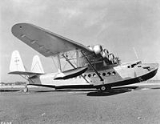
Samoan Clipper

Encyclopedia
Samoan Clipper was one of ten Pan American Airways
Sikorsky S-42
flying boat
s. It exploded over Pago Pago, American Samoa
, on January 11, 1938, while piloted by famous aviator, Ed Musick
. Musick and his crew of six died in the crash.
The aircraft developed an engine problem shortly after taking off from Pago Pago Harbor. The S-42 was fully loaded with fuel and exceeding the gross weight maximum for a safe landing. Because of this, Captain Musick elected to dump fuel before attempting an emergency landing. However, because of the seaplane's weight and reduced power, the S-42 circled the harbor with flaps extended to maintain lift while fuel dumping
was in progress. Apparently, Sikorsky and Pan American had never tested fuel dumping with flaps fully extended. The position of the fuel dump vents on the wing, coupled with the consequent airflow with extended flaps created a back flow of vaporizing fuel which lingered and grew around the trailing edge of the wing.
It is believed that an explosive fuel/air mixture eventually extended to the engine exhaust manifold causing a catastrophic detonation that destroyed the plane in flight.
Pan American World Airways
Pan American World Airways, commonly known as Pan Am, was the principal and largest international air carrier in the United States from 1927 until its collapse on December 4, 1991...
Sikorsky S-42
Sikorsky S-42
|-See also:-References:NotesBibliography* Davies, R.E.G. Pan Am: An Airline and its Aircraft. New York: Orion Books, 1987. ISBN 0-517-56639-7....
flying boat
Flying boat
A flying boat is a fixed-winged seaplane with a hull, allowing it to land on water. It differs from a float plane as it uses a purpose-designed fuselage which can float, granting the aircraft buoyancy. Flying boats may be stabilized by under-wing floats or by wing-like projections from the fuselage...
s. It exploded over Pago Pago, American Samoa
Pago Pago, American Samoa
Pago Pago , also spelled ', is the capital of American Samoa. In 2000, its population was 11,500. The city is served by Pago Pago International Airport. Tourism, entertainment, food, and tuna canning are the primary industries here. From 1878 to 1951, this was a coaling and repair station for the...
, on January 11, 1938, while piloted by famous aviator, Ed Musick
Ed Musick
Edwin Charles Musick was Chief Pilot for Pan American World Airways and pioneered many of Pan Am's transoceanic routes including the famous route across the Pacific Ocean on the China Clipper....
. Musick and his crew of six died in the crash.
The aircraft developed an engine problem shortly after taking off from Pago Pago Harbor. The S-42 was fully loaded with fuel and exceeding the gross weight maximum for a safe landing. Because of this, Captain Musick elected to dump fuel before attempting an emergency landing. However, because of the seaplane's weight and reduced power, the S-42 circled the harbor with flaps extended to maintain lift while fuel dumping
Fuel dumping
Fuel dumping is a procedure used by aircraft in certain emergency situations before a return to the airport shortly after takeoff, or before landing short of its intended destination to lighten the aircraft's weight.-Aircraft fuel dump:Aircraft have two major types of weight limits: the maximum ...
was in progress. Apparently, Sikorsky and Pan American had never tested fuel dumping with flaps fully extended. The position of the fuel dump vents on the wing, coupled with the consequent airflow with extended flaps created a back flow of vaporizing fuel which lingered and grew around the trailing edge of the wing.
It is believed that an explosive fuel/air mixture eventually extended to the engine exhaust manifold causing a catastrophic detonation that destroyed the plane in flight.
External links
- 1938 flights to and from New Zealand
- Airmail items carried on outward trip
- Samoan Clipper at http://planecrashinfo.com