

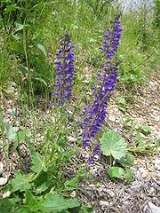
Salvia pratensis

Encyclopedia
Lamiaceae
The mints, taxonomically known as Lamiaceae or Labiatae, are a family of flowering plants. They have traditionally been considered closely related to Verbenaceae, but in the 1990s, phylogenetic studies suggested that many genera classified in Verbenaceae belong instead in Lamiaceae...
, native to Europe, western Asia and northern Africa. The specific epithet pratensis refers to its tendency to grow in meadows. It also grows in scrub edges and woodland borders.
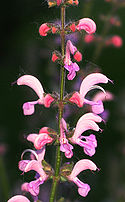
Salvia pratensis forms a basal clump from 1 to 1.5 m (3.3 to 4.9 ft) tall, with rich green rugose leaves that are slightly ruffled and toothed on the edges. The flower stalks are typically branched, with four to six flowers in each verticil. The 2.5 cm (0.984251968503937 in) flowers open from the base of the inflorescence, which grows up to 30.5 cm (12 in) long. The small calyx is dark brown. The flowers have a wide variety of color, from rich violet and violet-blue to bluish white, and from pink to pure white. The leaves are arranged in opposite pairs, with those on the lower part of the stem up to 15 cm (5.9 in) long, decreasing in size higher up the stem.
Salvia pratensis has naturalized in many parts of the United States, and is considered a noxious weed in the state of Washington. At one time it was banned from California because it was thought to have naturalized in three locations. It is widely grown in horticulture, especially Salvia pratensis subsp. Haematodes, which is prized by flower arrangers as a cut flower. Some botanists consider S. pratensis subsp. Haematodes as a separate species.
Salvia pratensis is said to be hardy from USDA Zone 3. Named cultivars include 'Atroviolacea', bearing dark blue to violet flowers; 'Baumgartenii', bearing blue to violet flowers; 'Haematodes', flower lilac-blue; 'Lupinoides', to 60 cm (23.6 in) , with white-flecked blue to purple flowers; 'Mitsommer' ("Midsummer"), flowers sky blue; 'Rosea', flowers rose-pink to purple; 'Rubicunda', flowers rose-red; 'Tenorii', to about 60 cm (23.6 in) tall, with blue flowers; and 'Variegata', with blue and sometimes white-tipped flowers.