
All Topics  
Saab 900

 
Saab 900

   Email Print
   Bookmark   Link


Saab 900


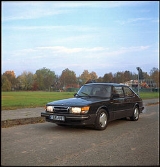
The 900 is a car that was made by Saab Automobile
Saab Automobile

Saab Automobile AB, better known as Saab, is a Swedish automaker and currently a wholly-owned subsidiary of General Motors. It is the exclusive automobile royal warrant holder as appointed by Carl XVI Gustaf of Sweden....
 from 1978 until 1998 in two generations. The first generation from 1978 to 1993 is known as the "classic"; the generation from 1994 to 1998 is known as the "new generation" (see below).

The "classic" 900 is based on the Saab 99
Saab 99

The 99 is an automobile produced by Saab Automobile from 1968 to 1984....
 chassis, though with a longer front end to meet U.S. frontal crash regulations. The 900 was produced in 2- and 4-door sedan, and 3- and 5-door hatchback configurations; additionally, from 1986, a cabriolet (convertible
Convertible

A convertible is a type of automobile in which the roof can retract and fold away, converting it from an enclosed to an open-air vehicle. Many different car body styles are manufactured and marketed in convertible form....
) model was produced.


Discussion
Ask a question about 'Saab 900'
Start a new discussion about 'Saab 900'
Answer questions from other users
Full Discussion Forum


Encyclopedia


The 900 is a car that was made by Saab Automobile
Saab Automobile

Saab Automobile AB, better known as Saab, is a Swedish automaker and currently a wholly-owned subsidiary of General Motors. It is the exclusive automobile royal warrant holder as appointed by Carl XVI Gustaf of Sweden....
 from 1978 until 1998 in two generations. The first generation from 1978 to 1993 is known as the "classic"; the generation from 1994 to 1998 is known as the "new generation" (see below).

The "classic" 900 is based on the Saab 99
Saab 99

The 99 is an automobile produced by Saab Automobile from 1968 to 1984....
 chassis, though with a longer front end to meet U.S. frontal crash regulations. The 900 was produced in 2- and 4-door sedan, and 3- and 5-door hatchback configurations; additionally, from 1986, a cabriolet (convertible
Convertible

A convertible is a type of automobile in which the roof can retract and fold away, converting it from an enclosed to an open-air vehicle. Many different car body styles are manufactured and marketed in convertible form....
) model was produced. There were single- and twin-carburetor
Carburetor

A carburetor or carburettor , is a device that blends Earth's atmosphere and fuel for an internal combustion engine. It was invented by Karl Benz before 1885 and patented in 1886....
, fuel-injection and turbocharged
Turbocharger

A turbocharger, or turbo, is a gas compressor used for forced induction of an internal combustion engine. Like a supercharger, the purpose of a turbocharger is to increase the mass of air entering the engine to create more power....
 engines, including both Full Pressure Turbo (FPT), and in European models during the early 90s, Low Pressure Turbos (LPT).

Overview


The Saab 900 was a front-engined, front-wheel-drive compact car
Compact car

A compact , small family or c-segment car is a car classification of automobile which are larger than a supermini car and smaller than a large family car....
 with a longitudinally-mounted, 45-degree slanted, L 4-cylinder engine, double wishbone front suspension
Suspension (vehicle)

Suspension is the term given to the system of spring , shock absorbers and Linkage that connects a vehicle to its wheels. Suspension systems serve a dual purpose ? contributing to the car's car handling and brake for good active safety and driving pleasure, and keeping vehicle occupants comfortable and reasonably well isolated from road no...
 and beam-axle rear suspension. In its heyday, the 900 was popular with drivers who enjoyed its comfort, safety, practicality (especially hatchbacks), and highway driving manners.

Like its predecessor the 99, the 900 contained a number of unusual design features that distinguish it from most other cars. Firstly, the engine was installed 'backwards', with power delivered from the crank at the front of the car. Secondly, the transmission, technically a transaxle
Transaxle

A transaxle, in the automotive field, is a major mechanical component which combines the functionality of the transmission , the differential and associated components of the driven axle into one integrated assembly....
, bolted directly to the bottom of the engine to form the oil pan (albeit with separate oil lubrication). Power from the crank would thus be delivered out of the engine at the front, then transferred down and back to the transmission below, via a set of chain-driven primary gears. Similarly, Minis also had their gearbox mounted directly below the engine; however, the Mini gearbox and engine shared the same oil, whereas the Saab 900 (and 99) gearboxes contained a separate sump for engine oil.

Very few front-wheel drive cars used a longitudinally-mounted engine configuration. Fewer still used a double wishbone suspension
Double wishbone suspension

In automobiles, a double wishbone suspension is an independent suspension design using two wishbone-shaped arms to locate the wheel. Each wishbone or arm has two mounting points to the chassis and one joint at the knuckle....
 design. Refined over several decades of two-digit Saab models, the 900's double wishbone design provided excellent handling and road feel. The rear suspension comprised a typical beam axle
Beam axle

A beam axle is a suspension system, also called a solid axle, in which one set of wheels is connected laterally by a single beam or shaft....
 design, stabilized with a Panhard rod
Panhard rod

A Panhard rod is a component of a automobile suspension system that provides lateral location of the axle. Originally invented by the Panhard automobile company of France in the early twentieth century, this device has been widely used ever since....
. However, the attachment points between the axle and chassis made up an unusual configuration that essentially consists of two Watt's linkage
Watt's linkage

Watt's linkage is a type of mechanical linkage invented by James Watt to constrain the movement of a steam engine piston in a straight line....
s at either end of the axle: a lower control arm attaches the axle to the bottom of the vehicle, while an upper link attaches at the top but faces towards the rear, unlike a typical 4-link design with both lower and upper links facing forward.

Early models did not have sway bar
Sway bar

A sway bar is an automobile suspension device. It connects opposite wheels together through short lever arms linked by a torsion spring. A sway bar increases the suspension's roll stiffness?its resistance to roll in turns, independent of its Hooke's law#Spring equation in the vertical direction....
s; they began appearing on certain models in 1985 and in U.S. and possibly other markets, became standard on all trim levels by the late 1980s. The sway bars decreased body roll, but at the expense of some ride comfort and when driven aggressively, increased inside wheelspin. The front and rear bars' diameter
Diameter

In geometry, a diameter of a circle is any straight line segment that passes through the center of the circle and whose endpoints are on the circle....
s were unchanged throughout the model's run.

Stylistically, the 900 utilized a deeply curved front windshield
Windshield

The windshield or windscreen of an aircraft, automobile, bus, motorcycle, or tram is the front window. Modern windshields are generally made of Laminated glass, a type of treated glass, which consists of two curved sheets of glass with a plastic layer laminated between them for safety, and are Polyurethaned into the window frame....
 for the best driver visibility
Driver visibility

In transport, driver visibility is the maximum distance at which the driver of a vehicle can see and identify prominent objects around the vehicle....
, calling attention to the marque's aircraft legacy. The hatchback, or Combi Coupé
Combi coupé

Combi coup? is a marketing term used by Sweden manufacturer Saab Automobile for a car body style similar to the liftback.The term is meant to denote that the car is mixture of a "combi" and a coup?, although in terms of interior space it's more of a sedan ....
 cars were exceptionally spacious, if not universally loved for their aesthetics. Also underscoring their aircraft lineage, the 900's dashboard was curved to enable easy reach of all controls and featured gauges lit up from the front. Saab engineers placed all controls and gauges in the dashboard according to their frequency of use and/or importance so that the driver need divert his gaze from the road for the shortest possible time and by the smallest angle. This is why, for example, the oft-used radio is placed so high in the dashboard.

The 900 underwent minor cosmetic design changes for 1987, including restyled front-end and bumpers that went from a vertical to a more sloped design; sheetmetal body parts were unchanged. Being a small car factory, for economic reasons, Saab kept the basic undercarriage more or less unchanged throughout the 900's production run.

The Saab 900 could be ordered with different options. One highly sought-after option was called the Aero or Sports Package (SPG), (or as it was known in the U.S. Special Performance Group) The Aero/SPG incorporated (depending on the market and model year) a body skirt; a sport-suspension (1987+) that included shorter, stiffer springs, stiffer shocks, and swaybars; leather seats; premium stereo, and air conditioning. Each of these features could, of course, be ordered independently from Saab's Accessories Catalog for fitment to standard models. Power output varied by model year and market but 900S and 900 Turbo models produced after 1985 were fitted with a 16-valve
Multi-valve

In automotive engineering, an engine is referred to as multi-valve when each cylinder has more than two poppet valve. Such designs have been around since at least 1912 and perhaps earlier....
 engine (Turbo of course receiving a turbocharger), while the basic 900 kept the earlier 8-valve
Multi-valve

In automotive engineering, an engine is referred to as multi-valve when each cylinder has more than two poppet valve. Such designs have been around since at least 1912 and perhaps earlier....
 engine.

A 1989 Saab 900 SPG owned by Peter Gilbert of Wisconsin, was driven over a million miles, before being donated to The Wisconsin Automotive Museum. Peter Gilbert claimed a million miles out of the turbocharging unit in addition to the engine itself. He was awarded by Saab with a Saab 9-5
Saab 9-5

The Saab 9-5 is an executive car produced by the Swedish automobile maker Saab Automobile. It was introduced in 1997 as the replacement to the Saab 9000....
 Aero.

History

The 1979 900 was available in three versions: The GL had the single-carb 99 hp/73.5 kW engine, the GLS had twin carburetors for 106 hp/79.5 kW, the EMS and GLE had fuel injection
Fuel injection

Fuel injection is a system for mixing fuel with air in an internal combustion engine. It has become the primary fuel delivery system used in gasoline Automobile engines, having almost completely replaced carburetors in the late 1980s....
 for 116 hp/87 kW, and the 900 Turbo produced 143 hp
Horsepower

Horsepower is the name of several non-International System of Units units of power . It was originally defined to allow the output of steam engines to be measured and compared with the power output of draft horses....
/107 kW
WATT

WATT is a radio station broadcasting a News radio-Talk radio-Sports radio format. Licensed to Cadillac, Michigan, it first began broadcasting in 1945....
. A five-speed transmission was introduced in the EMS and Turbo for 1980.

The 900 sedan was introduced in 1981 along with the phase-out of the old Saab B engine
Saab B engine

The Saab B engine was created in 1972 when SAAB bought Scania AB. It was completely built by Saab-Scania, at the S?dert?lje factory. The design was based on the Triumph Slant-4 engine, but with an increased engine displacement from 1.9 to 2.0 litres....
 in favor of the lighter Saab H engine
Saab H engine

The Saab H engine is a redesign of the Saab B engine. Despite the name it is not an H engine, but a slanted inline-4. The H engine was introduced in 1981 in the Saab 900 and was also used in the Saab 99 from 1982 onwards and the Saab 90....
. In the early 1980s, most 900s were produced in Trollhättan. However, coinciding with the production of the 9000, more 900's were produced elsewhere. The Valmet plant in Finland, referenced below under the 900C, also produced the non-convertible as evidenced by one previously owned by this author and imported by the SAAB US distributor. The plant in Arlöv (now closed), near Malmö, also produced some 900s.

A big change for 1982 was the introduction of Saab's Automatic Performance Control
Automatic Performance Control

Automatic Performance Control was the first engine knock and boost control system that was introduced on turbo charger Saab H engines in 1982 and was fitted to all subsequent 900 Turbos through 1993 , as well as 9000 Turbos through 1989....
 (APC), a.k.a. boost controller. The APC employed a knock
Engine knocking

Knocking in spark-ignition internal combustion engines occurs when combustion of the air-fuel ratio in the cylinder starts off correctly in response to ignition by the spark plug, but one or more pockets of air/fuel mixture explode outside the envelope of the normal combustion front....
 sensor, allowing the engine to use different grades of gasoline without engine damage. Another new feature that year was the introduction of central locking doors (on the GLE and Turbo). Asbestos
Asbestos

Asbestos is a naturally occurring silicate mineral with long, thin fibrous crystals. The word asbestos is derived from a Greek language adjective meaning inextinguishable....
-free brakes were introduced in 1983, an industry first. A new model also appeared that year in Sweden — the GLi, which used the fuel injected engine.

1984 saw the introduction of the 16-valve
Multi-valve

In automotive engineering, an engine is referred to as multi-valve when each cylinder has more than two poppet valve. Such designs have been around since at least 1912 and perhaps earlier....
 DOHC B202
Saab H engine

The Saab H engine is a redesign of the Saab B engine. Despite the name it is not an H engine, but a slanted inline-4. The H engine was introduced in 1981 in the Saab 900 and was also used in the Saab 99 from 1982 onwards and the Saab 90....
 engine. With a turbocharger and intercooler, it could produce 175 hp/129 kW in the Turbo 16 model (less for catalyst
Catalytic converter

A catalytic converter is a device used to reduce the toxicity of emissions from an internal combustion engine. First widely introduced on Mass production automobiles in the United States market for the 1975 model year to comply with tightening United States Environmental Protection Agency regulations on auto exhaust, catalytic converters a...
-equipped engines). The Turbo 16 Aero [designated SPG, Special Performance Group) in North American Markets] had a body kit allowing the car to reach 210 km/h (130 mph
Miles per hour

The mile per hour is a physical unit of speed, expressing the number of Mile covered per hour.It is currently the Unit of measurement used for speed limits, and speeds, on roads in the United Kingdom and United States....
). A different grille and 3-spoke steering wheel appeared across all models.

The dual-carb model (and "GL" nomenclature) was gone for 1985. Now, the base 900 had the single-carburetor engine, while the 900i added fuel injection
Fuel injection

Fuel injection is a system for mixing fuel with air in an internal combustion engine. It has become the primary fuel delivery system used in gasoline Automobile engines, having almost completely replaced carburetors in the late 1980s....
. Two turbocharged models were offered: The 900 Turbo had the 8-valve engine, while the T16S had the 16-valve intercooled unit. The 8-valve turbo had the intercooler
Intercooler

An intercooler, or charge air cooler, is an air-to-air or air-to-liquid heat exchanger used on Turbocharger and Supercharger internal combustion engines to improve their volumetric efficiency by increasing intake air charge density through Isochoric process cooling....
 the next year, while the 16-valve cars had hydraulic engine mounts. 1986 also marked the introduction of the 900 convertible in North America.

A new grille, headlights, and so-called "integrated" bumpers freshened the 900's look for 1987, though the sheet metal was unchanged. Several common parts for the 900 and 9000
Saab 9000

The 9000, Saab Automobile's first executive car, was released in 1985. It was replaced by the Saab 9-5 in the fall of 1998 for the 1999 model year....
 were introduced for 1988 model year, including brakes and wheel hubs. A water and oil cooled turbocharger (replacing the older oil-cooled unit) was also introduced to improve the unit's durability.

In each of the seasons 1987 and 1988, there was a special 'one-make' race series, in the UK
United Kingdom

The United Kingdom of Great Britain and Northern Ireland, commonly known as the United Kingdom , the UK or Britain,is a sovereign state located off the northwestern coast of continental Europe....
, called the Saab Turbo Mobil Challenge
Saab Turbo Mobil Challenge

The Saab Turbo Mobil Challenge was a one-make race series, run by the British Automobile Racing Club in the UK in 1987 and 1988. The cars permitted to compete were Saab 900 turbo cars in 10- and 12-lap races....
, sponsored by Saab Great Britain and Mobil
Mobil

Mobil was a major United States Petroleum company which merged with Exxon in 1999 to form ExxonMobil. Today Mobil continues as a major brand name within the combined company....
. It was run by the BARC
BARC

BARC is an abbreviation that can mean:* Bahamas Agriculture Research Centre* BARC speeder, a fictional vehicle in the Star Wars universe* Barge, Amphibious, Resupply, Cargo; later renamed LARC-LX...
.

The 8-valve engines were phased out in 1989 and 1990, with the turbo versions having been removed in North American markets by the end of 1984; North American 900S models received the non-turbo 16-valve engine for 1986. A non-turbo 16-valve engine replaced the 8-valve FI unit in the 900i (900S in North America
North America

North America is the northern continent of the Americas, situated in the Earth's northern hemisphere and almost totally in the western hemisphere....
) as well, while the carbureted engines were dropped. Larger pinion bearings were fitted to manual gearboxes for 1989 to improve their strength and reliability. A low pressure turbo engine was available in European markets in 1990 as well. Anti-lock brakes were introduced in 1990, and were standard on Turbo models and - along with a driver's side airbag - were standardized for all North American market cars.

A 2.1 L
Litér

Lit?r is a village in Veszpr?m , Hungary.External links ...
 (2119 cc/129 in³) (B212
Saab H engine

The Saab H engine is a redesign of the Saab B engine. Despite the name it is not an H engine, but a slanted inline-4. The H engine was introduced in 1981 in the Saab 900 and was also used in the Saab 99 from 1982 onwards and the Saab 90....
) engine was introduced in 1991. This engine was available in the United States
United States

The United States of America is a Federal government constitutional republic comprising U.S. state and a federal district. The country is situated mostly in central North America, where its Contiguous United States and Washington, D.C., the Capital districts and territories, lie between the Pacific Ocean and Atlantic Oceans, Borders of the U...
 until the end of the original 900, but in most of Europe
Europe

Europe is, conventionally, one of the world's seven continents. Comprising the westernmost peninsula of Eurasia, Europe is generally divided from Asia to its east by the water divide of the Ural Mountains, the Ural , the Caspian Sea, and by the Caucasus Mountains to the southeast....
, this engine was replaced a year later with the earlier B202
Saab H engine

The Saab H engine is a redesign of the Saab B engine. Despite the name it is not an H engine, but a slanted inline-4. The H engine was introduced in 1981 in the Saab 900 and was also used in the Saab 99 from 1982 onwards and the Saab 90....
 because of tax
Tax

To tax is to impose a financial charge or other levy upon an individual or Legal person by a state or the functional equivalent of a state.Taxes are also imposed by many subnational entity....
 regulations in some European countries for engines with a displacement of more than 2000 cc.

By 1990, the Saab 900 no longer offered the mesh wheels. There was also a change in the door locks, which carried over to the 900NG.

Front seats from the 9000
Saab 9000

The 9000, Saab Automobile's first executive car, was released in 1985. It was replaced by the Saab 9-5 in the fall of 1998 for the 1999 model year....
 were standard from 1991 on and electronically-adjustable ones were available as an option.

"Classic" 900 production ended on September 26, 1993, with a new Opel Vectra
Opel Vectra

The Opel Vectra is a large family car produced primarily by Opel, the Germany subsidiary of GM Europe . In the United Kingdom, it is sold under the Vauxhall Motors marque as Vauxhall Vectra ....
-based 900 entering production shortly afterwards. The final classic convertibles were still sold as 1994 models, with the Special Edition commanding top dollar in the resale market even today.

In all, 908,817 Saab 900s were built, including 48,888 convertibles.

Collectability

Nearly all special edition Saab are collectable. Being such a low volume manufacturer - any Saab limited edition model is considered a rarity. In terms of collector interest and investment viability, the 900 SPG (a high-performance version of the 1985-1991 Saab 900 Turbo 3-door typically equipped with leather interiors, aerodynamic side panels, and upgraded suspension components) is one of the most desired of the 900 series. The 1991 Beryl Green SPG, of which only 109 were made worldwide is considered to be the most rare - and in fact has for many enthusiasts never been seen except in pictures. The 1990 and 1991 Talledega Red SPG is also quite the item of interest for collectors. While several hundred Talledegas were made in 1990, only 40 were imported into the US in 1991. Lastly only four of the pearl white prototypes are known to exist in the US. One was destroyed and crushed for metal salvage in the late 1990s. One, in Rhode Island, has been heavily modified - but restored. One, on the west coast was never registered and is reputed to have less than on the odometer. It does however have a replacement engine. The last is said to have been well kept in its original condition and is somewhere in Upstate New York and was used as a daily driver during summer months.

As for convertibles, the initial run of (300) 1986 convertibles, the (288) black 1998 Springtime in Sweden Model and the (300) Monte Carlo Yellow and (300) Platana Gray 1991 Special Edition Models and (500) are most coveted.

Also, in 1985 and 1986, Saab imported a 2-door notchback and in 1993 they produced a series of 325 (314 were actually produced according to the Saab Museum) - the quintessential Saab.

Convertible

Saab900 Convertible Prototype Rear
C900conv
In the mid 1980s, the president of Saab-Scania of America, Robert J. Sinclair, suggested a convertible
Convertible

A convertible is a type of automobile in which the roof can retract and fold away, converting it from an enclosed to an open-air vehicle. Many different car body styles are manufactured and marketed in convertible form....
 version to increase sales. The first prototype was built by ASC, American Sunroof Company (now American Specialty Cars
American Specialty Cars

American Specialty Cars is an automobile supplier of highly engineered and designed roof systems, body systems and other specialty-vehicle systems for the world?s automakers....
). Similarly, Lynx Motors International Ltd produced two "convertible" models, just prior to the official 1986 launch.

The Trollhättan
Trollhättan

Trollh?ttan is a Cities of Sweden in V?sterg?tland, Sweden, and the seat of Trollh?ttan Municipality, V?stra G?taland County. The city is located 75 kilometre north of Sweden's second-largest city, Gothenburg....
 design
Design

Design is used both as a noun and a verb. The term is often tied to the various applied arts and engineering . As a verb, "to design" refers to the process of originating and planning for a product, structure, system, or component with intention....
 department, headed by Björn Envall
Björn Envall

Bj?rn Envall , born in 1942, is an automobile designer and was head of the design department at Saab Automobile, until his retirement. He started his career at Saab as an apprentice, under Sixten Sason, in the 1960s, especially helping with the design of the Saab 99 and the ill-fated Saab Catherina sports car....
, based its version on the 3-door hatchback while the Finnish plant used the sturdier 2-door version, which also looked better and was therefore selected for production. The initial production was not planned to be large but the orders kept coming in and a classic was born.

The new car was shown for the first time at the Internationale Automobil-Ausstellung
Internationale Automobil-Ausstellung

The International Motor Show or Internationale Automobil-Ausstellung is the world's largest motor show. It is held biennially in Frankfurt, Germany and is known in English as the Frankfurt Motor Show....
 (IAA) in Frankfurt
Frankfurt

is the largest city in the German States of Germany of Hesse and the List of cities in Germany with more than 100,000 inhabitants in Germany, with a 2008 population of 670,000....
 in the autumn of 1983. The first prototype aroused enormous interest and in April 1984, Saab decided to put the car in production at Valmet
Valmet

Valmet Oy was a Finland state-owned company. Valmet was formed in 1951, when the state of Finland decided to group their various factories working on Finnish war reparations to the Soviet Union under one company....
. The production of the first 900 convertible started during the spring of 1986.

The convertible usually had a 16-valve
Multi-valve

In automotive engineering, an engine is referred to as multi-valve when each cylinder has more than two poppet valve. Such designs have been around since at least 1912 and perhaps earlier....
 turbocharged
Turbocharger

A turbocharger, or turbo, is a gas compressor used for forced induction of an internal combustion engine. Like a supercharger, the purpose of a turbocharger is to increase the mass of air entering the engine to create more power....
 engine, some with intercooler
Intercooler

An intercooler, or charge air cooler, is an air-to-air or air-to-liquid heat exchanger used on Turbocharger and Supercharger internal combustion engines to improve their volumetric efficiency by increasing intake air charge density through Isochoric process cooling....
, but it was also offered in certain markets with a fuel-injected 2.1 L naturally-aspirated engine
Naturally-aspirated engine

A naturally-aspirated engine is a piston engine internal combustion engine that depends solely on atmospheric pressure to draw in combustion air....
 from 1991 on.

Influenced by General Motors
General Motors

General Motors Corporation , founded in 1908, is the world's second-largest automaker after Toyota, ranked by 2008 global unit sales. GM was the global sales leader for 77 consecutive calendar years from 1931 to 2008....
 (GM), in 1994 the "New Generation" (NG) 900 SE, based on the Opel Vectra
Opel Vectra

The Opel Vectra is a large family car produced primarily by Opel, the Germany subsidiary of GM Europe . In the United Kingdom, it is sold under the Vauxhall Motors marque as Vauxhall Vectra ....
 chassis, was introduced. While this design contained styling cues reminiscent of the classic 900, the GM 900 was fundamentally a different car. For many fans of the marque, the GM 900 marked the end of Saab's technology-driven design philosophy and, in their view, the beginning of the dilution
Trademark dilution

Trademark dilution is a trademark law concept permitting the owner of a famous trademark to forbid others from using that mark in a way that would lessen its uniqueness....
 of the SAAB brand
Brand

A brand is a collection of symbols, experiences and associations connected with a product, a service, a person or any other artifact or entity....
.

The cabriolet/convertible, however, was made on the 'classic' chassis for an additional year. This model is affectionately known as "The Goose", as, in some markets, the emblem on the back of the SE version reads "Saab 900 SE", which looks a bit like "GOOSE."

In US and Canadian markets, commemorative versions were produced for 1994 featuring special charcoal metallic "Nova Black" paint, a wood dash, black leather piping on the seats and higher-performing engines.

Engines

Saab introduced a turbocharger in 1978 in its 99
Saab 99

The 99 is an automobile produced by Saab Automobile from 1968 to 1984....
 Turbo with the B engine
Saab B engine

The Saab B engine was created in 1972 when SAAB bought Scania AB. It was completely built by Saab-Scania, at the S?dert?lje factory. The design was based on the Triumph Slant-4 engine, but with an increased engine displacement from 1.9 to 2.0 litres....
 (based on the Triumph Slant-4 engine
Triumph Slant-4 engine

The Triumph Slant-4 is an engine developed by Triumph Motor Company. According to Triumph historians Graham Robson and Richard Langworth in Triumph Cars, the complete story, the engine was developed in-house by a design team led by Lewis Dawtry and Harry Webster....
 designed for Saab by Triumph
Triumph Motor Company

The Triumph Motor Company had its origins in 1885 when Siegfried Bettmann and Moritz Schulte from Germany founded Bettmann & Co and started selling Triumph bicycles, from premises in London and from 1889 started making his own machines in Coventry, England....
). This engine was also used in early 900 Turbo models, which in export markets made Saab a household brand.

The B-engine was further designed into the H engine
Saab H engine

The Saab H engine is a redesign of the Saab B engine. Despite the name it is not an H engine, but a slanted inline-4. The H engine was introduced in 1981 in the Saab 900 and was also used in the Saab 99 from 1982 onwards and the Saab 90....
, which was used through 1993 (and 1994 cabriolets). The H-engine is very durable, and due to a fairly standardized engine management system, can be easily tuned
Engine tuning

Engine tuning is the adjustment, modification or design of internal combustion engines to yield optimal performance, to increase an engine's power output, economy, or durability....
 to 197 hp/147 kW, and with further bolt-on modifications, to the 247 hp/184 kW range. Saab used Bosch
Robert Bosch GmbH

Robert Bosch Gesellschaft mit beschr?nkter Haftung is a German diversified technology-based corporation which was started in 1886 by Robert Bosch in Stuttgart, Germany....
-made mechanical K-Jetronic
Jetronic

Jetronic is a trade name for a type of fuel injection technology marketed by Robert Bosch GmbH from the 1960s forward. Bosch licensed the concept to many automobile manufacturers....
 continuous fuel injection in the fuel injected and 8-valve turbocharged versions, and the Bosch LH 2.2 and 2.4
Jetronic

Jetronic is a trade name for a type of fuel injection technology marketed by Robert Bosch GmbH from the 1960s forward. Bosch licensed the concept to many automobile manufacturers....
 and Lucas Automotive electronic fuel injection systems were used in the 16-valve versions. The 2.1 L I4
Straight-4

The straight-4 or inline-4 engine is a four cylinder internal combustion engine with all four cylinder mounted in a straight line along the crankcase....
 16-valve engine used the Bosch LH 2.4.2 electronic fuel injection system.

What set the 900 Turbo apart from its turbo-equipped competitors, especially in the early- and mid-1980s, was the development and use of the Automatic Performance Control
Automatic Performance Control

Automatic Performance Control was the first engine knock and boost control system that was introduced on turbo charger Saab H engines in 1982 and was fitted to all subsequent 900 Turbos through 1993 , as well as 9000 Turbos through 1989....
 (APC) boost controller. The system allowed the engine to run at the limits of engine knocking
Engine knocking

Knocking in spark-ignition internal combustion engines occurs when combustion of the air-fuel ratio in the cylinder starts off correctly in response to ignition by the spark plug, but one or more pockets of air/fuel mixture explode outside the envelope of the normal combustion front....
. The system had a knock sensor attached to the motor block and if knocking of any kind was present, the APC-system would decrease the charge pressure by opening a wastegate
Wastegate

A wastegate is a valve that diverts exhaust gases away from the turbine wheel in a turbocharged engine system. Diversion of exhaust gases regulates the turbine speed, which in turn regulates the rotating speed of the Gas compressor....
, a bypass to the exhaust. This enabled the use of various octane fuels
Gasoline

File:GasCan.jpgGasoline or petrol is a petroleum-derived liquid mixture, primarily used as fuel in internal combustion engines.It consists mostly of aliphatic hydrocarbons, enhanced with iso-octane or the aromatic hydrocarbons toluene and benzene to increase its octane rating....
 and also made the use of the turbocharger safer for the engine. Later 900 Aeros and Carlssons had special APC controllers in red enclosures (so-called "redbox" APCs) that provided more boost and increased power to .

At first, Saab used a Garrett Systems
Garrett Systems

Honeywell Turbo Technologies is a unit of the Honeywell Transportation Systems division of Honeywell International. Formerly a manufacturer of turboprop engines and a pioneer in numerous aerospace technologies, the company has continued to manufacture high-end turbochargers and components for the automobile and truck industry....
 turbocharger (T3), which was oil-cooled. From 1988 through 1990, watercooled T3s were fitted. In 1990, Saab fitted Mitsubishi
Mitsubishi

The , Mitsubishi Group of Companies, or Mitsubishi Companies is a Japanese Conglomerate consisting of a range of autonomous businesses which share the Mitsubishi brand, trademark and legacy....
 TE-05 turbochargers in the SPG models only; in 1991, all 900 Turbos were fitted with the TE-05. Also watercooled, the TE-05 was slightly smaller than the Garrett T3s, providing improved throttle response and quicker spool-up. The TE-05 is unique in that its exhaust inlet flange utilizes a Garrett T3 pattern.

Engines:
  • 1979–1989 — 2.0 L
    Litér

    Lit?r is a village in Veszpr?m , Hungary.External links ...
     (1985 cc) B201
    Saab H engine

    The Saab H engine is a redesign of the Saab B engine. Despite the name it is not an H engine, but a slanted inline-4. The H engine was introduced in 1981 in the Saab 900 and was also used in the Saab 99 from 1982 onwards and the Saab 90....
     NA, single-carb, at 5200 rpm
    Revolutions per minute

    Revolutions per minute is a units of measurement of frequency: the number of Turn completed in one minute around a rotation around a fixed axis....
     and
  • 1979–1984 — 2.0 L (1985 cc) B201
    Saab H engine

    The Saab H engine is a redesign of the Saab B engine. Despite the name it is not an H engine, but a slanted inline-4. The H engine was introduced in 1981 in the Saab 900 and was also used in the Saab 99 from 1982 onwards and the Saab 90....
     NA, dual-carb, at 5200 rpm and
  • 1979–1989 — 2.0 L (1985 cc) B201
    Saab H engine

    The Saab H engine is a redesign of the Saab B engine. Despite the name it is not an H engine, but a slanted inline-4. The H engine was introduced in 1981 in the Saab 900 and was also used in the Saab 99 from 1982 onwards and the Saab 90....
     NA, FI
    Fuel injection

    Fuel injection is a system for mixing fuel with air in an internal combustion engine. It has become the primary fuel delivery system used in gasoline Automobile engines, having almost completely replaced carburetors in the late 1980s....
    , at 5500 rpm and at 3700 rpm
  • 1979–1985 — 2.0 L (1985 cc) B201
    Saab H engine

    The Saab H engine is a redesign of the Saab B engine. Despite the name it is not an H engine, but a slanted inline-4. The H engine was introduced in 1981 in the Saab 900 and was also used in the Saab 99 from 1982 onwards and the Saab 90....
     Turbo
    Turbocharger

    A turbocharger, or turbo, is a gas compressor used for forced induction of an internal combustion engine. Like a supercharger, the purpose of a turbocharger is to increase the mass of air entering the engine to create more power....
    , at 5000 rpm and
  • 1986–1989 — 2.0 L (1985 cc) B201
    Saab H engine

    The Saab H engine is a redesign of the Saab B engine. Despite the name it is not an H engine, but a slanted inline-4. The H engine was introduced in 1981 in the Saab 900 and was also used in the Saab 99 from 1982 onwards and the Saab 90....
     Intercooled
    Intercooler

    An intercooler, or charge air cooler, is an air-to-air or air-to-liquid heat exchanger used on Turbocharger and Supercharger internal combustion engines to improve their volumetric efficiency by increasing intake air charge density through Isochoric process cooling....
     turbo, - at 5000 rpm and
  • 1984–1993 — 2.0 L (1985 cc) B202
    Saab H engine

    The Saab H engine is a redesign of the Saab B engine. Despite the name it is not an H engine, but a slanted inline-4. The H engine was introduced in 1981 in the Saab 900 and was also used in the Saab 99 from 1982 onwards and the Saab 90....
     16-valve
    Multi-valve

    In automotive engineering, an engine is referred to as multi-valve when each cylinder has more than two poppet valve. Such designs have been around since at least 1912 and perhaps earlier....
     turbo, - at 5500 rpm and -
  • 1989–1993 — 2.0 L (1985 cc) B202
    Saab H engine

    The Saab H engine is a redesign of the Saab B engine. Despite the name it is not an H engine, but a slanted inline-4. The H engine was introduced in 1981 in the Saab 900 and was also used in the Saab 99 from 1982 onwards and the Saab 90....
     16-valve, NA, - at 6100 rpm and -
  • 1990–1993 — 2.0 L (1985 cc) B202
    Saab H engine

    The Saab H engine is a redesign of the Saab B engine. Despite the name it is not an H engine, but a slanted inline-4. The H engine was introduced in 1981 in the Saab 900 and was also used in the Saab 99 from 1982 onwards and the Saab 90....
     16-valve low pressure turbo (LPT), at 5600 rpm and
  •        –1994 — 2.0 L (1985 cc) B202
    Saab H engine

    The Saab H engine is a redesign of the Saab B engine. Despite the name it is not an H engine, but a slanted inline-4. The H engine was introduced in 1981 in the Saab 900 and was also used in the Saab 99 from 1982 onwards and the Saab 90....
     16-valve intercooled turbo (FPT) in the convertible.
  • 1991–1993 — 2.1 L (2119 cc) B212
    Saab H engine

    The Saab H engine is a redesign of the Saab B engine. Despite the name it is not an H engine, but a slanted inline-4. The H engine was introduced in 1981 in the Saab 900 and was also used in the Saab 99 from 1982 onwards and the Saab 90....
     NA, FI, at 6000 rpm and


Special models


900 GLi Gold

The Gold special edition was available in the UK in 1981 as the first 900 4 door Saloons, these had Turbo Spec Velour Interior finished in either Blue or Black with Gold pin stripes, twin air vent bonnet and fuel gauge showing tank contents in Litres.

900 Tjugofem

The tjugofem (= 25 in the Swedish language
Swedish language

Swedish is a North Germanic languages language, spoken by around 10 million people, predominantly in Sweden and parts of Finland, especially along the coast and on the ?land islands....
)) the Swedish language
Swedish language

Swedish is a North Germanic languages language, spoken by around 10 million people, predominantly in Sweden and parts of Finland, especially along the coast and on the ?land islands....
)) Saloon was released in a batch of 300 to celebrate SAABs 25th year in the UK. These had the 1985cc 8-Valve engine with Bosch K-Jetronic fuel injection. Interior trim was blue turbo velour with a special gear knob with the cars number. Exterior the model was a standard non-turbo apart from alloy wheels, Tjugofem pinstriping and Turbo style rear spoiler.

900C

900C was built in Uusikaupunki
Uusikaupunki

Uusikaupunki , is a list of towns in Finland and municipalities of Finland of Finland.It is located in the provinces of Finland of Western Finland and is part of the Finland Proper regions of Finland....
, Finland
Finland

Finland , officially the Republic of Finland , is a Nordic countries situated in the Fennoscandian region of northern Europe. It borders Sweden on the west, Russia on the east, and Norway on the north, while Estonia lies to its south across the Gulf of Finland....
 and in Arlöv
Arlöv

Arl?v is the seat of Burl?v Municipality, Sk?ne County, Sweden. It is statistically not defined as a urban areas of Sweden of its own, but forms part of the contiguous Malm? urban area, 5 km northeast of downtown Malm?....
, Sweden just outside Malmö, was a late 1980s carburetted model. It used an eight-valve B201 engine with a single carburetor
Carburetor

A carburetor or carburettor , is a device that blends Earth's atmosphere and fuel for an internal combustion engine. It was invented by Karl Benz before 1885 and patented in 1886....
 producing .

900 Aero or 900 SPG

In 1984, Saab introduced a high performance model known in Europe as the Aero. In North America, the model designation became SPG (Special Performance Group) due to a model and trademark conflict with GM. The Aero/SPG was the first Saab to be delivered with the 16-valve turbo motor. The concept Aero/SPG vehicles were met with huge acceptance by the motoring community. These prototypes were painted a striking Mother of Pearl White and had red leather interiors with matching red dashboards. Unfortunately, in testing, the pearlescent white was found to be too difficult to repair in terms of color match - and the color was never offered to the public for sale. Only a handful of these prototype Aero/SPGs were manufactured and are considered quite rare by collector standards. In 1985, the first year of consumer production, the Aero/SPG was delivered in black-painted livery. In the US the cars were featured with tan leather interiors. In Canada and in the rest of the world, the cars were black with red leather interiors. 1985 was the only year of the Aero/SPG when a color other than dark grey was available on the SPG in North America. Production of the SPG was extremely limited and paint color availability varied by year. The final year of production was 1991. In total - over the course of six years, just over 7,000 SPGs were built and imported to North America. In the rest of the word, Aeros were equally rare - especially those loaded with leather interiors, A/C and other luxuries considered standard by upscale North American consumers. The SPG is fondly regarded by car collectors and Saab enthusiasts.

900EP

The EP was a special Ecopower
Ecopower

Ecopower or EcoPower is a portmanteau word. It may refer to:*A design feature of the Saab H engine#B202 automobile engine;*A system developed by Pratt & Whitney to clean the interior working parts and surfaces of turbojet engines...
 model for the Italian market. It uses a 16 valve low pressure turbo (LPT) engine and has a pre-heated catalytic converter.

900 CD

In 1977 Valmet had created an elongated executive model of the 99 combi-coupé named "Finlandia". With the introduction of the 900, the concept was transferred onto the new chassis. The "Finlandia" was 20 cm (7.9 in) longer than standard, by adding 10 cm (3.9 in) to both front and rear doors, but only the rear leg room was larger. The idea behind the car was to produce an executive car which would appeal to the Nordic market as an option to big German and American sedans. The first cars were sold as the Saab 900 "Finlandia". These cars made between 1979 and 1982 were combi-coupés, and didn't have the 'CD' designation. Very few examples of these early models were exported. After the more representable 4 door sedan was introduced, the CD designation replaced the nickname and the Swedish Saab headquarters started to officially offer the car for export. The 900 CD was made at the Valmet
Valmet

Valmet Oy was a Finland state-owned company. Valmet was formed in 1951, when the state of Finland decided to group their various factories working on Finnish war reparations to the Soviet Union under one company....
 factory in Uusikaupunki
Uusikaupunki

Uusikaupunki , is a list of towns in Finland and municipalities of Finland of Finland.It is located in the provinces of Finland of Western Finland and is part of the Finland Proper regions of Finland....
, Finland
Finland

Finland , officially the Republic of Finland , is a Nordic countries situated in the Fennoscandian region of northern Europe. It borders Sweden on the west, Russia on the east, and Norway on the north, while Estonia lies to its south across the Gulf of Finland....
. At least in the domestic market the cars were essentially built to the buyers wishes. The list of optional extras for the CD included a leather
Leather

Leather is a material created through the tanning of rawhides and skins of animals, primarily cattlehide. The tanning process converts the putrescible skin into a durable, long-lasting and versatile natural material for various uses....
 interior, reading lights, rear blinds, footrests, and even an in-car telephone
Telephone

The telephone is a telecommunications device that is used to transmitter and receive electronically or digitally encoded sound between two or more people conversing....
. However, due to the cars special nature and demanding customer base, the trim and technical specifications of some examples can be unique. The Uusikaupunki
Uusikaupunki

Uusikaupunki , is a list of towns in Finland and municipalities of Finland of Finland.It is located in the provinces of Finland of Western Finland and is part of the Finland Proper regions of Finland....
 factory clearly had high aspirations for the car. Valmet even developed a prototype of an even longer, seven seat limousine
Limousine

A limousine is a luxury car sedan or saloon car, especially one with a lengthened wheelbase or driven by a chauffeur. The chassis of a limousine may have been extended by the manufacturer or by an independent coach builder....
 as a concept car of an official state car.

900 Springtime in Sweden [SIS]

In 1988, Saab commissioned 288 special convertibles as gifts to it US dealers. Dubbed the Springtime in Sweden, or "SiS" model these cars are differentiated by their color scheme and Aero/SPG-like bodywork and 3-spoke wheels. Each car was painted black, with buffalo grey leather interiors and black convertible roofs. Each car was marked with a special "Springtime in Sweden" emblem that was attached to the lower left of the glovebox door. All were Turbo models. Of the 288 built, four were automatics and the remaining 284 had 5-speed manual transmissions. Emblems on the exterior body were deleted in the scheme of the SPG, with only the word SAAB and the Saab-Scania roundel on the trunk appearing on the car. The car was fitted with the standard Saab grille for the period. In addition to the car, each dealer also received an Orrefors crystal vase, engraved with the Saab-Scania logo, packed in the trunk when they were delivered stateside as a surprise additional gift.

900 Enduro

The Enduro was a special version of the 900 Turbo assembled by Saab Australia; only twelve 900 Enduros were made . Five are believed to still be in existence as of December 2008.

The package consisted of large, flared fiberglass fenders, front and rear fiberglass spoilers, extra gauges (oil pressure [0 to 500kPa - 0 to 75 psi], battery voltage [10 to 16 volts] and ammeter [-50 to +50 A]) mounted where the radio usually was.

The cars were fitted with Simmons 'P-4' 3-piece composite alloy 7.5x15" wheels. The overall outside edge-to-edge distance is wider at the front and at the rear over a 900 Turbo of the day - mainly to fill the enormous guards. Tyres were 225/50VR15 Pirelli Cinturato both front and rear.

Suspension was improved with 290 mm (free length) by 17 mm 368 lb 7.1 turn springs up front and 300 mm (free length) by 16 mm 484 lb 9 turn springs at the rear. Steering caster was set to +2.25 deg +/- .25 deg, camber to -1.75 deg +/- .25 deg and toe in was 2.5 mm +/- 0.5 mm.

To increase performance, the wastegate was set at 17 psi (1.2 bar) which delivered a claimed from its 8-valve B201 slant-4 engine. Water injection came standard.

Paint was a 2-pack Dulux Acran enamel and came in at least two known colors - a metallic royal blue, and a very light green (almost white) referred to as "Marble White". The hood, side window frames and rear deck were painted in Dulux GT Satin Black. Large "ENDURO" stripes were emblazoned on the hood, the rear deck and along both sides at sill level.

900 Lux

The Lux was a special model available 1983 and 1984. It came in a two-tone paint, usually Slate Blue metallic on top and silver below.

900 SE

The SE model was produced in May 1990 and came with 5 doors Irridium Blue with blue-pin stripes down the sides. The car also featured multi-spoke alloys, full electrics, grey leather seats and wood effect as standard. Only 300 were originally made for the UK
United Kingdom

The United Kingdom of Great Britain and Northern Ireland, commonly known as the United Kingdom , the UK or Britain,is a sovereign state located off the northwestern coast of continental Europe....
 market, with a choice of either a 2.0L N/A engine or 2.0L lpt version. For further reference to 900 special models read "Saab 99 and 900: The complete story". Later more SE version were made; however these were not part of the original limited run.

900 Carlsson

The Carlsson was a special edition 900 made in honour of Erik Carlsson
Erik Carlsson

Erik Carlsson, aka "Carlsson p? taket" , was born March 5, 1929 in Trollh?ttan, Sweden and was a rally racing driver for Saab automobile....
, of which only 600 examples were made in the 3 years it was in production (1990 to 1992). It is thought by most that there were only 200 examples made but in fact there were 200 examples made for each of those 3 years. So it would be more likely that there are 200 examples of each of the 3 colours, which were, Black, White and Red. All 900 Carlssons were 3 door hatchbacks, had a body coloured AirFlow body kit, were fitted with twin chrome exhausts, and were powered by the 1985 cc turbocharged engine with an upgraded (Red) APC giving .

314 Commemorative Edition 900 Turbo Coupes were made for the U.S. market in 1993. All the cars were black with tan leather interior and had 5-speed manual transmissions. The horsepower was increased to 185hp by outfitting the cars with the "red box" APC controller, a 2.8 bar fuel pressure regulator (base turbo was 2.5 bar), and a distributor with enhanced vacuum advance. The cars rode on the SPG suspension. The interior was further embellished by a walnut dash facia and a leather gear knob and gaiter. The wheels were 15" "directionals" painted medium-gray metallic with a polished lip. Each Commemorative Edition was shipped with a small brass plaque indicating it's number in the series. The plaques indicate that the number built was 325 but only 314 were actually built. Additionally, 15 identically-equipped cars were shipped to Canada but have metric instruments.

500 Commemorative Edition 900T Convertibles were delivered to the U.S. market in 1994. They were the last 500 classic 900 convertibles to be built. They had the same performance modifications as the 1993 Commemorative Edition with the exception of the lower SPG suspension. They all had the 5-speed manual transmission, and came with the same uniquely styled wheels, walnut dash facia, and leather gear knob and gaiter. The tan leather interior was further enhanced with black piping, which was exclusive to this model. The cars were all painted Nova Black Metallic (another feature exclusive to the 1994 Comm Ed) and had tan canvass tops. 500 identically-equipped cars were shipped to Canada but have metric instruments.

900 Ruby

Only available in the UK, the Ruby had the 'Carlsson' engine but no body kit. All were in 'Ruby' Red and can be distinguished from other 900's by the colour coded bumpers. They also had the unique half leather, half grey zegna wool seating. There were 150 examples and were the last classic style 900's sold in the UK.

Conversions

  • Lynx Engineering produced two "convertible" models, just prior to the official 1986 launch.
  • A demountable camper module, the Toppola
    Toppola

    Toppola is a brand of camper shell originally made for the Saab 99 combi coup?. By removing the hatch and putting on the Toppola a car could be converted to a campervan in about 15 to 30 minutes....
    , was created for the 3/5-door hatchback.
  • Coachbuilder Nilsson built a variant Saab never thought of - a wagon, the styling of which was incredibly well executed.
  • Limousine conversions are few, but effective.


Dealer models

Some SAAB dealers made special models. SAAB Wimbledon made the Sprint and the Sport. The Sprint had a special body kit, lower, stiffer springs, and Pirelli P7 on 7"x16" wheels. It also came with an intercooler, full colour coding and 3-spoke leather steering wheel. The Sport had alloy wheels, full colour coding and spoilers, uprated suspension, 3-spoke leather steering wheel, Clarion stereo and an electric aerial. Heuschmid GmbH offered options such as tuning, intercooler, suspensions tweaking and custom alloy wheels. EIA Motors of France made a series of 100 normally aspired 16 valve tuned to . Lynx Motors in the UK made a short run conversion of the two-door 900 shell to a convertible.

Specifications

  • Front track: 1420 mm (55.9 in)
  • Rear track: 1430 mm (56.3 in)
  • Ground clearance: 150 mm (5.9 in)
  • Weight distribution: 60/40 (unloaded), 51/49 (fully loaded)


Notes on specifications The tire supplier varies by market and model year. In 1982, the US market was supplied with Pirelli P6 (not to be confused with the current P6 4 Season) 195/60HR15 tires for the 900turbo and Pirelli P8 185/65SR15 for the 900 (called the 900GLi in some markets) and 900S (called the 900EMS in some markets). Aero and SPG models, as well as vehicles that were delivered from the factory equipped with red-box APC systems were shod with 195/60VR-15 tires. In 1990, the US market 900 (called the 900i in some other markets) was supplied with Pirelli P8. In 1992, there were several tire suppliers and at least one US market brochure stated that the US distributor cannot allocate cars by tire manufacturer.

Saab 900 NG (1994-1998)


The second-generation Saab 900 (also referred to as the GM900 or NG900 among enthusiasts) is a compact executive car
Compact executive car

Compact executive car is a mainly United Kingdom car classification term applied to premium cars smaller than executive cars. In American English, they are usually referred to as Entry-level luxury car....
 which was produced by Saab Automobile
Saab Automobile

Saab Automobile AB, better known as Saab, is a Swedish automaker and currently a wholly-owned subsidiary of General Motors. It is the exclusive automobile royal warrant holder as appointed by Carl XVI Gustaf of Sweden....
 from 1994 until 1998, when it was replaced by the Saab 9-3
Saab 9-3

The Saab 9-3 is a compact executive car produced by the automaker Saab Automobile in Trollh?ttan, Sweden. The convertible version is manufactured in Austria by Magna Steyr....
 (in most markets; in 1999 in the USA). Based on GM's Opel Vectra platform
GM2900 platform

General Motors Corporation introduced the mid-size front-wheel drive GM2900 platform in 1988 with the introductions of the Opel Vectra A and the Vauxhall Cavalier Mk.3 for the 1989 model year....
, the NG900 was a replacement for the "classic" first-generation Saab 900
Saab 900

The 900 is a car that was made by Saab Automobile from 1978 until 1998 in two generations. The first generation from 1978 to 1993 is known as the "classic"; the generation from 1994 to 1998 is known as the "new generation" ....
. Although it bore a family resemblance to its predecessor, the NG900 was an entirely new model.

Variants

Variants included S (4-cylinder, non-turbo) and SE (4-cylinder turbo or V6) models in three-door, five-door and convertible
Convertible

A convertible is a type of automobile in which the roof can retract and fold away, converting it from an enclosed to an open-air vehicle. Many different car body styles are manufactured and marketed in convertible form....
 body styles. For 1997 and 1998 only, there was also a special edition 'Talladega' model, after a record-breaking endurance test in 1996, on the Talladega racetrack
Talladega Superspeedway

Talladega Superspeedway is a motorsports complex located in Talladega, Alabama, United States. It was constructed in the 1960s in place of abandoned airport runways by International Speedway Corporation, a business controlled by NASCAR's founding France family along with Daytona International Speedway and several other racetracks....
.

Depending on market, the NG900 was available with a choice of 2.0L or 2.3L Saab 16-valve DOHC engines (Saab engine codes B204
Saab H engine

The Saab H engine is a redesign of the Saab B engine. Despite the name it is not an H engine, but a slanted inline-4. The H engine was introduced in 1981 in the Saab 900 and was also used in the Saab 99 from 1982 onwards and the Saab 90....
, B234
Saab H engine

The Saab H engine is a redesign of the Saab B engine. Despite the name it is not an H engine, but a slanted inline-4. The H engine was introduced in 1981 in the Saab 900 and was also used in the Saab 99 from 1982 onwards and the Saab 90....
) in naturally aspirated or turbocharged form (2.0L only), as well as a 2.5L version of GM's European 54° V6 engine
GM 54-Degree V6 engine

General Motors Corporation' Opel division in Europe designed a compact V6 engine with an odd 54? vee angle. It was an iron block/aluminum head DOHC design with 4 valves per cylinder....
. Engine management for the turbos was by Saab Trionic
Trionic

Trionic is an engine management system developed by Saab Automobile, consisting of an engine control unit that controls ignition timing, fuel injection and acts as a boost controller....
 5 with Direct Ignition
Distributor

A distributor is a device in the ignition system of an internal combustion engine that routes high voltage from the ignition coil to the spark plugs in the correct firing order....
 (SDI) and Automatic Performance Control
Automatic Performance Control

Automatic Performance Control was the first engine knock and boost control system that was introduced on turbo charger Saab H engines in 1982 and was fitted to all subsequent 900 Turbos through 1993 , as well as 9000 Turbos through 1989....
, and for non-turbos by Bosch
Robert Bosch GmbH

Robert Bosch Gesellschaft mit beschr?nkter Haftung is a German diversified technology-based corporation which was started in 1886 by Robert Bosch in Stuttgart, Germany....
 motronic fuel injection. A distributor
Distributor

A distributor is a device in the ignition system of an internal combustion engine that routes high voltage from the ignition coil to the spark plugs in the correct firing order....
-operated ignition system
Ignition system

An ignition system is a system for igniting a fuel-air mixture. It is best known in the field of internal combustion engines but also has other applications, e.g....
 was provided for naturally-aspirated engines in some markets.

In contrast to the 'classic' Saab 900 with its longitudinally-mounted engine and front-hinged hood (bonnet), the NG900 had a more-common transversely-mounted engine with rear-hinged hood (bonnet).

In 1998 marketing materials for the successor Saab 9-3
Saab 9-3

The Saab 9-3 is a compact executive car produced by the automaker Saab Automobile in Trollh?ttan, Sweden. The convertible version is manufactured in Austria by Magna Steyr....
, Saab claimed over "1,100 improvements" had been made, although the new model was virtually indistinguishable to casual observers from the older model. In many markets the 1998 models were sold as 9-3's, though in the US, the 9-3 name was introduced in model year 1999.

Sensonic

The 'Sensonic' clutch variant, (available on the Turbo models only) provided a manual gear lever as in a standard manual transmission
Manual transmission

A manual transmission is a type of Transmission used in automotive applications. It generally utilizes a driver-operated clutch operated by a pedal or lever, for regulating torque transfer from the engine to the transmission, and a gear-shift either operated by hand or by foot ....
 car, but omitted the clutch pedal in favor of electronics which could control the clutch faster than the average driver.

When a driver started to move the gear shift knob/gear selector lever, a computer-controlled actuator operated the clutch. With the car in gear but stationary, the clutch was released only when gas was applied. If neither brake nor gas pedal was depressed, a warning tone sounded and a message flashed on the on-board display, and if no action was taken after 7 seconds, the engine was shut off.

Sensonic was discontinued after a short time, as it proved to be somewhat unreliable and expensive to repair.

The SAAB 900 handbook has an error, where it states that if the car is in gear and starts rolling backwards down a hill, the clutch will operate to stop it rolling back. This "Hill Start" mode was not actually implemented on the car.

Saab Information Display

The Saab 900 NG introduced the Saab Information Display
Saab Information Display

Saab Information Display, or SID, is the name for various in-car computer systems found on most Saab Automobile automobiles beginning in 1994 with the Saab_900#Saab_900_NG_.281994-1998.29....
, or SID, which gave the driver potentially useful realtime information while driving, such as fuel efficiency and outside temperature. SIDs were later put into all Saab models.

Engines

  • 2.0 L B204L
    Saab H engine

    The Saab H engine is a redesign of the Saab B engine. Despite the name it is not an H engine, but a slanted inline-4. The H engine was introduced in 1981 in the Saab 900 and was also used in the Saab 99 from 1982 onwards and the Saab 90....
     16-valve turbo intercooled
    Intercooler

    An intercooler, or charge air cooler, is an air-to-air or air-to-liquid heat exchanger used on Turbocharger and Supercharger internal combustion engines to improve their volumetric efficiency by increasing intake air charge density through Isochoric process cooling....
    , 185 hp (136 kW)
  • 2.0 L B204I
    Saab H engine

    The Saab H engine is a redesign of the Saab B engine. Despite the name it is not an H engine, but a slanted inline-4. The H engine was introduced in 1981 in the Saab 900 and was also used in the Saab 99 from 1982 onwards and the Saab 90....
     normally-aspirated 16-valve four cylinder,
  • 2.0 L B206I
    Saab H engine

    The Saab H engine is a redesign of the Saab B engine. Despite the name it is not an H engine, but a slanted inline-4. The H engine was introduced in 1981 in the Saab 900 and was also used in the Saab 99 from 1982 onwards and the Saab 90....
     normally-aspirated 16-valve four cylinder with no balance shaft
    Balance shaft

    In piston engine engineering, a balance shaft is an Eccentric weighted shaft which offsets vibrations in engine designs that are not inherently balanced ....
    s,
  • 2.3 L B234I
    Saab H engine

    The Saab H engine is a redesign of the Saab B engine. Despite the name it is not an H engine, but a slanted inline-4. The H engine was introduced in 1981 in the Saab 900 and was also used in the Saab 99 from 1982 onwards and the Saab 90....
     normally-aspirated 16-valve four cylinder,
  • 2.5 L B258I 54°
    GM 54-Degree V6 engine

    General Motors Corporation' Opel division in Europe designed a compact V6 engine with an odd 54? vee angle. It was an iron block/aluminum head DOHC design with 4 valves per cylinder....
     V6, 24-valve, DIN (125 kW)


Black Panel

One Saab innovation, inspired by the company's roots in aeronautics
Aeronautics

File:An-225 Mriya.jpgFile:Atlantis on Shuttle Carrier Aircraft.jpgFile:Typhoon f2 zj910 arp.jpgAeronautics is the science involved with the study, design, and manufacture of flight-capable machines, or the techniques of operating aircraft....
, was the 'Black Panel' (later 'Night Panel') feature, which allowed most instrument panel lights to be extinguished at night at the touch of a button, creating less distraction during night driving. While active, other instruments were allowed to illuminate themselves when driver attention was required. This feature was carried over (renamed 'Night Panel') into Saab 9-3
Saab 9-3

The Saab 9-3 is a compact executive car produced by the automaker Saab Automobile in Trollh?ttan, Sweden. The convertible version is manufactured in Austria by Magna Steyr....
 and Saab 9-5
Saab 9-5

The Saab 9-5 is an executive car produced by the Swedish automobile maker Saab Automobile. It was introduced in 1997 as the replacement to the Saab 9000....
 models.

Awards and achievements

1998
  • Best in Class, cars $25,000-$35,000 (900 S Turbo) - Kiplinger's Personal Finance, USA
1996
  • Among Top Ten Sports Cars - Consumer's Review, USA
  • IBCAM British Steel Auto Design Award (Saab 900 2.0i Coupé) - The Institute of British Carriage and Automobile Manufacturers, Great Britain
  • Best Buy - Consumers' Digest, USA
  • New world-records for endurance, at Talladega, USA


1995
  • Top Car in its Price Class (Saab 900 SEV6) - American Automobile Association (AAA)
  • Best Buy - Consumers' Digest, USA
  • Among Top Ten Sports Cars - Consumer's Review, USA
  • Technology Award 1995 for Saab Sensonic - Autocar, Great Britain


1993 and 1994
  • Top Choice in annual Car of the Year reader poll - Autoweek Magazine, USA
  • Annual Special Prize To Saab Safeseat - Motoring Journalists' Club, Denmark
  • One of the Ten Most Improved Cars And Trucks of 1994 - Syndicated automotive experts Mike Anson and Steven Parker, USA
  • Import Car of the Year 1993/94 in Japan - RJC (Automotive Researchers and Journalists Conference of Japan), Japan
  • Best Buy - Consumers' Digest, USA
  • Excellent Swedish Design 1994 - The Swedish Society of Crafts and Design, Sweden
  • Family Car of the Year (900S) - Motoring '94, Canada
    Canada

    Canada is a country occupying most of northern North America, extending from the Atlantic Ocean in the east to the Pacific Ocean in the west and northward into the Arctic Ocean....
  • Scandinavian Design Prize 1994 - The Scandinavian Design Council (The Nordic Design Centres)
  • Executive Car of the Year 1994 - Portuguese Car Trophy
  • 1993 Best Buy - Consumers' Digest, USA
  • 1994 Design of the Year - Automobile magazine, USA
  • Best New Car - Kiplinger's Personal Finance Magazine, USA
  • Car of the Year 1993 - Moottori magazine, Finland
  • Best of What's New - Popular Science, USA
  • 2nd Most Popular Car - STATUS magazine, Germany
  • 1994 Technology of the Year (for Saab Trionic) - Automobile magazine, USA


External links