
All Topics  
Roughness


   Email Print
   Bookmark   Link


Roughness


Roughness is a measure of the texture of a surface
Surface

In mathematics, specifically in topology, a surface is a two-dimensional topological manifold. The most familiar examples are those that arise as the boundaries of solid objects in ordinary three-dimensional Euclidean space E3....
. It is quantified by the vertical deviations of a real surface from its ideal form. If these deviations are large, the surface is rough; if they are small the surface is smooth. Roughness is typically considered to be the high frequency, short wavelength component of a measured surface (see surface metrology
Surface metrology

Surface metrology is the measurement of small-scale features on surfaces, and is a branch of Metrology. Surface primary form, surface waviness and surface roughness are the parameters most commonly associated with the field....
).

Roughness plays an important role in determining how a real object will interact with its environment.


Discussion
Ask a question about 'Roughness'
Start a new discussion about 'Roughness'
Answer questions from other users
Full Discussion Forum


Recent Posts


Encyclopedia


Roughness is a measure of the texture of a surface
Surface

In mathematics, specifically in topology, a surface is a two-dimensional topological manifold. The most familiar examples are those that arise as the boundaries of solid objects in ordinary three-dimensional Euclidean space E3....
. It is quantified by the vertical deviations of a real surface from its ideal form. If these deviations are large, the surface is rough; if they are small the surface is smooth. Roughness is typically considered to be the high frequency, short wavelength component of a measured surface (see surface metrology
Surface metrology

Surface metrology is the measurement of small-scale features on surfaces, and is a branch of Metrology. Surface primary form, surface waviness and surface roughness are the parameters most commonly associated with the field....
).

Roughness plays an important role in determining how a real object will interact with its environment. Rough surfaces usually wear
Wear

In materials science, wear is the erosion of material from a solid surface by the action of another substance. The study of the processes of wear is part of the discipline of tribology....
 more quickly and have higher friction
Friction

File:Friction alt.svgFriction is the force resisting the relative lateral motion of solid surfaces, fluid layers, or material elements in contact....
 coefficients than smooth surfaces (see tribology
Tribology

Tribology is the science and technology of interacting surfaces in relative Motion . It includes the study and application of the principles of friction, lubrication and wear....
). Roughness is often a good predictor of the performance of a mechanical component, since irregularities in the surface may form nucleation sites for cracks or corrosion.

Although roughness is usually undesirable, it is difficult and expensive to control in manufacturing
Manufacturing

Manufacturing is the use of machine, tool and labor to make things for use or sale. The term may refer to a range of human activity, from handicraft to high tech, but is most commonly applied to Industry production, in which raw material are transformed into finished good on a large scale....
. Decreasing the roughness of a surface will usually increase exponentially its manufacturing costs. This often results in a trade-off between the manufacturing cost of a component and its performance in application.

Measurement

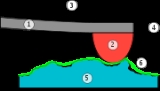
Roughness may be measured using contact or non-contact methods. Contact methods involve dragging a measurement stylus across the surface; these instruments include profilometers. Non-contact methods include interferometry, confocal microscopy, electrical capacitance and electron microscopy.

For 2D measurements, the probe usually traces along a straight line on a flat surface or in a circular arc around a cylindrical surface. The length of the path that it traces is called the measurement length. The wavelength of the lowest frequency filter that will be used to analyze the data is usually defined as the sampling length. Most standards recommend that the measurement length should be at least seven times longer than the sampling length, and according to the Nyquist–Shannon sampling theorem
Nyquist–Shannon sampling theorem

The Nyquist?Shannon sampling theorem is a fundamental result in the field of information theory, in particular telecommunications and signal processing....
 it should be at least ten times longer than the wavelength of interesting features. The assessment length or evaluation length is the length of data that will be used for analysis. Commonly one sampling length is discarded from each end of the measurement length.

For 3D measurements, the probe is commanded to scan over a 2D area on the surface. The spacing between data points may not be the same in both directions.

In some cases, the physics of the measuring instrument may have a large effect on the data. This is especially true when measuring very smooth surfaces. For contact measurements, most obvious problem is that the stylus may scratch the measured surface. Another problem is that the stylus may be too blunt to reach the bottom of deep valleys and it may round the tips of sharp peaks. In this case the probe is a physical filter that limits the accuracy of the instrument.

There are also limitations for non-contact instruments. For example instruments that rely on optical interference cannot resolve features that are less than some fraction of the frequency of their operating wavelength. This limitation can make it difficult to accurately measure roughness even on common objects, since the interesting features may be well below the wavelength of light. The wavelength of red light is about 650 nm, while the Ra of a ground shaft might be 2000 nm.

Analysis

In the past, surface finish was usually analyzed by hand. The roughness trace would be plotted on graph paper, and an experienced machinist decided what data to ignore and where to place the mean line. Today, the measured data is stored on a computer, and analyzed using methods from signal analysis and statistics.

The first step of roughness analysis is often to filter the raw measurement data to remove very high frequency data since it can often be attributed to vibrations or debris on the part surface. Next, the data is separated into roughness, waviness and form. This can be accomplished using reference lines, envelope methods, digital filters, fractals or other techniques. Finally the data is summarized using one or more of the roughness parameters, or a graph.

Specification

In the United States, surface finish is usually specified based on the ASME Y14.36M-1996 standard. Other standards also exist including International Organization for Standardization ISO 1302:2002 and Australian Standards AS ISO 1302-2005.

Lay patterns


A lay pattern is a repetitive impression created on the surface of a part. It is often representative of a specific manufacturing operation. A product designer may specify a lay pattern on a part because the directionality of the lay affects the part's function. Unless otherwise specified, roughness is measured perpendicular to the lay.

Roughness parameters

Each of the roughness parameters is calculated using a formula for describing the surface.

There are many different roughness parameters in use, but is by far the most common. Other common parameters include , , and . Some parameters are used only in certain industries or within certain countries. For example, the family of parameters is used mainly for cylinder bore linings, and the Motif parameters are used primarily within France.

Since these parameters reduce all of the information in a profile to a single number, great care must be taken in applying and interpreting them. Small changes in how the raw profile data is filtered, how the mean line is calculated, and the physics of the measurement can greatly affect the calculated parameter.

By convention every 2D roughness parameter is a capital R followed by additional characters in the subscript. The subscript identifies the formula that was used, and the R means that the formula was applied to a 2D roughness profile. Different capital letters imply that the formula was applied to a different profile. For example, Ra is the arithmetic average of the roughness profile, Pa is the arithmetic average of the unfiltered raw profile, and Sa is the arithmetic average of the 3D roughness.

Each of the formulas listed in the tables assumes that the roughness profile has been filtered from the raw profile data and the mean line has been calculated. The roughness profile contains ordered, equally spaced points along the trace, and is the vertical distance from the mean line to the data point. Height is assumed to be positive in the up direction, away from the bulk material.

Amplitude parameters

Amplitude parameters characterize the surface based on the vertical deviations of the roughness profile from the mean line. Many of them are closely related to the parameters found in statistics for characterizing population samples. For example, Ra is the arithmetic average of the absolute values and Rt is the range
Range

Range may refer to:...
 of the collected roughness data points.

The amplitude parameters are by far the most common surface roughness parameters found in the United States on mechanical engineering drawings and in technical literature. Part of the reason for their popularity is that they are straightforward to calculate using a digital computer
Computer

A computer is a machine that manipulates Data according to a list of Code .The first devices that resemble modern computers date to the mid-20th century , although the computer concept and various machines similar to computers existed earlier....
.

Parameter Description Formula
Ra, Raa, Ryniarithmetic average of absolute value
Absolute value

In mathematics, the absolute value of a real number is its numerical value without regard to its Negative and non-negative numbers. So, for example, 3 is the absolute value of both 3 and -3....
s
 
Rq, RRMSroot mean square
Root mean square

In mathematics, the root mean square , also known as the quadratic mean, is a statistics measure of the magnitude of a varying quantity. It is especially useful when variates are positive and negative, e.g., sinusoids....
d
 
Rvmaximum valley depth 
Rpmaximum peak height 
RtMaximum Height of the Profile 
Rskskewness
Skewness

In probability theory and statistics, skewness is a measure of the asymmetry of the probability distribution of a real number-valued random variable....
 
Rkukurtosis
Kurtosis

In probability theory and statistics, kurtosis is a measure of the "peakedness" of the probability distribution of a real number-valued random variable....
 
RzDIN, Rtmaverage distance between the highest peak and lowest valley in each sampling length, ASME Y14.36M - 1996 Surface Texture Symbols, where is the number of sampling lengths, and is for the sampling length.
RzJISJapanese Industrial Standard for , based on the five highest peaks and lowest valleys over the entire sampling length., where are the highest peak, and lowest valley respectively.


Slope, spacing, and counting parameters

Slope parameters describe characteristics of the slope of the roughness profile. Spacing and counting parameters describe how often the profile crosses certain thresholds. These parameters are often used to describe repetitive roughness profiles, such as those produced by turning
Turning

Turning is the process whereby a single point cutting tool is parallel to the surface. It can be done manually, in a traditional form of lathe, which frequently requires continuous supervision by the operator, or by using a computer controlled and automated lathe which does not....
 on a lathe
Lathe

A lathe is a machine tool which spins a block of material to perform various operations such as cutting, sanding, knurling, drilling, or Deformation_ with tools that are applied to the workpiece to create an object which has rotational symmetry about an axis of rotation....
.
Parameter Description Formula
Rdq, R?qthe RMS slope of the profile within the sampling length 


Bearing ratio curve parameters

These parameters are based on the bearing ratio curve
Abbott-Firestone curve

The Abbott-Firestone curve or bearing area curve describes the surface texture of an object. In physical terms, it is a plot of the bearing area or bearing length ratio at different heights above the object's general form....
 (also known as the Abbott-Firestone curve.) This includes the Rk family of parameters.

Fractal theory

The mathematician Benoît Mandelbrot
Benoît Mandelbrot

Beno?t B. Mandelbrot is a French people mathematics, best known as the father of fractal. He is Sterling Professor of Mathematical Sciences, Emeritus at Yale University; IBM Fellow Emeritus at the Thomas J....
 has pointed out the connection between surface roughness and fractal dimension
Fractal dimension

In fractal geometry, the fractal dimension, D, is a statistical quantity that gives an indication of how completely a fractal appears to fill space, as one zooms down to finer and finer scales....
.

Engineering

In most cases, roughness is considered to be detrimental to part performance. As a consequence, most manufacturing prints establish an upper limit on roughness, but not a lower limit.

It can be difficult to quantify the relationship between roughness and part performance because there are so many different ways to characterize the surface.

Tribology

Roughness is often closely related to the friction and wear properties of a surface. A surface with a large value, or a positive , will usually have high friction and wear quickly.

Deep valleys in the roughness profile are also important to tribology because they may act as lubricant reservoirs.

The peaks in the roughness profile are not always the points of contact. The form and waviness must also be considered.

Manufacturing

Many factors contribute to the surface roughness in manufacturing. When molding or forming a surface, the impression of the mold or die on the part is usually the principle factor in the surface roughness. In machining, and abrasive processes the interaction of the cutting edges and the microstructure of the material being cut both contribute to the roughness.

Just as different manufacturing processes produce parts at various tolerances, they are also capable of different roughnesses. Generally these two characteristics are linked: manufacturing processes that are dimensionally precise create surfaces with low roughness. In other words, if a process can manufacture parts to a narrow dimensional tolerance, the parts will not be very rough.

Cost

In general, the cost of manufacturing a surface increases greatly as the roughness tolerance decreases.

Other applications

  • International Roughness Index (IRI) - a dimensionless quantity
    Dimensionless quantity

    In dimensional analysis, a dimensionless quantity is a quantity without any physical units and thus a pure number. Such a number is typically defined as a product or ratio of quantity which do have units, in such a way that all the units cancel out....
     used for measuring road
    Road

    A road is an identifiable Road number, way or Trail between Location . Roads are typically smoothed, Pavement , or otherwise prepared to allow easy travel; though they need not be, and historically many roads were simply recognizable routes without any formal construction or Maintenance, repair and operations....
     roughness and proposed as a world standard by the World Bank
    World Bank

    The World Bank is a bank that provides financial and technical assistance to developing countries for development programs with the stated goal of reducing poverty....
    . Typically IRI is presented as an average value over 20 m, 100 m, 400 m, 1 mile etc. IRI is not an excellent indicator on ride quality. Consider two 10 cm high and arc-shaped traffic calming speed bumps, one "spinebreaker" being 1 m long and the other being as much as 10 m long and thus too smooth for calming city traffic. Both give an IRI20 of about 8 mm/m. Not being able to distinguish between two bumps that obviously give dramatically different ride quality, one can really question IRI as a pavement performance indicator.
  • Manning's n-value - used by geologists
    Geology

    Geology is the science and study of the solid and liquid matter that constitute the Earth. The field of geology encompasses the study of the composition, structural geology, physical properties, dynamics, and History of the Earth of Earth materials, and the processes by which they are formed, moved, and changed....
     to characterise river
    River

    A river is a natural stream of water, usually freshwater, flowing toward an ocean, a lake, or another stream. In some cases a river flows into the ground or dries up completely before reaching another body of water....
     channels.


See also


  • Embedment
    Embedment

    Embedment is a phenomenon in mechanical engineering in which the surfaces between mechanical members of a loaded joint embed. It can lead to failure by fatigue as described below, and is of particular concern when considering the design of critical Bolted joint....
  • Rugosity
    Rugosity

    Rugosity, fr, is a measure of small-scale variations or amplitude in the height of a surface,where Ar is the Real surface area and Ag is the geometric surface area....
  • Surface metrology
    Surface metrology

    Surface metrology is the measurement of small-scale features on surfaces, and is a branch of Metrology. Surface primary form, surface waviness and surface roughness are the parameters most commonly associated with the field....


Further reading

  • from Michigan Tech
  • at The University of Michigan Transportation Research Institute (UMTRI)
  • at Phoenix Marine Services
  • at USGS.
  • - interview with Mandelbrot at
  • from EverySpec
  • Marks' Standard Handbook for Mechanical Engineers, Section 13.5 "Surface Texture Designation, Production, and Control" by Thomas W. Wolf.
  • "Relating Road Roughness and Vehicle Speeds to Human Whole Body Vibration and Exposure Limits" by Ahlin & Granlund in International Journal of Pavement Engineering, Volume 3, Issue 4 December 2002 , pages 207 - 216.