
All Topics  
Rigel


   Email Print
   Bookmark   Link


Rigel


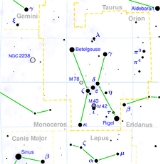
Rigel (ß Ori / ß Orionis / Beta Orionis) is the brightest star in the constellation Orion
Orion (constellation)

Orion , often referred to as "The Hunter," is a prominent constellation ? one of the largest, most conspicuous, and most recognizable in the night sky....
 and the sixth brightest star
List of brightest stars

Bright stars are bright because they have high luminosity and/or they are nearby. Below are the 91 brightest individual stars as seen from Earth in visible wavelengths ....
 in the sky, with visual magnitude 0.18. Although it has the Bayer designation
Bayer designation

A Bayer designation is a stellar designation in which a specific star is identified by a Greek alphabet, followed by the genitive case form of its parent constellation's Latin language name....
 "beta", it is almost always brighter than Alpha Orionis (Betelgeuse
Betelgeuse

Betelgeuse is a semiregular variable star located approximately 600 light-years away from Earth. It is the second brightest star in the constellation Orion and the ninth list of brightest stars in the night sky....
).
l is well beyond the current range of accurate parallax
Parallax

Parallax is an apparent displacement or difference of orientation of an object viewed along two different lines of sight, and is measured by the angle or semi-angle of inclination between those two lines....
 measurements; spectroscopic
Spectroscopy

Spectroscopy was originally the study of the interaction between radiation and matter as a function of wavelength . In fact, historically, spectroscopy referred to the use of visible light dispersed according to its wavelength, e.g....
 estimates place its distance between , while Hipparcos
Hipparcos

Hipparcos was a scientific mission of the European Space Agency , launched in 1989 and operated between 1989 and 1993. It was the first space experiment devoted to astrometry, the accurate measurement of star positions, parallaxes, and proper motions....
“best guess” is , with a margin of error
Margin of error

The margin of error is a statistic expressing the amount of random sampling error in a statistical survey's results. The larger the margin of error, the less faith one should have that the poll's reported results are close to the "true" figures; that is, the figures for the whole Statistical population....
 of about 19%.


Discussion
Ask a question about 'Rigel'
Start a new discussion about 'Rigel'
Answer questions from other users
Full Discussion Forum


Encyclopedia


Rigel Blue Supergiant
Rigel (ß Ori / ß Orionis / Beta Orionis) is the brightest star in the constellation Orion
Orion (constellation)

Orion , often referred to as "The Hunter," is a prominent constellation ? one of the largest, most conspicuous, and most recognizable in the night sky....
 and the sixth brightest star
List of brightest stars

Bright stars are bright because they have high luminosity and/or they are nearby. Below are the 91 brightest individual stars as seen from Earth in visible wavelengths ....
 in the sky, with visual magnitude 0.18. Although it has the Bayer designation
Bayer designation

A Bayer designation is a stellar designation in which a specific star is identified by a Greek alphabet, followed by the genitive case form of its parent constellation's Latin language name....
 "beta", it is almost always brighter than Alpha Orionis (Betelgeuse
Betelgeuse

Betelgeuse is a semiregular variable star located approximately 600 light-years away from Earth. It is the second brightest star in the constellation Orion and the ninth list of brightest stars in the night sky....
).

Physical properties

Rigel is well beyond the current range of accurate parallax
Parallax

Parallax is an apparent displacement or difference of orientation of an object viewed along two different lines of sight, and is measured by the angle or semi-angle of inclination between those two lines....
 measurements; spectroscopic
Spectroscopy

Spectroscopy was originally the study of the interaction between radiation and matter as a function of wavelength . In fact, historically, spectroscopy referred to the use of visible light dispersed according to its wavelength, e.g....
 estimates place its distance between , while Hipparcos
Hipparcos

Hipparcos was a scientific mission of the European Space Agency , launched in 1989 and operated between 1989 and 1993. It was the first space experiment devoted to astrometry, the accurate measurement of star positions, parallaxes, and proper motions....
“best guess” is , with a margin of error
Margin of error

The margin of error is a statistic expressing the amount of random sampling error in a statistical survey's results. The larger the margin of error, the less faith one should have that the poll's reported results are close to the "true" figures; that is, the figures for the whole Statistical population....
 of about 19%. Rigel is a Blue supergiant
Supergiant

Supergiants are among the most massive stars. In the Hertzsprung-Russell diagram they occupy the top region of the diagram. In the spectral classification supergiants are class Ia or Ib ....
 at 17 solar mass
Solar mass

The solar mass is a standard way to express mass in astronomy, used to describe the masses of other stars and galaxy. It is equal to the mass of the Sun, about two Names of large numbers kilograms or about 332,950 times the mass of the Earth, or 1,048 times the mass of Jupiter....
es, it shines with approximately 40,000 times the luminosity
Luminosity

Luminosity has different meanings in several different fields of science....
 of the Sun
Sun

The Sun , a G V star, is the star at the center of the Solar System. The Earth and other matter orbit the Sun, which by itself accounts for about 98.6% of the Solar System's mass....
. Rigel is the most luminous star in our local region of the Milky Way
Milky Way

The Milky Way, sometimes called simply the Galaxy, is the galaxy in which the Solar System is located. It is a barred spiral galaxy that is part of the Local Group of galaxies....
; the nearest more powerful star is Deneb
Deneb

Deneb is the brightest star in the constellation Cygnus and one of the vertices of the Summer Triangle. It is the 19th list of brightest stars, with an apparent magnitude of 1.25....
, almost 1,500 light years away in Cygnus.

As it is so bright and it is moving through a region of nebulosity, Rigel lights up several dust clouds in its general vicinity, the most notable being the IC 2118
IC 2118

IC 2118 , is believed to be an ancient supernova remnant or gas cloud illuminated by nearby supergiant Rigel in Orion . It lies in the Eridanus constellation, about 1000 light-years from Earth....
 (the Witch Head Nebula). Rigel is also associated with the Orion Nebula
Orion Nebula

The Orion Nebula is a diffuse nebula situated south of Orion 's Belt. It is one of the brightest nebulae, and is visible to the naked eye in the night sky....
, which—while more or less along the same line of sight as the star—is almost twice as far away from Earth. Despite the difference in distance, projecting Rigel's path through space for its expected age brings it close to the nebula. As a result, Rigel is sometimes classified as an outlying member of the Orion OB1 Association, along with many of the other bright stars in that region of the sky; more specifically, it is a member of the Taurus-Orion R1 Association, with the OB1 Association reserved for stars closer to the nebula and more recently formed.

Rigel is slightly variable, in an irregular way common to supergiants, with a range from 0.03 to 0.3 of a magnitude over roughly 22-25 days. A fourth star in the system is sometimes proposed, but it is generally considered that this is a misinterpretation of the main star's variability, which may be caused by physical pulsation of the surface.

Spectroscopy

Studies done on Rigel, looking at the Ha lines
H-alpha

In physics and astronomy, H-alpha, also written Ha, is a specific red visible emission line created by hydrogen with a wavelength of 6562.8 ?ngstr?m....
, have shown a wide variety of configurations. It varies from large emission to large absorption. Current studies are underway to determine if there is a pattern.

Rigel is surrounded by a shell of expelled gas, perhaps shed by its pulsations, stellar wind
Stellar wind

A stellar wind is a flow of neutral or charged gas ejected from the celestial body atmosphere of a star. It is distinguished from the bipolar outflows characteristic of young stars by being less collimated, although stellar winds are not generally spherically symmetric....
, or both; the issue remains unsolved.

System

Rigel has been a known visual binary since at least 1831, when it was first measured by F. G. W. Struve
Friedrich Georg Wilhelm von Struve

Friedrich Georg Wilhelm von Struve was a Baltic-German astronomer from a famous dynasty of astronomers....
. Though Rigel B is not particularly faint at magnitude 6.7, its closeness to Rigel A — which is over 500 times brighter — makes it a challenging target for telescopes smaller than . At Rigel's estimated distance, Rigel B is separated from its primary by over 2200 AU
Astronomical unit

An astronomical unit is a unit of length based on the mean distance from the Earth to the Sun. The precise value of the AU is currently accepted as 149,597,870,691 Plus-minus sign 6 metres ....
; not surprisingly, there has been no sign of orbital movement, though they share the same proper motion
Proper motion

The proper motion of a star is its angular change in position over time as seen from the Sun, as inferred after improper motions are accounted for....
.

Rigel B is itself a spectroscopic binary system, consisting of two main sequence
Main sequence

The main sequence is a continuous and distinctive band of stars that appear on plots of stellar Color index versus brightness. These color-absolute magnitude plots are known as Hertzsprung-Russell diagrams after their co-developers, Ejnar Hertzsprung and Henry Norris Russell....
 stars that orbit their center of gravity every 9.8 days. The stars both belong to the spectral class B9V; Rigel B is the more massive of the pair, at 2.5 versus 1.9 solar masses.

There was long-running controversy in the late 19th and early 20th century over the possible visible binarity of Rigel B. A number of experienced observers claimed to see it as a double, while others were unable to confirm it; indeed, the proponents themselves were sometimes unable to duplicate their results. Observations since have ruled out the likelihood of a visible companion to Rigel B.

Etymology and cultural significance

The star's name comes from its location at the "left foot" of Orion. It is a contraction of
, this being Arabic
Arabic language

Arabic is a Central Semitic language, thus related to and classified alongside other Semitic languages languages such as Hebrew language and Aramaic language....
 for "Left Foot of the Central One". Another Arabic name is
, "the foot of the great one" (giant, conqueror, etc.), which is also the source of the variant name Algebar. It also has the alternative traditional names Algebar or Elgebar, but these are rarely used.

It is known as (
, "The Seventh of the Three Stars") in Chinese. This mathematically questionable name is due to the fact that the Asterism of Three Stars was originally composed of just three stars, all of them in the girdle of the Orion. Later, four more stars were added to this asterism, but the name remained unchanged.

In stellar navigation, Rigel is one of the most important navigation star
Nautical almanac

A nautical almanac is a publication describing the positions and movements of celestial bodies for the purpose of enabling navigators to use celestial navigation to determine the position of their ship while at sea including the sun, moon, planets, and 57 stars chosen for their ease of identification and wide spacing....
s, since it is bright, easily located and equatorial, which means it is visible all around the world's oceans.

See also

  • Rigel in fiction
    Rigel in fiction

    Rigel , the brightest star in the constellation Orion , is a well-known star in Earth's northern hemisphere night sky and hence a popular science fiction setting or feature....


External links