


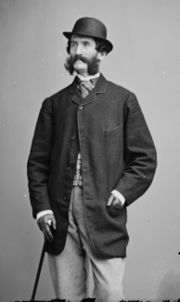
Richard Grant White

Encyclopedia
New York
New York is a state in the Northeastern region of the United States. It is the nation's third most populous state. New York is bordered by New Jersey and Pennsylvania to the south, and by Connecticut, Massachusetts and Vermont to the east...
USA.
Biography
White was born 23 May 4 1821 in New York City to Richard Mansfield White (b: 26 May 1797, Bloomfield, NJ) and Ann Eliza (Tousey or Towsey) White (b: 5 August 1802). He married Alexina Black Maese (b 4 Jul 1830) on 16 Oct 1850, they had 2 children Richard Mansfield White (b 25 Dec 1851) and Stanford WhiteStanford White
Stanford White was an American architect and partner in the architectural firm of McKim, Mead & White, the frontrunner among Beaux-Arts firms. He designed a long series of houses for the rich and the very rich, and various public, institutional, and religious buildings, some of which can be found...
(b 9 Nov 1853 in NY, NY).
White attended Bristol College
Bristol College, Pennsylvania
Bristol College, Bucks County, Pennsylvania, was an Episcopal college founded in 1833 by the Epsicopal Education Society and chartered in 1834. It was based on the "manual labour system", combining education with agricultural work. The founding principal was Revd Chauncey Colton and Caleb Sprague...
, Pa., 1835-37; New York University
New York University
New York University is a private, nonsectarian research university based in New York City. NYU's main campus is situated in the Greenwich Village section of Manhattan...
, 1837 graduating with A.B. in 1839 distinguishing himself at a scholar of letters and mathematics and was the orator and Grand Marshal at Commencement, and at a later date receiving a M.A. from New York University. He studied medicine and law being admitted to Bar in 1845.
White was one of the foremost literary and musical critics of his day. He had a distinguished career in journalism and literature as an editorial writer and musical critic for "The Courier and Enquirer," continuing when it merged into "The New York World". He wrote many books and articles for the leading American magazines, and contributed to Appleton's and Johnson's Cyclopsedias. "Words and Their Uses" being one of his most noted books. While writing on a wide range of subject his essay The Public-School Failure established him as a prominent and controversial social critic.
White was a Vice-President of the New Shakespeare Society of London, England and edited a twelve-volume edition of Shakespeare in 1857-65. He was Superintendent Revenue Marine Bureau, New York, 1861-78. White owned and maybe played a violincello now part of the collection at the Museum of Fine Arts in Boston, Massachusetts, USA.
See also
- Zachariah MontgomeryZachariah MontgomeryZachariah "Zach" Montgomery was a publisher, lawyer, politician, and author, particularly known for his skills as an orator....
- White relies in part on Montgomery's book, The Poison Fountain for some arguments against public education.
External links
- Richard Grant White entry at Find A Grave.com
- National Hymms by Richard Grant White, The universal anthology: a collection of the best literature ..., Volume 26 pg 223
- He Wanted to Abolish Public Schools by Robert M. Weiss — 1956 A discussion of Richard Grant White and why he wanted to abolish public schools.
- New York university; its history, influence, equipment and characteristics, with biographical sketches and portraits of founders, benefactors, officers and alumni
- The encyclopædia britannica: a dictionary of arts, sciences ..., Volume 28 edited by Hugh Chisholm pg601