

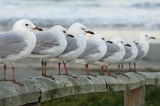
Red-billed Gull

Encyclopedia
The Red-billed Gull once also known as the Mackerel Gull, is a native of New Zealand
, being found throughout the country and on outlying islands including the Chatham Islands
and Sub-antarctic islands.The Māori
name of this species is Tarapunga or Akiaki. Its vernacular name is sometimes also used for the Dolphin Gull
, a somewhat similar-looking but unrelated species. As is the case with many gulls, the Red-billed Gull has traditionally been placed in the genus
Larus
.
with an all-red bill, red eye ring, red legs and feet, pale grey wings with black wingtips. The rest of the body and tail are white. There is virtually no visual difference between the male and female birds
. The immature gulls have a dark brown bill with only hints of red. The legs are also brown and there are brown spots on the grey wings.
of the Silver Gull
Larus novaehollandiae found in Australia
, and the two species are very similar in appearance. However the most recent research suggests that they are not particularly closely related.
and kleptoparasite
. Since European settlement its numbers have increased, especially around coastal towns and cities where it can scavenge from urban waste. It normally feeds on small fish, shell fish and worms (from pastures), and sometimes berries, lizards and insects.
s which endure across seasons, but there is a certain amount of extra-pair copulation. Courtship feeding is an important part of the preparation for mating. Nests are well formed and may be constructed of seaweed, grasses, leaves and ice plants. Generally two to three eggs are laid, their colour ranges from brown to grey with light and dark brown spots all over.
New Zealand
New Zealand is an island country in the south-western Pacific Ocean comprising two main landmasses and numerous smaller islands. The country is situated some east of Australia across the Tasman Sea, and roughly south of the Pacific island nations of New Caledonia, Fiji, and Tonga...
, being found throughout the country and on outlying islands including the Chatham Islands
Chatham Islands
The Chatham Islands are an archipelago and New Zealand territory in the Pacific Ocean consisting of about ten islands within a radius, the largest of which are Chatham Island and Pitt Island. Their name in the indigenous language, Moriori, means Misty Sun...
and Sub-antarctic islands.The Māori
Maori language
Māori or te reo Māori , commonly te reo , is the language of the indigenous population of New Zealand, the Māori. It has the status of an official language in New Zealand...
name of this species is Tarapunga or Akiaki. Its vernacular name is sometimes also used for the Dolphin Gull
Dolphin Gull
The Dolphin Gull , sometimes erroneously called the Red-billed Gull , is a gull native to southern Chile and Argentina, and the Falkland Islands. It is a coastal bird inhabiting rocky, muddy and sandy shores and is often found around seabird colonies...
, a somewhat similar-looking but unrelated species. As is the case with many gulls, the Red-billed Gull has traditionally been placed in the genus
Genus
In biology, a genus is a low-level taxonomic rank used in the biological classification of living and fossil organisms, which is an example of definition by genus and differentia...
Larus
Larus
Larus is a large genus of gulls with worldwide distribution . Many of its species are abundant and well-known birds in their ranges...
.
Description
The Red-billed Gull is a fairly small gullGull
Gulls are birds in the family Laridae. They are most closely related to the terns and only distantly related to auks, skimmers, and more distantly to the waders...
with an all-red bill, red eye ring, red legs and feet, pale grey wings with black wingtips. The rest of the body and tail are white. There is virtually no visual difference between the male and female birds
Sexual dimorphism
Sexual dimorphism is a phenotypic difference between males and females of the same species. Examples of such differences include differences in morphology, ornamentation, and behavior.-Examples:-Ornamentation / coloration:...
. The immature gulls have a dark brown bill with only hints of red. The legs are also brown and there are brown spots on the grey wings.
Distribution
It is the smallest gull commonly seen in New Zealand; a recent estimate of the population puts it at half a million birds in the country. Until recently it was regarded as a subspeciesSubspecies
Subspecies in biological classification, is either a taxonomic rank subordinate to species, ora taxonomic unit in that rank . A subspecies cannot be recognized in isolation: a species will either be recognized as having no subspecies at all or two or more, never just one...
of the Silver Gull
Silver Gull
The Silver Gull also known simply as "seagull" in Australia, is the most common gull seen in Australia. It has been found throughout the continent, but particularly coastal areas. The South African Hartlaub's Gull and the New Zealand Red-billed Gull The Silver Gull (Chroicocephalus...
Larus novaehollandiae found in Australia
Australia
Australia , officially the Commonwealth of Australia, is a country in the Southern Hemisphere comprising the mainland of the Australian continent, the island of Tasmania, and numerous smaller islands in the Indian and Pacific Oceans. It is the world's sixth-largest country by total area...
, and the two species are very similar in appearance. However the most recent research suggests that they are not particularly closely related.
Behaviour
Behaviourally, the Red-Billed Gull is a typical gull. It is an aggressive scavengerScavenger
Scavenging is both a carnivorous and herbivorous feeding behavior in which individual scavengers search out dead animal and dead plant biomass on which to feed. The eating of carrion from the same species is referred to as cannibalism. Scavengers play an important role in the ecosystem by...
and kleptoparasite
Kleptoparasitism
Kleptoparasitism or cleptoparasitism is a form of feeding in which one animal takes prey or other food from another that has caught, collected, or otherwise prepared the food, including stored food...
. Since European settlement its numbers have increased, especially around coastal towns and cities where it can scavenge from urban waste. It normally feeds on small fish, shell fish and worms (from pastures), and sometimes berries, lizards and insects.
Life cycle
They nest from October to December in colonies on the coast, either on islands or rocky headlands, cliffs and beaches. The birds form pair bondPair bond
In biology, a pair bond is the strong affinity that develops in some species between the males and females in a pair, potentially leading to breeding. Pair-bonding is a term coined in the 1940s that is frequently used in sociobiology and evolutionary psychology circles...
s which endure across seasons, but there is a certain amount of extra-pair copulation. Courtship feeding is an important part of the preparation for mating. Nests are well formed and may be constructed of seaweed, grasses, leaves and ice plants. Generally two to three eggs are laid, their colour ranges from brown to grey with light and dark brown spots all over.