
| The upper reaches of the River Kennet near Avebury | The Kennet is a river in the south of England, and a tributary of the River Thames...
through the outer suburbs of Reading to ThealeTheale railway station is a railway station in the village of Theale in the county of Berkshire in England. The station is served by local services operated by First Great Western between Reading and Newbury, a semi-fast service between Great Bedwyn and London Paddington as well as a limited...
, where the stone and oil terminals in the goods yard give the station an industrial feel. Out now into the BerkshireBerkshire is a county in the South East of England. It is also often referred to as the Royal County of Berkshire because of the presence of the royal residence of Windsor Castle in the county; this usage, which dates to the 19th century at least, was recognised by the Queen in 1958, and Letters...
countryside, the line passes through more local stations at AldermastonAldermaston railway station is a railway station named after the village of Aldermaston in the county of Berkshire in England. The station is in the nearby settlement of Aldermaston Wharf and approximately north from Aldermaston village. It was opened on December 21 1847 .- Description...
, MidghamMidgham railway station is a railway station named after the village of Midgham in the county of Berkshire in England. In fact the station is in the nearby valley bottom village of Woolhampton and some distance downhill from Midgham village itself...
and ThatchamThatcham railway station is a railway station in the village of Thatcham in the county of Berkshire in England. The station is served by local services operated by First Great Western from Reading to Newbury and Great Bedwyn. Most services are operated by Class 165 DMU's, of either 2 car or 3 car...
.
Newbury race course lies alongside the line on the left and has its own stationNewbury Racecourse railway station is a railway station serving the East Fields area of the town of Newbury in the county of Berkshire in England. It was opened on September 21 1905. The station is adjacent to Newbury Racecourse and sees heavy traffic and additional trains on race days...
a short distance east of the main Newbury railway stationNewbury railway station is a railway station in the centre of the town of Newbury in the county of Berkshire in England. It was opened on December 21, 1847 by the Great Western Railway company...
, where the town centre is close by on the right of the line. The station has a bay platform on the right for local terminating trains, and the through platforms are on loop lines that allow fast trains to overtake the local services that continue beyond the town. Some long distance trains also call here.
Beyond Newbury the railway follows the route of the Kennet and Avon CanalThe Kennet and Avon Canal is a canal in southern England. The name may refer to either the route of the original Kennet and Avon Canal Company, which linked the River Kennet at Newbury to the River Avon at Bath, or to the entire navigation between the River Thames at Reading and the Floating...
which crosses below to run on the left side of the line through KintburyKintbury railway station is a railway station in the village of Kintbury in the county of Berkshire in England. The station is served by local services operated by First Great Western from London Paddington via Reading and Newbury to Great Bedwyn....
then crosses back to the right before it reaches HungerfordHungerford railway station is a railway station in the town of Hungerford in the county of Berkshire in England. The station opened in December 1847. First Great Western provide the rail service to Hungerford station.- History :...
. The line crosses into WiltshireWiltshire is a ceremonial county in the south west of England. It is landlocked and borders the counties of Dorset, Somerset, Hampshire, Gloucestershire, Oxfordshire and Berkshire. It contains the unitary authority of Swindon and covers 3,485 km²...
and the canal crosses back to the left to run close beside the line through picturesque Little Bedwyn to reach Bedwyn railway stationBedwyn railway station is a railway station in the village of Great Bedwyn in the county of Wiltshire in England. It is also the main station for the market town of Marlborough a few miles away...
which is actually in Great Bedwynright|400px|View eastwards from Great Bedwyn showing canal and railwayGreat Bedwyn is a village and civil parish in the east of the English county of Wiltshire.-Location:...
. This is the outer limit of the London suburban services and a turn back siding is situated on the right just beyond the station.
On to Taunton
Communities served: PewseyPewsey is a large village in Wiltshire with a population of 3,237 people located approximately 80 miles west of London. It is well connected for London, the West Country and Wales being close to the M4 motorway and the A303. Also, the village is served by Pewsey railway station on the Great...
– WestburyWestbury is a town and civil parish in the west of the English county of Wiltshire, most famous for the Westbury White Horse.-Name:The most likely origin of the West- in Westbury is simply that the town is near the western edge of the county of Wiltshire, the bounds of which have been much the same...
– FromeFrome is a medium-sized town and civil parish in the Mendip district of Somerset, England. The town is approximately south of Bath, and located at the eastern end of the Mendip Hills. The centre of the town, through which the River Frome runs, is surrounded by hills.From AD 950 to 1650, Frome was...
– BrutonBruton is a town and civil parish in Somerset, England, situated on the River Brue seven miles south-east of Shepton Mallet, ten miles north-west of Gillingham and twelve miles south-west of Frome in the South Somerset district. The town has a population of 2,945...
– Castle CaryCastle Cary is a market town and civil parish in south Somerset, England, north west of Wincanton and south of Shepton Mallet.The town is situated on the River Cary, a tributary of the Parrett.- History :...
– TauntonTaunton is the county town of Somerset, England. The town, including its suburbs, had an estimated population of 61,400 in 2001. It is the largest town in the shire county of Somerset....
Long distance trains continue to follow the Kennet and Avon CanalThe Kennet and Avon Canal is a canal in southern England. The name may refer to either the route of the original Kennet and Avon Canal Company, which linked the River Kennet at Newbury to the River Avon at Bath, or to the entire navigation between the River Thames at Reading and the Floating...
which is on the left side of the line but on the right is Crofton Pumping StationCrofton Pumping Station is a pumping station near the village of Great Bedwyn in the English county of Wiltshire: it supplies the summit pound of the Kennet and Avon Canal with water....
where beam engineA beam engine is a design of engine based on the principles of a first-class lever. A force is applied to one end of a beam, which is pivoted in the middle, and the lever action transfers the force to create work at the other end of the beam....
s are preserved that once pumped water to the summit level of the canalCanals are artificial channels for water. There are two types of canal: aqueduct canals are used for the conveyance and delivery of water, and waterway canals are navigable transportation canals used for passage of goods and people, often connected to existing lakes, rivers, or oceans.The word...
; the long flight of Crofton LocksCrofton Locks are a flight of locks on the Kennet and Avon Canal, near the village of Great Bedwyn, Wiltshire, England.The nine locks achieve a total rise/fall of 61 ft 0 in and were built under the supervision of engineer John Rennie...
are opposite. The canal now dives beneath the line in a tunnel beneath the site of the closed Severnake railway station; the remains of the bridge that carried the Midland and South Western Junction RailwayThe Midland and South Western Junction Railway was, until the 1923 Grouping, an independent railway built to form a north-south link between the Midland and London and South Western Railways allowing the Midland and other companies' trains to reach the port of Southampton.-Formation:The M&SWJR...
over our line can also be seen. There was never a station at Burbage- Places :* Burbage Brook, river in Derbyshire, England* Burbage, Derbyshire, village in Derbyshire, England; now part of Buxton* Burbage, Leicestershire, parish in Leicestershire, England* Burbage, Wiltshire, parish in Wiltshire, England...
but the siding on the right served a wharf which allowed transhipment of goods between the canal and railway.
Some trains call at Pewsey railway stationPewsey railway station is a railway station in the village of Pewsey in the county of Wiltshire in England. The station is on the Berks and Hants line and is served by intercity services operated by First Great Western to and from the West Country. The average journey time to London Paddington from...
, where the building on the right-hand platform is a replica of the earlier building but the building on the main platform on the left is original. The site of Patney and Chirton railway station marks the start of a cut-off line that avoided the long loop (to the right) through Devizes railway station on the Berks and Hants Extension Railway.
A white horse can be seen carved on the hillside on the left of the approach to WestburyWestbury railway station serves the town of Westbury, Wiltshire, England. The station is managed by First Great Western.The station is a major junction, serving the Reading to Plymouth Line with services to and from Penzance and London Paddington, the Wessex Main Line with services to and from...
while a cement factory lies alongside the line on the right. Non-stop trains curve to the left to pass under the Wessex Main LineThe Wessex Main Line is the railway line from Bristol Temple Meads to Southampton. Diverging from this route is the Heart of Wessex Line from Westbury to Weymouth.The places served are listed below.*Bristol*Keynsham*Oldfield Park*Bath...
and avoid the complex of junctions around the station, but trains that call here diverge to the right at Heywood Road Junction. Another line curves sharply to the right to join the Wessex Main Line towards TrowbridgeTrowbridge railway station is a railway station on the Wessex Main Line between Bradford on Avon and Westbury. The station is south east of Bristol Temple Meads and is managed by First Great Western....
at Hawkeridge Junction, a route that forms a diversionary route for the Great Western Main Line. Our train, however, curves left past the Panel Signal Box to join the Wessex Main Line in the opposite direction and enter the station.
There are sidings on both sides of the line west of the station. On the right are those used for stabling the local DMUA diesel multiple unit or DMU is a multiple unit train consisting of multiple carriages powered by one or more on-board diesel engines. They may also be referred to as a railcar or railmotor, depending on country.-Design:...
s between services, and a Network RailNetwork Rail owns and operates Britain’s rail infrastructure. It is a British "not for dividend" company limited by guarantee whose principal asset is Network Rail Infrastructure Limited, a company limited by shares....
"virtual quarry" where ballast is stockpiled for distribution. The sidings on the left are mainly used by stone trains from Mendips*Mendip Hills, an area of Somerset, England *Mendip, a local government district of Somerset, England*Chewton Mendip, a village in the Mendip Hills*Mendip TV Mast*251 Menlove Avenue, John Lennon's childhood home named Mendips...
quarries further west along the line. Our line diverges right from the Wessex Main Line (which continues towards SalisburySalisbury is a railway station serving the city of Salisbury, Wiltshire. Located southwest of London Waterloo, the station is the crossing point of the West of England Main Line and the Wessex Main Line. The station is operated by South West Trains.-History:...
) and curves around behind the virtual quarry to reach Fairwood Junction where trains that avoided the station rejoin the historic route, which here was constructed by the Wilts, Somerset and Weymouth RailwayThe Wilts, Somerset and Weymouth Railway was a broad gauge railway that linked the Great Western Railway at Chippenham, Wiltshire with Weymouth, Dorset, England. Branches ran to Devizes, Bradford-on-Avon and Salisbury in Wiltshire, and to Radstock in Somerset. The majority of the line survives...
.
Crossing from "Wilts" (Wiltshire) into SomersetSomerset is a county in South West England. The county town is Taunton, which is in the south of the county. The ceremonial county of Somerset borders the counties of Bristol and Gloucestershire to the north, Wiltshire to the east, Dorset to the south-east, and Devon to the south-west...
we come to Clink Road Junction where a branch line diverges on the right to Frome railway stationFrome railway station serves a largely rural area of the county of Somerset in England, and is situated in the town of Frome.The station is located on a long branch line which loops off the main line railway, which carries services on both the London to Penzance Line and Bristol to Weymouth route...
, where a rare wooden train shedA train shed is an adjacent building to a railway station where the tracks and platforms are covered by a roof. It is also known as an overall roof...
still survives, and Whatley Quarry. Frome is served by Heart of Wessex LineThe Heart of Wessex Line, also known as the Bristol to Weymouth line, is a United Kingdom railway line that runs from Bristol to Westbury to Weymouth...
local services but few long distance trains call there instead of following the avoiding line to Blatchbridge Junction.
The next junction on the right is at WithamWitham railway station was a station serving the Somerset village of Witham Friary and was located on the Frome to Yeovil section of the Wilts, Somerset and Weymouth Railway that opened in 1856....
, where the old East Somerset RailwayThe East Somerset Railway is a heritage railway in Somerset, running between Cranmore and Mendip Vale. Prior to the Beeching Axe, the railway ran from Witham to Wells, meeting both the Cheddar Valley line and Somerset and Dorset Joint Railway at the latter station.- History :The line was...
carries stone trains from Merehead Quarry and continues to Cranmore-Facilities:The station buildings contain a ticket office, museum and waiting room.As the main station and home of the East Somerset Railway, Cranmore station also provides several facilities for visitors:* Car parking* Children's play area* Picnic area...
. After passing through Bruton railway stationBruton railway station serves a largely rural area of the county of Somerset in England. The station is situated in the small town of Bruton....
, the line passes the remains of the Somerset and Dorset Joint RailwayThe Somerset & Dorset Joint Railway – almost always referred to as "the S&D" – was an English railway line connecting Bath in north east Somerset and Bournemouth now in south east Dorset but then in Hampshire...
at Cole, and then arrives at the junction station at Castle CaryCastle Cary railway station serves a largely rural area of the county of Somerset in England. The station is situated approximately north of the town of Castle Cary, and south of Shepton Mallet....
. Here it curves right, away from the Heart of Wessex Line which continues to WeymouthWeymouth railway station is a railway station serving the town of Weymouth, Dorset, England. The station is the terminus of both the South Western Main Line from London Waterloo and the Heart of Wessex Line from .-History:...
via Yeovil Pen MillYeovil Pen Mill railway station is one of two stations serving the town of Yeovil, Somerset. The station is situated just under a mile to the east of the town centre.The station is located south of Bristol Temple Meads, on the Heart of Wessex Line...
, a diversionary route that is used when the usual route to ExeterExeter St Davids station is the most important of seven National Rail stations in the city of Exeter in southwest England. Today the station is owned by Network Rail and operated by First Great Western.-History:...
is blocked.
The main line is now on the Castle Cary Cut-Off|}The Castle Cary Cut-Off is a railway line from Castle Cary railway station to Cogload Junction near Taunton, Somerset, England, which reduced the length of the London to Penzance Line by 20¼ miles.-History:...
that opened on 2 July 1906 to shorten the so-called "Great Way Round" via BristolBristol Temple Meads railway station is the oldest and largest railway station in Bristol, England. It is an important interchange hub for public transport in Bristol, with bus services to various parts of the city and surrounding districts, and a ferry service to the city centre in addition to the...
. After passing through Somerton Tunnel the line soon finds itself crossing the low-lying and comes onto the Somerset LevelsThe Somerset Levels is a sparsely populated coastal plain and wetland area of central Somerset, England, between the Quantock and Mendip hills....
and at to Langport and Curry Rivel Junction, where the old Yeovil branch line. used to join from the left, only to diverge right at Athelney to join the Bristol to Taunton LineThe Bristol to Taunton Line is a main line railway in England, which links the Great Western Main Line at Bristol Temple Meads to the London to Penzance Line at Taunton, Somerset. Passenger services are operated by First Great Western and CrossCountry....
at Durston. The 1906 openings saw an additional cut-off from Athelney to Cogload JunctionCogload Junction is a railway junction in Durston, Somerset, England. It is where the 1906-opened London to Penzance Line via Castle Cary joins the original line that runs via Bristol...
where we join the route from Bristol, the old Bristol and Exeter RailwayThe Bristol & Exeter Railway was a railway company formed to connect Bristol and Exeter. It was friendly to the Great Western Railway, which had been opened between London and Bristol the previous year, and the two railways operated in collaboration....
.
The Taunton and Bridgwater Canal now runs alongside the railway on the right. We next pass the site of Creech railway station and the junction (on the left) of the former Chard branch lineThe Chard Branch, opened in two parts: firstly, by the London and South Western Railway as a branch line from Chard Junction to Chard Central; and secondly by the Bristol and Exeter Railway in 1863, as a branch line from Taunton to Chard Central. The combined line inter-connected Somerset's main...
. The River ToneThe River Tone is a river in Somerset, that flows through Taunton and joins the River Parrett.The River Tone is about long. It rises at Beverton Pond near Huish Champflower in the Brendon Hills and flows through Curry and Hay Moors which are designated as a Site of Special Scientific Interest.At...
joins us on the left and the canal passes beneath the line to join it at Firepool, which is behind the site of the old goods yard just outside Taunton railway stationTaunton railway station is a junction station on the London to Penzance Line, from London Paddington station. It is situated in Taunton, Somerset, England and is operated by First Great Western but also served by CrossCountry trains.- History :...
.
Taunton to Exeter
Communities served: TauntonTaunton is the county town of Somerset, England. The town, including its suburbs, had an estimated population of 61,400 in 2001. It is the largest town in the shire county of Somerset....
– Tiverton and WillandWilland is a village in Mid-Devon, England, within the area. It is about 19 km north of Exeter and 11 km east of Tiverton. In 1991 the population was 3750 although recently this has grown considerably...
– ExeterExeter is a city and district in Devon, England; it is the county town of Devon. Exeter is located approximately northeast of Plymouth, and southwest of Bristol, on the River Exe. The city has a population of 111,076 according to the 2001 Census....
The train leaves Taunton with the abandoned engine shedEngine shed may refer to:* Engine shed, also called a motive power depot or roundhouse, a structure used for the maintenance of railway locomotives.* Engine Shed , a music and entertainment venue on the University of Lincoln's campus....
on the left, and passes the engineer's depot at Fairwater Yard on the same side. The former Norton Fitzwarren railway stationNorton Fitzwarren railway station is an untimetabled station on the West Somerset Railway in Somerset, England. It was built in 2009 about north of the site of an earlier station that served the village of Norton Fitzwarren from 1873 until 1961...
is an unlucky location that has seen two serious collisions and a fatal train fire over the years. The West Somerset RailwayThe West Somerset Railway is a railway line that originally linked and in Somerset, England. It opened in 1862 and was extended from Watchet to by the Minehead Railway in 1874. Although just a single track, improvements were needed in the first half of the twentieth century to accommodate the...
diverges on the right and work is under way to provide new facilities here for this heritage railwayA heritage railway , preserved railway , tourist railway , or tourist railroad is a term used for a railway which is run as a tourist attraction, is usually but not always run by volunteers, and often seeks to re-create railway scenes of the past A heritage railway (United Kingdom and Australia),...
which includes relaying track for a short distance along the old Devon and Somerset RailwayThe Devon and Somerset Railway ran from near Taunton in Somerset to Barnstaple in North Devon. It was operated from the outset by the Bristol and Exeter Railway which became part of the Great Western Railway on 1 January 1876.-History:...
that formed a third route in between the main line and the West Somerset. On the left of the line an embankment marks the remains of the Grand Western CanalThe Grand Western Canal ran between Taunton in Somerset and Tiverton in Devon in the United Kingdom. The canal had its origins in various plans, going back to 1796, to link the Bristol Channel and the English Channel by a canal, bypassing Lands End...
.
After passing over Victory CrossingThe term level crossing is a crossing on one level — without recourse to a bridge or tunnel — of a railway line by a road or path...
at Bradford-on-Tone, the line starts to climb upwards. It passes through the remains of Wellington station and then under the A38 roadThe A38 is a major A-class trunk road in England.Though formally known as the Exeter - Leeds Trunk Road, it actually runs from Bodmin in Cornwall to Mansfield in Nottinghamshire. It is 292 miles long...
at Beambridge, which was the site of the line's terminus while work was underway to excavate the Whiteball Tunnel at the top of Wellington Bank. It was coming down here that City of Truro became the first locomotive to exceed 100 mph (160 km/h).
Through the tunnel and into DevonDevon is a large county in England. The county is also referred to as Devonshire, although that is an unofficial name, rarely used inside of the county itself and often indicating a traditional or historical context. The county shares borders with Cornwall to the west and Dorset and Somerset to...
, the M5 motorwayThe M5 is a motorway in England. It runs from a junction with the M6 at West Bromwich near Birmingham to Exeter in Devon. Heading south-west, the M5 runs east of West Bromwich and west of Birmingham through Sandwell Valley...
comes alongside on the left and the line arrives at to Tiverton ParkwayTiverton Parkway railway station is on the London to Penzance Line, from London Paddington station; it is operated by First Great Western. The "Parkway" name signifies that the station is a distance from Tiverton town itself: it is actually located near the village of Sampford Peverell in Devon,...
, the railhead for much of north Devon thanks to the A361 roadThe A361 is a major road in England and at 195 miles is the longest 3 digit A road in the UK. It runs south from Ilfracombe on the north Devon coast to Barnstaple, turning south-east to Tiverton then, after a break , north east from Taunton in Somerset through Street and Glastonbury, past Frome...
that joins the motorway next to the station. A short distance further brings us to Tiverton Loops, the site of the former Tiverton Junction railway station.
The motorway service station on the left marks the site of Cullompton railway station, and then the line passes the remains of Hele & Bradninch and Silverton railway stations. At Silverton the old Exe Valley Railway|}The Exe Valley Railway was a small branch of the Great Western Railway that ran from Exeter St Davids railway station to Dulverton. The northern part of the line was originally called the Tiverton and North Devon Railway and it opened in 1884; the following year the line south of Tiverton opened...
used to join from the right, and then the railway sweeps through the valley of the River Culmthumb|Old stone bridge with pedestrian refuges over River Culm at Culmstock The River Culm flows through Devon, England. It rises in the Blackdown Hills at a spring - - near Culmhead and flows west through Hemyock, then Culmstock to Uffculme...
to where it joins the River ExeThe River Exe in England rises near the village of Simonsbath, on Exmoor in Somerset, near the Bristol Channel coast, but flows more or less directly due south, so that most of its length lies in Devon. It reaches the sea at a substantial ria, the Exe Estuary, on the south coast of Devon...
near Cowley Bridge Junction. Here the Tarka LineThe Tarka Line is a railway line from Exeter to Barnstaple in Devon, England. The line follows the River Creedy, River Yeo and River Taw for some of its route...
from BarnstapleBarnstaple railway station is the terminus of a long branch line, known as the Tarka Line, north west of Exeter St Davids, in Devon.It was known as Barnstaple Junction from 1874 to 1970 as it was the junction for lines to Ilfracombe and Bideford....
joins on the right and the line then passes (on the same side) Riverside Yard and an old transhipment shed. Until 20 May 1892, when the former Great Western RailwayThe Great Western Railway was a British railway company that linked London with the south west and west of England and most of Wales. It was founded in 1833, received its enabling Act of Parliament in 1835, and ran its first trains three years later...
lines that we are travelling on were converted from the broad gaugeBroad gauge railways use a rail gauge greater than the standard gauge of .- List :For a list see: List of broad gauges, by gauge and country- History :...
, the shed was used to transfer goods between broad gauge wagons and the standard gaugeThe standard gauge is a widely-used rail gauge. Approximately 60% of the world's existing railway lines are built to this gauge...
wagons used by the London and South Western RailwayThe London and South Western Railway was a railway company in England from 1838 to 1922. Its network extended from London to Plymouth via Salisbury and Exeter, with branches to Ilfracombe and Padstow and via Southampton to Bournemouth and Weymouth. It also had many routes connecting towns in...
to Yeovil and Barnstaple.
Passing over the wide Red Cow level crossingThe term level crossing is a crossing on one level — without recourse to a bridge or tunnel — of a railway line by a road or path...
, we enter Exeter St Davids railway stationExeter St Davids station is the most important of seven National Rail stations in the city of Exeter in southwest England. Today the station is owned by Network Rail and operated by First Great Western.-History:...
.
Exeter to Newton Abbot
Communities served: ExeterExeter is a city and district in Devon, England; it is the county town of Devon. Exeter is located approximately northeast of Plymouth, and southwest of Bristol, on the River Exe. The city has a population of 111,076 according to the 2001 Census....
– StarcrossStarcross is a riverside village with a population of approximately 2000, situated on the west bank of the estuary of the River Exe in Devon, England. The village is popular in summer with leisure craft, and is home to one of the UK's oldest sailing clubs....
(and ExmouthExmouth is a town in Devon. It may also refer to:Places*Exmouth Peninsula in Southern Chile*Exmouth, Western AustraliaPeople*Edward Pellew, 1st Viscount Exmouth , a British naval officerShips...
via a seasonal ferry service) – Dawlish WarrenDawlish Warren is a small seaside resort near the town of Dawlish on the south coast of Devon, England. Dawlish Warren consists almost entirely of holiday accommodation and facilities for holiday-makers, especially caravan sites....
– DawlishDawlish is a town on the south coast of Devon, England, 12 miles from the County town of Exeter, with a population of around 13,000 people. During the eighteenth century, it grew from a small fishing port to become a well-known seaside resort....
– TeignmouthTeignmouth is a town in Devon, England, situated on the north bank of the estuary mouth of the River Teign. In 1690, it was the last place in England to be invaded by a foreign power...
– Newton AbbotNewton Abbot is a market town in Devon, England on the River Teign, with a population of 23,580 .Newton Abbot has a racecourse and boasts three country parks: Decoy, Stover and Bradley...
On leaving Exeter St Davids the line to Exeter CentralExeter Central railway station is the smaller of Exeter's main railway stations, but is the more centrally located. It is situated on the London Waterloo-Exeter main line, and is also served by local services to Exmouth, Paignton and Barnstaple.-History:...
climbs away on the left while on the right can be seen the Panel Signal Box by the entrance to the Exeter TMDExeter TMD is a railway Traction Maintenance Depot situated in Exeter, Devon, England, next to the city's main St Davids station. The depot is operated by First Great Western....
where local First Great WesternFirst Great Western is the operating name of First Greater Western Ltd, a British train operating company owned by FirstGroup, which operates services in the west and south west of England and South Wales....
DMUA diesel multiple unit or DMU is a multiple unit train consisting of multiple carriages powered by one or more on-board diesel engines. They may also be referred to as a railcar or railmotor, depending on country.-Design:...
s are maintained. Our line, the old South Devon RailwayThe South Devon Railway Company built and operated the railway from Exeter to Plymouth and Torquay in Devon, England. It was a broad gauge railway built by Isambard Kingdom Brunel-Chronology:* 1844 South Devon Railway Act passed by parliament...
main line, crosses the River ExeThe River Exe in England rises near the village of Simonsbath, on Exmoor in Somerset, near the Bristol Channel coast, but flows more or less directly due south, so that most of its length lies in Devon. It reaches the sea at a substantial ria, the Exe Estuary, on the south coast of Devon...
and a parallel flood relief channel, and then passes above the suburbs of ExeterExeter is a city and district in Devon, England; it is the county town of Devon. Exeter is located approximately northeast of Plymouth, and southwest of Bristol, on the River Exe. The city has a population of 111,076 according to the 2001 Census....
along a stone viaductA viaduct is a bridge composed of several small spans. The term viaduct is derived from the Latin via for road and ducere to lead something. However, the Ancient Romans did not use that term per se; it is a modern derivation from an analogy with aqueduct. Like the Roman aqueducts, many early...
on which is situated Exeter St Thomas railway stationExeter St Thomas railway station is a suburban railway station in Exeter. The station is elevated on a low viaduct with entrances on Cowick Street. The station is unstaffed with the former station building now used for offices and a Chinese restaurant...
. The church of St David, with its spire, and the older Exeter Cathedral can be seen on the hill above the river. Beyond this is an industrial area where two lines used to branch out. On the left a short line went down to the Exeter CanalThe Exeter Canal, downstream of Exeter, Devon, England was built in 1563 which means it pre-dates the "canal mania" period and is one of the oldest artificial waterways in the UK.-History:...
at City Basin; on the right a longer branch|}The Teign Valley Line was a single track railway line that ran from Heathfield, Devon to Exeter via the Teign Valley. Its main stations were at Chudleigh, Christow and Ide, and it joined the South Devon main line at Exeter City Basin Junction....
ran to HeathfieldFor the station in Sussex see Heathfield railway stationHeathfield railway station was on the Moretonhampstead and South Devon Railway at Heathfield, nearly 4 miles from Newton Abbot, Devon, England....
on the Newton Abbot to Moretonhampstead branchThe Moretonhampstead and South Devon Railway was a broad gauge railway which linked the South Devon Railway at Newton Abbot railway station with Bovey Tracey and Moretonhampstead, Devon, England....
.
Once out in the countryside our line crosses marshes as it runs alongside the canal and river. What looks like a level crossing in the fields near Countess WearCountess Wear, alternatively called Countess Weir, is a residential district within the city of Exeter, in the English county of Devon. The name derives from the weir constructed in 1286 on the instruction of Isabella de Fortibus, Countess of Devon....
is actually a lifting bridge across the canal. After passing the site of Exminster railway station, with its George HennetGeorge Hennet was a railway engineer and contractor. He undertook many contracts for Isambard Kingdom Brunel's broad gauge railways in the South West of England and funded the provision of extra facilities on the South Devon Railway, these formed the basis of a general trading business that he...
station house on the right, the canal comes more clearly into view on the left and joins the River ExeThe River Exe in England rises near the village of Simonsbath, on Exmoor in Somerset, near the Bristol Channel coast, but flows more or less directly due south, so that most of its length lies in Devon. It reaches the sea at a substantial ria, the Exe Estuary, on the south coast of Devon...
, as does the railway, at Turf. The square pond to the left of the line is the site of Turf engine house. This stretch of the line used to have long water troughsA track pan or water trough is a device to enable a steam railway locomotive to replenish its water supply while in motion...
between the rails from which steam locomotives could refill their water tanks without stopping.
From Powderham CastlePowderham Castle, is located south of Exeter, Devon, England. The Powderham Estate, in which it is set, runs down to the western shores of the estuary of the River Exe between the villages of Kenton and Starcross....
the railway is right alongside the river; on the right of the line is the castle's deer parkDeer Park may refer to:* Medieval deer park, parkland originally used by the nobility for hunting deer.- Place names :Australia* Deer Park, Victoria, a suburb of Melbourne, located within the City of BrimbankCanada...
, while on the left, across the river, trains on the Avocet LineThe Avocet Line is the railway line in England connecting Exeter with Exmouth. It was originally built by the London and South Western Railway. The line follows the Exe Estuary for most of its route, giving views of the estuary...
may be seen near Lympstone Commando railway stationLympstone Commando railway station is a railway station on the branch line from Exeter to Exmouth in Devon, England.The station is a rare example of a passenger station not open to the general public: it is exclusively for the use of visitors to the Royal Marine Commando Training Centre at...
. Our train now enters the village of StarcrossStarcross railway station is a small station on the London to Penzance Line in the village of Starcross, Devon, England. It is on the shore of the River Exe estuary and is linked to a pier used by the ferry to Exmouth on the other side of the estuary...
beyond which is the pier for the Exmouth to Starcross FerryThe Exmouth to Starcross Ferry is a passenger ferry which crosses the mouth of the River Exe in the English county of Devon. It links the town of Exmouth on the eastern side of the Exe estuary to the village of Starcross on the western side. The ferry is operated by Exe to Sea Cruises.The ferry...
and, on the right, the old Starcross engine house. A little further along the river the railway crosses the mouth of CockwoodCockwood is a small village on the west side of the Exe Estuary in the county of Devon, England. Lying between the villages of Dawlish Warren and Starcross, it is separated from the estuary by the main railway line between Exeter and Torquay, and is set around a small tidal harbour which boats must...
harbour. Near the shipwreck here on the left was the long Exe Bight Pier, in use from 1869 for about ten years. Dawlish WarrenDawlish Warren is a small seaside resort near the town of Dawlish on the south coast of Devon, England. Dawlish Warren consists almost entirely of holiday accommodation and facilities for holiday-makers, especially caravan sites....
now comes into sight; the sand dunes are home to a nature reserve where many wading and sea birds can be seen. The railway line opens out into four lines at Dawlish Warren railway stationDawlish Warren railway station serves the seaside resort and holiday camps of Dawlish Warren in Devon, England, at the mouth of the River Exe. The station is on the London to Penzance Line 10½ miles west of Exeter St Davids...
, where the platforms are alongside loop lines that allow fast trains to overtake stopping services.
On the left is the beach and seaside amusements; on the right are some camping coachCamping coaches were offered by many railway companies in the United Kingdom as accommodation for holiday makers in rural or coastal areas.The coaches were old passenger vehicles no longer suitable for use in trains, which were converted to provide basic sleeping and living space at static locations...
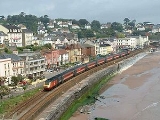
es in the old goods yard. The railway now comes onto the Sea WallThe South Devon Railway sea wall is situated on the south coast of Devon in England. It is probably the most photographed section of railway in the United Kingdom as a footpath runs alongside the railway between Dawlish Warren and Dawlish, and another footpath forms a continuation to the sea front...
which it shares with a footpath, although it quickly enters the short and deep cutting at Langstone Rock where we see the distinctive local red sandstoneThe New Red Sandstone is a chiefly British geological term for the beds of red sandstone and associated rocks laid down throughout the Permian to the beginning of the Triassic that underlie the Jurassic Lias; the term distinguishes it from the Devonian Old Red Sandstone...
cliffs for the first time. Emerging above the beach, views can be had across the sea towards TorbayTorbay is an east-facing bay and natural harbour, at the western most end of Lyme Bay in the south-west of England, situated roughly midway between the cities of Exeter and Plymouth. Part of the ceremonial county of Devon, Torbay was made a unitary authority on April 1, 1998...
.
Approaching Dawlish railway stationDawlish railway station is on the London to Penzance Line and serves the town of Dawlish in Devon, England. The station and line is built on the sea wall, and has often suffered from storm damage due its proximity to the sea...
, Coastguard's Cottage is on the right. Although now a cafe, this building was used by the railway during its construction and then sold to the coastguard; their boat house is below the footbridge. The town can be seen off to the right from Colonnade Viaduct at the other end of the station.
The footpath along the Sea Wall now ends and the line enters its first tunnel, the Kennaway Tunnel beneath Lea Mount, beyond which is Coryton beach and then Coryton tunnel. The next beach is the private Shell Cove and then the railway passes through Phillot Tunnel and Clerk's Tunnel, emerging onto a section of sea wall at Breeches Rock before diving into Parson's Tunnel beneath Hole Head. The last two tunnels are named after the Parson and Clerk Rocks, two stacksA stack is a geological landform consisting of a steep and often vertical column or columns of rock in the sea near a coast. Stacks are formed when part of a headland is eroded by hydraulic action, which is the force of the sea or water crashing against the rock...
in the sea off Hole Head. When the tunnel was dug the workers cut into a smugglers tunnel which ran from a hidden entrance above the cliff down to a secluded cove.
Beyond Parson's Tunnel is a short viaductA viaduct is a bridge composed of several small spans. The term viaduct is derived from the Latin via for road and ducere to lead something. However, the Ancient Romans did not use that term per se; it is a modern derivation from an analogy with aqueduct. Like the Roman aqueducts, many early...
across Smugglers Lane and then the footpath resumes alongside the line for the final stretch of the Sea Wall past Sprey Point to the cutting at Teignmouth Eastcliff. On the right side of the railway near Sprey Point can be seen the remains of a lime kiln used during the construction of the line.
The railway passes through to Teignmouth railway stationTeignmouth railway station is on the London to Penzance Line and serves the resort of Teignmouth, Devon, England. It is operated by First Great Western.-History:...
then continues through a cutting to emerge behind the busy Teignmouth Harbour, after which the railway resumes its course alongside the water, now the River TeignThe River Teign is a river in the county of Devon, England.Like many Devon rivers, the Teign rises on Dartmoor, near Cranmere Pool. Its course on the moor is crossed by a clapper bridge near Teigncombe, just below the prehistoric Kestor Settlement. It leaves the moor at its eastern side, flowing...
. The cuttings on both sides of the station were originally tunnels and were opened out between 1879 and 1884. The railway passes under the long ShaldonShaldon is a village in South Devon, England. It is located opposite Teignmouth in South Devon, England and situated on the River Teign. It has been described as "a quaint English drinking village, with a fishing problem".. The village is a popular bathing place and is characterised by Georgian...
Bridge and then follows the river past the small promontoriesPromontory may refer to:*Promontory, a prominent mass of land which overlooks lower lying land or a body of water*Promontory, Utah, the location where the United States first Transcontinental Railroad was completed...
at Flow Point, Red Rock, and Summer House, opposite which can be seen the waterside inn at Coombe CellarsCoombe Cellars Inn is a public house on the south bank of the estuary of the River Teign in south Devon, England. It is near the village of Combeinteignhead. The pub, owned by Brewers Fayre until 2006, is now owned by Mitchells & Butlers....
.
After leaving the riverside the line crosses Hackney Marshes and passes between the railway sidings at Hackney Yard (left), and the race course and former Moretonhampstead branchThe Moretonhampstead and South Devon Railway was a broad gauge railway which linked the South Devon Railway at Newton Abbot railway station with Bovey Tracey and Moretonhampstead, Devon, England....
(right). The industrial area to the left of Newton Abbot railway stationNewton Abbot railway station serves the town of Newton Abbot in Devon, England. It is from London on the London to Penzance Line, at the junction for the branch to . For many years it was also the junction for Moretonhampstead and the site of a large locomotive workshop...
is the site of the South Devon RailwayThe South Devon Railway Company built and operated the railway from Exeter to Plymouth and Torquay in Devon, England. It was a broad gauge railway built by Isambard Kingdom Brunel-Chronology:* 1844 South Devon Railway Act passed by parliament...
locomotive workshops – the older stone buildings are the only surviving railway buildings.
Newton Abbot to Plymouth
Communities served: Newton AbbotNewton Abbot is a market town in Devon, England on the River Teign, with a population of 23,580 .Newton Abbot has a racecourse and boasts three country parks: Decoy, Stover and Bradley...
– TotnesTotnes is a market town at the head of the estuary of the River Dart in Devon, England within the South Devon Area of Outstanding Natural Beauty...
– IvybridgeIvybridge is a small town and civil parish in the South Hams, in Devon, England. It lies about east of Plymouth. It is at the southern extremity of Dartmoor, a National Park of England and Wales and lies along the A38 "Devon Expressway" road...
– PlymouthPlymouth is a city and unitary authority area on the coast of Devon, England, about south west of London. It is built between the mouths of the rivers Plym to the east and Tamar to the west, where they join Plymouth Sound...
Just outside Newton Abbot a line branches off on the left but continues to run alongside the main line. This is the Riviera LineThe Riviera Line is a local railway line that connects the city of Exeter to the "English Riviera" resorts of Torbay in Devon, England. It is closely linked with the London to Penzance Line with which it shares the route along the South Devon sea wall...
to PaigntonPaignton railway station is the railway station serving Paignton in Devon, England. It is the terminus of the Riviera Line from Exeter and is also an interchange between National Rail services and the preserved Paignton and Dartmouth Steam Railway.-History:...
and the two routes part company at Aller Junction when our main line curves to the right to start the climb up past Stoneycombe Quarry to DaintonDainton may refer to:* Dainton, Devon, a location in the county of Devon, England* Frederick Dainton, Baron Dainton , a British academic chemist and university administrator* Lee Dainton...
Tunnel. The line from Exeter to Plymouth was designed by Isambard Kingdom BrunelIsambard Kingdom Brunel, FRS , was a British engineer. He is best known for the creation of the Great Western Railway, a series of famous steamships, including the first propeller-driven transatlantic steamship, and numerous important bridges and tunnels...
as an atmospheric railwayAn atmospheric railway uses air pressure to provide power for propulsion. A pneumatic tube is laid between the rails, with a piston running in it suspended from the train through a sealable slot in the top of the tube...
which allowed steeper gradients, sharper curves, and lighter structures. Atmospheric trains never ran beyond Newton Abbot but the legacy of the aborted scheme means that line speeds on towards Plymouth are lower than elsewhere on the route.
Once through Dainton Tunnel the line drops down past pretty Littlehempstone and shortly the South Devon RailwayThe South Devon Railway Trust is a charitable organization that operates a heritage railway from Totnes to Buckfastleigh in Devon, alongside the River Dart...
, a heritage railwayA heritage railway , preserved railway , tourist railway , or tourist railroad is a term used for a railway which is run as a tourist attraction, is usually but not always run by volunteers, and often seeks to re-create railway scenes of the past A heritage railway (United Kingdom and Australia),...
, can be seen on the right . Our line immediately crosses over the River DartThe River Dart is a river in Devon, England which rises high on Dartmoor, and releases to the sea at Dartmouth. Its valley and surrounding area is a place of great natural beauty.-Watercourse:...
and arrives at Totnes railway stationTotnes railway station serves the towns of Totnes and Dartington in Devon, England. It is situated on the London to Penzance Line and is operated by First Great Western...
, which has passing loops to allow slower trains to be overtaken. Behind the right-hand platform can be seen a dairy which is built around the old atmospheric engine house.
The steep climb up Rattery BankThe South Devon Banks are a series of steep inclines on the ex-GWR railway line linking Exeter and Plymouth in Devon, England. These two major towns are separated by the rocky uplands of Dartmoor forcing the early railway surveyors to propose that the line skirt the difficult terrain of the...
starts right from the end of the platform, a steep challenge in former days to trains that called at Totnes. At the top is Rattery Viaduct and the Marley Tunnel. The original single-track tunnel had a second bore added alongside it in 1893 when the line was doubled. The line is now running along the southern edge of DartmoorDartmoor is an area of moorland in the centre of Devon, England. Protected by National Park status, it covers .The granite upland dates from the Carboniferous period of geological history. The moorland is capped with many exposed granite hilltops , providing habitats for Dartmoor wildlife. The...
. Brent railway station was once the junction for the Kingsbridge branch lineKingsbridge branch line was a single track branch line railway in Devon, England. The line, which became known as the Primrose Line, opened in 1893 and despite local opposition closed in 1963. It left the Reading to Plymouth Line at Brent and ran , following the route of the River Avon to...
which joined our route in the cutting just before the station. Curving to the left the line passes over the Brent Mill Viaduct and then the Glazebrook Viaduct.
After passing through the Wrangaton Tunnel the line passes through the remains of Wrangaton railway station; Monksmoor Siding on the right used to serve a naval stores depot. Just beyond the site of Bittaford Platform is the Bittaford Viaduct. The industrial buildings on the right were built as china clay dries where clay dug on Dartmoor was treated; the Redlake TramwayThe Redlake Tramway was a railway built to carry supplies and workers between the clay workings at Redlake and Bittaford, the nearest settlement. It was built in 1911 to a gauge of , and ran for a circuitous .-Remnants:...
was built alongside the pipeline that carried the liquid clay.
The line now comes to Ivybridge railway stationIvybridge railway station is situated on the London to Penzance Line and serves the town of Ivybridge in Devon, England. The station re-opened in the 1994 to the east of the original station, which had been closed in 1965. The station is operated by First Great Western.-First station:The first...
. The platforms here are staggered with the one on the left nearer Totnes than the one on the right. This station only opened in 1994; the original station closed in 1965 and was on the far side of the curving Ivybridge Viaduct where an old goods shedA goods shed is a railway building designed for storing goods before or after carriage in a train.A typical goods shed will have a track running through it to allow goods wagons to be unloaded under cover, although sometimes they were built alongside a track with possibly just a canopy over the door...
can be seen on the left. More curves bring us to the Blatchford Viaduct and then the old Cornwood railway station where George HennetGeorge Hennet was a railway engineer and contractor. He undertook many contracts for Isambard Kingdom Brunel's broad gauge railways in the South West of England and funded the provision of extra facilities on the South Devon Railway, these formed the basis of a general trading business that he...
's station house can be seen in the trees on the right.
Slade Viaduct brings us to the top of Hemerdon Bank, the steepest climb for trains heading towards Newton Abbot. A fast run down the bank brings us to the site of Plympton railway station, which is hard to spot among modern housing on the left, and then Tavistock Junction. The large goods yard here includes a maintenance shed for on-track equipment and a connection to the china clay drier at Marsh Mills. This is on the former South Devon and Tavistock RailwayThe South Devon and Tavistock Railway was a broad gauge railway linking Plymouth with Tavistock in Devon, England. It opened in 1859, was extended by the Launceston and South Devon Railway to Launceston, Cornwall, in 1865, and was closed in 1962....
although the junction originally faced Plymouth.
The line swings left under the Marsh Mills Viaduct of the A38 roadThe A38 is a major A-class trunk road in England.Though formally known as the Exeter - Leeds Trunk Road, it actually runs from Bodmin in Cornwall to Mansfield in Nottinghamshire. It is 292 miles long...
and then runs alongside the tidal estuary of the River PlymThe River Plym is a river in Devon, England. Its source is 450m above sea level on Dartmoor, in an upland marshy area called Plym Head. From the upper reaches which contain antiquities and mining remains the river flows roughly southwest and enters the sea near to the city of Plymouth, where the...
on the left, with the grounds of Saltram HouseSaltram House is a George II era mansion located in Plympton, Plymouth, England. The house that can be seen today is the work of Robert Adam, who altered the original Tudor house on two occasions. The saloon is sometimes cited as one of Adam's finest interiors...
at PlymstockPlymstock is a civil parish and lower middle class commuter suburb of Plymouth in the English county of Devon.The name derives from the Anglo-Saxon for 'holy place on the river Plym', with the river Plym in turn being named after the neighbouring town of Plympton. Situated on the east bank of the...
on the far bank. Underneath the Embankment Road bridge which carries the A38 over the line again and Laira TMDLaira TMD is a railway Traction Maintenance Depot situated in Plymouth, Devon, England. The depot is operated by First Great Western and is mainly concerned with the overhaul and daily servicing of their fleet of High Speed Trains and also the DMUs used on local services...
is seen, also on the left. Laira maintains First Great WesternFirst Great Western is the operating name of First Greater Western Ltd, a British train operating company owned by FirstGroup, which operates services in the west and south west of England and South Wales....
's High Speed TrainsThe British Rail Class 43 is the TOPS classification used for the InterCity 125 High Speed Train power cars, built by BREL from 1976 to 1982....
in Devon. A triangle of lines takes a freight route down to the PlymouthPlymouth is a city and unitary authority area on the coast of Devon, England, about south west of London. It is built between the mouths of the rivers Plym to the east and Tamar to the west, where they join Plymouth Sound...
waterfront via the closed Friary stationPlymouth Friary railway station was the London and South Western Railway terminus in Plymouth, Devon, England.-History:London and South Western Railway trains first arrived at Plymouth on 17 May 1876, entering the town from the east...
, which was the terminus for trains on the rival route from London Waterloo station.
Passing through the short Mutley Tunnel, trains emerge past the Royal Eye Infirmary (right) into Plymouth railway stationPlymouth railway station serves the city of Plymouth, Devon, England. It is situated on the northern edge of the city centre close to the North Cross roundabout...
. This was originally known as North Road Station as trains continued beyond it to Plymouth MillbayPlymouth Millbay railway station was the original railway terminus in Plymouth, Devon, England. It was used for passenger trains from 1849 to 1941.- History :...
.
Infrastructure
The route is double track throughout with passing loops at certain locations. The maximum speed is 125 mph to Exeter, 60 mph between Exeter - Newton Abbot and 100 mph between Newton Abbot - Penzance. The route has a gauge clearance of W7 except Reading to Westbury and Taunton to Exeter which are the larger W8, and is open to rolling stock up to Route Availability 8. Signalling requires 4 minutes between trains on most of the route, but 8 minutes approaching Cogload JunctionCogload Junction is a railway junction in Durston, Somerset, England. It is where the 1906-opened London to Penzance Line via Castle Cary joins the original line that runs via Bristol...
and 6 minutes west of Newton Abbot. Signalling is by multiple-aspect signals controlled from Reading, Westbury, Exeter, and Plymouth. Most of these are three aspect, but some sections of two- or four- aspect signalling also exist.
The Network RailNetwork Rail owns and operates Britain’s rail infrastructure. It is a British "not for dividend" company limited by guarantee whose principal asset is Network Rail Infrastructure Limited, a company limited by shares....
Business Plan recognises that the heaviest traffic flows are on the section through Newbury where there is a large commuter traffic to London. The main pinch point is between Reading West and Southcote Junction where the route is shared with trains to and from Basingstoke and south coast ports. It is forecast that demand for journeys towards London can be met up to 2016 by increased service levels; three trains each hour will be needed to the west of England. By 2026 seating demand is forecast to be in excess of capacity from as far west as Westbury, and by as much as 14%. There are also significant current traffic levels and predicted growth on local services around Exeter.
Future Changes
The section between Reading and Newbury has been earmarked for electrification by 2016 as part of a scheme to electrify the Great Western Mainline. This would allow Intercity services to the South West currently operated by HSTsThe British Rail Class 43 is the TOPS classification used for the InterCity 125 High Speed Train power cars, built by BREL from 1976 to 1982....
to be operated by bi-mode versions of the Hitachi Super ExpressSuper Express is the name given to the Hitachi rolling stock forming the UK Department for Transport's preferred option for the Intercity Express Programme. It would initially be operated on the Great Western Main Line and East Coast Main Line, with maximum speed limited to . Agility Trains stated...
using electric power as far as Newbury instead of Reading. The electrification of the line to Newbury would allow commuter services to using electrically powered trains to run the entire distance from London Paddington to Newbury. These could be the 5-car version of the Super Express but the DfT white paper calls for electric services beyond Reading to be operated by cascaded and completely modernised ThameslinkThe British Rail Class 319 dual-voltage electric multiple units were built by BREL York in two batches in 1987–88 and 1990. The trains were introduced for new north-south cross-London services from Bedford to Brighton, and since privatisation these services have been operated by Thameslink and...
commuter trains from the end of 2016. This would allow the existing DMUs that operate on this section to be cascaded to the Bristol area, the South West and Northern England. However, since electrification will not extend to Bedwyn, commuter services west of Newbury would have to be operated by DMUs or the bi-mode version of the 5-car Super Express.
In addition to the electrification of the line to Newbury there are to be significant changes to the layout of Reading station. These include the building of a bridge to carry the fast lines of the Great Western Main Line over the Reading to Plymouth Line. There will also be an additional four platforms built on the north side of Reading station to be used for the relief lines whilst the existing platforms will be used exclusively by fast trains to London and the West.
Additional plans for the route include the reduction of the distances between signals west of Newton Abbot; making the down loop at Newbury Racecourse reversible to improve train handling on race days; the extension of the turnback siding at Bedwyn to accommodate six-car DMUA diesel multiple unit or DMU is a multiple unit train consisting of multiple carriages powered by one or more on-board diesel engines. They may also be referred to as a railcar or railmotor, depending on country.-Design:...
s; increase line speed as far as Cogload JunctionCogload Junction is a railway junction in Durston, Somerset, England. It is where the 1906-opened London to Penzance Line via Castle Cary joins the original line that runs via Bristol...
; a third track from there and direct access to the northern bay platform at Taunton; allow tilting trainsThe Class 221 SuperVoyagers are diesel electric multiple unit express trains built by Bombardier Transportation between 2000 and 2002 and entering service 12 April 2002....
to operate in tilting mode west of Newton Abbot where the curvature severely restricts speeds for conventional trains.
Current services
The majority of services on the route are operated by First Great WesternFirst Great Western is the operating name of First Greater Western Ltd, a British train operating company owned by FirstGroup, which operates services in the west and south west of England and South Wales....
. These services include the high speed trains from London Paddington to PenzancePenzance railway station serves the town of Penzance, Cornwall, UK. The station is the western terminus of the Cornish Main Line from London Paddington. The current journey time to or from London is about five hours....
, Plymouth or PaigntonPaignton railway station is the railway station serving Paignton in Devon, England. It is the terminus of the Riviera Line from Exeter and is also an interchange between National Rail services and the preserved Paignton and Dartmouth Steam Railway.-History:...
. Some of these services travel through Reading and Bristol to join the line at Taunton. Other HST services operate from Paddington to Exeter, although some terminate at Westbury or Frome. The operator also provides local services along much of the line, including those between Reading and Bedwyn; Westbury and Castle Cary; and Exeter to Plymouth.
CrossCountryCrossCountry is the brand name of XC Trains Ltd., a British train operating company owned by Arriva. The company operates a network of express and long-distance train services between a variety of towns and cities outside London.- Formation :...
services operate between Taunton and Plymouth. These services travel north from Taunton through Bristol Temple MeadsBristol Temple Meads railway station is the oldest and largest railway station in Bristol, England. It is an important interchange hub for public transport in Bristol, with bus services to various parts of the city and surrounding districts, and a ferry service to the city centre in addition to the...
to either North East England/Scotland or North West England; some continue westwards beyond Plymouth.
South West TrainsSouth West Trains is the trading name of a train operating company operating in the United Kingdom, providing train services to the south-west of London, chiefly in Greater London and the counties of Surrey, Hampshire, Dorset, Devon, Somerset, Berkshire, Wiltshire and the Isle of Wight, the area...
operate some services between Exeter and Plymouth. Reading and Westbury are also served by this operator on other routes.
See also