All Topics  
Rajiformes

 
Rajiformes

   Email Print
   Bookmark   Link


Rajiformes


Rajiformes is the order of true rays and skate
Skate

Skates are Chondrichthyes belonging to the family Rajidae in the superorder Batoidea of rays. There are more than 200 described species in 25 genera....
s, flat-bodied cartilaginous fishes
Chondrichthyes

Chondrichthyes or cartilaginous fishes are jawed fish with paired Fins, paired nares, scales, two-chambered hearts, and skeletons made of cartilage rather than bone....
 related to shark
Shark

Sharks are a type of fish with a full Cartilage skeleton and a highly Streamlines, streaklines and pathlinesd body. They respire with the use of five to seven gill slits....
s.

Rajiforms are distinguished by the presence of greatly enlarged pectoral fins, which reach as far forward as the sides of the head, with a generally flattened body. The eyes and spiracle
Spiracle

Spiracles are small openings on the surface of some animals that usually lead to respiratory systems.In elasmobranchs , a spiracle is found behind each eye, and is often used to pump water through the gills while the animal is at rest ....
s are located on the upper surface of the body, and the gill slits on the underside. They have flattened, crushing teeth, and are generally carnivorous, although manta ray
Manta ray

The manta ray , is the largest of the batoidea, with the largest known specimen having been more than 7.6 m across, with a weight of about 2,300 kg ....
s are filter feeders.


Discussion
Ask a question about 'Rajiformes'
Start a new discussion about 'Rajiformes'
Answer questions from other users
Full Discussion Forum


Encyclopedia


Rajiformes is the order of true rays and skate
Skate

Skates are Chondrichthyes belonging to the family Rajidae in the superorder Batoidea of rays. There are more than 200 described species in 25 genera....
s, flat-bodied cartilaginous fishes
Chondrichthyes

Chondrichthyes or cartilaginous fishes are jawed fish with paired Fins, paired nares, scales, two-chambered hearts, and skeletons made of cartilage rather than bone....
 related to shark
Shark

Sharks are a type of fish with a full Cartilage skeleton and a highly Streamlines, streaklines and pathlinesd body. They respire with the use of five to seven gill slits....
s.

Rajiforms are distinguished by the presence of greatly enlarged pectoral fins, which reach as far forward as the sides of the head, with a generally flattened body. The eyes and spiracle
Spiracle

Spiracles are small openings on the surface of some animals that usually lead to respiratory systems.In elasmobranchs , a spiracle is found behind each eye, and is often used to pump water through the gills while the animal is at rest ....
s are located on the upper surface of the body, and the gill slits on the underside. They have flattened, crushing teeth, and are generally carnivorous, although manta ray
Manta ray

The manta ray , is the largest of the batoidea, with the largest known specimen having been more than 7.6 m across, with a weight of about 2,300 kg ....
s are filter feeders. Most species give birth to live young, although some lay eggs with a horny capsule ("mermaid's purse
Mermaid's purse

Mermaid's purses are the normally empty Egg cases of skates, sharks and batoidea. They are among the objects which are washed in by the sea, and can be found at the shore, at the furthest point of the high tide....
").

Classification

There are several proposed classifications of fish in the superorder Batoidea
Batoidea

Batoidea is a superorder of Chondrichthyes containing more than 500 described species in thirteen families. They are commonly known as rays, but that term is also used specifically for batoids in the order Rajiformes, the "true rays"....
. In some classifications the order Rajiformes is split into two or three orders, the additional orders being Myliobatiformes
Myliobatiformes

Myliobatiformes Compagno, 1973 is a proposed order of batoidea. It is a sister group to Rajiformes, the true rays, and contains the following families:...
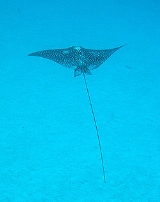
, containing the eagle ray
Eagle ray

Eagle rays are a family of mostly large batoidea living in the open ocean rather than at the bottom of the sea.The taxonomy of this group is uncertain; it is placed either in the order Myliobatiformes or Rajiformes....
s and their relatives; Rhinobatiformes, containing the guitarfish
Guitarfish

The guitarfish are a family, Rhinobatidae, of batoidea. The guitarfish are known for an elongated body with a flattened head and trunk and small ray like wings....
es (which may be further split into Rhynchobatiformes, containing the shovelnosed guitarfishes, and Rhiniformes, the guitarfish
Guitarfish

The guitarfish are a family, Rhinobatidae, of batoidea. The guitarfish are known for an elongated body with a flattened head and trunk and small ray like wings....
es).

  • Anacanthobatidae (smooth skate
    Smooth skate

    The smooth skates or leg skates are the batoidea family Anacanthobatidae. It contains a single genus Anacanthobatis, though in recent times the subgenus Sinobatis is occasionally elevated to full genus rank....
    s)
  • Arhynchobatidae (softnose skate
    Softnose skate

    The softnose skates are a family, Arhynchobatidae, of cartilaginous fishes in the order Rajiformes. There are 11 genera and 81-85 species, though there may be many more undescribed....
    s)
  • Dasyatidae (stingray
    Stingray

    The stingrays are a family, Dasyatidae of batoidea, cartilaginous fishes related to sharks. They are common in coastal tropical marine waters throughout the world, and several species are known to enter fresh water....
    s). Named for the venomous spines along the tail; these contain a poison that causes pain and may cause symptoms such as nausea, vomiting, fever, chills, muscle cramps, tremors, paralysis, fainting, seizures, elevated heart rate, and decreased blood pressure (depending on the species). In addition, some species' toxins can be fatal to humans.
  • Gymnuridae (butterfly ray
    Butterfly ray

    The butterfly rays are a group of Batoidea in the family Gymnuridae. They are found in warm oceans worldwide, and occasionally in estuary....
    s)
  • Hexatrygonidae (sixgill stingray
    Sixgill stingray

    The sixgill stingray, Hexatrygon bickelli, is an unusual species of deep-sea batoidea. It is distinguished by its long, soft snout and six pairs of gill slits ....
    s)
  • Myliobatidae (eagle ray
    Eagle ray

    Eagle rays are a family of mostly large batoidea living in the open ocean rather than at the bottom of the sea.The taxonomy of this group is uncertain; it is placed either in the order Myliobatiformes or Rajiformes....
    s). The largest of rays, including the giant manta ray
    Manta ray

    The manta ray , is the largest of the batoidea, with the largest known specimen having been more than 7.6 m across, with a weight of about 2,300 kg ....
    s. Most eagle rays have one poison-carrying spine.
  • Plesiobatidae (deepwater stingray
    Deepwater stingray

    The deepwater stingray or giant stingaree, Plesiobatis daviesi, is a species of batoidea and the only species in the family Plesiobatidae....
    s)
  • Potamotrygonidae
    Potamotrygonidae

    River stingrays are neotropical freshwater fishes of the Potamotrygonidae family .They are native to eastern South America, living in rivers that drain into the Caribbean, and into the Atlantic as far south as the R?o de la Plata in Argentina....
     (river stingrays)
  • Rajidae (hardnose skates)
  • Rhinobatidae (guitarfish
    Guitarfish

    The guitarfish are a family, Rhinobatidae, of batoidea. The guitarfish are known for an elongated body with a flattened head and trunk and small ray like wings....
    es). They have a body structure similar that of the sawfishes, but are not thought to be closely related.
  • Urolophidae (round ray
    Round ray

    The round rays are a family, Urolophidae, of Batoidea. They are found in temperate and tropical oceans throughout the world.As their name implies, they have disc-shaped bodies, which are formed by wide pectoral fins that merge in front of the head....
    s)