
All Topics  
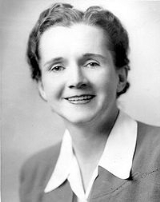
Rachel Carson

 
Rachel Carson

   Email Print
   Bookmark   Link


Rachel Carson


Rachel Louise Carson (May 27, 1907 – April 14, 1964) was an American marine biologist
Marine biology

Marine biology is the scientific study of living organisms in the ocean or other Marine or brackish bodies of water.Given that in biology many scientific classification, families and Genera have some species that live in the sea and others that live on land, marine biology classifies species based on the environment rather than on taxon...
 and nature writer whose writings are credited with advancing the global environmental movement
Environmental movement

The environmental movement, a term that includes the conservation movement and green movement movements, is a diverse scientific, social, and political movement for addressing environmental issues....
.

Carson started her career as a biologist in the U.S. Bureau of Fisheries
United States Fish and Wildlife Service

The United States Fish and Wildlife Service is the unit of the U.S. Department of the Interior dedicated to the management and preservation of wildlife....
, and became a full-time nature writer in the 1950s. Her widely praised 1951 bestseller The Sea Around Us
The Sea Around Us

The Sea Around Us is a prize-winning 1951 bestseller by Rachel Carson about life in the World Ocean and the life of the ocean. It is the second book Carson wrote, following the well-reviewed but poor-selling Under the Sea-Wind , and is the book that launched Carson into the public eye....
 won her financial security and recognition as a gifted writer. Her next book, The Edge of the Sea
The Edge of the Sea

The Edge of the Sea was Rachel Carson's third book in her sea trilogy, published in 1955. It was reprinted in 1998 by Mariner Books....
, and the republished version of her first book, Under the Sea Wind, were also bestsellers.


Discussion
Ask a question about 'Rachel Carson'
Start a new discussion about 'Rachel Carson'
Answer questions from other users
Full Discussion Forum


Encyclopedia


Rachel Louise Carson (May 27, 1907 – April 14, 1964) was an American marine biologist
Marine biology

Marine biology is the scientific study of living organisms in the ocean or other Marine or brackish bodies of water.Given that in biology many scientific classification, families and Genera have some species that live in the sea and others that live on land, marine biology classifies species based on the environment rather than on taxon...
 and nature writer whose writings are credited with advancing the global environmental movement
Environmental movement

The environmental movement, a term that includes the conservation movement and green movement movements, is a diverse scientific, social, and political movement for addressing environmental issues....
.

Carson started her career as a biologist in the U.S. Bureau of Fisheries
United States Fish and Wildlife Service

The United States Fish and Wildlife Service is the unit of the U.S. Department of the Interior dedicated to the management and preservation of wildlife....
, and became a full-time nature writer in the 1950s. Her widely praised 1951 bestseller The Sea Around Us
The Sea Around Us

The Sea Around Us is a prize-winning 1951 bestseller by Rachel Carson about life in the World Ocean and the life of the ocean. It is the second book Carson wrote, following the well-reviewed but poor-selling Under the Sea-Wind , and is the book that launched Carson into the public eye....
 won her financial security and recognition as a gifted writer. Her next book, The Edge of the Sea
The Edge of the Sea

The Edge of the Sea was Rachel Carson's third book in her sea trilogy, published in 1955. It was reprinted in 1998 by Mariner Books....
, and the republished version of her first book, Under the Sea Wind, were also bestsellers. Together, her sea trilogy explores the whole of ocean life, from the shores to the surface to the deep sea.

In the late 1950s, Carson turned her attention to conservation and the environmental problems caused by synthetic pesticide
Pesticide

A pesticide is a substance or mixture of substances used to kill a pest .A pesticide may be a chemical substance, biological agent , antimicrobial, disinfectant or device used against any pest ....
s. The result was Silent Spring
Silent Spring

Silent Spring is a book written by Rachel Carson and published by Houghton Mifflin in September 1962. The book is widely credited with helping launch the environmental movement....
 (1962), which brought environmental concerns to an unprecedented portion of the American public. Silent Spring spurred a reversal in national pesticide policy—leading to a nationwide ban on DDT
DDT

DDT is one of the best known synthetic pesticides. It is a chemical with a long, unique, and controversial history.First synthesized in 1874, DDT's insecticidal properties were not discovered until 1939....
 and other pesticides—and the grassroots
Grassroots

A grassroots movement is one driven by the constituent of a community. The term implies that the creation of the movement and the group supporting it is natural and spontaneous, highlighting the differences between this and a movement that is orchestrated by traditional power structures....
 environmental movement the book inspired led to the creation of the Environmental Protection Agency
United States Environmental Protection Agency

The U.S. Environmental Protection Agency is an List of United States federal agencies of the federal government of the United States charged to Regulation of chemicals and protect human health by safeguarding the natural environment: air, water, and land....
. Carson was posthumously awarded the Presidential Medal of Freedom
Presidential Medal of Freedom

The Presidential Medal of Freedom is a decoration bestowed by the President of the United States and is, along with theequivalent Congressional Gold Medal bestowed by an act of United States Congress, the highest Civilian decorations of the United States in the United States....
 by Jimmy Carter.

Life and work


Early life and education

Rachel Carson was born on May 27, 1907, on a small family farm near Springdale
Springdale, Pennsylvania

Springdale is a borough in Allegheny County, Pennsylvania, Pennsylvania, 18 miles northeast of Pittsburgh along the Allegheny River. The population was 3,828 at the 2000 United States Census....
, Pennsylvania
Pennsylvania

The Commonwealth of Pennsylvania , often colloquially referred to as PA by natives and Northeasterners, is a U.S. state located in the Northeastern United States and Mid-Atlantic States regions of the United States....
, just up the Allegheny River
Allegheny River

The Allegheny River is a principal tributary of the Ohio River; it is located in the Eastern United States. The Allegheny River joins with the Monongahela River to form the Ohio River at the "Point State Park#History" of Point State Park in Downtown Pittsburgh Pittsburgh, Pennsylvania....
 from Pittsburgh
Pittsburgh, Pennsylvania

Pittsburgh is the second largest city in the U.S. state of Pennsylvania with a population of 312,819. The population of the seven-county metropolitan area is 2,462,571....
. As a child, she spent many hours learning about ponds, fields, and forests from her mother, who taught Rachel and her older brother and sister the lessons of nature-study. Carson was an avid reader, and, from a remarkably young age, a talented writer. She also spent a lot of time exploring around her farm. She began writing stories (often involving animals) at age eight, and had her first published story at age ten. She especially enjoyed the St. Nicholas Magazine
St. Nicholas Magazine

The St. Nicholas Magazine was a successful United States children's magazine, published by Charles Scribner's Sons beginning in November 1873, and designed for children five to eighteen....
 (which carried her first published stories), the works of Beatrix Potter
Beatrix Potter

Helen Beatrix Potter was an English author, illustrator, mycology and Conservation movement who was best known for her many best-selling Children's literature that featured animal characters, such as Peter Rabbit....
, and the novels of Gene Stratton Porter, and in her teen years, Herman Melville
Herman Melville

Herman Melville was an American novelist, short story writer, essayist and poet. His first three books gained much attention, the first becoming a bestseller, but after a fast-blooming literary success in the late 1840s, his popularity declined precipitously in the mid-1850s and never recovered during his lifetime....
, Joseph Conrad
Joseph Conrad

Joseph Conrad was a Polish novelist, writing in English. Many critics regard him as one of the greatest novelists in the English language, despite his not having learned to speak English fluently until he was in his twenties ....
 and Robert Louis Stevenson
Robert Louis Stevenson

Robert Louis Balfour Stevenson , was a Scottish novelist, poet, essayist and Travel writing. Stevenson was greatly admired by many authors, including Jorge Luis Borges, Ernest Hemingway, Rudyard Kipling, Vladimir Nabokov, J....
. The natural world, particularly the ocean, was the common thread of her favorite literature. Carson attended Springdale's small school through tenth grade, then completed high school in nearby Parnassus, Pennsylvania, graduating in 1925 at the top of her class of forty-four students.

At the Pennsylvania College for Women (today known as Chatham University), as in high school, Carson was somewhat of a loner. She originally studied English, but switched her major to biology in January 1928, though she continued contributing to the school's student newspaper and literary supplement. Though admitted to graduate standing at Johns Hopkins University
Johns Hopkins University

The Johns Hopkins University, commonly referred to as Hopkins or JHU, is a private university research university located in Baltimore, Maryland, Maryland, United States....
 in 1928, she was forced to remain at the Pennsylvania College for Women for her senior year due to financial difficulties; she graduated magna cum laude in 1929. After a summer course at the Marine Biological Laboratory
Marine Biological Laboratory

The Marine Biological Laboratory is an international center for research and education in biology and ecology. Founded in 1888, the MBL is the oldest independent marine laboratory in the Americas, taking advantage of a coastal setting in the Cape Cod village of Woods Hole, Massachusetts....
, she continued her studies in zoology
Zoology

Zoology is the branch of biology concerned with the study of animals. The most common pronunciation of "zoology" is ; however, an alternative pronunciation is ....
 and genetics
Genetics

Genetics , a discipline of biology, is the science of heredity and Genetic variation in living organisms. The fact that living things inherit traits from their parents has been used since prehistoric times to improve crop plants and animals through selective breeding....
 at Johns Hopkins in the fall of 1929.

After her first year of graduate school, Carson became a part-time student, taking an assistantship in Raymond Pearl
Raymond Pearl

Raymond Pearl was an United States biologist, regarded as one of the founders of biogerontology. He spent most of his career at Johns Hopkins University in Baltimore....
's laboratory, where she worked with rats and Drosophila
Drosophila

Drosophila is a genus of small fly, belonging to the family Drosophilidae, whose members are often called "fruit flies" or more appropriately pomace flies, vinegar flies, or wine flies, a reference to the characteristic of many species to linger around overripe or rotting fruit....
, to earn money for tuition. After false starts with pit vipers and squirrel
Squirrel

File:Eichh?rnchen D?sseldorf Hofgarten edit.jpgA squirrel is one of many small or medium-sized rodents in the family Sciuridae. In the English language-speaking world, squirrel commonly refers to members of this family's genus Sciurus and Tamiasciurus, which are tree squirrels with large bushy tails, indigenous to Asia, the America...
s, she completed a dissertation project on the embryonic development of the pronephros
Pronephros

Pronephros the most primitive of the three excretory systems that develop in vertebrates, corresponding to the first stage of kidney development....
 in fish. She earned a master's degree in zoology in June 1932. She had intended to continue for a doctorate, but in 1934 Carson was forced to leave Johns Hopkins to search for a full-time teaching position to help support her family. In 1935, her father died suddenly, leaving Carson to care for her aging mother and making the financial situation even more critical. At the urging of her undergraduate biology mentor Mary Scott Skinker, she settled for a temporary position with the U.S. Bureau of Fisheries writing radio copy for a series of weekly educational broadcasts entitled "Romance Under the Waters". The series of fifty-two seven-minute programs focused on aquatic life and was intended to generate public interest in fish biology and in the work of the bureau—a task the several writers before Carson had not managed. Carson also began submitting articles on marine life in the Chesapeake Bay
Chesapeake Bay

The Chesapeake Bay is the largest estuary in the United States. It lies off the Atlantic Ocean, surrounded by Maryland and Virginia. The Chesapeake Bay's drainage basin covers in the District of Columbia and parts of six states: New York, Pennsylvania, Delaware, Maryland, Virginia, and West Virginia....
, based on her research for the series, to local newspapers and magazines.

Carson's supervisor, pleased with the success of the radio series, asked her to write the introduction to a public brochure about the fisheries bureau; he also worked to secure her the first full-time position that became available. Sitting for the civil service exam, she outscored all other applicants and in 1936 became only the second woman to be hired by the Bureau of Fisheries for a full-time, professional position, as a junior aquatic biologist.

Early career and publications


At the U.S. Bureau of Fisheries, Carson's main responsibilities were to analyze and report field data on fish populations, and to write brochures and other literature for the public. Using her research and consultations with marine biologists as starting points, she also wrote a steady stream of articles for The Baltimore Sun
The Baltimore Sun

The Baltimore Sun is the U.S. state of Maryland?s largest general circulation daily newspaper and provides comprehensive coverage of local and regional news, events, issues, people, and industries....
 and other newspapers. However, her family responsibilities further increased in January 1937 when her older sister died, leaving Carson as the sole breadwinner for her mother and two nieces.

In July 1937, the Atlantic Monthly accepted a revised version of an essay, "The World of Waters", that she had originally written for her first fisheries bureau brochure; her supervisor had deemed it too good for that purpose. The essay, published as "Undersea", was a vivid narrative of a journey along the ocean floor. It marked a major turning point in Carson's writing career. Publishing house Simon & Schuster
Simon & Schuster

Simon & Schuster, Inc., a division of CBS Corporation, is a publisher founded in New York City in 1924 by Richard L. Simon and M. Lincoln Schuster....
, impressed by "Undersea", contacted Carson and suggested that she expand it into book form. Several years of writing resulted in Under the Sea Wind (1941), which received excellent reviews but sold poorly. In the meantime, Carson's article-writing success continued—her features appeared in Sun Magazine, Nature
Nature (journal)

Nature is a prominent scientific journal, first published on 4 November 1869. Although most scientific journals are now highly specialized, Nature is one of the few journals, along with other weekly journals such as Science and Proceedings of the National Academy of Sciences, that still publishes original research articles ac...
, and Collier's
Collier's Weekly

Collier's Weekly was an United States magazine founded by Peter Fenelon Collier and published from 1888 to 1957. With the passage of decades, the title was shortened to Collier's....
.

Carson attempted to leave the Bureau (by then transformed into the Fish and Wildlife Service) in 1945, but few jobs for naturalists were available as most money for science was focused on technical fields in the wake of the Manhattan Project
Manhattan Project

The Manhattan Project was the project to develop the first atomic weapon during World War II; involving the United States, the United Kingdom, and Canada....
. In mid-1945, Carson first encountered the subject of DDT
DDT

DDT is one of the best known synthetic pesticides. It is a chemical with a long, unique, and controversial history.First synthesized in 1874, DDT's insecticidal properties were not discovered until 1939....
, a revolutionary new pesticide (lauded as the "insect bomb" after the atomic bombings of Hiroshima and Nagasaki
Atomic bombings of Hiroshima and Nagasaki

The atomic bombings of Hiroshima and Nagasaki were nuclear warfares near the end of World War II against the Empire of Japan by the United States at the executive order of President of the United States Harry S....
) that was only beginning to undergo tests for safety and ecological effects. DDT was but one of Carson's many writing interests at the time, and editors found the subject unappealing; she published nothing on DDT until 1962.

Carson rose within the Fish and Wildlife Service, supervising a small writing staff by 1945 and becoming chief editor of publications in 1949. Though her position provided increasing opportunities for fieldwork and freedom in choosing her writing projects, it also entailed increasingly tedious administrative responsibilities. By 1948, Carson was working on material for a second book and had made the conscious decision to begin a transition to writing full-time. That year, she took on a literary agent, Marie Rodell
Marie Rodell

Marie Freid Rodell was a literary agent and author who managed the publications of much of environmentalist Rachel Carson's writings, as well as the first book by civil rights activist Martin Luther King, Jr.....
; they formed a close professional relationship that would last the rest of Carson's career.

Oxford University Press

Oxford University Press is a publisher and a department of the University of Oxford in England. It is the largest university press in the world, being larger than all the American university presses combined with Cambridge University Press....
 expressed interest in Carson's book proposal for a life history of the ocean, spurring her to complete the manuscript of what would become The Sea Around Us
The Sea Around Us

The Sea Around Us is a prize-winning 1951 bestseller by Rachel Carson about life in the World Ocean and the life of the ocean. It is the second book Carson wrote, following the well-reviewed but poor-selling Under the Sea-Wind , and is the book that launched Carson into the public eye....
 by early 1950. Chapters appeared in Science Digest
Science Digest

Science Digest was a monthly united States magazine published by the Hearst Corporation from 1937 through 1986. It initially had an 8 x 5 inch format with about 100 pages, and was targeted at persons with a high school education level....
 and the Yale Review
Yale Review

The Yale Review is the self-proclaimed oldest literary magazine in the United States. It is published by Yale University.It was founded originally in 1819 as The Christian Spectator, and renamed the Yale Review in 1911 by its new editor, Wilbur Lucius Cross....
—the latter chapter, "The Birth of an Island", winning the American Association for the Advancement of Science
American Association for the Advancement of Science

The American Association for the Advancement of Science is an international non-profit organization with the stated goals of promoting cooperation between scientists, defending scientific freedom, encouraging scientific responsibility, and supporting science education and science outreach for the betterment of all humanity....
's George Westinghouse Science Writing Prize—and nine chapters were serialized in The New Yorker
The New Yorker

The New Yorker is an United States magazine that publishes reportage, commentary, criticism, essays, fiction, satire, cartoons, and poetry. Starting as a weekly in the mid-1920s, the magazine is now published 47 times per year, with five of these issues covering two-week spans....
. The Sea Around Us remained on the New York Times bestseller list for 86 weeks, was abridged by Reader's Digest
Reader's Digest

File:Readers Digest00.jpgReader's Digest is a monthly general-interest family magazine co-founded in 1922 by Lila Bell Wallace and DeWitt Wallace....
, won the 1952 National Book Award
National Book Award

The National Book Awards are among the most eminent literary prizes in the United States. Started in 1950, the awards are presented annually to American authors for literature published in the prior year, as well as lifetime achievement awards including the "Medal of Distinguished Contribution to American Letters" and the "Literarian Award"....
 and the Burroughs Medal, and resulted in Carson being awarded two honorary doctorates. She also licensed a documentary film to be based on The Sea Around Us. The book's success led to the republication of Under the Sea Wind, which also became a best-seller. With success came financial security, and Carson was able to give up her job in 1952 to concentrate on writing full time.

Carson was inundated with speaking engagements, fan mail
Fan mail

Fan mail is mail sent to a public figure, especially a celebrity, by their admirers or "fan "....
 and other correspondence regarding The Sea Around Us, along with work on the documentary script that she had secured the right to review. She was extremely unhappy with the final version of the script by writer, director and producer Irwin Allen
Irwin Allen

Irwin Allen was a television and film producer nicknamed "The Master of Disaster" for his work in the disaster film genre. He was also notable for creating a number of television series....
; she found it untrue to the atmosphere of the book and scientifically embarrassing, describing it as "a cross between a believe-it-or-not and a breezy travelogue." She discovered, however, that her right to review the script did not extend to any control over its content. Allen proceeded in spite of Carson's objections to produce a very successful documentary. It won the 1953 Oscar for Best Documentary, but Carson was so embittered by the experience that she never again sold film rights to her work.

Relationship with Dorothy Freeman


Carson moved with her mother to Southport Island, Maine in 1953, and in July of that year met Dorothy Freeman (1898–1978)—the beginning of an extremely close relationship that would last the rest of Carson's life. The nature of the relationship between Carson and Freeman has been the subject of much interest and speculation. It is probably best described as a romantic friendship
Romantic friendship

The term romantic friendship refers to a very close but non-sexual interpersonal relationship between friendships, often involving a degree of physical closeness beyond that which is common in modern Western world societies, for example holding hands, cuddling, and sharing a bed....
. Carson met Freeman, a summer resident of the island along with her husband, after Freeman had written to Carson to welcome her. Freeman had read The Sea Around Us, a gift from her son, and was excited to have the prominent author as a neighbor. Carson's biographer Linda Lear writes that "Carson sorely needed a devoted friend and kindred spirit who would listen to her without advising and accept her wholly, the writer as well as the woman." She found this in Freeman. The two women had a number of common interests, nature chief among them, and began exchanging letters regularly while apart. They would continue to share every summer for the remainder of Carson's life, and meet whenever else their schedules permitted.

Though Lear does not explicitly describe the relationship as romantic, others (such as the encyclopedia glbtq
Glbtq.com

glbtq.com is an online encyclopedia that presents detailed biography of notable gay, lesbian, bisexual, transgender, and queer people. It is the most popular LGBT-inclusive information site on Alexa Internet....
) have noted that Carson and Freeman knew that their letters could be interpreted as lesbian
Lesbian

File:Lesbian Couple from back holding hands.jpgLesbian is a term most widely used in the English language to describe sexual and romantic desire between females....
, even though "the expression of their love was limited almost wholly to letters and very occasional farewell kisses or holding of hands." Freeman shared parts of Carson's letters with her husband to help him understand the relationship, but much of their correspondence was carefully guarded. Shortly before Carson's death, she and Freeman destroyed hundreds of letters. The surviving correspondence was published in 1995 as Always, Rachel: The Letters of Rachel Carson and Dorothy Freeman, 1952–1964: An Intimate Portrait of a Remarkable Friendship, edited by Freeman's granddaughter. According to one reviewer, the pair "fit Carolyn Heilbrun's characterization of a strong female friendship, where what matters is 'not whether friends are homosexual or heterosexual, lovers or not, but whether they share the wonderful energy of work in the public sphere'".

The Edge of the Sea and transition to conservation work


In early 1953 Carson began library and field research on the ecology and organisms of the Atlantic shore. In 1955, she completed the third volume of her sea trilogy, The Edge of the Sea
The Edge of the Sea

The Edge of the Sea was Rachel Carson's third book in her sea trilogy, published in 1955. It was reprinted in 1998 by Mariner Books....
, which focuses on life in coastal ecosystems (particularly along the Eastern Seaboard
Eastern seaboard

An Eastern seaboard can mean any easternmost part of a continent, or its countries, states and/or cities.Eastern seaboard may also refer to:...
). It appeared in The New Yorker in two condensed installments shortly before the October 26 book release. By this time, Carson's reputation for clear and poetical prose was well-established; The Edge of the Sea received highly favorable reviews, if not quite as enthusiastic as for The Sea Around Us.

Through 1955 and 1956, Carson worked on a number of projects—including the script for an Omnibus
Omnibus (US TV series)

Omnibus was an United States commercially-sponsored, educational TV series, broadcast live primarily on Sunday afternoons at 4:00 pm Eastern time, from November 9, 1952 until 1961....
 episode, "Something About the Sky"—and wrote articles for popular magazines. Her plan for the next book was to address evolution
Evolution

In biology, evolution is change in the heritability trait of a population of organisms from one generation to the next. These changes are caused by a combination of three main processes: variation, reproduction, and selection....
, but the publication of Julian Huxley
Julian Huxley

Sir Julian Sorell Huxley Fellow of the Royal Society was an English evolutionary biologist, Humanist and Internationalism . He was a proponent of natural selection, and a leading figure in the mid-twentieth century evolutionary synthesis....
's Evolution in Action—and her own difficulty in finding a clear and compelling approach to the topic—led her to abandon the project. Instead, her interests were turning to conservation. She considered an environment-themed book project tentatively entitled Remembrance of the Earth and became involved with The Nature Conservancy
The Nature Conservancy

The Nature Conservancy is a US charitable environmental organization working to preserve the plants, animals, and natural communities that represent the diversity of life on Earth by protecting the lands and waters they need to survive....
 and other conservation groups. She also made plans to buy and preserve from development an area in Maine she and Freeman called the "Lost Woods".

Early in 1957, family tragedy struck a third time when one of the nieces she had cared for in the 1940s died at the age of 31, leaving a five-year-old orphan son, Roger Christie. Carson took on that responsibility, adopting the boy, alongside continuing to care for her aging mother; this took a considerable toll on Carson. She moved to Silver Spring
Silver Spring, Maryland

Silver Spring is an urbanized, unincorporated area in Montgomery County, Maryland, United States. After Baltimore, Maryland and Columbia, Maryland, the Silver Spring Census-designated place is the third most populous place in Maryland....
, Maryland
Maryland

Maryland is a U.S. state located in the Mid Atlantic States of the United States, bordering Virginia, West Virginia and the Washington, D.C. to the south and west, Pennsylvania to the north, and Delaware to the east....
 to care for Roger, and much of 1957 was spent putting their new living situation in order and focusing on specific environmental threats.

By fall 1957, Carson was closely following federal proposals for widespread pesticide spraying; the USDA planned to eradicate fire ants
Red imported fire ant

The red imported fire ants , or simply RIFA, is one of over 280 members of the widespread genus Fire ant. Although the red imported fire ant is native to South America, it has become a pest in the United States, Australia, Taiwan, Philippines, and the southern People's Republic of China province of Guangdong....
, and other spraying programs involving chlorinated hydrocarbons and organophosphates were on the rise. For the rest of her life, Carson's main professional focus would be the dangers of pesticide overuse.

Silent Spring


Research and writing

Starting in the mid-1940s, Carson had become concerned about the use of synthetic pesticides, many of which had been developed through the military funding of science
Military funding of science

The military funding of science has had a powerful transformative effect on the practice and products of scientific research since the early 20th century....
 since World War II
World War II

World War II, or the Second World War , was a global military conflict which involved a Participants in World War II, including all of the great powers, organised into two opposing military alliances: the Allies of World War II and the Axis powers....
. It was the USDA's 1957 fire ant eradication program, however, that prompted Carson to devote her research, and her next book, to pesticides and environmental poisons. The fire ant program involved aerial spraying of DDT
DDT

DDT is one of the best known synthetic pesticides. It is a chemical with a long, unique, and controversial history.First synthesized in 1874, DDT's insecticidal properties were not discovered until 1939....
 and other pesticides (mixed with fuel oil
Fuel oil

Fuel oil is a fractional distillation obtained from petroleum distillation, either as a distillate or a residue. Broadly speaking, fuel oil is any liquid petroleum product that is burned in a furnace or boiler for the generation of heat or used in an engine for the generation of power, except oils having a flash point of approximately and oi...
), including the spraying of private land. Landowners in Long Island filed a suit to have the spraying stopped, and many in affected regions followed the case closely. Though the suit was lost, the Supreme Court
Supreme Court of the United States

The Supreme Court of the United States is the highest judicial body in the United States, and leads the federal United States federal courts. It consists of the Chief Justice of the United States and eight Associate Justice of the Supreme Court of the United States, who are nominated by the President of the United States and confirmed with th...
 granted petitioners the right to gain injunctions against potential environmental damage in future; this laid the basis for later successful environmental actions.

The Washington, D.C. chapter of the Audubon Society also actively opposed such spraying programs, and recruited Carson to help make public the government's exact spraying practices and the related research. Carson began the four-year project of what would become Silent Spring
Silent Spring

Silent Spring is a book written by Rachel Carson and published by Houghton Mifflin in September 1962. The book is widely credited with helping launch the environmental movement....
 by gathering examples of environmental damage attributed to DDT. She also attempted to enlist others to join the cause: essayist E. B. White
E. B. White

Elwyn Brooks "E. B." White was an United States writer, best known as the author of children's literature Charlotte's Web and Stuart Little, and as the co-author of the widely used language guide The Elements of Style....
, and a number of journalists and scientists. By 1958, Carson had arranged a book deal, with plans to co-write with Newsweek
Newsweek

Newsweek is an United States weekly newsmagazine published in New York City. It is distributed throughout the United States and internationally....
 science journalist Edwin Diamond. However, when The New Yorker commissioned a long and well-paid article on the topic from Carson, she began considering writing more than simply the introduction and conclusion as planned; soon it was a solo project. (Diamond would later write one of the harshest critiques of Silent Spring.)

As her research progressed, Carson found a sizable community of scientists who were documenting the physiological and environmental effects of pesticides. She also took advantage of her personal connections with many government scientists, who supplied her with confidential information. From reading the scientific literature and interviewing scientists, Carson found two scientific camps when it came to pesticides: those who dismissed the possible danger of pesticide spraying barring conclusive proof, and those who were open to the possibility of harm and willing to consider alternative methods such as biological pest control
Biological pest control

Biological control of pests in agriculture is a method of pest control that relies on predation, parasitism, herbivory, or other natural mechanisms....
.

By 1959, the USDA's Agricultural Research Service
Agricultural Research Service

The Agricultural Research Service is the principal in-house research agency of the United States Department of Agriculture . ARS is one of four agencies in USDA's Research, Education, and Economics mission area....
 responded to the criticism of Carson and others with a public service film, Fire Ants on Trial; Carson characterized it as "flagrant propaganda
Propaganda

Propaganda is the dissemination of information aimed at influencing the opinions or behaviors of large numbers of people. As opposed to Objectivity providing information, propaganda in its most basic sense presents information in order to influence its audience....
" that ignored the dangers that spraying pesticides (especially dieldrin
Dieldrin

Dieldrin is a chlorinated hydrocarbon originally produced in 1948 by J. Hyman & Co, Denver, as an insecticide. The molecule has a ring structure based on naphthalene....
 and heptachlor
Heptachlor

Heptachlor is an insecticide that usually comes in the form of a white or tan powder, the tan powder being of lower purity. It is similar to insecticide chlordane....
) posed to humans and wildlife. That spring, Carson wrote a letter, published in The Washington Post
The Washington Post

The Washington Post is the newspaper with the largest circulation in Washington, D.C., United States and is the city's oldest paper, founded in 1877....
, that attributed the recent decline in bird populations—in her words, the "silencing of birds"—to pesticide overuse. That was also the year of the "Great Cranberry Scandal": the 1957, 1958, and 1959 crops of U.S. cranberries
Cranberry

Cranberries are a group of evergreen dwarf shrubs or trailing vines in the genus Vaccinium subgenus Oxycoccos, or in some treatments, in the distinct genus Oxycoccos....
 were found to contain high levels of the herbicide aminotriazole (which caused cancer in laboratory rats) and the sale of all cranberry products was halted. Carson attended the ensuing FDA hearings on revising pesticide regulations; she came away discouraged by the aggressive tactics of the chemical industry representatives, which included expert testimony that was firmly contradicted by the bulk of the scientific literature she had been studying. She also wondered about the possible "financial inducements behind certain pesticide programs".

Research at the Library of Medicine
United States National Library of Medicine

The United States National Library of Medicine , operated by the United States federal government, is the world's largest medical library. The collections of the National Library of Medicine include more than seven million books, journals, technical reports, manuscripts, microfilms, photographs, and images on medicine and related science...
 of the National Institutes of Health
National Institutes of Health

The National Institutes of Health is an agency of the United States Department of Health and Human Services and is the primary agency of the United States government responsible for biomedical and health-related research....
 brought Carson into contact with medical researchers investigating the gamut of cancer-causing chemicals. Of particular significance was the work of National Cancer Institute
National Cancer Institute

The National Cancer Institute is part of the United States Federal government's National Institutes of Health. The NCI is a federally funded research and development center, one of eight agencies that compose the United States Public Health Service in the United States Department of Health and Human Services....
 researcher and founding director of the environmental cancer section Wilhelm Hueper, who classified many pesticides as carcinogens. Carson and her research assistant Jeanne Davis, with the help of NIH librarian Dorothy Algire, found evidence to support the pesticide-cancer connection; to Carson the evidence for the toxicity of a wide array of synthetic pesticides was clear-cut, though such conclusions were very controversial beyond the small community of scientists studying pesticide carcinogenesis
Carcinogenesis

'Carcinogenesis' , is the process by which normal cell are transformed into cancer cells.Cell division is a physiological process that occurs in almost all tissues and under many circumstances....
.

By 1960, Carson had more than enough research material, and the writing was progressing rapidly. In addition to the thorough literature search, she had investigated hundreds of individual incidents of pesticide exposure and the human sickness and ecological damage that resulted. However, in January, a duodenal ulcer followed by several infections kept her bedridden for weeks, greatly delaying the completion of Silent Spring. As she was nearing full recovery in March (just as she was completing drafts of the two cancer chapters of her book), she discovered cysts in her left breast, one of which necessitated a mastectomy
Mastectomy

In medicine, mastectomy is the medical term for the surgical removal of one or both breasts, partially or completely. Mastectomy is usually done to treat breast cancer; in some cases, women and some men believed to be at high risk of breast cancer have the operation prophylaxis, that is, to prevent cancer rather than treat it....
. Though her doctor described the procedure as precautionary and recommended no further treatment, by December Carson discovered that the tumor was in fact malignant
Malignant

Malignant is a medical term used to describe a severe and progressively worsening disease. The term is most familiar as a description of cancer....
 and the cancer had metastasized. Her research was also delayed by revision work for a new edition of The Sea Around Us, and by a collaborative photo essay with Erich Hartmann
Erich Hartmann (photographer)

Erich Hartmann was an American photographer....
. Most of the research and writing was done by the fall of 1960, except for the discussion of recent research on biological controls and investigations of a handful of new pesticides. However, further health troubles slowed the final revisions in 1961 and early 1962.

It was difficult finding a title for the book; "Silent Spring" was initially suggested as a title for the chapter on birds. By August 1961, Carson finally agreed to the suggestion of her literary agent Marie Rodell: Silent Spring would be a metaphorical title for the entire book—suggesting a bleak future for the whole natural world—rather than a literal chapter title about the absence of birdsong. With Carson's approval, editor Paul Brooks at Houghton Mifflin
Houghton Mifflin

Houghton Mifflin Harcourt Publishing Company is a leading educational publisher in the United States. The company's headquarters is located in Boston's Back Bay....
 arranged for illustrations by Louis and Lois Darling, who also designed the cover. The final writing was the first chapter, "A Fable for Tomorrow", which was intended to provide a gentler introduction to what might otherwise be a forbiddingly serious topic. By mid-1962, Brooks and Carson had largely finished the editing, and were laying the groundwork for promoting the book by sending the manuscript out to select individuals for final suggestions.

Argument

As biographer Mark Hamilton Lytle writes, Carson "quite self-consciously decided to write a book calling into question the paradigm
Paradigm

The word paradigm has been used in linguistics and science to describe distinct concepts.To the 1960s, the word was specific to grammar: the 1900 Merriam-Webster dictionary defines its technical use only in the context of grammar or, in rhetoric, as a term for an illustrative parable or fable....
 of scientific progress
Scientific progress

Scientific progress is the idea that science increases its problem solving ability through the application of some scientific method....
 that defined postwar American culture." The overriding theme of Silent Spring is the powerful—and often negative—effect humans have on the natural world.

Carson's main argument is that pesticide
Pesticide

A pesticide is a substance or mixture of substances used to kill a pest .A pesticide may be a chemical substance, biological agent , antimicrobial, disinfectant or device used against any pest ....
s have detrimental effects on the environment; they are more properly termed "biocide
Biocide

A biocide is a chemical substance capable of killing life, usually in a selective way. Biocides are commonly used in medicine, agriculture, forestry, and in industry where they prevent the fouling of water and oil pipelines....
s", she argues, because their effects are rarely limited to the target pests. DDT is a prime example, but other synthetic pesticides come under scrutiny as well—many of which are subject to bioaccumulation
Bioaccumulation

Bioaccumulation refers to the accumulation of substances, such as pesticides, or other organic chemicals in an organism. Bioaccumulation occurs when an organism absorbs a toxin at a rate greater than that at which the substance is lost....
. Carson also accuses the chemical industry
Chemical industry

The chemical industry comprises the companies that produce industrial chemicals. It is central to modern world economy, converting raw materials into more than 70,000 different products....
 of intentionally spreading disinformation
Disinformation

Disinformation is falsity or inaccurate information that is spread deliberately. It is synonymous with and sometimes called Black propaganda. It may include the distribution of forgery documents, manuscripts, and photographs, or propagation of malicious rumors and Fabrication intelligence....
 and public officials of accepting industry claims uncritically. Most of the book is devoted to pesticides' effects on natural ecosystems, but four chapters also detail cases of human pesticide poisoning, cancer, and other illnesses attributed to pesticides. About DDT and cancer, the subject of so much subsequent debate, Carson says only a little:

Carson predicts increased consequences in the future, especially as targeted pests develop resistance to pesticides while weakened ecosystems fall prey to unanticipated invasive species
Invasive species

Invasive species is a phrase with several definitions. The first definition expresses the phrase in terms of non-indigenous species that adversely affect the habitats they invade economically, environmentally or ecologically....
. The book closes with a call for a biotic
Biotic

Biotic means relating to, produced by, or caused by living organisms.The term biotic may also refer to:*Life, or ecosystem, the condition of living organisms,...
 approach to pest control as an alternative to chemical pesticides.

Promotion and reception

Carson and the others involved with publication of Silent Spring expected fierce criticism. They were particularly concerned about the possibility of being sued for libel. Carson was also undergoing radiation therapy
Radiation therapy

Radiation therapy is the medicine use of ionizing radiation as part of cancer oncology to control malignant cell s . Radiotherapy may be used for curative or Adjuvant chemotherapy cancer treatment....
 to combat her spreading cancer, and expected to have little energy to devote to defending her work and responding to critics. In preparation for the anticipated attacks, Carson and her agent attempted to amass as many prominent supporters as possible before the book's release.

Most of the book's scientific chapters were reviewed by scientists with relevant expertise, among whom Carson found strong support. Carson attended the White House Conference on Conservation in May, 1962; Houghton Mifflin distributed proof copies of Silent Spring to many of the delegates, and promoted the upcoming New Yorker serialization. Among many others, Carson also sent a proof copy to Supreme Court Justice William O. Douglas
William O. Douglas

William Orville Douglas was a United States Supreme Court Associate Justice. With a term lasting 36 years and 209 days, he is the longest-serving justice in the history of the Supreme Court....
, a long-time environmental advocate who had argued against the court's rejection of the Long Island pesticide spraying case (and who had provided Carson with some of the material included in her chapter on herbicides).

Though Silent Spring had generated a fairly high level of interest based on pre-publication promotion, this became much more intense with the serialization in The New Yorker, which began in the June 16, 1962 issue. This brought the book to the attention of the chemical industry and its lobbyists, as well as a wide swath of the American populace. Around that time Carson also learned that Silent Spring had been selected as the Book-of-the-Month for October; as she put it, this would "carry it to farms and hamlets all over that country that don't know what a bookstore looks like—much less The New Yorker." Other publicity included a positive editorial in The New York Times
The New York Times

The New York Times is an American daily newspaper published in New York City. The largest metropolitan newspaper in the United States, "The Gray Lady"?named for its staid appearance and style?is regarded as a national newspaper of record....
 and excerpts of the serialized version in Audubon Magazine, with another round of publicity in July and August as chemical companies responded. The story of the birth defect-causing drug thalidomide
Thalidomide

Thalidomide is a sedative-hypnotic, and multiple myeloma medication. The drug is a potent Teratology in rabbits and primates including humans: this means that severe birth defects may result if the drug is taken during pregnancy....
 broke just before the book's publication as well, inviting comparisons between Carson and Frances Oldham Kelsey
Frances Oldham Kelsey

Frances Kathleen Oldham Kelsey, Ph.D., M.D., is a naturalized United States pharmacologist, most famous as the reviewer for the U.S. Food and Drug Administration who refused to authorize thalidomide for market because she had concerns about the drug's safety....
, the Food and Drug Administration
Food and Drug Administration

The U.S. Food and Drug Administration is an Government agency of the United States Department of Health and Human Services and is responsible for regulating and supervising the safety of foods, dietary supplements, Medications, vaccines, Biopharmaceutical, blood transfusion, medical devices, Electromagnetic radiation-emitting devices, veteri...
 reviewer who had blocked the drug's sale in the United States.

In the weeks leading up to the September 27 publication there was strong opposition to Silent Spring. DuPont
DuPont

E. I. du Pont de Nemours and Company is an United States chemical industry that was founded in July 1802 as a gunpowder mill by Eleuth?re Ir?n?e du Pont....
 (a main manufacturer of DDT and 2,4-D) and Velsicol Chemical Company (exclusive manufacturer of chlordane
Chlordane

Chlordane is a manufactured chemical that was used as a pesticide in the United States from 1948 to 1988. It does not occur naturally in the environment....
 and heptachlor
Heptachlor

Heptachlor is an insecticide that usually comes in the form of a white or tan powder, the tan powder being of lower purity. It is similar to insecticide chlordane....
) were among the first to respond. DuPont compiled an extensive report on the book's press coverage and estimated impact on public opinion. Velsicol threatened legal action against Houghton Mifflin as well as The New Yorker and Audubon Magazine unless the planned Silent Spring features were canceled. Chemical industry representatives and lobbyists also lodged a range of non-specific complaints, some anonymously. Chemical companies and associated organizations produced a number of their own brochures and articles promoting and defending pesticide use. However, Carson's and the publishers' lawyers were confident in the vetting process Silent Spring had undergone. The magazine and book publications proceeded as planned, as did the large Book-of-the-Month printing (which included a pamphlet endorsing the book by William O. Douglas).

American Cyanamid
American Cyanamid

American Cyanamid is a large, diversified, American chemical compound manufacturer, founded by Frank Washburn in 1907.Lederle Laboratories, maker of Centrum and Stresstabs vitamins, was Cyanamid's pharmaceutical division....
 biochemist Robert White-Stevens and former Cyanamid chemist Thomas Jukes were among the most aggressive critics, especially of Carson's analysis of DDT. According to White-Stevens, "If man were to follow the teachings of Miss Carson, we would return to the Dark Ages, and the insects and diseases and vermin would once again inherit the earth." Others went further, attacking Carson's scientific credentials (because her training was in marine biology rather than biochemistry) and her personal character. White-Stevens labeled her "a fanatic defender of the cult of the balance of nature", while former Secretary of Agriculture Ezra Taft Benson
Ezra Taft Benson

Ezra Taft Benson was the thirteenth President of the Church of The Church of Jesus Christ of Latter-day Saints from 1985 until his death and was United States United States Secretary of Agriculture for both of the administrations of President of the United States Dwight D....
—in a letter to Dwight D. Eisenhower
Dwight D. Eisenhower

Dwight David ?Ike? Eisenhower was the List of Presidents of the United States President of the United States from 1953 until 1961 and a General of the Army in the United States Army....
—reportedly concluded that because she was unmarried despite being physically attractive, she was "probably a Communist".

Many critics repeatedly asserted that she was calling for the elimination of all pesticides. Yet Carson had made it clear she was not advocating the banning or complete withdrawal of helpful pesticides, but was instead encouraging responsible and carefully managed use with an awareness of the chemicals' impact on the entire ecosystem. In fact, she concludes her section on DDT in Silent Spring not by urging a total ban, but with advice for spraying as little as possible to limit the development of resistance.

The academic community—including prominent defenders such as H. J. Muller, Loren Eisley, Clarence Cottam, and Frank Egler—by and large backed the book's scientific claims; public opinion soon turned Carson's way as well. The chemical industry campaign backfired, as the controversy greatly increased public awareness of potential pesticide dangers, as well as Silent Spring book sales. Pesticide use became a major public issue, especially after the CBS Reports
CBS Reports

CBS Reports was the umbrella title used for documentaries by CBS News which aired starting in 1959 through the 1990s. The series sometimes aired as a wheel series rotating with 60 Minutes , as a series of its own or as specials....
 TV special "The Silent Spring of Rachel Carson" that aired April 3, 1963. The program included segments of Carson reading from Silent Spring and interviews with a number of other experts, mostly critics (including White-Stevens); according to biographer Linda Lear, "in juxtaposition to the wild-eyed, loud-voiced Dr. Robert White-Stevens in white lab coat, Carson appeared anything but the hysterical alarmist that her critics contended." Reactions from the estimated audience of ten to fifteen million were overwhelmingly positive, and the program spurred a congressional review of pesticide dangers and the public release of a pesticide report by the President's Science Advisory Committee
President's Science Advisory Committee

In 1951 President of the United States Harry S. Truman established the Science Advisory Committee as part of the Office of Defense Mobilization ....
. Within a year or so of publication, the attacks on the book and on Carson had largely lost momentum.

In one of her last public appearances, Carson had testified before President Kennedy's Science Advisory Committee. The committee issued its report on May 15, 1963, largely backing Carson's scientific claims. Following the report's release, she also testified before a Senate subcommittee to make policy recommendations. Though Carson received hundreds of other speaking invitations, she was unable to accept the great majority of them. Her health was steadily declining as her cancer outpaced the radiation therapy, with only brief periods of remission. She spoke as much as she was physically able, however, including a notable appearance on The Today Show and speeches at several dinners held in her honor. In late 1963, she received a flurry of awards and honors: the Paul Bartsch Award (from the Audubon Naturalist Society), the Audubon Medal (from the American Geographical Society
American Geographical Society

The American Geographical Society is an organization of professional geographers. It was founded in 1851 in New York City. Most Fellows of the Society are Americans, but among them have always been a significant number of Fellows from around the world....
), and induction into the American Academy of Arts and Letters.

Weakened from breast cancer and her treatment regimen, Carson became ill with a respiratory virus in January 1964. Her condition worsened from there: in February, doctors found that she had severe anemia from her radiation treatments, and in March they discovered that the cancer had reached her liver. She died of a heart attack on April 14, 1964, at the age of 56.

Her interment was located at Parklawn Memorial Park and Menorah Gardens in Rockville, Maryland
Rockville, Maryland

Rockville is the county seat of Montgomery County, Maryland, United States. According to the 2007 census update, the city had a total population of 58,706, making it the third largest city in Maryland....
.

Legacy


Collected papers and posthumous publications


Carson bequeathed her manuscripts and papers to Yale University
Yale University

Yale University is a private university in New Haven, Connecticut. Founded in 1701 as the Collegiate School, Yale is the Colonial Colleges institution of higher education in the United States and is a member of the Ivy League....
, to take advantage of the new state-of-the-art preservations facilities of the Beinecke Rare Book and Manuscript Library
Beinecke Rare Book and Manuscript Library

Yale University's Beinecke Rare Book and Manuscript Library was a 1963 gift of the Beinecke family. The building, designed by architect Gordon Bunshaft, of the firm of Skidmore, Owings, and Merrill, is the largest building in the world reserved exclusively for the preservation of rare books and manuscripts....
. Her longtime agent and literary executor Marie Rodell
Marie Rodell

Marie Freid Rodell was a literary agent and author who managed the publications of much of environmentalist Rachel Carson's writings, as well as the first book by civil rights activist Martin Luther King, Jr.....
 spent nearly two years organizing and cataloging Carson's papers and correspondence, distributing all the letters to their senders so that only what each correspondent approved of would be submitted to the archive.

In 1965, Rodell arranged for the publication of an essay Carson had intended to expand into a book: A Sense of Wonder. The essay, which was combined with photographs by Charles Pratt and others, exhorts parents to help their children experience the "lasting pleasures of contact with the natural world", which "are available to anyone who will place himself under the influence of earth, sea and sky and their amazing life."

In addition to the letters in Always Rachel, in 1998 a volume of Carson's previously unpublished work was published as Lost Woods: The Discovered Writing of Rachel Carson, edited by Linda Lear. All of Carson's books remain in print.

Grassroots environmentalism and the EPA


Carson's work had a powerful impact on the environmental movement. Silent Spring, in particular, was a rallying point for the fledgling social movement in the 1960s. According to environmental engineer and Carson scholar H. Patricia Hynes, "Silent Spring altered the balance of power in the world. No one since would be able to sell pollution as the necessary underside of progress so easily or uncritically." Carson's work, and the activism it inspired, are at least partly responsible for the deep ecology
Deep ecology

Deep ecology is a recent branch of ecological philosophy that considers humankind an integral part of its natural environment. It is a body of thought that places greater value on non-human species, ecosystems and processes in nature than established environmental movement and green movements....
 movement, and the overall strength of the grassroots environmental movement since the 1960s. It was also influential on the rise of ecofeminism
Ecofeminism

Ecofeminism is a social and political movement which points to the existence of considerable common ground between environmentalism and feminism, with some currents linking deep ecology and feminism....
 and on many feminist scientists.

Carson's most direct legacy in the environmental movement was the campaign to ban the use of DDT in the United States (and related efforts to ban or limit its use throughout the world). Though environmental concerns about DDT had been considered by government agencies as early as Carson's testimony before the President's Science Advisory Committee, the 1967 formation of the Environmental Defense Fund was the first major milestone in the campaign against DDT. The organization brought lawsuits against the government to "establish a citizen's right to a clean environment", and the arguments employed against DDT largely mirrored Carson's. By 1972, the Environmental Defense Fund and other activist groups had succeeded in securing a phase-out of DDT use in the United States (except in emergency cases).

The creation, in 1970, of the Environmental Protection Agency
United States Environmental Protection Agency

The U.S. Environmental Protection Agency is an List of United States federal agencies of the federal government of the United States charged to Regulation of chemicals and protect human health by safeguarding the natural environment: air, water, and land....
 addressed another concern that Carson had brought to light. Until then, the same agency (the USDA) was responsible both for regulating pesticides and promoting the concerns of the agriculture industry; Carson saw this as a conflict of interest
Conflict of interest

A conflict of interest occurs when an individual or organization has an interest that might compromise their reliability. A conflict of interest exists even if no improper act results from it, and can create an appearance of impropriety that can undermine confidence in the conflicted individual or organization....
, since the agency was not responsible for effects on wildlife or other environmental concerns beyond farm policy. Fifteen years after its creation, one journalist described the EPA as "the extended shadow of Silent Spring". Much of the agency's early work, such as enforcement of the 1972 Federal Insecticide, Fungicide, and Rodenticide Act
Federal Insecticide, Fungicide, and Rodenticide Act

The Federal Insecticide, Fungicide, and Rodenticide Act , et seq. is a United States federal law that set up the basic U.S. system of pesticide regulation to protect applicators, consumers and the natural environment....
, was directly related to Carson's work.

Criticisms of environmentalism and DDT restrictions

Carson and the environmental movement were—and continue to be—criticized by some conservatives, who argue that restrictions placed on pesticides have caused needless deaths and hampered agriculture, and more generally that environmental regulation unnecessarily restricts economic freedom
Economic freedom

Economic freedom is a controversy term used in economic research and policy debates. As with Freedom generally, there are various definitions, but no universally accepted concept of economic freedom....
.(a) Rich Karlgaard, "", Forbes.com, May 18, 2007. Accessed September 23, 2007.
(b) Keith Lockitch, "", Capitalism Magazine, May 23, 2007. Accessed May 24, 2007
(c) David Roberts
David Roberts (journalist)

David Roberts is a primary staff writer for Grist Magazine, an online environmental publication based in Seattle, Washington. Born and raised in Tennessee, he pursued a graduate degree in philosophy at the University of Montana before leaving academia for the Seattle tech industry in 1999....
, "" Grist.com, May 24, 2007. Accessed September 23, 2007.
(d) Paul Driessen, "", The Washington Times, April 29, 2007. Accessed May 30, 2007.
(e) Iain Murray, "", National Review, May 31, 2007. Accessed May 31, 2007. For example, the conservative magazine Human Events
Human Events

Human Events is a weekly Conservatism magazine founded in 1944. The magazine takes its name from the first sentence of the United States United States Declaration of Independence which reads "When in the course of human events..."...
 gave Silent Spring an honorable mention for the "Ten Most Harmful Books of the 19th and 20th Centuries". In the 1980s, the policies of the Reagan Administration
Reagan Administration

The United States President of the United States of Ronald Reagan, also known as the Reagan Administration, was a Republican Party administration headed by Ronald Reagan from January 20, 1981 to January 20, 1989....
 emphasized economic growth at the expense of environmental regulation, rolling back many of the environmental policies adopted in response to Carson and her work.

Carson's vocal expressions of concern about thehuman health effects
DDT

DDT is one of the best known synthetic pesticides. It is a chemical with a long, unique, and controversial history.First synthesized in 1874, DDT's insecticidal properties were not discovered until 1939....
 and environmental impact
DDT

DDT is one of the best known synthetic pesticides. It is a chemical with a long, unique, and controversial history.First synthesized in 1874, DDT's insecticidal properties were not discovered until 1939....
 of DDT has come under the most intense fire. Political scientist Charles Rubin was one of the most vociferous critics in the 1980s and 1990s, though he accused her merely of selective use of source and fanaticism (rather than the more severe criticism Carson received upon Silent Springs release). In the 2000s, critics have claimed that Carson is responsible for millions of malaria
Malaria

Malaria is a Vector -borne infectious disease caused by protozoan parasites. It is widespread in Tropics and subtropical regions, including parts of the Americas, Asia, and Africa....
 deaths, because of the DDT bans her work prompted. Biographer Mark Hamilton Lytle finds these estimates unrealistic, even assuming that Carson can be "blamed" for worldwide DDT policies, and suggests that malaria is much less significant than a number of other widespread preventable public health problems in Africa. Carson never actually called for an outright ban on DDT.

Some experts have argued that restrictions placed on the agricultural use of DDT have increased its effectiveness as a tool for battling malaria. According to pro-DDT advocate Amir Attaran
Amir Attaran

Amir Attaran is a Canada lawyer, immunologist, and law professor.Currently, Attaran is Associate Professor of Law and Population Health and the holder of the Canada Research Chair in Law, Population Health and Global Development Policy at the University of Ottawa....
 the result of the 2004 Stockholm Convention
Stockholm Convention

Stockholm Convention on Persistent Organic Pollutants is an international legally binding agreement on Persistent Organic Pollutant .In 1995, the Governing Council of the United Nations Environment Programme called for global action to be taken on Persistent organic pollutantss, which it defined as ?chemical substances that persist in the...
 banning DDT's use in agriculture
"is arguably better than the status quo ... For the first time, there is now an insecticide which is restricted to vector control only, meaning that the selection of resistant mosquitoes will be slower than before." But though Carson's legacy has been closely tied to DDT, Roger Bate
Roger Bate

Roger Bate is an economist who has held a variety of positions in free market, libertarian, and conservative think tanks and lobby groups. His current work focuses on U.S....
 of the DDT advocacy organization Africa Fighting Malaria
Africa Fighting Malaria

Africa Fighting Malaria is an NGO based in Washington DC and South Africa which states it "seeks to educate people about the scourge of Malaria and the political economy of malaria control"....
 warns that "A lot of people have used Carson to push their own agendas. We just have to be a little careful when you're talking about someone who died in 1964."

Posthumous honors


A variety of groups ranging from government institutions to environmental and conservation organizations to scholarly societies have celebrated Carson's life and work since her death. Perhaps most significantly, on June 9, 1980 Carson was awarded the Presidential Medal of Freedom
Presidential Medal of Freedom

The Presidential Medal of Freedom is a decoration bestowed by the President of the United States and is, along with theequivalent Congressional Gold Medal bestowed by an act of United States Congress, the highest Civilian decorations of the United States in the United States....
, the highest civilian honor in the United States, in recognition of her influence on President Kennedy and her foundational role in the environmental movement. A U.S. postage stamp was issued in her honor the following year; several other countries have since issued Carson postage as well.

Haer Pbg 9thstreet 361504pv
Carson's birthplace and childhood home in Springdale
Springdale, Pennsylvania

Springdale is a borough in Allegheny County, Pennsylvania, Pennsylvania, 18 miles northeast of Pittsburgh along the Allegheny River. The population was 3,828 at the 2000 United States Census....
, Pennsylvania
Pennsylvania

The Commonwealth of Pennsylvania , often colloquially referred to as PA by natives and Northeasterners, is a U.S. state located in the Northeastern United States and Mid-Atlantic States regions of the United States....
—now known as the Rachel Carson Homestead
Rachel Carson Homestead

Rachel Carson Homestead is a National Register of Historic Places site in Springdale, Pennsylvania, Pennsylvania, United States, 18 miles northeast of Pittsburgh, Pennsylvania along the Allegheny River....
—became a National Register of Historic Places
National Register of Historic Places

The National Register of Historic Places is the United States government official list of districts, sites, buildings, structures, and objects deemed worthy of preservation....
 site, and the nonprofit Rachel Carson Homestead Association was created in 1975 to manage it. Her home
Rachel Carson House

The Rachel Carson House is a typical suburban ranch-style house, built in 1956 in Colesville, Maryland for Rachel Carson. Carson wrote her classic work Silent Spring there in 1962 ....
 in Colesville, Maryland
Colesville, Maryland

Colesville is a census-designated place and an unincorporated area in Montgomery County, Maryland, Maryland in the United States....
 where she wrote
Silent Spring was named a National Historic Landmark
National Historic Landmark

A National Historic Landmark is a building, :wiktionary:site, structure, object, or district, that is officially recognized by the Federal government of the United States for its historical significance....
 in 1991 . Near Pittsburgh, a hiking trail, maintained by the Rachel Carson Trails Conservancy, was dedicated to Carson in 1975. A Pittsburgh bridge was also renamed in Carson's honor as the Rachel Carson Bridge
Rachel Carson Bridge

Rachel Carson Bridge, also known as the Ninth Street Bridge, spans the Allegheny River in Downtown Pittsburgh Pittsburgh, Pennsylvania.Named for the naturalist Rachel Carson, a Pittsburgh native, it is one of three parallel bridges called Three Sisters , the others being the Roberto Clemente Bridge and the Andy Warhol Bridge....
. The Pennsylvania Department of Environmental Protection
Pennsylvania Department of Environmental Protection

The Pennsylvania Department of Environmental Protection was established on July 1, 1995, is the agency in the U.S. State of Pennsylvania responsible for protecting and preserving the land, air, water, and energy resources through enforcement of the State's environmental laws....
 State Office Building in Harrisburg is named in her honor. An elementary school in Gaithersburg, Montgomery County, MD, built in 1990, was named in her honor, as was a middle school
Middle school

Middle school or junior high school serves as a "bridge" between elementary school and high school. The terms can be used in different ways in different countries, sometimes interchangeably....
 in Herndon, VA.

A number of conservation area
Conservation area

A conservation area is a tract of land that has been awarded protected status in order to ensure that natural features, cultural heritage or biota are safeguarded....
s have been named for Carson as well. Between 1964 and 1990, near Brookeville
Brookeville, Maryland

Brookeville is a town located twenty miles north of Washington, D.C. and two miles north of Olney, Maryland in northeastern Montgomery County, Maryland....
 in Montgomery County, Maryland
Montgomery County, Maryland

Montgomery County of the U.S. state of Maryland is situated just north of Washington, D.C. and southwest of Baltimore. It is one of the most affluent counties in the nation, and has the highest percentage of residents over 25 years old who hold a post-graduate degree....
 were acquired and set aside as the Rachel Carson Conservation Park, administered by the Maryland-National Capital Park and Planning Commission
Maryland-National Capital Park and Planning Commission

The Maryland-National Capital Park and Planning Commission is bi-county agency that administers parks and urban planning in Montgomery County, Maryland and Prince George's County, Maryland Counties in Maryland....
. In 1969, the Coastal Maine National Wildlife Refuge became the Rachel Carson National Wildlife Refuge
Rachel Carson National Wildlife Refuge

File:Rcnwr-1.jpg The Rachel Carson National Wildlife Refuge is a National Wildlife Refuge made up of several parcels of land along of Maine's southern coast....
; expansions will bring the size of the refuge to about . In 1985, North Carolina
North Carolina

North Carolina is a U.S. state located on the Atlantic Seaboard in the southeastern United States. The state borders South Carolina and Georgia to the south, Tennessee to the west and Virginia to the north....
 renamed one of its estuarine reserves in honor of Carson, in Beaufort
Beaufort, North Carolina

Beaufort is a town in Carteret County, North Carolina, North Carolina, United States. The population was 3,771 at the 2000 census and it is the county seat of Carteret County, North Carolina....
.

Carson is also a frequent namesake for prizes awarded by philanthropic, educational and scholarly institutions. The Rachel Carson Prize
Rachel Carson Prize

The Rachel Carson Prize is an international Environmentalism, established in Stavanger, Norway in 1991 to commemorate the achievements of environmentalist Rachel Carson and to award efforts in her spirit....
, founded in Stavanger
Stavanger

is a city and municipalities of Norway in the counties of Norway of Rogaland, Norway. Stavanger was established as a municipality 1 January 1838 . The rural municipalities of Hetland and Madla merged with Stavanger 1 January 1965....
, Norway
Norway

Norway , officially the Kingdom of Norway, is a constitutional monarchy in Northern Europe that occupies the western portion of the Scandinavian Peninsula....
 in 1991, is awarded to women who have made a contribution in the field of environmental protection. The American Society for Environmental History
American Society for Environmental History

The American Society for Environmental History is a professional society for the field of environmental history. It publishes Environmental History ....
 has awarded the Rachel Carson Prize for Best Dissertation since 1993. Since 1998, the Society for Social Studies of Science
Society for Social Studies of Science

The Society for Social Studies of Science is a nonprofit scholarly association devoted to the studies of science and technology. It was founded in 1975 and has, in 2008, an international membership of over 1200....
 has awarded an annual Rachel Carson Book Prize for "a book length work of social or political relevance in the area of science and technology studies."

Centennial events

2007 was the centennial of Carson's birth. On Earth Day
Earth Day

Earth Day is one of two observances, both held annually during spring in the northern hemisphere, and autumn in the southern hemisphere. These are intended to inspire awareness of and appreciation for the Earth's environment....
 (April 22, 2007),
Courage for the Earth: Writers, Scientists, and Activists Celebrate the Life and Writing of Rachel Carson was released as "a centennial appreciation of Rachel Carson's brave life and transformative writing", thirteen essays by prominent environmental writers and scientists. Democratic Senator Benjamin L. Cardin, Maryland
Maryland

Maryland is a U.S. state located in the Mid Atlantic States of the United States, bordering Virginia, West Virginia and the Washington, D.C. to the south and west, Pennsylvania to the north, and Delaware to the east....
, had intended to submit a resolution celebrating Carson for her "legacy of scientific rigor coupled with poetic sensibility" on the 100th anniversary of her birth. The resolution was blocked by Republican Senator Tom Coburn
Tom Coburn

Thomas Allen "Tom" Coburn, M.D. , is an United States politician and Physician. A member of the United States Republican Party, he currently serves as the junior United States Senate from Oklahoma....
, Oklahoma
Oklahoma

Oklahoma is a U.S. state and a sovereignty located in the South Central United States and Southern United States of the United States of America ....
, who said that "The junk science and stigma surrounding DDT—the cheapest and most effective insecticide on the planet—have finally been jettisoned." The Rachel Carson Homestead Association held a May 27 birthday party and sustainable feast at her birthplace and home in Springdale, Pennsylvania
Springdale, Pennsylvania

Springdale is a borough in Allegheny County, Pennsylvania, Pennsylvania, 18 miles northeast of Pittsburgh along the Allegheny River. The population was 3,828 at the 2000 United States Census....
, and the first Rachel Carson Legacy Conference in Pittsburgh with E.O. Wilson as keynote speaker. Both Rachel's Sustainable Feast and the conference continue as annual events.

List of works


  • Under the Sea Wind, 1941, Simon & Schuster, Penguin Group, 1996, ISBN 0-14-025380-7
  • Fishes of the Middle West, 1943, United States Government Printing Office
  • Fish and Shellfish of the Middle Atlantic Coast, 1945, United States Government Printing Office
  • Chincoteague: A National Wildlife Refuge, 1947, United States Government Printing Office
  • Mattamuskeet: A National Wildlife Refuge, 1947, United States Government Printing Office
  • Parker River: A National Wildlife Refuge, 1947, United States Government Printing Office
  • Bear River: A National Wildlife Refuge, 1950, United States Government Printing Office (with Vanez T. Wilson)
  • The Sea Around Us
    The Sea Around Us

    The Sea Around Us is a prize-winning 1951 bestseller by Rachel Carson about life in the World Ocean and the life of the ocean. It is the second book Carson wrote, following the well-reviewed but poor-selling Under the Sea-Wind , and is the book that launched Carson into the public eye....
    , 1951, Oxford University Press, 1991, ISBN 0-19-506997-8
  • The Edge of the Sea
    The Edge of the Sea

    The Edge of the Sea was Rachel Carson's third book in her sea trilogy, published in 1955. It was reprinted in 1998 by Mariner Books....
    , 1955, Mariner Books, 1998, ISBN 0-395-92496-0
  • Silent Spring
    Silent Spring

    Silent Spring is a book written by Rachel Carson and published by Houghton Mifflin in September 1962. The book is widely credited with helping launch the environmental movement....
    , Houghton Mifflin, 1962, Mariner Books, 2002, ISBN 0-618-24906-0
    • Silent Spring initially appeared serialized in three parts in the June 16, June 23, and June 30, 1962 issues of The New Yorker
      The New Yorker

      The New Yorker is an United States magazine that publishes reportage, commentary, criticism, essays, fiction, satire, cartoons, and poetry. Starting as a weekly in the mid-1920s, the magazine is now published 47 times per year, with five of these issues covering two-week spans....
      magazine
  • The Sense of Wonder, 1965, HarperCollins, 1998: ISBN 0-06-757520-X published posthumously
  • Always, Rachel: The Letters of Rachel Carson and Dorothy Freeman 1952–1964 An Intimate Portrait of a Remarkable Friendship, Beacon Press, 1995, ISBN 0-8070-7010-6 edited by Martha Freeman (granddaughter of Dorothy Freeman)
  • Lost Woods: The Discovered Writing of Rachel Carson, Beacon Press, 1998, ISBN 0-8070-8547-2


See also


  • Environmentalism
    Environmentalism

    Environmentalism is a broad philosophy and social movement centered on a concern for the Conservation movement and improvement of the environment ....
  • Rachel Carson Greenway
    Rachel Carson Greenway

    The Rachel Carson Greenway is a set of three trails in Central Maryland. The Greenway is named for Silent Spring author Rachel Carson, who lived in the area....
     (three trails in Central Maryland)
  • Women and the environment through history
    Women and the environment through history

    Environmental history books have mostly focused on men?s roles, and generally women?s involvement with nature has been ignored. Even historical texts have been deficient in writing about women participation in environmentalist actions....


Further reading


  • Brooks, Paul. The House of Life: Rachel Carson at Work. Houghton Mifflin, 1972. ISBN 0395135176. This book is a personal memoir by Carson's Houghton Mifflin editor and close friend Paul Brooks.
  • Jezer, Marty
    Martin Jezer

    Marty Jezer , was a well-known activist and author. Born Martin Jezer and raised in the Bronx, he earned a history degree from Lafayette College....
    .
    Rachel Carson: Biologist and Author. Chelsea House Publications, 1988. ISBN 155546646X
  • Matthiessen, Peter (ed.). Courage for the Earth: Writers, Scientists, and Activists Celebrate the Life and Writing of Rachel Carson. Mariner Books, 2007. ISBN 0618872760
  • Moore, Kathleen Dean and Sideris, Lisa H. (ed.). Rachel Carson: Legacy and Challenge. Albany, New York: SUNY Press, 2008.
  • Quaratiello, Arlene . Rachel Carson: A Biography. Westport, Connecticut: Greenwood Press, 2004. ISBN 0-313-32388-7


External links


Biographical resources


  • - Yale University Library finding aid for Carson's papers
  • —website by Carson biographer Linda Lear
  • —Bill Moyer's Journal, PBS.org, 9-21-2007
  • —a two-act play about Carson, written and performed by Kaiulani Lee based on the posthumous work of the same name.


Carson-related organizations


Criticism


  • —an anti-Carson website by the Competitive Enterprise Institute
    Competitive Enterprise Institute

    The Competitive Enterprise Institute is a non-profit libertarian think tank founded in 1984 by Fred L. Smith and based in Washington, D.C. CEI's stated belief is that consumers are best helped not by government regulation of commerce interests, but by consumers being allowed to make their own choices in a free marketplace....
  • . Reason Online, June 12, 2002