

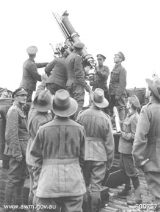
QF 13 pounder 9 cwt

Encyclopedia
The 13 pounder 9 cwt anti-aircraft gun became the standard mobile British anti-aircraft gun of the World War I
era, especially in theatres outside Britain. 13 pounder referred to the weight of the shell, 9 cwt
referred to the weight of the barrel and breech (9 x 112 lb = 1008 lb), to differentiate it from other varieties of "13 pounder".
and 18 pounder
guns proved unsatisfactory, primarily due to their low muzzle velocities. On 18 February 1915 Sir John French, commander of the British Expeditionary Force in France, asked for an anti-aircraft gun with a muzzle velocity of 2000 feet per second (609.6 m/s). On 19 August 1915 the Army Council proposed adapting existing 18-pounder guns (3.3-inch bore) to use 13-pounder (3-inch) shells, thus meeting the requirement for higher velocity.
This weapon combined an 18 pounder breech and barrel with a liner (sleeve) inserted to reduce the bore from 3.3 inches (83.8 mm) to 3 inches (76.2 mm) so that it could fire the slightly smaller 13 pounder shell but still use the larger cartridge and propellant charge of the 18 pounder resulting in a much higher velocity. A slight neck was introduced in the 18 pounder cartridge to hold the slightly narrower 13 pounder shell in place.
The initial Mk III mounting was based on the 13 pounder Mk II anti-aircraft mounting, but proved to be not strong enough for the extra power of the 18 pounder cartridge.
The Mk IV mounting which followed raised the height by 9 inches (228.6 mm) and increased recoil from 24 to 35 inches (889 mm) and hence relieved the strain on the mounting.
Several guns are known to have been mounted on 2-wheeled high-angle field carriages and deployed on the Italian front
. Hogg & Thurston state that they could theoretically be used as anti-aircraft guns, field guns or howitzers, but they were not officially introduced and may have been of an experimental nature. Routledge states that the carriage was improvised because some of 4th AA Group's guns had arrived in Italy without mountings.
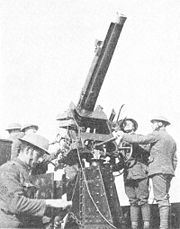 As World War I progressed, it was replaced in the home air defence of England (against German heavy bombers) by the more powerful QF 3 inch 20 cwt
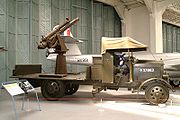
gun, but continued in all other theatres. It was usually deployed mounted on medium lorries such as the Thornycroft
Type J with a speed of 18 miles per hour, in sections of 2 guns.
On the Western Front they were typically used to protect troop columns, airfields, bases, supply dumps and observation balloons.
As important as the raw performance of the gun itself was the new technology being developed to allow fast calculation of aircraft height and predict where it would be when the shell arrived near it. Modern aircraft could fly at over 100 miles per hour and to 20,000 ft (much lower over the battlefield) by 1918, which made the old reliable artillery shooting techniques obsolete. The shell took 10.1 seconds to reach 5000 ft (1,524 m) fired at 25° above horizontal, 15.5 seconds to reach 10000 ft (3,048 m) at 40°, 22.1 seconds to reach 15000 ft (4,572 m) at 55°. Hence the aircraft position had be calculated 10 – 22 seconds in advance and fuzes needed to be set to explode at the correct height.
By the end of World War I, a 13 pounder AA Section was accompanied by 2 Wilson-Dalby Trackers with a rudimentary electronic computer to provide tachymetric prediction, a UB2 rangefinder, a Height/Fuze Indicator (HFI) and an Identification telescope. German fighters countered by attacking at low level - a few hundred feet. AA guns would continue to fire but the shells would then explode over the heads of those they were defending. But it brought attacking aircraft within range of defensive machine guns. Few aircraft were actually directly shot down, each requiring an average 4,000 - 4,500 shells, but guns were often employed in aerial barrages to deny an airspace to aircraft rather than to simply shoot down individually targeted aircraft. Brigadier Routledge notes that "in the BEF [i.e. on the Western Front] stress was laid on long-range deterrent fire; indeed in Fourth Army this was the BRA's stated policy. 'Kills' were therefore less common. Moreover, gun and fighter zones were not separated, as in Britain, and this made set plans for action less workable".
Routledge further comments that in World War I British cooperation between infantry and anti-aircraft sections was generally rudimentary. However, he points out a successful integration in the Allied advance on the Piave in Italy in late 1918, where S and V Batteries of 4th AA group used their 13 pdr 9 cwt guns to provide mobile air and ground fire in close support of infantry. This tactic later became common in World War II.
At the end of World War I, a total of 306 were in service worldwide, 232 of these on the Western Front
(out of a total 348 AA guns there).
World War I
World War I , which was predominantly called the World War or the Great War from its occurrence until 1939, and the First World War or World War I thereafter, was a major war centred in Europe that began on 28 July 1914 and lasted until 11 November 1918...
era, especially in theatres outside Britain. 13 pounder referred to the weight of the shell, 9 cwt
Hundredweight
The hundredweight or centum weight is a unit of mass defined in terms of the pound . The definition used in Britain differs from that used in North America. The two are distinguished by the terms long hundredweight and short hundredweight:* The long hundredweight is defined as 112 lb, which...
referred to the weight of the barrel and breech (9 x 112 lb = 1008 lb), to differentiate it from other varieties of "13 pounder".
History
Earlier anti-aircraft guns based on 13 pounderOrdnance QF 13 pounder
The Ordnance QF 13-pounder quick-firing field gun was the standard equipment of the British Royal Horse Artillery at the outbreak of World War I.-History:...
and 18 pounder
Ordnance QF 18 pounder
The Ordnance QF 18 pounder, or simply 18-pounder Gun, was the standard British Army field gun of the World War I era. It formed the backbone of the Royal Field Artillery during the war, and was produced in large numbers. It was also used by British and Commonwealth Forces in all the main theatres,...
guns proved unsatisfactory, primarily due to their low muzzle velocities. On 18 February 1915 Sir John French, commander of the British Expeditionary Force in France, asked for an anti-aircraft gun with a muzzle velocity of 2000 feet per second (609.6 m/s). On 19 August 1915 the Army Council proposed adapting existing 18-pounder guns (3.3-inch bore) to use 13-pounder (3-inch) shells, thus meeting the requirement for higher velocity.
This weapon combined an 18 pounder breech and barrel with a liner (sleeve) inserted to reduce the bore from 3.3 inches (83.8 mm) to 3 inches (76.2 mm) so that it could fire the slightly smaller 13 pounder shell but still use the larger cartridge and propellant charge of the 18 pounder resulting in a much higher velocity. A slight neck was introduced in the 18 pounder cartridge to hold the slightly narrower 13 pounder shell in place.
The initial Mk III mounting was based on the 13 pounder Mk II anti-aircraft mounting, but proved to be not strong enough for the extra power of the 18 pounder cartridge.
The Mk IV mounting which followed raised the height by 9 inches (228.6 mm) and increased recoil from 24 to 35 inches (889 mm) and hence relieved the strain on the mounting.
Several guns are known to have been mounted on 2-wheeled high-angle field carriages and deployed on the Italian front
Italian Campaign (World War I)
The Italian campaign refers to a series of battles fought between the armies of Austria-Hungary and Italy, along with their allies, in northern Italy between 1915 and 1918. Italy hoped that by joining the countries of the Triple Entente against the Central Powers it would gain Cisalpine Tyrol , the...
. Hogg & Thurston state that they could theoretically be used as anti-aircraft guns, field guns or howitzers, but they were not officially introduced and may have been of an experimental nature. Routledge states that the carriage was improvised because some of 4th AA Group's guns had arrived in Italy without mountings.
Combat use
QF 3 inch 20 cwt
The QF 3 inch 20 cwt anti-aircraft gun became the standard anti-aircraft gun used in the home defence of the United Kingdom against German airships and bombers and on the Western Front in World War I. It was also common on British warships in World War I and submarines in World War II...
gun, but continued in all other theatres. It was usually deployed mounted on medium lorries such as the Thornycroft
Thornycroft
Thornycroft was a United Kingdom-based vehicle manufacturer which built coaches, buses, and trucks from 1896 until 1977.-History:Thornycroft started out with steam vans and lorries. John Isaac Thornycroft, the naval engineer, built his first steam lorry in 1896...
Type J with a speed of 18 miles per hour, in sections of 2 guns.
On the Western Front they were typically used to protect troop columns, airfields, bases, supply dumps and observation balloons.
As important as the raw performance of the gun itself was the new technology being developed to allow fast calculation of aircraft height and predict where it would be when the shell arrived near it. Modern aircraft could fly at over 100 miles per hour and to 20,000 ft (much lower over the battlefield) by 1918, which made the old reliable artillery shooting techniques obsolete. The shell took 10.1 seconds to reach 5000 ft (1,524 m) fired at 25° above horizontal, 15.5 seconds to reach 10000 ft (3,048 m) at 40°, 22.1 seconds to reach 15000 ft (4,572 m) at 55°. Hence the aircraft position had be calculated 10 – 22 seconds in advance and fuzes needed to be set to explode at the correct height.
By the end of World War I, a 13 pounder AA Section was accompanied by 2 Wilson-Dalby Trackers with a rudimentary electronic computer to provide tachymetric prediction, a UB2 rangefinder, a Height/Fuze Indicator (HFI) and an Identification telescope. German fighters countered by attacking at low level - a few hundred feet. AA guns would continue to fire but the shells would then explode over the heads of those they were defending. But it brought attacking aircraft within range of defensive machine guns. Few aircraft were actually directly shot down, each requiring an average 4,000 - 4,500 shells, but guns were often employed in aerial barrages to deny an airspace to aircraft rather than to simply shoot down individually targeted aircraft. Brigadier Routledge notes that "in the BEF [i.e. on the Western Front] stress was laid on long-range deterrent fire; indeed in Fourth Army this was the BRA's stated policy. 'Kills' were therefore less common. Moreover, gun and fighter zones were not separated, as in Britain, and this made set plans for action less workable".
Routledge further comments that in World War I British cooperation between infantry and anti-aircraft sections was generally rudimentary. However, he points out a successful integration in the Allied advance on the Piave in Italy in late 1918, where S and V Batteries of 4th AA group used their 13 pdr 9 cwt guns to provide mobile air and ground fire in close support of infantry. This tactic later became common in World War II.
At the end of World War I, a total of 306 were in service worldwide, 232 of these on the Western Front
Western Front (World War I)
Following the outbreak of World War I in 1914, the German Army opened the Western Front by first invading Luxembourg and Belgium, then gaining military control of important industrial regions in France. The tide of the advance was dramatically turned with the Battle of the Marne...
(out of a total 348 AA guns there).
Performance
The following table compares the gun's performance with the other British World War I anti-aircraft guns:-| Gun | muzzle velocity (ft/s) | Shell (lb) | Max. height (ft) | |||
|---|---|---|---|---|---|---|
| QF 13 pounder Mk III QF 13 pounder 6 cwt AA gun The Ordnance QF 13 pounder Mk III anti-aircraft gun, also known as 13 pounder 6 cwt, was an early British improvisation in World War I to adapt the 13 pounder field gun to anti-aircraft use... |
1600 | 12.5 | ? | ? | ? | 17,000 |
| QF 13 pounder 9 cwt | 1990 | 12.5 | 10.1 | 15.5 | 22.1 | 19,000 |
| QF 12 pdr 12 cwt QF 12 pounder 12 cwt AA gun The 12 pounder 12 cwt anti-aircraft gun was borrowed for AA use from the QF 12 pounder 12 cwt coast defence gun with the addition of a modified cradle for higher elevation, a retaining catch for the cartridge, and an additional spring recuperator above the barrel and high-angle sights. Writers... |
2200 | 12.5 | 9.1 | 14.1 | 19.1 | 20,000 |
| QF 3 inch 20 cwt QF 3 inch 20 cwt The QF 3 inch 20 cwt anti-aircraft gun became the standard anti-aircraft gun used in the home defence of the United Kingdom against German airships and bombers and on the Western Front in World War I. It was also common on British warships in World War I and submarines in World War II... 1914 |
2500 | 12.5 | 8.3 | 12.6 | 16.3 | 23,500 |
| QF 3 inch 20 cwt QF 3 inch 20 cwt The QF 3 inch 20 cwt anti-aircraft gun became the standard anti-aircraft gun used in the home defence of the United Kingdom against German airships and bombers and on the Western Front in World War I. It was also common on British warships in World War I and submarines in World War II... 1916 |
2000 | 16 | 9.2 | 13.7 | 18.8 | 22,000 |
| QF 4 inch Mk V WWI QF 4 inch Mk V naval gun The QF 4 inch Mk V gun was a Royal Navy gun of World War I which was adapted on HA mountings to the heavy anti-aircraft role both at sea and on land, and was also used as a coast defence gun.-Naval service:... |
2350 | 31 (3 c.r.h.) | 4.4?? | 9.6 | 12.3 | 28,750 |
| QF 4 inch Mk V WWII QF 4 inch Mk V naval gun The QF 4 inch Mk V gun was a Royal Navy gun of World War I which was adapted on HA mountings to the heavy anti-aircraft role both at sea and on land, and was also used as a coast defence gun.-Naval service:... |
2350 | 31 (4.38/6 c.r.h.) | ? | ? | ? | 31,000 |
Surviving examples
- 13 pdr 9 cwt on Mk III mounting on a Thornycroft Lorry at Imperial War Museum, Duxford, England