
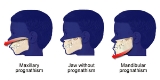
Prognathism is a term used to describe the positional relationship of the mandible and/or
maxillaThe maxilla is a fusion of two bones along the palatal fissure that form the upper jaw. This is similar to the mandible , which is also a fusion of two halves at the mental symphysis. Sometimes The maxilla (plural: maxillae) is a fusion of two bones along the palatal fissure that form the upper...
to the skeletal base where either of the jaws protrudes beyond a predetermined imaginary line in the
coronal plane of the skull. In general dentistry, oral and maxillofacial surgery and orthodontics this is assessed clinically or radiographically (
cephalometricsCephalometry is the measurement of the human head by imaging, traditionally from x-ray films.-Dentistry:Cephalometric analysis is used in dentistry, and especially in orthodontics, to gauge the size and spacial relationships of the teeth, jaws, and cranium...
). The word prognathism derives from Greek
pro (forward) and
gnathos (jaw). One or more types of prognathism may result in the common condition of
malocclusionA malocclusion is a misalignment of teeth or incorrect relation between the teeth of the two dental arches. The term was coined by Edward Angle, the "father of modern orthodontics", as a derivative of occlusion, which refers to the manner in which opposing teeth meet.-Presentation:Most people have...
(including overbite), where an individual's top
teethTeeth are small, calcified, whitish structures found in the jaws of many vertebrates that are used to break down food. Some animals, particularly carnivores, also use teeth for hunting or for defensive purposes. The roots of teeth are embedded in the Mandible bone or the Maxillary bone and are...
do not align with the lower teeth.
Presentation
The vast majority of prognathism in humans is due to normal variation among phenotypes. In human populations where prognathism is not the norm, it may be a malformation, the result of injury, a disease state or a hereditary condition. Prognathism is considered a disorder only if it affects
masticationMastication or chewing is the process by which food is crushed and ground by teeth. It is the first step of digestion and it increases the surface area of foods to allow more efficient break down by enzymes. During the mastication process, the food is positioned between the teeth for grinding by...
,
speechIn linguistics, manner of articulation describes how the tongue, lips, jaw, and other speech organs are involved in making a sound. Often the concept is only used for the production of consonants, even though the movement of the articulars will also greatly alter the resonant properties of the...
or social function as a byproduct of severely affected aesthetics of the face.
Clinical determinants include soft tissue analysis where the clinician assesses nasolabial angle, the relationship of the soft tissue portion of the chin to the nose, and the relationship between the upper and lower lips; also used is dental arch relationship assessment such as
Angle's classificationA malocclusion is a misalignment of teeth or incorrect relation between the teeth of the two dental arches. The term was coined by Edward Angle, the "father of modern orthodontics", as a derivative of occlusion, which refers to the manner in which opposing teeth meet.-Presentation:Most people have...
.
Cephalometric analysis is the most accurate way of determining all types of prognathism as it includes assessments of skeletal base, occlusal plane angulation, facial height, soft tissue assessment and anterior dental angulation. Various calculations and assessments of the information in a cephalometric radiograph allow the clinician to objectively determine dental and skeletal relationships and determine a treatment plan.
Maxillary prognathism is a protrusion of the
maxillaThe maxilla is a fusion of two bones along the palatal fissure that form the upper jaw. This is similar to the mandible , which is also a fusion of two halves at the mental symphysis. Sometimes The maxilla (plural: maxillae) is a fusion of two bones along the palatal fissure that form the upper...
, and is also a common feature of many populations. It is not to be confused with
micrognathismMicrognathism is a condition where the jaw is undersized. It is also sometimes called "Mandibular hypoplasia". It is common in infants, but is usually self-corrected during growth, due to the jaws increasing in size. It may be a cause of abnormal tooth alignment and in severe cases can hamper...
, although combinations of both may be found. It affects the middle third of the face, causing it to jut out, thereby increasing the facial area. Mandibular prognathism is a protrusion of the mandible, affecting the lower third of the face. Alveolar prognathism is a protrusion of that portion of the maxilla where the teeth are located, in the dental lining of the upper jaw. Prognathism can also be used to describe ways that the maxillary and mandibular dental arches relate to one another, including malocclusion (where the upper and lower teeth do not align). When there is maxillary and/or alveolar prognathism which causes an alignment of the maxillary incisors significantly anterior to the lower teeth, the condition is called an
overjetA malocclusion is a misalignment of teeth or incorrect relation between the teeth of the two dental arches. The term was coined by Edward Angle, the "father of modern orthodontics", as a derivative of occlusion, which refers to the manner in which opposing teeth meet.-Presentation:Most people have...
. When the reverse is the case, and the lower jaw extends forward beyond the upper, the condition is referred to as
retrognathia (reverse overjet).
Alveolar prognathism
Not all alveolar prognathism is anomalous, and significant differences can be observed among different ethnic groups.
Harmful habits such as
thumb suckingThumb sucking is a behavior found in humans, chimpanzees, captive Ring-tailed Lemurs, and other primates. It usually involves placing the thumb into the mouth and rhythmically repeating sucking contact for a prolonged duration...
or
tongue thrustingTongue thrust is the common name of orofacial muscular imbalance, a human behavioral pattern in which the tongue protrudes through the anterior incisors during swallowing, speech, and while the tongue is at rest...
can result in or exaggerate an alveolar prognathism, causing teeth to misalign. Functional appliances can be used in growing children to help modify bad habits and neuro-muscular function, with the aim of correcting this condition
Alveolar prognathism easily can be corrected also with fixed orthodontic therapy. However, relapse is quite common, unless the cause is removed or a long term retention is used.
Maxillary prognathism
In disease states, maxillary prognathism is associated with
Cornelia de Lange SyndromeCornelia de Lange Syndrome often termed as Bushy Syndrome is a genetic disorder that can lead to severe developmental anomalies. It affects the physical and intellectual development of a child. Exact incidence is unknown, but it is estimated at 1 in 10,000 to 30,000.! Appx...
; however, so-called false maxillary prognathism, or more accurately,
retrognathismRetrognathia is a type of malocclusion which refers to an abnormal posterior positioning of the maxilla or mandible, particularly the mandible, relative to the facial skeleton and soft tissues....
, where there is a lack of growth of the mandible, is by far a more common condition.
Prognathism, if not extremely severe, can be treated in growing patients with orthodontic functional or orthopaedic appliances. In adult patients this condition can be corrected by means of a combined surgical/orthodontic treatment, where most of the time a mandibular advancement is performed. The same can be said for mandibular prognathism.
Mandibular prognathism (progenism)
Pathologic mandibular prognathism is a potentially disfiguring, genetic disorder where the lower
jawThe jaw is any opposable articulated structure at the entrance of the mouth, typically used for grasping and manipulating food. The term jaws is also broadly applied to the whole of the structures constituting the vault of the mouth and serving to open and close it and is part of the body plan of...
outgrows the upper, resulting in an extended
chinIn the human anatomy, the chin is the lowermost part of the face.It is formed by the lower front of the mandible.People show a wide variety of chin structures. See Cleft chin....
.
The condition is colloquially known as
Habsburg jaw,
Habsburg lip or
Austrian Lip (see House of Habsburg) due to its prevalence in that bloodline. The trait is easily traceable in portraits of Habsburg family members. This has provided tools for people interested in studying
geneticsGenetics , a discipline of biology, is the science of genes, heredity, and variation in living organisms....
and
pedigreeA pedigree chart is a diagram that shows the occurrence and appearance or phenotypes of a particular gene or organism and its ancestors from one generation to the next, most commonly humans, show dogs, and race horses....
analysis. Most instances are considered polygenetic.
It is alleged to have been derived through a female from the princely
PolishPoland , officially the Republic of Poland , is a country in Central Europe bordered by Germany to the west; the Czech Republic and Slovakia to the south; Ukraine, Belarus and Lithuania to the east; and the Baltic Sea and Kaliningrad Oblast, a Russian exclave, to the north...
family of Piasts, its Masovian branch. The deformation of lips is clearly visible on tomb sculptures of Mazovian Piasts in the
St. John's CathedralSt. John's Archcathedral in Warsaw is a Catholic church in Warsaw's Old Town, is the only one archcathedral in Warszawa, the other 3 are cathedrals in the Polish capital. St. John's stands immediately adjacent to Warsaw's Jesuit church, and is one of the oldest churches in the city and the main...
in
WarsawWarsaw is the capital and largest city of Poland. It is located on the Vistula River, roughly from the Baltic Sea and from the Carpathian Mountains. Its population in 2010 was estimated at 1,716,855 residents with a greater metropolitan area of 2,631,902 residents, making Warsaw the 10th most...
. However this may be, there exists evidence that the trait is longstanding. It is perhaps first observed in
Maximilian IMaximilian I , the son of Frederick III, Holy Roman Emperor and Eleanor of Portugal, was King of the Romans from 1486 and Holy Roman Emperor from 1493 until his death, though he was never in fact crowned by the Pope, the journey to Rome always being too risky...
(1459–1519).
Traits such as these that were common to royal families are believed to have been passed on and exaggerated over time through
royal intermarriageRoyal intermarriage is the practice of members of ruling dynasties marrying into other reigning families. It was more commonly done in the past as part of strategic diplomacy for reasons of state...
which caused acute
inbreedingInbreeding is the reproduction from the mating of two genetically related parents. Inbreeding results in increased homozygosity, which can increase the chances of offspring being affected by recessive or deleterious traits. This generally leads to a decreased fitness of a population, which is...
. Due to the large amount of politically motivated intermarriage among Habsburgs, the dynasty was virtually unparalleled in the degree of its inbreeding.
Charles II of SpainCharles II was the last Habsburg King of Spain and the ruler of large parts of Italy, the Spanish territories in the Southern Low Countries, and Spain's overseas Empire, stretching from the Americas to the Spanish East Indies...
is said to have had the most pronounced case of the Habsburg jaw on record. His jaw was so deformed that he was unable to chew.
Many dog breeds have underbite, particularly those with short faces, like
Shih TzuThe Shih Tzu is a breed of dog weighing with long silky hair. The breed originated in China and is among the earliest breeds. Shih Tzu were officially recognized by the American Kennel Club in 1969...
s and
BoxerDeveloped in Germany, the Boxer is a breed of stocky, medium-sized, short-haired dog. The coat is smooth and fawn or brindled, with or without white markings. Boxers are brachycephalic , and have a square muzzle, mandibular prognathism , very strong jaws and a powerful bite ideal for hanging on to...
s. This may be due, as in the case of
bulldogBulldog is the name for a breed of dog commonly referred to as the English Bulldog. Other Bulldog breeds include the American Bulldog, Olde English Bulldogge and the French Bulldog. The Bulldog is a muscular heavy dog with a wrinkled face and a distinctive pushed-in nose...
s, to a slower growing maxilla in relation to the mandible.
Treatment
The most common treatment for mandibular prognathism is a combination of
orthodontics Orthodontics, orthodontia, or orthodonture is the first specialty of dentistry that is concerned with the study and treatment of malocclusions , which may be a result of tooth irregularity, disproportionate jaw relationships, or both...
and
orthognathic surgeryOrthognathic surgery is surgery to correct conditions of the jaw and face related to structure, growth, sleep apnea, TMJ disorders, malocclusion problems owing to skeletal disharmonies, or other orthodontic problems that cannot be easily treated with braces. Originally coined by Dr. Harold...
. The orthodontics can involve braces, removal of teeth, or a bite splint.
History
Prognathism is well-recorded as a trait of several historical individuals. The most famous case is that of the House of Habsburg, among whom mandibular prognathism was a family trait; indeed, the condition is frequently called "Habsburg Jaw" as a result of its centuries-long association with the family. Among the Habsburgs, the most prominent case of mandibular prognathism is that of
Charles II of SpainCharles II was the last Habsburg King of Spain and the ruler of large parts of Italy, the Spanish territories in the Southern Low Countries, and Spain's overseas Empire, stretching from the Americas to the Spanish East Indies...
, who had prognathism so pronounced he could neither speak clearly nor chew as a result of generations of politically-motivated
inbreedingInbreeding is the reproduction from the mating of two genetically related parents. Inbreeding results in increased homozygosity, which can increase the chances of offspring being affected by recessive or deleterious traits. This generally leads to a decreased fitness of a population, which is...
. The consequence of this and other genetic defects was the
War of the Spanish SuccessionThe War of the Spanish Succession was fought among several European powers, including a divided Spain, over the possible unification of the Kingdoms of Spain and France under one Bourbon monarch. As France and Spain were among the most powerful states of Europe, such a unification would have...
.