

.gif)
President's House (Philadelphia, Pennsylvania)

Encyclopedia
The President's House in Philadelphia at 524-30 Market Street
was the third Presidential mansion. It was occupied by President George Washington
from November 1790 to March 1797 and President John Adams
from March 1797 to May 1800.
During the British occupation of Philadelphia between 1777–1778 in the American Revolutionary War
, British commander William Howe
used the house as his headquarters.
Under the July 1790 Residence Act
, Philadelphia served as the national capital for ten years until the construction of facilities in the District of Columbia.
Historic events at the house included the signings of the Fugitive Slave Act of 1793
and the Alien and Sedition Acts
.
, created in 1956.
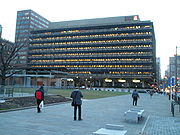 Construction in the area later uncovered portions of the foundations of the house and attached slave quarters. A new structure shows the outline of the original buildings and allows visitors to view the remaining foundations. Signage discusses the history of the structure, as well as the roles of Washington's slaves.
Market Street (Philadelphia)
Market Street, originally known as High Street, is a major east–west street in Philadelphia, Pennsylvania. For the majority of its length, it serves as Pennsylvania Route 3....
was the third Presidential mansion. It was occupied by President George Washington
George Washington
George Washington was the dominant military and political leader of the new United States of America from 1775 to 1799. He led the American victory over Great Britain in the American Revolutionary War as commander-in-chief of the Continental Army from 1775 to 1783, and presided over the writing of...
from November 1790 to March 1797 and President John Adams
John Adams
John Adams was an American lawyer, statesman, diplomat and political theorist. A leading champion of independence in 1776, he was the second President of the United States...
from March 1797 to May 1800.
During the British occupation of Philadelphia between 1777–1778 in the American Revolutionary War
American Revolutionary War
The American Revolutionary War , the American War of Independence, or simply the Revolutionary War, began as a war between the Kingdom of Great Britain and thirteen British colonies in North America, and ended in a global war between several European great powers.The war was the result of the...
, British commander William Howe
William Howe, 5th Viscount Howe
William Howe, 5th Viscount Howe, KB, PC was a British army officer who rose to become Commander-in-Chief of British forces during the American War of Independence...
used the house as his headquarters.
Under the July 1790 Residence Act
Residence Act
The Residence Act of 1790, officially titled An Act for establishing the temporary and permanent seat of the Government of the United States, is the United States federal law that settled the question of locating the capital of the United States, selecting a site along the Potomac River...
, Philadelphia served as the national capital for ten years until the construction of facilities in the District of Columbia.
Historic events at the house included the signings of the Fugitive Slave Act of 1793
Fugitive Slave Act of 1793
The Fugitive Slave Clause of the U.S. Constitution guaranteed the right of a slaveholder to recover an escaped slave...
and the Alien and Sedition Acts
Alien and Sedition Acts
The Alien and Sedition Acts were four bills passed in 1798 by the Federalists in the 5th United States Congress in the aftermath of the French Revolution's reign of terror and during an undeclared naval war with France, later known as the Quasi-War. They were signed into law by President John Adams...
.
After removal of the capital
The building was later converted to a hotel, then demolished during the 19th century. Remaining portions of the walls were cleared during the construction of Independence Mall in 1945. The site is part of the Independence National Historical ParkIndependence National Historical Park
Independence National Historical Park is a United States National Historical Park in Philadelphia that preserves several sites associated with the American Revolution and the nation's founding history. Administered by the National Park Service, the park comprises much of the downtown historic...
, created in 1956.
See also
- Samuel Osgood House (New York City)Samuel Osgood House (New York City)The Samuel Osgood House, also known as Walter Franklin House, was a house at 1 Cherry Street in Manhattan. It served as the first Presidential Mansion, housing George Washington, his family, and household staff, from April 23, 1789 until February 23, 1790, during the 21 months that New York City...
, first Presidential mansion - Alexander Macomb House, second Presidential mansion
- Germantown White House, twice temporarily occupied by President Washington