
Home      Discussion      Topics      Dictionary      Almanac
Signup       Login
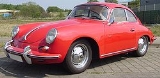
Porsche 356

Porsche 356

Overview
The Porsche
Porsche
Porsche Automobil Holding SE, usually shortened to Porsche SE a Societas Europaea or European Public Company, is a German based holding company with investments in the automotive industry....

 356
was the company's first production automobile. It was a lightweight and nimble handling rear-engine rear-wheel-drive 2 door sports car
Sports car
A sports car is a small, usually two seat, two door automobile designed for high speed driving and maneuverability....

 available in hardtop coupe and open configurations. Design innovations continued during the years of manufacture, contributing to its motorsports success and popularity. Production started in 1948 at Gmünd, Austria where approximately 50 cars were built. In 1950 the factory relocated to Zuffenhausen
Zuffenhausen
Zuffenhausen is an urban district in the northern suburbs of Stuttgart, the capital of the German state of Baden-Württemberg. It consists mainly of the formerly independent city of Zuffenhausen. The Zuffenhausen district has an area of 1,200 hectares and 35,568 inhabitants .The oldest surviving...

, Germany and general production of the 356 continued until April 1965, well after the replacement model 911
Porsche 911
The Porsche 911 is a luxury 2-door sports coupe made by Porsche AG of Stuttgart, Germany. It has a distinctive design, rear-engined and with independent rear suspension, an evolution of the swing axle on the Porsche 356. The engine was also air-cooled until the introduction of the Type 996 in 1998...

 made its autumn 1963 debut. It is estimated approximately half of the total production of 76,000 356s still survive.
Discussion
Ask a question about 'Porsche 356'
Start a new discussion about 'Porsche 356'
Answer questions from other users
Full Discussion Forum
 
Unanswered Questions
Recent Discussions
Encyclopedia
The Porsche
Porsche
Porsche Automobil Holding SE, usually shortened to Porsche SE a Societas Europaea or European Public Company, is a German based holding company with investments in the automotive industry....

 356
was the company's first production automobile. It was a lightweight and nimble handling rear-engine rear-wheel-drive 2 door sports car
Sports car
A sports car is a small, usually two seat, two door automobile designed for high speed driving and maneuverability....

 available in hardtop coupe and open configurations. Design innovations continued during the years of manufacture, contributing to its motorsports success and popularity. Production started in 1948 at Gmünd, Austria where approximately 50 cars were built. In 1950 the factory relocated to Zuffenhausen
Zuffenhausen
Zuffenhausen is an urban district in the northern suburbs of Stuttgart, the capital of the German state of Baden-Württemberg. It consists mainly of the formerly independent city of Zuffenhausen. The Zuffenhausen district has an area of 1,200 hectares and 35,568 inhabitants .The oldest surviving...

, Germany and general production of the 356 continued until April 1965, well after the replacement model 911
Porsche 911
The Porsche 911 is a luxury 2-door sports coupe made by Porsche AG of Stuttgart, Germany. It has a distinctive design, rear-engined and with independent rear suspension, an evolution of the swing axle on the Porsche 356. The engine was also air-cooled until the introduction of the Type 996 in 1998...

 made its autumn 1963 debut. It is estimated approximately half of the total production of 76,000 356s still survive.

History


Prior to World War II
World War II
World War II, or the Second World War , was a global conflict lasting from 1939 to 1945, involving most of the world's nations—including all of the great powers—eventually forming two opposing military alliances: the Allies and the Axis...

 Porsche designed and built three Type 64
Porsche 64
The Porsche 64, also known as the VW Aerocoupe, Type 64 and Type 60K10, is considered by many to be the first automobile from what was to become the Porsche company, as a true design precursor to the production model of after the war. The model number comes from the fact that it was built mainly...

 cars for a 1939 Berlin to Rome race that was cancelled. In 1948 the mid-engine, tubular chassis 356 prototype called "No. 1"
Porsche 356/1
The Porsche 356/1 was the first real Porsche car created by Ferdinand "Ferry" Porsche. This prototype car was a two-seater open roadster with a mid-mounted, air-cooled flat-4 engine of 1,131 cc displacement that produced...

 was completed. This led to some debate as to the "first" Porsche automobile, but the 356 is considered by Porsche to be its first production model.

The 356 was created by Ferdinand "Ferry" Porsche (son of Dr. Ing. Ferdinand Porsche, founder of the company). Like its cousin, the Volkswagen Beetle
Volkswagen Beetle
The Volkswagen Type 1, widely known as the Volkswagen Beetle or Volkswagen Bug, is an economy car produced by the German auto maker Volkswagen from 1938 until 2003...

 (which Ferdinand Porsche
Ferdinand Porsche
Ferdinand Porsche was an Austrian automotive engineer and honorary Doctor of Engineering. He is best known for creating the first hybrid vehicle , the Volkswagen Beetle, and the Mercedes-Benz SS/SSK, as well as the first of many Porsche automobiles...

 Senior had designed), the 356 was a four-cylinder, air-cooled, rear-engine
Rear-engine design
In automobile design, a rear-engine design layout places the engine at the rear of the vehicle. The center of gravity of the engine itself is past the rear axle...

, rear-wheel-drive car utilizing unitized
Monocoque
Monocoque is a construction technique that supports structural load by using an object's external skin, as opposed to using an internal frame or truss that is then covered with a non-load-bearing skin or coachwork...

 pan and body construction. While the 356's body was an original design by Porsche employee Erwin Komenda
Erwin Komenda
Erwin Komenda ex Dr Ferdinand Porsche employee, helped in the design of the bodies for the VW Beetle and various Porsche sports cars....

, its mechanicals (including engine, suspension and chassis) were derived from the Volkswagen. The first 356 was road certified in Austria on June 8, 1948, and used many Volkswagen parts for manufacturing economy. Quickly though, Porsche re-engineered and refined the car with a focus on performance. By the late '50s many fewer parts were shared between Volkswagen and Porsche. The early 356 automobile bodies produced at Gmünd were handcrafted in aluminum, but when production moved to Zuffenhausen, Germany in 1950, models produced there were steel-bodied.

Little noticed at its inception, the first 356s sold primarily in Austria and Germany. It took Porsche two years, starting with the first prototype in 1948, to manufacture the first 50 automobiles. By the early 1950s the 356 had gained some renown among enthusiasts on both sides of the Atlantic for its aerodynamics, handling, and excellent build quality. It was common for owners to race the car as well as drive it on the street. Increasing success with its racing and road cars brought Porsche orders for over 10,000 units in 1964, and by the time 356 production ended in 1965 approximately 76,000 had been produced.

Variants

Porsche 356 production
Type Quantity

356 (1948–55) 7,627
356A (1955–59) 21,045
356B (1959–63) 30,963
356C (1963-65/66) 16,678

Total 76,313

The basic design of the 356 remained the same throughout its lifespan, with evolutionary, functional improvements rather than annual superficial styling changes. Nevertheless a variety of models in both coupe and convertible forms were produced from 1948 through 1965.

Cabriolet models (convertibles) were offered from the start, and in the early 1950s sometimes comprised over 50% of total production. One of the most desirable collector models is the 356 "Speedster", introduced in late 1954 after Max Hoffman
Max Hoffman
Max Hoffman, , was an Austrian-born importer of automobiles into the United States during the 1950s. Doing business among gentlemen who knew one another well, he was known for his handshake deals that always were upheld without a written contract...

, the sole US importer of Porsches, advised the company that a lower-cost, somewhat spartan open-top version could sell well in the American market. With its low, raked windscreen (which could be removed for weekend racing), bucket seat
Bucket seat
A bucket seat is a seat contoured to hold one person, distinct from bench seats which are flat platforms designed to seat multiple people. Bucket seats are standard in fast cars to keep riders in place when making sharp or quick turns...

s and minimal folding top, the Speedster was an instant hit, especially in Southern California. Production of the Speedster peaked at 1,171 cars in 1957 and then started to decline. It was replaced in late 1958 by the "Convertible D" model. It featured a taller, more practical windshield, [allowing improved headroom with the top erected], roll-up glass side-windows and more comfortable seats. The following year the 356B "Roadster" convertible replaced the D model but the sports car market's love affair with top-down motoring was fading; soft-top 356 model sales declined significantly in the early 60s. Today these early four-cylinder models are highly coveted by collectors and enthusiasts worldwide.

To distinguish among the major revisions of the model, 356's are generally classified into a few major groups. 356 coupes and "cabriolets" (soft-top) built through 1954 are readily identifiable by their split (1948 to 1952) or bent (centre-creased, 1953 to 1954) windscreens. In 1955, with numerous small but significant changes, the 356A was introduced. Its internal factory designation, "Type 1," gave rise to its nickname "T1" among enthusiasts. In early 1957 a second revision of the 356A was produced, known as Type 2 (or T2). In late 1959 more significant styling and technical refinements gave rise to the 356B (a T5 body type)
The mid 1962 356B model was changed to the T6 body type (twin engine lid grilles, an external fuel filler in the right front wing/fender and larger windows). A unique "Karmann Hardtop" or "Notchback" 356B model was produced in 1961 and 1962. The 1961 production run was essentially a cabriolet body with the optional steel cabriolet hardtop welded in place. The 1962 line (T6 production) was a very different design in that the new T6 notchback coupe body did not start life as a cabriolet, but with its own production design—In essence, part cabriolet rear end design, part T6 coupe windshield frame, unique hard top. Both years of these unique cars have taken the name “Karmann Notchback”.

The last revision of the 356 was the 356C introduced for the 1964 model year. It featured disc brake
Disc brake
The disc brake or disk brake is a device for slowing or stopping the rotation of a wheel while it is in motion.A brake disc is usually made of cast iron, but may in some cases be made of composites such as reinforced carbon–carbon or ceramic matrix composites. This is connected to the wheel and/or...

s all round, as well as an option for the most powerful pushrod engine Porsche had ever produced, the 95 hp "SC." 356 production peaked at 14,151 cars in 1964, the year that its successor, the new 911
Porsche 911
The Porsche 911 is a luxury 2-door sports coupe made by Porsche AG of Stuttgart, Germany. It has a distinctive design, rear-engined and with independent rear suspension, an evolution of the swing axle on the Porsche 356. The engine was also air-cooled until the introduction of the Type 996 in 1998...

, was introduced to the US market (it was introduced slightly earlier in Europe). The company continued to sell the 356C in North America through 1965 as demand for the model remained quite strong in the early days of the heavier and more 'civilized' 911. The last ten 356's (cabriolets) were assembled for the Dutch police force in March 1966 as 1965 models.

The 356's four-cylinder pushrod engine was later re-introduced in Porsche's "entry-level" 912
Porsche 912
The Porsche 912 is a sports car that was manufactured by Porsche of Germany between 1965 and 1969 as their entry-level model. The 912 is a nimble-handling compact performance four-seat vehicle, delivering 90 SAE horsepower at 5800 rpm. It is capable of up to fuel economy. This combination is...

 model, offered between 1965 and 1969 as response to customer complaints that the new 911 (at nearly twice the price of the 356) was too expensive. Although in some ways the 912 did reprise the 356's specifications, it would not be accurate to say the 912 was successor to the 356; when the decision was made to replace the 356, the 911 was the only car intended to carry the Porsche name forward. Rather the 912 was an afterthought intended to supply the lower-priced end of the market, which the expensive, complex but faster and heavier 911 could not do.

Body Design


The car was built of a unibody construction which has made restoration difficult for cars which were kept in rust-prone climates.

Engine


Like the other most famous of Dr. Porsche's designs, the Volkswagen Beetle, the Porsche 356 had a rear-mounted air-cooled pushrod OHV flat-4 engine.

Legacy


The 356 has always been popular with the motor press. In 2004, Sports Car International
Sports Car International
Sports Car International was an automobile magazine in the United States published by Ross Periodicals Inc. that was focused on sports cars. The magazine was published from 1986 to 2008. Its business offices were located in Novato, California....

ranked the 356C tenth on their list of Top Sports Cars of the 1960s. Today, the Porsche 356 is a highly regarded collector car. The Porsche 356 Carrera (with its special DOHC racing engine), Super 90 and Speedster models are today among the most desirable 356 models. Few 356 Carreras were produced and these often bring well over $250,000 at auction. A fully restored 356 Carrera Speedster (of which only about 140 were ever made) will sell for around $300,000 at auction.

The original selling price of a late 1950s Porsche was around US$4,000, which was also the price of a new Cadillac
Cadillac
Cadillac is an American luxury vehicle marque owned by General Motors . Cadillac vehicles are sold in over 50 countries and territories, but mostly in North America. Cadillac is currently the second oldest American automobile manufacturer behind fellow GM marque Buick and is among the oldest...

; today they regularly bring between US$20,000 to well over US$100,000 at auction.

Thousands of owners worldwide maintain the 356 tradition, preserving their cars and driving them regularly. The US-based 356 Registry is the largest American club.

According to Autozeitung
Autozeitung
Autozeitung or Auto Zeitung is a German language automobile enthusiast magazine. It is headquartered in Cologne, Germany....

magazine, a new generation of Porsche 356 will be produced in 2013.

356 in racing


The Porsche 356, close to stock or highly modified, has enjoyed much success in rallying, the 24 hours of Le Mans
24 Hours of Le Mans
The 24 Hours of Le Mans is the world's oldest sports car race in endurance racing, held annually since near the town of Le Mans, France. Commonly known as the Grand Prix of Endurance and Efficiency, race teams have to balance speed against the cars' ability to run for 24 hours without sustaining...

, the 1000 km Buenos Aires
1000 km Buenos Aires
The 1000 km Buenos Aires was an endurance sports car event held in Buenos Aires, Argentina. The race mostly run on the Autódromo Oscar Alfredo Gálvez, although it would run the Costanera circuit in 1957...

, the Mille Miglia
Mille Miglia
The Mille Miglia was an open-road endurance race which took place in Italy twenty-four times from 1927 to 1957 ....

, the Targa Florio
Targa Florio
The Targa Florio was an open road endurance automobile race held in the mountains of Sicily near Palermo. Founded in 1906, it was the oldest sports car racing event, part of the World Sportscar Championship between 1955 and 1973...

, the Carrera Panamericana
Carrera Panamericana
The Carrera Panamericana was a border-to-border sports car racing event on open roads in Mexico similar to the Mille Miglia and Targa Florio in Italy. Running for five consecutive years from 1950 to 1954, it was widely held by contemporaries to be the most dangerous race of any type in the world...

, as well as many other important car racing events.

Several Porsche 356s were stripped down in weight, and were modified in order to have better performance and handling for these races. A few notable examples include the Porsche 356 SL, and the Porsche 356A Carrera GT.

In the early 1960s Porsche collaborated with Abarth
Abarth
Abarth is an Italian racing car maker founded by Austrian-Italian Carlo Abarth and Italian Armando Scagliarini in Turin in 1949. Its logo depicts a stylized scorpion on a red and yellow background.- History :...

 and built the Porsche 356B Carrera GTL Abarth coupé, which enjoyed some success in motor sports.

See also

  • Porsche 550 Spyder
  • Lake Underwood
    Lake Underwood
    Lake Underwood was an American entrepreneur who competed as a champion in the racing of prototype automobiles and motorcycles...

    —an American race driver who helped popularise the model

External links