

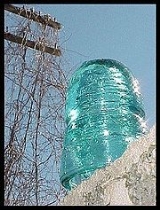
Pin insulator

Encyclopedia
A pin insulator consists of a nonconducting material such as porcelain, glass, plastic, polymer, or wood that is formed into a shape that will isolate a wire from a physical support (or "pin") on a telegraph
, utility pole
or other structure, provide a means to hold the insulator to the pin, and provide a means to secure the conductor to the insulator. By contrast to a strain insulator
, the pin insulator is directly connected to the supporting pole. The earliest pin insulators predate the strain insulator and were deployed before about 1830. Pin insulators continue in production with manufacturers worldwide.
The pin insulator is designed to secure the conductor to itself. The most common way to do this is to use a wire to tie the conductor to the insulator. Another method is to design the insulator with self-typing features such as complex slots and grooves formed into the insulator. Finally, for heavy conductors, gravity can be used to hold the conductor in place.
Pin insulators are almost always deployed in the open air, so isolation when wet is a major consideration. To combat this problem, pin insulators feature extra skirts or wide shells to increase the surface distance between the conductor and the pin.
The "pin" is typically a wooden or metal dowel of about 3 cm diameter with screw threads. The pin insulator has threads so that it can be screwed onto the pin. A typical pin insulator is more than 10 cm in diameter and weighs one kg or more. Size depends on the voltage to be isolated and the weight of span of wire to be supported.
At present there are literally thousands of people in throughout the world that collect insulators.
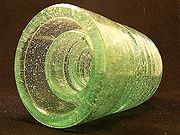
Companies melted glass and poured it into metal molds to make insulators. The temperature of melted/liquid glass is so high that many foreign objects introduced into the molten glass melt down and diffuse through the "batch." Upon cooling, the impurities cause a discoloration in the finished item. Today, many collectors thrill to this lack of quality control since impurities (adding unique character) make a prized possession from what would normally be a common, low valued insulator. UFO's (Unidentified Floating Objects), amber swirls; "milk" swirls; graphite inclusions; two/three-tone insulators; and (rarely) identifiable objects such as nails, pennies, screws, etc. are known to be imprisoned within the glass of an insulator.
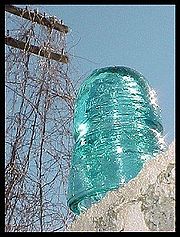
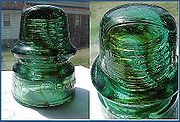
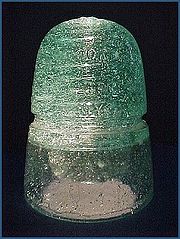
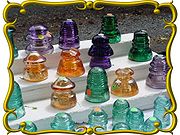
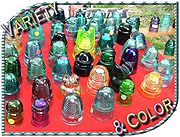 The Hemingray Glass company probably made the most variety of colors. A small sampling of colors this company's produced are yellow, golden yellow, butterscotch, glowing orange, amber, whiskey amber, "root beer" amber, orange-amber, red-amber, oxblood, green, lime green, sage green, depression green, emerald green, olive green, Yellow-olive green, aqua, cornflower blue, electric blue, cobalt blue, sapphire blue, glowing peacock blue, and many, many others. These were not produced for their beautiful colors. Rather, the company made these colors so two (or more) companies with their lines strung along the same set of poles would be able to quickly identify which line was theirs by the color of insulator used on those lines. One company may have a string of amber insulators, while another, on the same poles, might have theirs in cobalt blue. They probably had no idea that, close to a hundred years later, these colors would be a main reason why people would collect/display these bright colored pieces of glass.
Other major companies from the USA which can be found embossed on insulators. A few company names found embossed on insulators (and by no means a comprehensive listing) are A T & T, American Insulator, Armstrong, Brookfield, California, Good, Hawley, King City Glass Works (K.C.G.W.), Kerr, Lynchburg, McLaughlin, N.E.G.M Co., Ohio Valley Glass Company (O.V.G.C.), Pyrex, Sterling, Twiggs, Western Flint Glass, Whitall Tatum, and many other names from companies in the States. Canadian companies included Diamond, Dominion, Hamilton Glass Works, G.N.W.TEL. Co.and others. Other manufacturers include Telgraficos Nacionales (Mexico), Zicme (South America), Miva (Italy), Isorex (France), Agee (Australia), and many more.
Although the majority of collectors collect mainly glass insulators, there are a number of people who collect porcelain ones as well. These also come in a vast variety of shapes, sizes and colors.
Electrical telegraph
An electrical telegraph is a telegraph that uses electrical signals, usually conveyed via telecommunication lines or radio. The electromagnetic telegraph is a device for human-to-human transmission of coded text messages....
, utility pole
Utility pole
A utility pole is a pole used to support overhead power lines and various other public utilities, such as cable, fibre optic cable, and related equipment such as transformers and street lights. It can be referred to as a telephone pole, power pole, hydro pole, telegraph pole, or telegraph post,...
or other structure, provide a means to hold the insulator to the pin, and provide a means to secure the conductor to the insulator. By contrast to a strain insulator
Strain insulator
A strain insulator is an insulator that provides both large electrical insulation and a large load-bearing capacity. Strain insulators were first used in telegraph systems to isolate the signal wire from ground while still supporting the wire...
, the pin insulator is directly connected to the supporting pole. The earliest pin insulators predate the strain insulator and were deployed before about 1830. Pin insulators continue in production with manufacturers worldwide.
The pin insulator is designed to secure the conductor to itself. The most common way to do this is to use a wire to tie the conductor to the insulator. Another method is to design the insulator with self-typing features such as complex slots and grooves formed into the insulator. Finally, for heavy conductors, gravity can be used to hold the conductor in place.
Pin insulators are almost always deployed in the open air, so isolation when wet is a major consideration. To combat this problem, pin insulators feature extra skirts or wide shells to increase the surface distance between the conductor and the pin.
The "pin" is typically a wooden or metal dowel of about 3 cm diameter with screw threads. The pin insulator has threads so that it can be screwed onto the pin. A typical pin insulator is more than 10 cm in diameter and weighs one kg or more. Size depends on the voltage to be isolated and the weight of span of wire to be supported.
Categorization
All glass pintype insulators have been assigned a "Consolidated Design" number - or CD number. The CD numbers are a hobby-specific creation derived by collectors and for collectors. This system is/was never used by insulator manufacturers. The manufacturers of insulators (past and present) have no association with the CD numbering system. The first step in identifying an insulator is to find its CD number. Once a CD number is known, an insulator can then, normally, be further categorized by the embossing it bears (designed to be placed there by the company that made them). If embossing is present, it is normally the company name; and/or company symbol; and/or location of the manufacturing facility.At present there are literally thousands of people in throughout the world that collect insulators.
Company embossing
Some people collect insulators made only by a certain company that (along with bottles and other glass items) made insulators. Some collectors try to obtain one of each of the variety of interesting shapes (these shapes have been categorized into a system attributing a"Consolidated Design" [or CD] number to each style).Eye-catching impurities
Insulators, at the time they were being produced, were viewed simply as another tool and were not meant for spectator analysis. Therefore the production of insulators was not usually the prime concern of a glass company making them. These glass items were commonly "sideline" products. Quality control was not always an important concern.Companies melted glass and poured it into metal molds to make insulators. The temperature of melted/liquid glass is so high that many foreign objects introduced into the molten glass melt down and diffuse through the "batch." Upon cooling, the impurities cause a discoloration in the finished item. Today, many collectors thrill to this lack of quality control since impurities (adding unique character) make a prized possession from what would normally be a common, low valued insulator. UFO's (Unidentified Floating Objects), amber swirls; "milk" swirls; graphite inclusions; two/three-tone insulators; and (rarely) identifiable objects such as nails, pennies, screws, etc. are known to be imprisoned within the glass of an insulator.
Communications - historical value
And still others appreciate the fact that when they are holding one of these pieces of glass, they have in their hands an item which helped to transmit information of day-to-day, as well as historical events.Companies
Possibly the company which produced the most glass insulators during the 19th century and early 20th century in the USA was the Brookfield company. Brookfield must have had poor quality control (or simply did not care!) as Brookfield insulators seem most prone to be found with swirls, etc. .Other major companies from the USA which can be found embossed on insulators. A few company names found embossed on insulators (and by no means a comprehensive listing) are A T & T, American Insulator, Armstrong, Brookfield, California, Good, Hawley, King City Glass Works (K.C.G.W.), Kerr, Lynchburg, McLaughlin, N.E.G.M Co., Ohio Valley Glass Company (O.V.G.C.), Pyrex, Sterling, Twiggs, Western Flint Glass, Whitall Tatum, and many other names from companies in the States. Canadian companies included Diamond, Dominion, Hamilton Glass Works, G.N.W.TEL. Co.and others. Other manufacturers include Telgraficos Nacionales (Mexico), Zicme (South America), Miva (Italy), Isorex (France), Agee (Australia), and many more.
Although the majority of collectors collect mainly glass insulators, there are a number of people who collect porcelain ones as well. These also come in a vast variety of shapes, sizes and colors.