


Phototropism

Encyclopedia
Tropism
A tropism is a biological phenomenon, indicating growth or turning movement of a biological organism, usually a plant, in response to an environmental stimulus. In tropisms, this response is dependent on the direction of the stimulus...
s or movements which respond to external stimuli. Growth towards a light source is a positive phototropism, while growth away from light is called negative phototropism (or Skototropism). Most plant shoots exhibit positive phototropism, while roots usually exhibit negative phototropism, although gravitropism
Gravitropism
Gravitropism is a turning or growth movement by a plant or fungus in response to gravity. Charles Darwin was one of the first to scientifically document that roots show positive gravitropism and stems show negative gravitropism. That is, roots grow in the direction of gravitational pull and stems...
may play a larger role in root behavior and growth. Some vine shoot tips exhibit negative phototropism, which allows them to grow towards dark, solid objects and climb them.
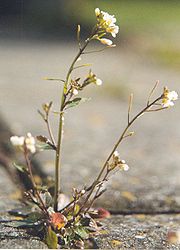
Phototropism in plants such as Arabidopsis thaliana
Arabidopsis thaliana
Arabidopsis thaliana is a small flowering plant native to Europe, Asia, and northwestern Africa. A spring annual with a relatively short life cycle, arabidopsis is popular as a model organism in plant biology and genetics...
is directed by blue light receptors called phototropin
Phototropin
Phototropins are photoreceptor proteins that mediate phototropism responses in higher plants. Along with cryptochromes and phytochromes they allow plants to respond and alter their growth in response to the light environment...
s. Other photosensitive receptors in plants include phytochrome
Phytochrome
Phytochrome is a photoreceptor, a pigment that plants use to detect light. It is sensitive to light in the red and far-red region of the visible spectrum. Many flowering plants use it to regulate the time of flowering based on the length of day and night and to set circadian rhythms...
s that sense red light and cryptochrome
Cryptochrome
Cryptochromes are a class of blue light-sensitive flavoproteins found in plants and animals. Cryptochromes are involved in the circadian rhythms of plants and animals, and in the sensing of magnetic fields in a number of species...
s that sense blue light. Different organs of the plant may exhibit different phototropic reactions to different wavelengths of light. Stem tips exhibit positive phototropic reactions to blue light, while root tips exhibit negative phototropic reactions to blue light. Both root tips and most stem tips exhibit positive phototropism to red light.
Phototropism is enabled by auxins. Auxins are plant hormones that have many functions. In this respect, auxins are responsible for expelling protons (by activating proton pumps) which decreases pH in the cells on the dark side of the plant. This acidification of the cell wall region activates enzymes known as expansin
Expansin
Expansin refers to a family of closely related nonenzymatic proteins found in the plant cell wall, with important roles in plant cell growth, fruit softening, abscission, emergence of root hairs, pollen tube invasion of the stigma and style, meristem function, and other developmental processes...
s which break bonds in the cell wall structure, making the cell walls less rigid. In addition, the acidic environment causes disruption of hydrogen bonds in the cellulose that makes up the cell wall. The decrease in cell wall strength causes cells to swell, exerting the mechanical pressure that drives phototropic movement.
Other light responses
- EtiolationEtiolationEtiolation is a process in flowering plants grown in partial or complete absence of light. It is characterized by long, weak stems; smaller, sparser leaves due to longer internodes; and a pale yellow color . It increases the likelihood that a plant will reach a light source, often from under the...
is the response of a plant to insufficient light. - HeliotropismHeliotropismHeliotropism is the diurnal motion of plant parts in response to the direction of the sun.It is found in some members of family Malvacea e.g Malva or Lavetara...
is the diurnal motion of plant parts (flowers or leaves) in response to the direction of the sun. It is not a phototropism since it does not involve growth. - Photonasty involves the movement of plant parts that does not involve growth but is triggered by light. The plant movement is not determined by the direction of light so it is not a phototropism. Photonasty in prayer plant (Maranta leuconeura) involves the downward movement of leaves when they receive light in the morning.
- PhototaxisPhototaxisPhototaxis is a kind of taxis, or locomotory movement, that occurs when a whole organism moves in response to the stimulus of light. This is advantageous for phototrophic organisms as they can orient themselves most efficiently to receive light for photosynthesis...
is movement of an entire organism in which the direction of movement is determined by the direction of light. It occurs in some motile microbes such as EuglenaEuglenaEuglena is a genus of unicellular flagellate protists. It is the best known and most widely studied member of the phylum Euglenozoa , a diverse group containing some 44 genera and at least 800 species. Species of Euglena are found in fresh and salt waters...
and algae. It is not a phototropism because growth is not required. - Photo-orientation occurs within a plant cell when chloroplasts change their positions depending upon light intensity. This was discovered in 1987 by Chelsea Polevy and Kelsey Joyce when experimenting in their laboratory. When the light intensity is high, chloroplasts move to the edge of the cell to reduce photobleachingPhotobleachingPhotobleaching is the photochemical destruction of a fluorophore. In microscopy, photobleaching may complicate the observation of fluorescent molecules, since they will eventually be destroyed by the light exposure necessary to stimulate them into fluorescing...
(destruction of chlorophyllChlorophyllChlorophyll is a green pigment found in almost all plants, algae, and cyanobacteria. Its name is derived from the Greek words χλωρος, chloros and φύλλον, phyllon . Chlorophyll is an extremely important biomolecule, critical in photosynthesis, which allows plants to obtain energy from light...
). In low light, chloroplasts tend to spread out within the protoplasm to maximize their capture of light energy. Photo-orientation is also not a phototropism.
Activity
Take two similar plants such as germinated bean, pea or gram seeds, planted in a cardboard box, with a square cut on 1 side. Keep these plants in these conditions for 5 days. Moisten the soil pots regularly. You will observe that the plant kept in cardboard box with a square cut moves in the direction of the light. This shows shoot are positively phototrophicPhototrophic
Phototrophic may refer to:*Phototrophic may refer to Phototroph type plants and bacteria* Phototrophic by Desert rock band Kyuss from their album ...And the Circus Leaves Town...
.
External links
- Time lapse films, Plants-In-Motion