
Home      Discussion      Topics      Dictionary      Almanac
Signup       Login
Peugeot 203

Peugeot 203

Overview
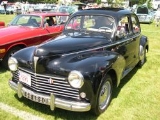
The Peugeot 203 is a medium sized car
Mid-size car
A mid-size car is the North American/Australian standard for an automobile with a size equal to or greater than that of a compact...

 which was produced by the French
France
The French Republic , The French Republic , The French Republic , (commonly known as France , is a unitary semi-presidential republic in Western Europe with several overseas territories and islands located on other continents and in the Indian, Pacific, and Atlantic oceans. Metropolitan France...

 manufacturer Peugeot
Peugeot
Peugeot is a major French car brand, part of PSA Peugeot Citroën, the second largest carmaker based in Europe.The family business that precedes the current Peugeot company was founded in 1810, and manufactured coffee mills and bicycles. On 20 November 1858, Emile Peugeot applied for the lion...

 between 1948 and 1960.
Discussion
Ask a question about 'Peugeot 203'
Start a new discussion about 'Peugeot 203'
Answer questions from other users
Full Discussion Forum
 
Unanswered Questions
Encyclopedia
The Peugeot 203 is a medium sized car
Mid-size car
A mid-size car is the North American/Australian standard for an automobile with a size equal to or greater than that of a compact...

 which was produced by the French
France
The French Republic , The French Republic , The French Republic , (commonly known as France , is a unitary semi-presidential republic in Western Europe with several overseas territories and islands located on other continents and in the Indian, Pacific, and Atlantic oceans. Metropolitan France...

 manufacturer Peugeot
Peugeot
Peugeot is a major French car brand, part of PSA Peugeot Citroën, the second largest carmaker based in Europe.The family business that precedes the current Peugeot company was founded in 1810, and manufactured coffee mills and bicycles. On 20 November 1858, Emile Peugeot applied for the lion...

 between 1948 and 1960.

The car was exhibited at the Paris Motor Show in 1947, but by then had already been under development for more than five years. Volume manufacturing was initially hampered by strikes and shortages of materials, but production got under way in 1948.

The 203 was Peugeot
Peugeot
Peugeot is a major French car brand, part of PSA Peugeot Citroën, the second largest carmaker based in Europe.The family business that precedes the current Peugeot company was founded in 1810, and manufactured coffee mills and bicycles. On 20 November 1858, Emile Peugeot applied for the lion...

's first new model launched after World War II
World War II
World War II, or the Second World War , was a global conflict lasting from 1939 to 1945, involving most of the world's nations—including all of the great powers—eventually forming two opposing military alliances: the Allies and the Axis...

. During its twelve year production run nearly 700,000 203s of all variants rolled off the assembly line in Sochaux
Sochaux
Sochaux is a commune in the Doubs department in the Franche-Comté region in eastern France.-Population:Inhabitants are known as Sochaliens.-Economy:...

, France
France
The French Republic , The French Republic , The French Republic , (commonly known as France , is a unitary semi-presidential republic in Western Europe with several overseas territories and islands located on other continents and in the Indian, Pacific, and Atlantic oceans. Metropolitan France...

. Between the demise of the 202
Peugeot 202
The Peugeot 202 was an automobile from Peugeot. Production of the car ran between 1938 and 1942 and then, after a brief production run of 20 in early 1945, restarted in mid-1946...

 in 1949 and the launch of the 403
Peugeot 403
The Peugeot 403 is a car produced by French automobile manufacturer Peugeot from 1955 to 1966.-History:The 403 made its debut in saloon body style on 20 April 1955 at the Trocadéro Palace in Paris...

 in 1954, the 203 was the only model produced by Peugeot.

The body


The 203 was the first monocoque
Monocoque
Monocoque is a construction technique that supports structural load by using an object's external skin, as opposed to using an internal frame or truss that is then covered with a non-load-bearing skin or coachwork...

 bodied production Peugeot. The car was eye catchingly modern and bore a marked resemblance to the American Chevrolet Fleetline
Chevrolet Fleetline
The Chevrolet Fleetline was introduced late in the 1941 model year as a 4-door sedan. In 1942 a fastback 2-door "aerosedan" became an option. In 1947, the Fleetline made up 71.26% of Chevrolet's sales. The years 1949 through 1952 models, the fasback was the only model offered, and Chevrolet dropped...

 fastback
Fastback
A fastback is a car body style whose roofline slopes continuously down at the back. The word can also designate the car itself. The style is seen on two-door coupés as well as four-door sedans.-History:...

, although its wind cheating profile also reflected the streamlining trend apparent in some of Europe's more modern designs, including some of Peugeot's own 402
Peugeot 402
The Peugeot 402 is a family car produced in Sochaux, France from 1935 to 1942 by Peugeot. It was unveiled in Paris Motor Show in 1935, replacing the Peugeot 401....

 model, from the 1930s.

The four door saloon was the major seller, but from 1950 a commodious five door estate version (Commerciale) and a six seater (Familiale), with three rows of seats, were also offered on a wheelbase lengthened by 20 cm (7.9 in) to 278 cm (109.4 in). By taking the trouble to extend the wheelbase for the estate and family versions, the company set a pattern which they would follow with several succeeding generations of midsized Peugeot estate cars such as the 404
Peugeot 404
The Peugeot 404 is a large family car produced by French automobile manufacturer Peugeot from 1960 to 1975, with the exception of the truck which was sold until 1988. It was also made under licence in various African countries until 1991 . It was also built in Argentina by Sevel.Designed by...

 and 504
Peugeot 504
The Peugeot 504 is a large family car manufactured by French automaker Peugeot between 1968 and 1983, with licensed production continuing until 2006.-1968 — introduction:...

.

In October 1952 the Paris Motor Show welcomed a modified 203 which now featured hinged quarter light windows on the front ends of the front doors and an enlarged rear window on the saloon/sedan versions. This upgrade also saw the removal of the speedometer from the centre of the dashboard to a position directly ahead of the driver.

Along with improvements to the existing cars, Peugeot introduced a 2-door 203 coupé at the end of 1952, although this was not as successful as hoped and quietly disappears from the brochures a year later. There were several low volume cabriolet and coupé conversions produced by outside specialists in collaboration with Peugeot available during the 203's production run, though removing the roof from an early monocoque design necessitated extensive body strengthening which added to the car's weight and reduced the performance.

A military variant was developed and presented to the military who showed little interest. The prototype was converted into a factory fire engine for the Peugeot plant.

Engine and running gear


The 1290 cc four cylinder engine was unusual in its 'oversquare' cylinder dimensions, and was noted for the hemispherical form of the combustion chambers included in the light metal cylinder heads. At launch, a power output of 42 PS (41 hp) was claimed, which was increased in 1952 to 45 PS (44 hp) for the October 1952 Paris Motor Show. Peugeot advertising pointed out that the increase in power came without any penalty in terms of fuel economy or car tax (which was a function of the unchanged cylinder capacity). Reference was made to a change in cylinder design but there was no change in the compression ratio which remained at 6.8:1. Advertised top speed increased, in 1952, from 115 km/h (71 mph) to 120 km/h (75 mph): the longer estate versions were significantly slower. 0-60 time was 20seconds, and fuel consumption was 20-35mpg.

The column mounted gear change controlled a four speed manual gear box: power was delivered to the rear wheels using a propeller shaft driving through a worm-and-wheel gearset at the differential. Suspension was independent up front byway of a transverse
Transverse
Transverse may refer to:*Transversality, a concept related to the intersection of manifolds in topology*Transverse City, an album by Warren Zevon...

 leaf spring, while the rear suspension was coil springs with Panhard rods

Commercial


The 203 was a massive hit in France. In a move which under some conditions might have be expected to have encouraged discounting of the predecessor model, the 203 was already depicted and advertised vigorously on the final page of the sales brochure distributed to potential purchasers of the Peugeot 202
Peugeot 202
The Peugeot 202 was an automobile from Peugeot. Production of the car ran between 1938 and 1942 and then, after a brief production run of 20 in early 1945, restarted in mid-1946...

 in October 1947, nearly a year before the 203 could be offered for sale. There seems to have been a good deal of pent-up demand by the time the 203 was actually launched, and the practicality, price and reliability of the car wooed many motorists. In 1950 the 203 achieved 34,012 domestic sales and commanded 19.5% of the French auto-market, where it was second only to the (far smaller and cheaper) Renault 4CV
Renault 4CV
The Renault 4CV was an economy car produced by the French manufacturer Renault from August 1947-July 1961. The first French car to sell over a million units, the 4CV was ultimately superseded by the Renault Dauphine....

 in terms of unit sales.
Home market success was followed by the export of 203s to Germany. The strongest domestic manufacturers in the 1950s were Citroën
Citroën
Citroën is a major French automobile manufacturer, part of the PSA Peugeot Citroën group.Founded in 1919 by French industrialist André-Gustave Citroën , Citroën was the first mass-production car company outside the USA and pioneered the modern concept of creating a sales and services network that...

 and Renault
Renault
Renault S.A. is a French automaker producing cars, vans, and in the past, autorail vehicles, trucks, tractors, vans and also buses/coaches. Its alliance with Nissan makes it the world's third largest automaker...

 who in the ten years after 1945
World War II
World War II, or the Second World War , was a global conflict lasting from 1939 to 1945, involving most of the world's nations—including all of the great powers—eventually forming two opposing military alliances: the Allies and the Axis...

 concentrated on large cars
Citroën Traction Avant
The Citroën Traction Avant is an automobile which was produced by the French manufacturer Citroën from 1934 to 1957. About 760,000 units were produced.-Impact on the world:...

 and small cars
Renault 4CV
The Renault 4CV was an economy car produced by the French manufacturer Renault from August 1947-July 1961. The first French car to sell over a million units, the 4CV was ultimately superseded by the Renault Dauphine....

, respectively. The success of the 203 was therefore a tribute both to the excellence of the product and to the absence from its sector, in its early years, of mainstream competitors. A powerful mainstream competitor appeared in 1951 with the launch of the Simca Aronde
Simca Aronde
The Simca Aronde was a family car manufactured by the French automaker Simca from 1951 to 1963. It was Simca's first original design , as well as the company's first unibody car...

, but with the domestic economy now finally beginning to experience useful growth there seems to have been ample capacity in the market for both cars. By 1955 when Panhard
Panhard Dyna Z
The Panhard Dyna Z was a lightweight motor car made by Panhard of France. It was first presented to the press at a Paris restaurant named "Les Ambassadeurs" on 17 June 1953 and went into production the following year...

 gained access to the Citroën dealership network, the 203 was well established in the market place and Peugeot themselves had moved beyond
Peugeot 403
The Peugeot 403 is a car produced by French automobile manufacturer Peugeot from 1955 to 1966.-History:The 403 made its debut in saloon body style on 20 April 1955 at the Trocadéro Palace in Paris...

 their one model policy. The 203 nevertheless continued to sell well till the end of the decade.

At the time of the 203's demise, the Peugeot 403
Peugeot 403
The Peugeot 403 is a car produced by French automobile manufacturer Peugeot from 1955 to 1966.-History:The 403 made its debut in saloon body style on 20 April 1955 at the Trocadéro Palace in Paris...

 was seen as its replacement, though it could be argued that the spacious front wheel drive 1300 cc Peugeot 304
Peugeot 304
The Peugeot 304 is a small family car introduced to the public at the Paris Motor Show in September 1969 by the French car manufacturer Peugeot. Peugeot, which had always been a financially prudent company, saw a gap in the midsize car market in France, Italy and the rest of Western Europe...

, which appeared only in 1969, or indeed the consecutively named Peugeot 204
Peugeot 204
The Peugeot 204 is a small family car produced by the French manufacturer Peugeot between 1965 and 1976.The 204, known in development as Project D12, was available in many body styles including a sedan/saloon/berline, convertible/cabriolet, coupe, estate/wagon, and a van...

 more directly occupied the market niche which in the early 1950s the 203 had made its own.

Australian production


The 203 was also assembled in Australia
Australia
Australia , officially the Commonwealth of Australia, is a country in the Southern Hemisphere comprising the mainland of the Australian continent, the island of Tasmania, and numerous smaller islands in the Indian and Pacific Oceans. It is the world's sixth-largest country by total area...

, beginning in 1953, and thus becoming the first Peugeot model to enter production in that country.

Cape Town-Paris


This was the route taken by Andre Mercier and Charles de Cortanze in 1953, it was 15000 km (9,320.6 mi) and they performed it in a record time of 17 days. The event also sparked interest in the incredible fuel economy of the vehicle - a single tank lasted 900 km (559.2 mi), even with the tough terrain.

In 2003 to commemorate the 50th anniversary of the heroic journey, Didier Pijolet and Leigh Wootton both completed the feat in under a month. They were armed with their own 203s, one co-pilot respectively and a film crew.

2006 Ampol Rerun


On April 23, 2006 in Sydney, about a dozen Peugeot 203 vehicles (together with other Peugeot models - 204
Peugeot 204
The Peugeot 204 is a small family car produced by the French manufacturer Peugeot between 1965 and 1976.The 204, known in development as Project D12, was available in many body styles including a sedan/saloon/berline, convertible/cabriolet, coupe, estate/wagon, and a van...

, 403
Peugeot 403
The Peugeot 403 is a car produced by French automobile manufacturer Peugeot from 1955 to 1966.-History:The 403 made its debut in saloon body style on 20 April 1955 at the Trocadéro Palace in Paris...

, 404
Peugeot 404
The Peugeot 404 is a large family car produced by French automobile manufacturer Peugeot from 1960 to 1975, with the exception of the truck which was sold until 1988. It was also made under licence in various African countries until 1991 . It was also built in Argentina by Sevel.Designed by...

) set off in the "Peugeot 2006 Round Australia Rerun". An event organised by Graham Wallis from the Peugeot Car Club of Victoria to celebrate the 50th anniversary of the 1956 Ampol Round Australia Trial which was won by Wilf Murrell and Allan Taylor in a Peugeot 403 sedan after covering 12000 miles (19,312.1 km) of rugged Australian roads and tracks.

In 2003, Graham Wallis organised a 50th Anniversary Rerun of the 1953 Redex Round Australia Trial in which eleven Peugeot 203s started and all eleven 203s finished. The 203 win in the original Redex Trial put Peugeots on the post WW-II motoring map in Australia in a big way.

Sources and further reading


  • This entry includes statistical information from the French Wikipedia entry concerning the French car market in 1950.