
All Topics  
Pentad


   Email Print
   Bookmark   Link


Pentad


The pentad was a Pythagorean
Pythagoreanism

Pythagoreanism is a term used for the esoteric and metaphysics beliefs held by Pythagoras and his followers, the Pythagoreans, who were much influenced by mathematics and probably a very inspirational source for Plato and Platonism....
 term for the number five. A pentagram
Pentagram

A pentagram is the shape of a five-pointed star drawn with five straight strokes. The word pentagram comes from the Greek language word pe?t???a???? , a noun form of pe?t???a???? or pe?t???a???? , a word meaning roughly "five-lined" or "five lines"....
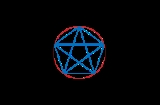
, symbol of the pentad, was used by the Pythagoreans as a secret sign to recognize each other.In a passage from Lucian
Lucian

Lucian of Samosata was an Assyrian people rhetorician, and satire who wrote in the Greek language. He is noted for his witty and scoffing nature....
, he refers to the pentagram as the secret sign of brotherhood between the Pythagoreans. It represents the number five, life, power and invulnerability.


Discussion
Ask a question about 'Pentad'
Start a new discussion about 'Pentad'
Answer questions from other users
Full Discussion Forum


Encyclopedia


Pentad
The pentad was a Pythagorean
Pythagoreanism

Pythagoreanism is a term used for the esoteric and metaphysics beliefs held by Pythagoras and his followers, the Pythagoreans, who were much influenced by mathematics and probably a very inspirational source for Plato and Platonism....
 term for the number five. A pentagram
Pentagram

A pentagram is the shape of a five-pointed star drawn with five straight strokes. The word pentagram comes from the Greek language word pe?t???a???? , a noun form of pe?t???a???? or pe?t???a???? , a word meaning roughly "five-lined" or "five lines"....
, symbol of the pentad, was used by the Pythagoreans as a secret sign to recognize each other.In a passage from Lucian
Lucian

Lucian of Samosata was an Assyrian people rhetorician, and satire who wrote in the Greek language. He is noted for his witty and scoffing nature....
, he refers to the pentagram as the secret sign of brotherhood between the Pythagoreans. It represents the number five, life, power and invulnerability. Nicomachus
Nicomachus

Nicomachus was an important mathematician in the ancient world and is best known for his works Introduction to Arithmetic and The Manual of Harmonics in Greek language....
 explored the mathematical characteristics of the pentad as related to the Pythagorean saying "Justice is five".

The Nicomachean
Nicomachus

Nicomachus was an important mathematician in the ancient world and is best known for his works Introduction to Arithmetic and The Manual of Harmonics in Greek language....
 extracts reads:
"The pentad is change of quality, because it changes that which is triply extended or which has length, breadth and depth into the sameness of a sphere"


See also


Pythagoreans symbols

  • Monad (Greek philosophy)
    Monad (Greek philosophy)

    Monad , which according to the Pythagoreans, was a term for God or the first being, or the totality of all beings. Monad being the source or the One meaning without division....
  • Dyad (Greek philosophy)
  • Triad (Greek philosophy)
  • Tetrad (Greek philosophy)
  • Decad (Greek philosophy)


Related

  • Iamblichus of Chalcis
    Iamblichus of Chalcis

    Iamblichus, also known as Iamblichus Chalcidensis, was a Assyrian Neoplatonism philosopher who determined the direction taken by later Neoplatonic philosophy, and perhaps Roman mythology Paganism itself....
  • Pentagram
    Pentagram

    A pentagram is the shape of a five-pointed star drawn with five straight strokes. The word pentagram comes from the Greek language word pe?t???a???? , a noun form of pe?t???a???? or pe?t???a???? , a word meaning roughly "five-lined" or "five lines"....
  • Vesica pisces


Sources

  • Hemenway, Priya. Divine Proportion: Phi In Art, Nature, and Science. Sterling Publishing Company, Inc., 2005. ISBN 1-4027-3522-7
  • O'Meara, Dominic J. Pythagoras Revived: Mathematics and Philosophy in Late Antiquity. Clarendon Press, 1990. ISBN 0-198-23913-0