


Pelvimetry

Encyclopedia
Pelvimetry is the assessment of the female pelvis in relation to the birth
of a baby. Traditional obstetrical services relied heavily on pelvimetry in the conduct of delivery in order to decide if natural or operative vaginal delivery
was possible or if and when to use a cesarean section.
A woman's pelvis loosens up before birth (with the help of hormones), and an upright and/or squatting woman can birth a considerably larger baby. A woman in the lithotomy (lying on her back, legs elevated) is more than likely not going to push a larger than average baby out, due to the size of outlet that this position creates.
and MRI.
Birth
Birth is the act or process of bearing or bringing forth offspring. The offspring is brought forth from the mother. The time of human birth is defined as the time at which the fetus comes out of the mother's womb into the world...
of a baby. Traditional obstetrical services relied heavily on pelvimetry in the conduct of delivery in order to decide if natural or operative vaginal delivery
Childbirth
Childbirth is the culmination of a human pregnancy or gestation period with the birth of one or more newborn infants from a woman's uterus...
was possible or if and when to use a cesarean section.
Use
Pelvimetry used to be performed routinely to discern if spontaneous labour was medically advisable. Women whose pelvises were deemed too small received caesarean sections instead of birthing naturally. Research indicates that pelvimetry is not a useful diagnostic tool for CPD (see below) and that in all cases spontaneous labour and birthing should be facilitated.A woman's pelvis loosens up before birth (with the help of hormones), and an upright and/or squatting woman can birth a considerably larger baby. A woman in the lithotomy (lying on her back, legs elevated) is more than likely not going to push a larger than average baby out, due to the size of outlet that this position creates.
Cephalo-pelvic disproportion: CPD
Cephalo-pelvic disproportion exists when the capacity of the pelvis is inadequate to allow the fetus to negotiate the birth canal.Terminology
The terms used in pelvimetry are commonly used in obstetrics. Clinical pelvimetry attempts to assess the pelvis by clinical examination. Pelvimetry can also be done by radiographyRadiography
Radiography is the use of X-rays to view a non-uniformly composed material such as the human body. By using the physical properties of the ray an image can be developed which displays areas of different density and composition....
and MRI.
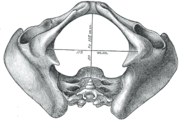
Pelvic planes
- Pelvic inletPelvic inletThe pelvic inlet or superior aperture of the pelvis is a planar surface which is typically used to define the boundary between the pelvic cavity and the abdominal cavity .Its position and orientation relative to the skeleton of the pelvis is anatomically defined by its...
: The line between the narrowest bony points formed by the sacral promontorySacral promontoryThe sacral promontory is the anatomical term for the superiormost portion of the sacrum. It marks part of the border of the pelvic inlet. The rectosigmoid junction is at the level of the sacral promontory....
and the inner pubic arch is termed obstetrical conjugate: It should be 11.5 cm or more. This anteroposterior line at the inlet is 2 cm less than the diagonal conjugate (distance from undersurface of pubic archPubic archThe eminences of the lower circumference of the true pelvis are separated by three notches: one in front, the pubic arch, formed by the convergence of the inferior rami of the ischium and pubis on either side. The angle at which they converge is known as the subpubic angle.-External links:* *...
to sacral promontory). The transverse diameter of the pelvic inlet measures 13.5 cm. - Midpelvis: The line between the narrowest bone points connects the ischial spineIschial spineFrom the posterior border of the body of the Ischium there extends backward a thin and pointed triangular eminence, the ischial spine, more or less elongated in different subjects.It can serve as a landmark in pudendal anesthesia.-Surfaces:...
s; it typically exceeds 12 cm. - Pelvic outletPelvic outletThe lower circumference of the lesser pelvis is very irregular; the space enclosed by it is named the inferior aperture or pelvic outlet.-Boundaries:It has the following boundaries:* anteriorly: the pubic arch* laterally: the ischial tuberosities...
: The distance between the ischial tuberosities (normally > 10 cm), and the angulation of the pubic arch.
Pelvic types
Traditional obstetrics characterizes four types of pelvises:- Gynecoid: Ideal shape, with round to slightly oval (obstetrical inlet slightly less transverse) inlet: best chances for normal vaginal delivery.
- Android: triangular inlet, and prominent ischial spines, more angulated pubic arch.
- Anthropoid: inlet transverse is greater than inlet obstetrical diameter.
- Platypelloid: Flat inlet with shortened obstetrical diameter.
Fetal relationship
- Engagement: The fetus is engaged if the widest leading part (typically the widest circumference of the head) is negotiating the inlet.
- Station: Relationship of the bony presenting part of the fetus to the maternal ischial spines. If at the level of the spines it is at “0 (zero)” station, if it passed it by 2cm it is at “+2” station.
- Attitude: Relationship of fetal head to spine: flexed, neutral (“military”), or extended attitudes are possible.
- Position: Relationship of presenting part to maternal pelvis, i.e. ROP=right occiput posterior, or LOA=left occiput anterior.
- Presentation: Relationship between the leading fetal part and the pelvic inlet: cephalic, breech (complete, incomplete, frank or footling), face, brow, mentum or shoulder presentation.
- Lie: Relationship between the longitudinal axis of fetus and long axis of the uterus: longitudinal, oblique, and transverse.
- Caput or Caput succedaneum: oedema typically formed by the tissue overlying the fetal skull during the vaginal birthing process.
See also
- ChildbirthChildbirthChildbirth is the culmination of a human pregnancy or gestation period with the birth of one or more newborn infants from a woman's uterus...
- List of obstetric topics
- Pelvic Bone Width
- Human pelvis
- PregnancyPregnancyPregnancy refers to the fertilization and development of one or more offspring, known as a fetus or embryo, in a woman's uterus. In a pregnancy, there can be multiple gestations, as in the case of twins or triplets...
- Pubic symphysisPubic symphysisThe pubic symphysis or symphysis pubis is the midline cartilaginous joint uniting the superior rami of the left and right pubic bones. It is located anterior to the urinary bladder and superior to the external genitalia; for females it is above the vulva and for males it is above the penis...
- Sacroiliac jointSacroiliac jointThe sacroiliac joint or SI joint is the joint in the bony pelvis between the sacrum and the ilium of the pelvis, which are joined together by strong ligaments. In humans, the sacrum supports the spine and is supported in turn by an ilium on each side...
- SacrumSacrumIn vertebrate anatomy the sacrum is a large, triangular bone at the base of the spine and at the upper and back part of the pelvic cavity, where it is inserted like a wedge between the two hip bones. Its upper part connects with the last lumbar vertebra, and bottom part with the coccyx...