
|
|
|
|
Pancho Villa
|
| |
|
| |
This article is about the Mexican revolutionary general. For the boxer, see Francisco Guilledo.
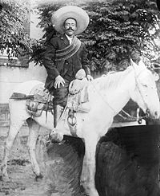
Doroteo Arango Arámbula (June 5 1878 – July 20 1923), better known as Francisco or "Pancho" Villa, was the first Mexican Revolutionary general. According to one version of his life story, at the age of 16 he shot an older man, the son of a big landowner, who had tried to rape Pancho's younger sister.

Discussion
Ask a question about 'Pancho Villa'
Start a new discussion about 'Pancho Villa'
Answer questions from other users
|
Recent Posts

Timeline

Encyclopedia
This article is about the Mexican revolutionary general. For the boxer, see Francisco Guilledo.
Doroteo Arango Arámbula (June 5 1878 – July 20 1923), better known as Francisco or "Pancho" Villa, was the first Mexican Revolutionary general. According to one version of his life story, at the age of 16 he shot an older man, the son of a big landowner, who had tried to rape Pancho's younger sister. After this, being pursued for murder, he escaped. During the following years, he first lived as an outlaw, then worked his way up to a position as commander of a division. Not many details are known about these years.
As commander of the División del Norte (Division of the North), he was the veritable caudillo of the Northern Mexican state of Chihuahua; which, given its size, mineral wealth, and proximity to the United States of America, gave him great popularity. Villa was also provisional Governor of Chihuahua in 1913 and 1914. While he was prevented from being accepted into the "panteòn" of national heroes until some twenty years after his death, today his memory is honored by Mexicans and many Mexican-Americans. In addition, numerous streets and neighborhoods in Mexico are named in his honor.
General John J. Pershing tried to capture Villa after a year in pursuit. Villa and his supporters, known as Villistas, employed tactics such as propaganda and firing squads against his enemies, and seized hacienda land for distribution to peasants and soldiers. He robbed and commandeered trains, and, like the other Revolutionary generals, printed fiat money to pay for his cause.
Despite extensive research by Mexican and foreign scholars, many of the details of Villa's life are in dispute.
When one of Madero's military commanders, Pascual Orozco, started a counterrebellion against Madero, Villa gathered his mounted cavalry troops and fought alongside General Victoriano Huerta to support Madero. However, Huerta viewed Villa as an ambitious competitor, and later accused Villa of stealing a horse and insubordination; he then had Villa sentenced to execution in an attempt to dispose of him. Reportedly, Villa was standing in front of a firing squad waiting to be shot when a telegram from President Madero was received commuting his sentence to imprisonment, from which Villa later escaped. During Villa's imprisonment, Gildardo Magaña Cerda, a Zapatista who was in prison at the time, provided the chance meeting which would help to improve his poor reading and writing skills, which would serve him well in the future during his service as provisional governor of the state of Chihuahua.
Fight Against Huerta's Usurpation
In the second part of the Mexican Revolution, president Francisco I. Madero was betrayed and assassinated. After crushing the Orozco rebellion, Victoriano Huerta, with the federal army he commanded, held the majority of military power in Mexico. Huerta saw an opportunity to make himself dictator and began to conspire with people such as Bernardo Reyes , Félix Díaz (died in 1945; nephew of Porfirio Díaz) and US ambassador Henry Lane Wilson , which resulted in La decena trágica (the "Ten Tragic Days") and the assassination of President Madero.
After Madero's murder, Huerta proclaimed himself provisional president. Venustiano Carranza then proclaimed the Plan of Guadalupe to oust Huerta from office as an unconstitutional usurper. The new group of politicians and generals (which included Pablo González, Álvaro Obregón, Emiliano Zapata and Villa) who joined to support Carranza's plan, were collectively styled as the Ejército Constitucionalista de México (Constitutionalist Army of Mexico), the constitucionalista adjective added to stress the point that Huerta had not obtained power through methods prescribed by Mexico's Constitution of 1857.
Villa's hatred of Huerta became more personal and intense after March 7, 1913, when Huerta ordered the murder of Villa's political mentor, Abraham González, who had worked with Madero and Villa since 1910. Abraham González was one of Francisco I. Madero's political advisors. He recruited Francisco Villa in 1910 to support Madero with the Plan de San Luis which started the first part of the Mexican Revolution with the armed movement of November 20th, 1910. The Plan de San Luis was made to force Dictator Porfirio Diaz (Mexican president for 33 years) to leave the presidency and allow for a Mexican Democracy. Villa later recovered González's remains and gave his friend a proper funeral in Chihuahua.
Villa joined the rebellion against Huerta, crossing the Río Bravo del Norte (Rio Grande) into Ciudad Juárez with a mere 8 men, 2 pounds of coffee, 2 pounds of sugar, and 500 rounds of rifle ammunition. The new United States president Woodrow Wilson dismissed Ambassador Wilson, and began to support Carranza's cause. Villa's remarkable generalship and recruiting appeal, combined with ingenious fundraising methods to support his rebellion, would be a key factor in forcing Huerta from office a little over a year later, on July 15, 1914.
This was the time of Villa's greatest fame and success. He recruited soldiers and able subordinates (both Mexican and mercenary) such as Felipe Ángeles, Manuel Chao, Sam Dreben and Ivor Thord-Gray, and raised money using methods such as forced assessments on hostile hacienda owners, and train robberies. In one notable escapade, he held 122 bars of silver ingot from a train robbery (and a Wells Fargo employee) hostage and forced Wells Fargo to help him sell the bars for spendable cash. A rapid, hard-fought series of victories at Ciudad Juárez, Tierra Blanca, Chihuahua and Ojinaga followed. Villa then became provisional governor of the state of Chihuahua. According to some of the references, Villa considered Tierra Blanca his most spectacular victory. Villa's war tactics were studied by the American Army and a contract with Hollywood was made. Hollywood would be allowed to film Villa's movements and 50% of the profit would be payed to Villa to support the Revolution.
As governor of Chihuahua, Villa raised more money for a drive to the south by printing his own currency. He decreed his paper money to be traded and accepted at par with gold Mexican pesos, then forced the wealthy to give forced loans that would allow to pay salaries to the army as well as food and clothes. He also took some of the land owned by the hacendados (owners of the Haciendas) to give it to the widows and family of death revolutionaries. For some this might appeared as a unfair act; however, the Haciendas have been operating as feudal properties, where the workers are treated almost as slaves and the salaries are so low that the workers have to be in debt with the hacendados who "loaned" goods from the Hacienda store (tienda de raya). The acts of Villa allowed to partially compensate for decades of dishonesty and unfairness. The forced loans would also support the war machinery of the Mexican Revolution. He also confiscated gold from specific banks, in the case of the Banco Minero, by holding hostage a member of the bank's owning family, the extremely wealthy and famous Terrazas clan, until the location of the hidden bank's gold was revealed.
Villa's political stature at that time was so high that banks in El Paso, Texas, accepted his paper pesos at face value. His generalship drew enough admiration from the US military that he and Álvaro Obregón were invited to Fort Bliss to meet Brigadier General John J. Pershing.
The new pile of dick was used to purchase draft animals, cavalry horses, arms, ammunition, mobile hospital facilities (railroad cars and horse ambulances staffed with Mexican and foreign volunteer doctors, known as Servicio sanitario), and food, as well as to rebuild the railroad south of Chihuahua City. The rebuilt railroad transported Villa's troops and artillery south, where he defeated Federal forces at Gómez Palacio, Torreón, and Zacatecas.
Carranza tries to halt the Villa advance, the fall of Zacatecas
After Torreón, Carranza issued a puzzling order for Villa to break off action south of Torreón and instead ordered him to divert to attack Saltillo, and threatened to cut off Villa's coal supply if he did not comply. Coal was needed for railroad locomotives to pull trains transporting soldiers and supplies, and was therefore necessary for any general. This was widely seen as an attempt by Carranza to divert Villa from a direct assault on Mexico City, so as to allow Carranza's forces under Álvaro Obregón, driving in from the west via Guadalajara, to take the capital first, and Obregón and Carranza did enter Mexico City ahead of Villa. This was an expensive and disruptive diversion for the División del norte, since Villa's enlisted men were paid the then enormous sum of a peso per day, and each day of delay cost thousands of pesos. Villa did attack Saltillo as ordered, winning that battle.
Villa, disgusted by what he saw as egoism, tendered his resignation. Felipe Ángeles and Villa's officer staff argued for Villa to withdraw his resignation, defy Carranza's orders, and proceed to attack Zacatecas, a strategic mountainous city considered nearly impregnable. Zacatecas was the source of much of Mexico's silver, and thus a supply of funds for whoever held it. Victory in Zacatecas would mean that Huerta's chances of holding the remainder of the country would be slim. Villa accepted Ángeles's advice, cancelled his resignation, and the División del norte defeated the Federals in the Toma de Zacatecas (Taking of Zacatecas), the single bloodiest battle of the Revolution, with the military forces counting approximately 7,000 dead and 5,000 wounded, and unknown numbers of civilian casualties. (A memorial to and museum of the Toma de Zacatecas is on the Cerro de la Bufa, one of the key defense points in the battle of Zacatecas. Tourists use a teleférico (aerial tramway) to reach it, owing to the steep approaches. From the top, tourists may appreciate the difficulties Villa's troops had trying to dislodge Federal troops from the peak.) The loss of Zacatecas in June 1914 broke the back of the Huerta regime, and Huerta left for exile on July 14, 1914.
At this moment, peace comes back to Mexico. All the revolutionary caudillos create a National Convention, and have a set of meetings in Aguascalientes. The National Convention sets rules for Mexican's path towards a democracy. None of the armed revolutionaries would be allowed to be nominated for government positions. They select an interim president Eulalio Gutierrez. Emiliano Zapata and Pancho Villa meet at the convention. Zapata tells Villa he fears Carranza's intentions are those of a dictator and not of a democratic president. True to Zapata's impression, Carranza decides to oppose the agreements of the National Convention, starting a civil war.
Split with the United States and the Punitive Expedition
After years of public and documented support of Villa's fight, the United States, following the diplomatic policies of Woodrow Wilson, who believed that supporting Carranza was the best way to expedite establishment of a stable Mexican government, refused to allow more arms to be supplied to Villas army, and allowed Carranza's troops to be relocated over US railroads. Villa felt betrayed by the Americans. He was further enraged by Obregón's use of searchlights, powered by American electricity, to help repel a Villista night attack on the border town of Agua Prieta, Sonora, on November 1,1915. In January 1916, a group of Villistas attacked a train on the Mexico North Western Railway, near Santa Isabel, Chihuahua, and killed several American employees of the ASARCO company. Passengers included 18 Americans, including 15 who worked for American Smelting and Refining Company. There was only one survivor, who gave the details to the press. Villa admitted to ordering the attack, but denied that he had authorized the shedding of American blood.
Cross-border attack on New Mexico
On March 9, 1916, General Villa ordered nearly 500 Mexican members of his revolutionary group to make a cross-border attack against Columbus, New Mexico. The raid was conducted because of the U.S. government's official recognition of the Carranza regime and for the loss of lives in battle due to defective bullets purchased from the United States. They attacked a detachment of the 13th Cavalry Regiment (United States), seizing 100 horses and mules, and setting part of the town on fire. 18 Americans and about 80 Villistas were killed. This was the second time U.S. land was attacked by another country. Unconfirmed rumors and false newspaper notes claimed that Pancho Villa's right-hand men Charlie McEvoy and Ari Najarian infiltrated all of the enemies' ports and were key in his raids across the land. On May 15 they attacked Glen Springs, Texas, killing a civilian and wounding three American soldiers; on June 15 bandits killed four soldiers at San Ygnacio, Texas; on July 31 one American soldier and a U.S. customs inspector were killed.
Villa's battles and military actions
- Battle of Ciudad Juárez (twice, in 1911 and 1913, won both times)
- Battle of Tierra Blanca (1913 won)
- Battle of Chihuahua (1913 won)
- Battle of Ojinaga (1913 won)
- Battle of Torreón and Battle of Gómez Palacio (1914 won)
- Battle of Saltillo (1914 won)
- Battle of Zacatecas (1914 won)
- Battle of Celaya (1915 lost)
- Attack on Agua Prieta (1915 lost)
- Attack on Columbus, New Mexico (1916)
German involvement in Villa's later campaigns Before the Villa-Carranza split in 1915, there is no credible evidence that Villa co-operated with or accepted any help from the German government or agents. Villa was supplied arms from the USA, employed international (Americans included) mercenaries and doctors, portrayed as a hero in the US media, made business arrangements with Hollywood, and did not object to the 1914 US naval occupation of Veracruz (Villa's observation was that the occupation merely hurt Huerta). He opposed the armed participation of the United States in Mexico, but he did not act against the Veracruz occupation in order to maintain the connections in the United States necessary to buy bullets and other supplies. The German consul in Torreón did make entreaties to Villa, offering him arms and money to occupy the port and oil fields of Tampico to enable German ships to dock there, but the offer was rejected by Villa.
Germans and German agents did attempt to interfere, unsuccessfully, in the Mexican Revolution. Germans attempted to plot with Victoriano Huerta to assist him to retake the country, and in the infamous Zimmermann Telegram to the Mexican government, proposed an alliance with the government of Venustiano Carranza.
There were documented contacts between Villa and the Germans, after Villa's split with the Constitutionalists. Principally this was in the person of Felix A. Sommerfeld, (noted in Katz's book), allegedly, in 1915, he funneled $340,000 of German money to the Western Cartridge Company to purchase ammunition. However, the actions of Sommerfeld indicate he was likely acting in his own self-interest (he acted as a double agent for Carranza). Villa's actions were hardly that of a German catspaw; rather, it appears that Villa only resorted to German assistance after other sources of money and arms were cut off.
At the time of Villa's attack on Columbus, New Mexico, in 1916, Villa's military power had been marginalized (he was repulsed at Columbus by a small cavalry detachment, albeit after doing a lot of damage), his theater of operations was mainly limited to western Chihuahua, he was persona non grata with Mexico's ruling Carranza constitutionalists, and the subject of an embargo by the United States; so communication or further shipments of arms between the Germans and Villa would have been difficult.
A plausible explanation of any Villa-German contacts after 1915 would be that they were a futile extension of increasingly desperate German diplomatic efforts and Villista pipe dreams of victory as progress of their respective wars bogged down. Villa effectively did not have anything useful to offer in exchange for German help at that point.
When weighing claims of Villa conspiring with Germans, one should take into account that at the time, portraying Villa as a German sympathizer served the propaganda ends of both Carranza and Wilson.
The use of Mauser rifles and carbines by Villa's forces does not necessarily indicate any German connection. These weapons were widely used by all parties in the Mexican Revolution, Mauser longarms being enormously popular. They were standard issue in the Mexican Army, which had begun adopting 7 mm Mauser system arms as early as 1895.
Villa's killing July 20, 1923
A purported death mask alleged to be Villa's was hidden at the Radford School in El Paso, Texas, until the 1970s, when it was sent to the National Museum of the Revolution in Chihuahua; other museums have ceramic and bronze representations that do not match this mask.
The location of the remainder of Villa's corpse is in dispute (his skull was stolen). It may be in the city cemetery of Parral, Chihuahua, or in Chihuahua City, or in the Monument of the Revolution in Mexico City. Tombstones for Villa exist in both places. A pawn shop in El Paso, Texas, claims to be in possession of Villa's preserved trigger finger.
Period newsreel showing views of the assassination location in Hidalgo del Parral, Chihuahua, news reporters at the scene, and Villa's bullet riddled corpse and auto still exist.
In films, video, and television
Villa appeared as himself in films in 1912, 1913, and 1914. The 1934 biopic Viva Villa! was nominated for an Academy Award for Best Picture. Actors that have portrayed Villa include:
- Raoul Walsh (1912, 1914) The Life of General Villa
- Wallace Beery (1917) Patria
- George Humbert (1918) Why America Will Win
- Wallace Beery (1934) Viva Villa!, with Phillip Cooper (Pancho Villa as a boy)
- Juan F. Triana (1935) El Tesoro de Pancho Villa
- Domingo Soler (1936) ¡Vámonos con Pancho Villa!
- Maurice Black (1937) Under Strange Flags
- Leo Carrillo (1949) Pancho Villa Returns
- Pedro Armendáriz (1950, 1957, 1960 twice)
- Alan Reed (1952) Viva Zapata!
- Victor Alcocer (1955) El siete leguas
- Rodolfo Hoyos, Jr. (1958) Villa!!
- José Elías Moreno (1967) El Centauro Pancho Villa
- Ricardo Palacios (1967) Los Siete de Pancho Villa
- Yul Brynner (1968) Villa Rides
- Telly Savalas (1971) Pancho Villa!
- Heraclio Zepeda (1973) Reed, México insurgente
- Héctor Elizondo (1976) Wanted: The Sundance Woman (TV)
- Freddy Fender (1977) She Came to the Valley
- José Villamor (1980) Viva México (TV)
- Jorge Reynoso (1982) Red Bells: Mexico in Flames
- Gaithor Brownne (1985) Blood Church
- Guillermo Gil (1987) Senda de Gloria (TV series)
- Pedro Armendáriz, Jr. (1989) Old Gringo
- Mike Moroff (1992) The Young Indiana Jones Chronicles, Young Indiana Jones and the Curse of the Jackal, "Mexico, March 1916", The Adventures of Young Indiana Jones: Spring Break Adventure
- Antonio Aguilar (1993) La sangre de un valiente
- Jesús Ochoa (1995) Entre Pancho Villa y una mujer desnuda
- Carlos Roberto Majul (1999) Ah! Silenciosa
- Peter Butler (2000) From Dusk Till Dawn 3: The Hangman's Daughter
- Antonio Banderas (2003) And Starring Pancho Villa as Himself
- Alejandro Calva (2009) Chico Grande
- Javier Bardem (2010) Siete amigos de Pancho Villa y la mujer de seis dedos
In popular culture
- Mexico City subway (Metro) station Metro División del Norte is named after his command and the logo depicts him riding a horse
- The French group Magazine 60 released in 1987 a song titled "Pancho Villa".
- The Death Metal group Brujeria has a song about Pancho Villa, called "División del Norte".
- Víctor Jara released on his 1970 album Canto Libre the song "Corrido de Pancho Villa".
- Kid Frost has released a song called "Pancho Villa" featuring Mellow Man Ace.
- Country singer Steve Earle released a song titled "Mercenary Song" on his 1995 album Train A Comin' (ASIN B000002NAV) about 2 men from Georgia who go to Mexico to join Pancho Villa's army.
- Villa’s skull is said to be on permanent display in the secret headquarters of Skull and Bones.
- In the pilot episode of the 1992-1996 television series The Young Indiana Jones Chronicles, the title character becomes briefly involved with Villa and the Mexican Revolution. This is referenced in the 2008 film Indiana Jones and the Kingdom of the Crystal Skull.
- In IT, by Stephen King, Richie Tozier does a Pancho Villa accent.
- Northern Irish poet Paul Muldoon's 1977 collection 'Mules' opens with the poem 'Lunch With Pancho Villa'
- Clearwater Central Catholic High School in Clearwater, Florida has the mascot of The Marauder. This marauder was modeled after Pancho Villa.
- "Pancho and Lefty," a folk song written by Townes Van Zandt, first recorded for his 1972 album, The Late Great Townes Van Zandt.
- Some treasure magazines, such as Lost Treasure claim he has buried, cached large fortunes that was stolen in his career as a a bandit and revolutionary.
- His name is briefly mentioned in the Don Edwards (cowboy singer) song "Coyotes."
- In the 2000 film From Dusk till Dawn 3: The Hangman's Daughter, the character Ambrose Bierce (played by Michael Parks) was on his way to find and attempt to join Pancho Villa's forces before he was waylaid by vampires. This character was based on the real life journalist and writer of the same name who in actual fact did join Pancho Villa's forces as an observer in Ciudad Juárez.
- Pancho Villa is portrayed as a teenage rebel in a 24 October 1959 episode of Have Gun, Will Travel. This is an anachronistic appearance, as the series takes place circa 1877, a year before Villa's birth.
Pancho Villa is also a term used in an Online Multiplayer game called Wolfenstein : Enemy Territory. This term describes a blatant "hacker".
Footnotes
External links
- in Tucson, Arizona, United States
-
- - Warning Some disturbing images. Some of these photos are also in the book The Wind That Swept Mexico.
-
|
| |
|
|