
All Topics  
Pachomius

 
Pachomius

   Email Print
   Bookmark   Link


Pachomius


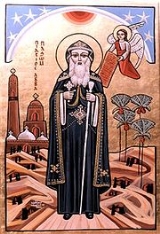
Saint Pachomius (ca. 292-348), also known as Abba Pachomius and Pakhom in Arabic ?????? ????????, is generally recognized as the founder of Christian
Christian

A Christian is a person who adheres to Christianity, a Monotheism#Christian view religion centered on the life and teachings of Jesus and interpreted by Christians to have been prophesied in the Hebrew Bible/Old Testament....
 cenobitic
Cenobitic

Cenobitic monasticism is a monastery tradition that stresses community life. Often in the West, the community belongs to a religious order and the life of the cenobitic monk is regulated by a rule, a collection of precepts....
 monasticism. His saint day is celebrated on 9 May.

as born in 292 in Thebes
Thebes, Egypt

Thebes was a city in Ancient Egypt located about 800 km south of the Mediterranean, on the east bank of the river Nile . It was the capital of Waset, the fourth Upper Egyptian Nome ....
 (Luxor
Luxor

Luxor is a city in Upper Egypt and the capital of Luxor Governorate. Its population numbers 376,022 , and its area is about . As the site of the ancient Egyptian city of Thebes, Egypt, Luxor has frequently been characterized as the "world's greatest open air museum", the ruins of the temple complexes at Karnak and Luxor Temple standing wi...
, Egypt
Egypt

Egypt is a country mainly in North Africa, with the Sinai Peninsula forming a land bridge in Western Asia. Covering an area of about , Egypt borders the Mediterranean Sea to the north, the Gaza Strip and Israel to the northeast, the Red Sea to the east, Sudan to the south and Libya to the west....
) to pagan parents. According to his hagiography
Hagiography

Hagiography is the study of saints. A hagiography, from Greek ' and ' , refers literally to writings on the subject of such holy people, and specifically the biography of ecclesiastical and secular leaders....
, he was swept up against his will in a Roman army recruitment drive at the age of 20, a common occurrence during the turmoils and civil wars of the period, and held in captivity.


Discussion
Ask a question about 'Pachomius'
Start a new discussion about 'Pachomius'
Answer questions from other users
Full Discussion Forum


Encyclopedia


Saint Pachomius (ca. 292-348), also known as Abba Pachomius and Pakhom in Arabic ?????? ????????, is generally recognized as the founder of Christian
Christian

A Christian is a person who adheres to Christianity, a Monotheism#Christian view religion centered on the life and teachings of Jesus and interpreted by Christians to have been prophesied in the Hebrew Bible/Old Testament....
 cenobitic
Cenobitic

Cenobitic monasticism is a monastery tradition that stresses community life. Often in the West, the community belongs to a religious order and the life of the cenobitic monk is regulated by a rule, a collection of precepts....
 monasticism. His saint day is celebrated on 9 May.

Biography

He was born in 292 in Thebes
Thebes, Egypt

Thebes was a city in Ancient Egypt located about 800 km south of the Mediterranean, on the east bank of the river Nile . It was the capital of Waset, the fourth Upper Egyptian Nome ....
 (Luxor
Luxor

Luxor is a city in Upper Egypt and the capital of Luxor Governorate. Its population numbers 376,022 , and its area is about . As the site of the ancient Egyptian city of Thebes, Egypt, Luxor has frequently been characterized as the "world's greatest open air museum", the ruins of the temple complexes at Karnak and Luxor Temple standing wi...
, Egypt
Egypt

Egypt is a country mainly in North Africa, with the Sinai Peninsula forming a land bridge in Western Asia. Covering an area of about , Egypt borders the Mediterranean Sea to the north, the Gaza Strip and Israel to the northeast, the Red Sea to the east, Sudan to the south and Libya to the west....
) to pagan parents. According to his hagiography
Hagiography

Hagiography is the study of saints. A hagiography, from Greek ' and ' , refers literally to writings on the subject of such holy people, and specifically the biography of ecclesiastical and secular leaders....
, he was swept up against his will in a Roman army recruitment drive at the age of 20, a common occurrence during the turmoils and civil wars of the period, and held in captivity. It was here that local Christians would daily bring food and comforts to the inmates, which made a lasting impression on him, and he vowed to investigate Christianity further when he got out. As fate would have it, he was able to get out of the army without ever having to fight, was converted and baptised (314). He then came into contact with a number of well known ascetics and decided to pursue that path. He sought out the hermit Palaemon and came to be his follower (317).

After studying seven years with the Elder Palamon, Pachomius set out to lead the life of a hermit
Hermit

A hermit is a person who lives to some greater or lesser degree in solitude and/or isolation from society.In Christianity the term was originally applied to a Christian who lives the eremitic life out of a religious conviction, namely the Catholic spirituality#Desert spirituality of the Old Testament ....
 near St. Anthony of Egypt
Anthony the Great

Anthony the Great , also known as Saint Anthony, Anthony the Abbot, Anthony of Egypt, Anthony of the Desert, Anthony the Anchorite, Abba Antonius , and Father of All Monks, was an Christianity saint from Egypt, a prominent leader among the Desert Fathers....
, whose practices he imitated until, according to legend, he heard a voice in Tabennisi that told him to build a dwelling for the hermits to come to. An earlier ascetic named Macarius
Macarius of Egypt

Macarius of Egypt was an Egyptian Christianity monasticism and hermit. He is also known as Macarius the Elder, Macarius the Great and The Lamp of the Desert....
 had earlier created a number of proto-monasteries called "larves", or cells, where holy men would live in a community setting who were physically or mentally unable to achieve the rigors of Anthony's solitary life. Pachomius set about organizing these cells into a formal organization.

Up to this point in time, Christian asceticism
Asceticism

Asceticism describes a life-style characterized by abstinence from various sorts of worldly pleasures often with the aim of pursuing religious and spirituality goals....
 had been solitary or eremitic. Male or female monastics lived in individual huts or caves and met only for occasional worship services. Pachomius seems to have created the community or cenobitic
Cenobitic

Cenobitic monasticism is a monastery tradition that stresses community life. Often in the West, the community belongs to a religious order and the life of the cenobitic monk is regulated by a rule, a collection of precepts....
 organization, in which male or female monastics lived together and had their possessions in common under the leadership of an abbot
Abbot

The word abbot, meaning father, is a title given to the head of a monastery in various traditions, including Christianity. The office may also be given as an honorary title to a clergyman who is not actually the head of a monastery....
 or abbess
Abbess

An abbess is the female religious superior, or Mother Superior, of an abbey of nuns.In Roman Catholic and Anglican abbeys, the mode of election, position, rights, and authority of an abbess correspond generally with those of an abbot....
. Pachomius himself was hailed as "Abba" (father) which is where we get the word Abbot from. This first cenobitic monastery was in Tabennisi, Egypt.

He established his first monastery between 318 and 323. The first to join him was his elder brother John, and soon more than 100 monks lived at his monastery. He came to found nine monasteries in his lifetime, and after 336, Pachomius spent most of his time at his Pabau monastery. From his initial monastery, demand quickly grew and, by the time of his death in 346, one count estimates there were 3000 monasteries dotting Egypt from north to south. Within a generation after his death, this number grew to 7000 and then moved out of Egypt into Palestine and the Judea Desert, Syria, North Africa and eventually Western Europe.

He is also credited with being the first Christian to use and recommend use of a prayer rope
Prayer rope

A prayer rope is a loop made up of complex knots, usually out of wool or silk, that is used by Eastern Orthodox Christianity and Eastern Catholic Churches to count the number of times they have prayer the Jesus Prayer: "Lord Jesus Christ, son of God, have mercy on me, a sinner."...
. He was visited once by Basil of Caesarea
Basil of Caesarea

Basil of Caesarea, also called Saint Basil the Great, was the bishop of Caesarea Mazaca in Cappadocia, Asia Minor . He was an influential 4th century Christian theologian and monastic....
 who took many of his ideas and implemented them in Caesarea, where Basil also made some adaptations that became the ascetic rule, or Ascetica, the rule still used today by the Eastern Orthodox Church
Eastern Orthodox Church

The Eastern Orthodox Church is the second largest single Christian communion in the world with an estimated 225 million members worldwide. It is considered by its adherents to be the Four Marks of the Church established by Jesus Christ and his Apostles nearly 2000 years ago....
, and comparable to that of the Rule of St. Benedict in the West.

Though Pachomius sometimes acted as lector for nearby shepherds, neither he or any of his monks became priests. St Athanasius visited and wished to ordain him in 333, but Pachomius fled from him. Athanasius' visit was probably a result of Pachomius' zealous defence of orthodoxy against Arianism
Arianism

Arianism is the theological teaching of Arius , a Christian priest, who was first ruled a heresy at the First Council of Nicea, later exonerated and then pronounced a heretic again after his death....
.

He remained abbot to the cenobites for some forty years. When he caught an epidemic disease (probably plague
Bubonic plague

Plague is a deadly infectious disease caused by the Enterobacteriaceae Yersinia pestis . Plague is a zoonotic, primarily carried by rodents and spread to humans via fleas....
), he called the monks, strengthened their faith, and appointed his successor. He then departed on 14 Pashons
Pashons 14 (Coptic Orthodox liturgics)

Pashons 13 - Coptic calendar - Pashons 15 ...
, 64 A.M. (9 May, 348
348

Events...
 A.D.)

His reputation as a holy man has endured. He is currently commemorated in several liturgical calendars, including that of the Evangelical Lutheran Church in America
Evangelical Lutheran Church in America

The Evangelical Lutheran Church in America is a mainline Protestantism List of Christian denominations headquartered in Chicago, Illinois. Formed in 1988 by the merging of three churches and currently having about 4.70 million baptized members, it is the largest of all the Lutheranism denominations in the Religion in the United States and t...
.

Coptic literature


Examples of purely Coptic literature
Coptic literature

Coptic literature is the body of writings in the Coptic language of Egypt, the last stage of the indigenous Egyptian language. It comprises mostly Christian texts dating after the 2nd century AD, but also includes Old Coptic writings that predate the Christian era....
 are the works of Abba Antonius and Abba Pachomius
Pachomius

Saint Pachomius , also known as Abba Pachomius and Pakhom in Arabic ?????? ????????, is generally recognized as the founder of Christian cenobitic monasticism....
, who spoke only Coptic, and the sermons and preachings of Abba Shenouda, who chose to write only in Coptic. Abba Shenouda was a popular leader who only spoke to the Copts in Coptic, the language of the repressed, not in Greek, the language of the repressive ruler.

The Pachomian
Pachomius

Saint Pachomius , also known as Abba Pachomius and Pakhom in Arabic ?????? ????????, is generally recognized as the founder of Christian cenobitic monasticism....
 system tended to treat religious literature as mere written instructions.

The earliest original writings in Coptic language
Coptic language

Coptic or Coptic Egyptian is the final stage of the Egyptian language, a northern Afro-Asiatic languages language spoken in Egypt until at least the seventeenth century....
 were the letters by St. Anthony of Egypt, first of the “Desert Fathers.” During the 3rd and 4th centuries many ecclesiastics and monks wrote in Coptic, among them, St. Pachomius, whose monastic rule (the first cenobitic rule, for solitary monks gathered in communities) survives only in Coptic. St. Athanasius, is the first Patriarch of Alexandria
Patriarch of Alexandria

The Patriarch of Alexandria is the Archbishop of Alexandria and Cairo, Egypt. Historically, this office has included the designation of Pope , and did so earlier than that of the Bishop of Rome....
 to use Coptic
Coptic language

Coptic or Coptic Egyptian is the final stage of the Egyptian language, a northern Afro-Asiatic languages language spoken in Egypt until at least the seventeenth century....
, as well as Greek.

See also

  • St. Benedict
  • Desert Fathers
    Desert Fathers

    The Desert Fathers were Hermits, Ascetics and Monks who lived mainly in the Scetes desert of Egypt, beginning around the third century. Very few of the Desert Fathers lived in other deserted regions of Egypt....
  • Book of the First Monks
    Book of the First Monks

    The Book of the First Monks is a medieval Christian work in the contemplative and hermit tradition of the Carmelites.Carmelite tradition holds that it was Elijah who inspired the early hermits who settled near the spring on Mount Carmel....
  • Coptic Saints
    Coptic saints

    Egypt was one of the first countries to know Christianity, with Saint Mark bringing Christianity to the country around 55 AD. The Egyptian Christians, also known as the Copts, have produced thousands of saints, many of whom are recognised simultaneously in the Oriental Orthodox Churches, the Eastern Orthodox Churches, and the Catholic Church....
  • Coptic monasticism
    Coptic monasticism

    Coptic Monasticism is claimed to be the original form of Monasticism as Pachomius, a Copt from Upper Egypt, established the first communal living in the Monastery of Saint Anthony ...


External links

  • The Rule Of Pachomius: , , , &