
All Topics  
Optical phenomenon

 
Optical Phenomenon

   Email Print
   Bookmark   Link


Optical phenomenon


An optical phenomenon is any observable event which results from the interaction of light
Light

Light, or visible light, is electromagnetic radiation of a wavelength that is Visible spectrum to the human eye , or up to 380?750 nm. In the broader field of physics, light is sometimes used to refer to electromagnetic radiation of all wavelengths, whether visible or not....
 and matter
Matter

In common usage, matter is anything that has both mass and volume . A more rigorous definition is used in science: matter is what atoms and molecules are made of....
. See also list of optical topics
List of optical topics

Probably some Wikipedia articles on topics in optics are not yet listed on this page. If you cannot find the topic you are interested in on this page, the article may nonetheless exist; you can try to find it using the "Search" box, or look in :Category:Optics and its subcategories....
 and optics
Optics

Optics is the study of the behavior and properties of light including its optical phenomena with matter and its imaging by optical instruments....
. A Mirage
Mirage

A mirage is a naturally occurring optical phenomenon in which light rays are bent to produce a displaced image of distant objects or the sky. The word comes to English via the French language mirage, from the Latin mirare, meaning "to look at, to wonder at"....
 is an example of an optical phenomenon.

Common optical phenomena are often due to the interaction of light from the sun or moon with the atmosphere, clouds, water, or dust and other particulates. One common example would be the rainbow
Rainbow

A rainbow is an optics and meteorology phenomenon that causes a optical spectrum of light to appear in the sky when the Sun shines onto droplets of moisture in the Earth's atmosphere....
, when light from the sun is reflected and refracted by water droplets.


Discussion
Ask a question about 'Optical phenomenon'
Start a new discussion about 'Optical phenomenon'
Answer questions from other users
Full Discussion Forum


Encyclopedia


An optical phenomenon is any observable event which results from the interaction of light
Light

Light, or visible light, is electromagnetic radiation of a wavelength that is Visible spectrum to the human eye , or up to 380?750 nm. In the broader field of physics, light is sometimes used to refer to electromagnetic radiation of all wavelengths, whether visible or not....
 and matter
Matter

In common usage, matter is anything that has both mass and volume . A more rigorous definition is used in science: matter is what atoms and molecules are made of....
. See also list of optical topics
List of optical topics

Probably some Wikipedia articles on topics in optics are not yet listed on this page. If you cannot find the topic you are interested in on this page, the article may nonetheless exist; you can try to find it using the "Search" box, or look in :Category:Optics and its subcategories....
 and optics
Optics

Optics is the study of the behavior and properties of light including its optical phenomena with matter and its imaging by optical instruments....
. A Mirage
Mirage

A mirage is a naturally occurring optical phenomenon in which light rays are bent to produce a displaced image of distant objects or the sky. The word comes to English via the French language mirage, from the Latin mirare, meaning "to look at, to wonder at"....
 is an example of an optical phenomenon.

Common optical phenomena are often due to the interaction of light from the sun or moon with the atmosphere, clouds, water, or dust and other particulates. One common example would be the rainbow
Rainbow

A rainbow is an optics and meteorology phenomenon that causes a optical spectrum of light to appear in the sky when the Sun shines onto droplets of moisture in the Earth's atmosphere....
, when light from the sun is reflected and refracted by water droplets. Some, such as the green ray, are so rare they are sometimes thought to be mythical. Others, such as Fata Morgana
Fata Morgana (mirage)

A fata morgana, Italian translation of Morgan le Fay, the fairy shapeshifting half-sister of King Arthur, is a mirage, an optical phenomenon which results from a temperature inversion....
s, are commonplace in favored locations.

Other phenomena are simply interesting aspects of optics
Optics

Optics is the study of the behavior and properties of light including its optical phenomena with matter and its imaging by optical instruments....
, or optical effects. The colors generated by a prism are often shown in classrooms for instance.
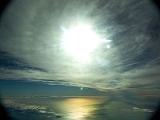
Sunhaloovergoldenbay4thfeb06

A list of optical phenomena


Optical phenomena include those arising from the optical properties of: the atmosphere
Atmosphere

An atmosphere is a layer of gases that may surround a material body of sufficient mass, by the gravity of the body, and are retained for a longer duration if gravity is high and the atmosphere's temperature is low....
; of the rest of nature (Other phenonema); of object
Object

Object may refer to,* Object , a thing, being or concept** Entity, something that is tangible and within the grasp of the senses* Object , a sentence element, such as a direct object or an indirect object...
s, whether natural or human-made (Optical effects); and of our eye
Eye

Eyes are Organ that detect light, and send signals along the optic nerve to the visual system and other areas of the brain. Complex optical systems with resolving power have come in ten fundamentally different forms, and 96% of animal species possess a complex optical system....
s (Entoptic phenomena). Also listed here are unexplained phenomena that could have an optical explanation and "optical illusion
Optical illusion

An optical illusion is characterized by visual perception images that differ from objective reality. The information gathered by the eye is processed in the brain to give a percept that does not tally with a physical measurement of the stimulus source....
s" for which optical explanations have been excluded.

There are many phenomena which result from either the particle
Photon

In physics, the photon is an elementary particle, the quantum of the electromagnetic field and the basic unit of light and all other forms of electromagnetic radiation....
 or the wave
Electromagnetic radiation

Electromagnetic radiation takes the form of wave propagation waves in a vacuum or in matter. EM radiation has an electric field and magnetic field component which oscillate in phase perpendicular to each other and to the direction of energy Wave propagation....
 nature of light. Some are quite subtle and observable only by precise measurement using scientific instruments. One famous observation was of the bending of light from a star by the Sun
Sun

The Sun , a G V star, is the star at the center of the Solar System. The Earth and other matter orbit the Sun, which by itself accounts for about 98.6% of the Solar System's mass....
 during a solar eclipse. This demonstrated that space
Spacetime

In physics, spacetime is any mathematical model that combines space and Time in physics into a single continuum . Spacetime is usually interpreted with space being Three-dimensional space and time playing the role of a fourth dimension that is of a different sort than the spatial dimensions....
 is curved. See Theory of relativity
Theory of relativity

File:spacetime curvature.pngThe theory of relativity, or simply relativity, generally refers specifically to two theories of Albert Einstein: special relativity and general relativity....
.

Observations of some phenomena such as the photoelectric effect
Photoelectric effect

The photoelectric effect is a phenomenon in which electrons are emitted from matter after the absorption of energy from electromagnetic wave such as x-rays or visible light....
, the flow of electric current in a material or through a vacuum (as in a photocell) when the material is exposed to light, led to advances in science, as they could not be easily explained by existing theory.

Atmospheric optical phenomena

  • Afterglow
    Afterglow

    An afterglow is a broad high arch of whitish or rosy light appearing in the sky due to very fine particles of dust suspended in the high regions of the earth's atmosphere....
  • Airglow
    Airglow

    The airglow is the very weak emission of light by the Earth's atmosphere; as a result, the night sky is never completely dark. It was first noticed in 1868 by Anders ?ngstr?m....
  • Alexander's band
    Alexander's band

    Alexander's band or Alexander's dark band is an optical phenomenon associated with rainbows which was named after Alexander of Aphrodisias who first described it....
    , the dark region between the two bows of a double rainbow.
  • Alpenglow
    Alpenglow

    Alpenglow is an optical phenomenon. When the Sun is just below the horizon, a Horizontal plane red glowing band can sometimes be observed on the opposite horizon....
  • Anticrepuscular rays
    Anticrepuscular rays

    Anticrepuscular rays are similar to crepuscular rays, but seen opposite the sun in the sky. Sunlight travels in straight lines, but the projections of these lines on Earth's spherical atmosphere are great circles....
  • Auroral light (northern and southern lights, aurora borealis and aurora australis)
  • Belt of Venus
    Belt of Venus

    The Belt of Venus or Venus's Girdle is the Victorian era name for an atmospheric phenomenon seen at sunrise and sunset. Shortly after sunset or shortly before sunrise the observer is, or is very nearly, surrounded by a pinkish glow or antitwilight arch that extends roughly 10??20? above the horizon....
  • Circumzenithal arc
    Circumzenithal arc

    The circumzenithal arc or circumzenith arc , also called the Bravais' arc, is an optical phenomenon similar in appearance to a rainbow; but it arises from refraction of sunlight through non-terminated, horizontally-oriented ice crystals, generally in cirrus clouds, rather than from water droplets....
  • Crepuscular rays
    Crepuscular rays

    Crepuscular rays, in Earth's atmosphere optics are Ray of sunlight that appear to radiate from a single point in the sky. These rays, which stream through gaps in clouds or between other objects, are columns of sunlit air separated by darker cloud-shadowed regions....
  • Earthquake lights
  • Elve
    Lightning

    File:Blesk.jpgLightning is an Earth's atmosphere discharge of electricity usually accompanied by thunder, which typically occurs during thunderstorms, and sometimes during volcano or dust storms....
    s
  • Glories
    Glory (optical phenomenon)

    A glory is an optical phenomenon appearing much like an iconic Saint's Halo about the head of the observer which is produced by light backscattered towards its source by a cloud of uniformly-sized water droplets....
     (also known as Brocken's Specter or Specter of the Brocken)
  • the Green ray
  • Halos
    Halo (optical phenomenon)

    A halo is an optical phenomenon that appears near or around the Sun or Moon, and sometimes near other strong light sources such as street lights....
    , of Sun or Moon, including sun dog
    Sun dog

    A sun dog or sundog is a common bright circular spot on a solar Halo . It is an atmospheric optical phenomenon primarily associated with the Reflection or refraction of sunlight by small ice crystals making up Cirrus cloud or cirrostratus clouds....
    s
  • Heiligenschein
    Heiligenschein

    Heiligenschein is an optical phenomenon which creates a bright spot around the shadow of the viewer's head. It is created when the surface on which the shadow falls has special optical characteristics....
     or halo effect, partly caused by the Opposition effect
    Opposition effect

    The opposition effect is the brightening of a rough surface, or an object with many particles, when illuminated from directly behind the observer....
  • Iridescent Clouds
  • Light pillar
    Light pillar

    A light pillar is a visual phenomenon created by the reflection of light from ice crystals with near horizontal parallel planar surfaces. The light can come from the sun in which case the phenomenon is called a sun pillar or solar pillar....
  • Rainbow
    Rainbow

    A rainbow is an optics and meteorology phenomenon that causes a optical spectrum of light to appear in the sky when the Sun shines onto droplets of moisture in the Earth's atmosphere....
    s
  • Mirage
    Mirage

    A mirage is a naturally occurring optical phenomenon in which light rays are bent to produce a displaced image of distant objects or the sky. The word comes to English via the French language mirage, from the Latin mirare, meaning "to look at, to wonder at"....
    s (including Fata Morgana
    Fata Morgana (mirage)

    A fata morgana, Italian translation of Morgan le Fay, the fairy shapeshifting half-sister of King Arthur, is a mirage, an optical phenomenon which results from a temperature inversion....
    )
  • Sprites
    Sprite (lightning)

    Sprites are large scale electrical discharges, or upper-atmospheric lightning, which occur high above thunderstorm clouds, or cumulonimbus, giving rise to a quite varied range of visual shapes....


  • Shadow set
  • Tyndall effect
    Tyndall effect

    The Tyndall effect is an effect of light scattering by colloid particles or particles in Suspension . It is named after the 19th century Irish scientist John Tyndall....


Other optical phenomena

  • Gegenschein
    Gegenschein

    Gegenschein , is a faint brightening of the night sky in the region of the antisolar point....
  • Iridescence
    Iridescence

    Iridescence is an optical phenomenon in which hue changes with the angle from which a surface is viewed. Iridescence may be easily seen in soap bubbles and butterfly wings....
  • Opposition effect
    Opposition effect

    The opposition effect is the brightening of a rough surface, or an object with many particles, when illuminated from directly behind the observer....
  • Sylvanshine
    Sylvanshine

    Sylvanshine is an optical phenomenon in which dew-covered trees of species whose leaves are wax-covered retroreflection beams of light, as from a vehicle's headlights, sometimes causing trees to appear to be snow-covered at night during the summer....
  • Zodiacal light
    Zodiacal light

    The zodiacal light is a faint, roughly triangular, whitish glow seen in the night sky which appears to extend up from the vicinity of the sun along the ecliptic or zodiac....


Optical effects

  • Asterism
    Asterism (gemmology)

    In gemmology, an asterism is an optical phenomenon displayed by some ruby, sapphires, and other gemstone of an enhanced reflective area in the shape of a "star" on the surface of a cabochon cut from the stone....
    , star gems
    Gemstone

    A gemstone or gem, also called a precious or semi-precious stone, is a piece of attractive mineral, which — when cut and polished — is used to make jewellery or other adornments....
     such as star sapphire
    Sapphire

    Sapphire refers to gem varieties of the mineral corundum, an aluminium oxide , when it is a color other than red, in which case the gem would instead be a ruby....
     or star ruby
    Ruby

    A ruby is a pink to blood-red gemstone, a variety of the mineral corundum . The red color is caused mainly by the presence of the element chromium....
    .
  • Aura, a phenomenon in which gas or dust surrounding an object luminesces or reflects light from the object.
  • Aventurescence
    Aventurescence

    In gemology, aventurescence is an optics reflectance effect seen in certain gemstone. The effect amounts to a metallic glitter, arising from minute, preferentially oriented mineral platelets within the material....
    , also called the Schiller effect, spangled gems
    Gemstone

    A gemstone or gem, also called a precious or semi-precious stone, is a piece of attractive mineral, which — when cut and polished — is used to make jewellery or other adornments....
     such as aventurine quartz and sunstone
    Sunstone

    Sunstone is a plagioclase feldspar exhibiting in certain directions a aventurescence, which has led to its use as a gemstone.The effect appears to be due to reflections from enclosures of red haematite, in the form of minute scales, which are hexagonal, rhombus or irregular in shape, and are disposed parallel to the principal Cleavage ....
    .
  • The camera obscura
    Camera obscura

    The camera obscura is an optical device used, for example, in drawing or for entertainment. It is one of the inventions leading to photography....
  • Caustics
    Caustic (optics)

    In optics, a caustic is the envelope of light rays Reflection or refraction by a curved surface or object, or the Projection of that envelope of rays on another surface....
  • Chatoyancy
    Chatoyancy

    In gemology, chatoyancy , or chatoyance, is an optics reflectance effect seen in certain gemstones. Coined from the French "oeil de chat", meaning "cat's eye", chatoyancy arises either from the fibrous structure of a material, as in Tiger's-eye quartz, or from fibrous inclusions or cavities within the stone, as in cat's eye chrysobery...
    , cat's eye gems
    Gemstone

    A gemstone or gem, also called a precious or semi-precious stone, is a piece of attractive mineral, which — when cut and polished — is used to make jewellery or other adornments....
     such as chrysoberyl
    Chrysoberyl

    The mineral or gemstone chrysoberyl, not to be confused with beryl, is an aluminium of beryllium with the formula BeAl2O4....
     cat's eye or aquamarine
    Aquamarine

    Aquamarine is a gemstone-quality transparent variety of beryl, having a delicate blue or turquoise color, suggestive of the tint of seawater. It is closely related to the gem emerald....
     cat's eye
  • Chromatic polarization
  • Cathodoluminescence
    Cathodoluminescence

    Cathodoluminescence is an optical p and electrical phenomenon phenomenon whereby a beam of electrons is generated by an electron gun and then impacts on a luminescent material such as a phosphor, causing the material to emit visible light....
  • Diffraction
    Diffraction

    Diffraction is normally taken to refer to various phenomena which occur when a wave encounters an obstacle. It is described as the apparent bending of waves around small obstacles and the spreading out of waves past small openings....
    , the apparent bending and spreading of light wave
    Wave

    A wave is a disturbance that propagates through space and time, usually with transference of energy. While a mechanical wave exists in a medium , waves of electromagnetic radiation can travel through vacuum, that is, without a medium....
    s when they meet an obstruction.
  • Dispersion
    Dispersion (optics)

    In optics, dispersion is the phenomenon in which the phase velocity of a wave depends on its frequency.Media having such a property are termed dispersive media....
  • Double refraction
  • The Double-slit experiment
    Double-slit experiment

    The double-slit experiment in quantum mechanics is an experiment that demonstrates the inseparability of the wave and Elementary particle natures of light and other quantum particles....
  • Electroluminescence
    Electroluminescence

    Electroluminescence is an optical phenomenon and electrical phenomenon in which a material emits light in response to an electric current passed through it, or to a strong electric field....
  • Evanescent wave
    Evanescent wave

    An evanescent wave is a Near and far field wave exhibiting exponential decay with distance. Evanescent waves are always associated with matter, and are most intense within one-third wavelength from any acoustical, optical, or electromagnetic transducer....
  • Fluorescence
    Fluorescence

    Fluorescence is a luminescence that is mostly found as an optical phenomenon in cold bodies, in which the molecular absorption of a photon triggers the emission of a photon with a longer wavelength....
    , also called luminescence or photoluminescence
    Photoluminescence

    Photoluminescence is a process in which a substance absorbs photons and then re-radiates photons. quantum mechanics, this can be described as an Quantum jump to a higher energy level and then a return to a lower energy state accompanied by the emission of a photon....
    .
  • Phosphorescence
    Phosphorescence

    File:Phosphorescence.jpgFile:Phosphorescent.jpgPhosphorescence is a specific type of photoluminescence related to fluorescent. Unlike fluorescence, a phosphorescent material does not immediately re-emit the radiation it absorbs....
  • metamerism
    Metamerism (color)

    In colorimetry, metamerism is the matching of apparent color of objects with different spectral power distributions. Colors that match this way are called metamers....
     as of alexandrite
  • Newton's rings
    Newton's rings

    The phenomenon of Newton's rings, named after Isaac Newton, is an interference pattern caused by the reflection of light between two surfaces - a sphere surface and an adjacent flat surface....
  • Pleochroism
    Pleochroism

    Pleochroism is an optical phenomenon in which mineral grains within a Rock appear to be different colors when observed at different angles under a polarization petrographic microscope....
     gem
    Gemstone

    A gemstone or gem, also called a precious or semi-precious stone, is a piece of attractive mineral, which — when cut and polished — is used to make jewellery or other adornments....
    s or crystal
    Crystal

    A crystal or crystalline solid is a solid material whose constituent atoms, molecules, or ions are arranged in an orderly repeating pattern extending in all three spatial dimensions....
    s which seem many-colored
  • Polarized light
    Polarization

    Polarization is a property of waves that describes the orientation of their oscillations. For transverse waves such as many electromagnetic waves, it describes the orientation of the oscillations in the plane perpendicular to the wave's direction of travel....
    -related phenomena such as double refraction, or Haidinger's brush
    Haidinger's brush

    Haidinger's brush is an entoptic phenomenon first described by Austrianphysicist Wilhelm Karl von Haidinger in 1844.Many people are able to perceive polarization of light....
  • Rayleigh scattering
    Rayleigh scattering

    Rayleigh scattering is the elastic scattering of light or other electromagnetism radiation by particles much smaller than the wavelength of the light....
     (Why the sky is blue, sunsets are red, clouds are white, and associated phenomena)
  • Refraction
    Refraction

    Refraction is the change in direction of a wave due to a change in its speed. This is most commonly observed when a wave passes from one optical medium to another....
  • Sonoluminescence
    Sonoluminescence

    Sonoluminescence is the emission of short bursts of light from Implosion Liquid bubbles in a liquid when excited by sound....
    • Shrimpoluminescence
      Sonoluminescence

      Sonoluminescence is the emission of short bursts of light from Implosion Liquid bubbles in a liquid when excited by sound....
  • Synchrotron radiation
    Synchrotron radiation

    Synchrotron radiation is electromagnetic radiation, similar to cyclotron radiation, but generated by the acceleration of Ultrarelativistic limit charged particles through magnetic fields....
  • The separation of light into colors by a prism
  • Triboluminescence
    Triboluminescence

    Triboluminescence is an optical phenomenon in which light is generated when asymmetrical crystal bonds in a material are broken when that material is scratched, crushed, or rubbed....
  • The Zeeman effect
    Zeeman effect

    The Zeeman effect is the splitting of a spectral line into several components in the presence of a static magnetic field. It is analogous to the Stark effect, the splitting of a spectral line into several components in the presence of an electric field....
  • Thomson Scattering
    Thomson scattering

    In physics, Thomson scattering is the elastic scattering of electromagnetic radiation by acharged particle. The electric and magnetic components of the...
  • Total internal reflection
    Total internal reflection

    Total internal reflection is an optical phenomenon that occurs when a ray of light strikes a medium boundary at an angle larger than the critical angle with respect to the normal to the surface....
  • Twisted light
  • The Umov effect
    Umov effect

    The Umov effect, also known as Umov's law, is a relationship between the albedo of an astronomical object, and the degree of polarization of light reflecting off it....


  • The ability of light to travel through space or through a vacuum.


Entoptic phenomena

  • Diffraction
    Diffraction

    Diffraction is normally taken to refer to various phenomena which occur when a wave encounters an obstacle. It is described as the apparent bending of waves around small obstacles and the spreading out of waves past small openings....
     of light through the eye lashes
  • Floaters
  • Haidinger's brush
    Haidinger's brush

    Haidinger's brush is an entoptic phenomenon first described by Austrianphysicist Wilhelm Karl von Haidinger in 1844.Many people are able to perceive polarization of light....
  • Monocular
    Monocular

    A monocular is a modified refracting telescope used to magnify the images of distant objects by passing light through a series of lens and Prism s; the use of prisms results in a mass telescope....
     diplopia
    Diplopia

    Diplopia, commonly known as double vision, is the simultaneous perception of two images of a single object. These images may be displaced horizontally, vertically, or diagonally in relation to each other....
     (or polyplopia) from reflections at boundaries between the various ocular media
  • Phosphene
    Phosphene

    A phosphene is an entoptic phenomenon characterized by the experience of seeing light without light actually entering the eye. The word phosphene comes from the Greek words phos and phainein ....
    s from stimulation other than by light (e.g., mechanical, electrical) of the rod cell
    Rod cell

    Rod cells, or rods, are photoreceptor cells in the retina of the eye that can function in less intense light than can the other type of photoreceptor, cone cells....
    s and cones
    Cone cell

    Cone cells, or cones, are photoreceptor cells in the retina of the eye which function best in relatively bright light. The cone cells gradually become sparser towards the periphery of the retina....
     of the eye or of other neurons of the visual system
  • Purkinje images
    Purkinje images

    Purkinje images are reflections of objects from structure of the eye. They are also known as Purkinje reflexes and as Purkinje-Sanson images. There are at least four Purkinje images that are visible on looking at an eye....
    .


Optical illusions


  • The unusually large size of the Moon
    Moon

    The Moon is Earth's only natural satellite and the List of natural satellites by diameter satellite in the Solar System. The average centre-to-centre distance from the Earth to the Moon is km, about thirty times the diameter of the Earth....
     as it rises and sets, the moon illusion
    Moon illusion

    The Moon illusion is an optical illusion in which the Moon appears larger near the horizon than it does while higher up in the sky. This optical illusion also occurs with the sun and constellation....
  • The shape of the sky, the sky bowl
    Moon illusion

    The Moon illusion is an optical illusion in which the Moon appears larger near the horizon than it does while higher up in the sky. This optical illusion also occurs with the sun and constellation....


Unexplained phenomena

Some phenomena are still unexplained, and they could very possibly be some kind of optical phenomena. Some consider many of these "mysteries" to be simply local tourist attractions not worthy of investigation.

  • Marfa lights
  • Hessdalen light
    Hessdalen light

    Hessdalen Lights are unexplained lights usually seen in the valley of Hessdalen, Norway.These lights are well known and have been recorded and studied by physicists....
    s
  • Min Min light
    Min Min light

    Min Min Light is the name given to an unusual light formation that has been reported numerous times in eastern Australia. The lights have been reported from as far south as Brewarrina in western New South Wales, to as far north as Boulia in northern Queensland....
    s
  • Light of Saratoga
    Light of Saratoga

    The "Light of Saratoga" is a legend located in the Big Thicket of Southeast Texas. This legend of a mysterious light is also known as the "Ghost Road" of Saratoga, the "Saratoga Light", and "Bragg Road Ghost Light" by local residents....
     
  • Naga Fireballs
    Naga fireballs

    The Naga fireballs are a phenomenon seen in the Mekong river - in Thailand and in Laos - in which glowing balls rise from depths. The balls are reddish in colour and about the size of an egg; they rise a couple of hundred metres before disappearing....


External links

  • Reference site
  • Site for reporting Aurora activity data
  • Official NASA site with many photos
  • Many atmospheric optical effect photos and descriptions


Further reading

  • Thomas D. Rossing and Christopher J. Chiaverina, Light Science: Physics and the Visual Arts, Springer, New York, 1999, hardback, ISBN 0-387-98827-0
  • Robert Greenler, Rainbows, Halos, and Glories, Elton-Wolf Publishing, 1999, hardback, ISBN 0-89716-926-3
  • Polarized Light in Nature, G. P. Können, Translated by G. A. Beerling, Cambridge University Press, 1985, hardcover, ISBN 0-521-25862-6
  • M.G.J. Minnaert, Light and Color in the Outdoors, ISBN 0-387-97935-2
  • John Naylor "Out of the Blue: A 24-hour Skywatcher's Guide", CUP, 2002, ISBN 0-521-80925-8
  • (German).