
Home      Discussion      Topics      Dictionary      Almanac
Signup       Login
Ondol

Ondol

Overview
An ondol, also called gudeul, in Korean traditional architecture, is underfloor heating
Underfloor heating
Underfloor heating and cooling is a form of central heating and cooling which achieves indoor climate control for thermal comfort using conduction, radiation and convection...

 which uses direct heat transfer from wood smoke to the underside of a thick masonry floor. In modern usage it refers to any type of underfloor heating, or a hotel or sleeping room in Korean (as opposed to Western) style.
Discussion
Ask a question about 'Ondol'
Start a new discussion about 'Ondol'
Answer questions from other users
Full Discussion Forum
 
Recent Discussions
Encyclopedia
An ondol, also called gudeul, in Korean traditional architecture, is underfloor heating
Underfloor heating
Underfloor heating and cooling is a form of central heating and cooling which achieves indoor climate control for thermal comfort using conduction, radiation and convection...

 which uses direct heat transfer from wood smoke to the underside of a thick masonry floor. In modern usage it refers to any type of underfloor heating, or a hotel or sleeping room in Korean (as opposed to Western) style.

The main components of the traditional ondol are a firebox
Firebox
In a steam engine, the firebox is the area where the fuel is burned, producing heat to boil the water in the boiler. Most are somewhat box-shaped, hence the name.-Railway locomotive firebox :...

 or stove
Stove
A stove is an enclosed heated space. The term is commonly taken to mean an enclosed space in which fuel is burned to provide heating, either to heat the space in which the stove is situated or to heat the stove itself, and items placed on it...

 (agungi; 아궁이) accessible from an adjoining (typically kitchen or master bedroom) room, a raised masonry
Masonry
Masonry is the building of structures from individual units laid in and bound together by mortar; the term masonry can also refer to the units themselves. The common materials of masonry construction are brick, stone, marble, granite, travertine, limestone; concrete block, glass block, stucco, and...

 floor underlain by horizontal smoke passages, and a vertical, freestanding chimney
Chimney
A chimney is a structure for venting hot flue gases or smoke from a boiler, stove, furnace or fireplace to the outside atmosphere. Chimneys are typically vertical, or as near as possible to vertical, to ensure that the gases flow smoothly, drawing air into the combustion in what is known as the...

 on the opposite exterior providing a draft. The heated floor is supported by stone piers or baffles to distribute the smoke, covered by stone slabs, clay and an impervious layer such as oiled paper.

Origin


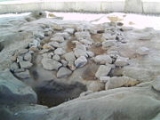
The earliest use of ondol has been found at an archaeological site in present-day North Korea.
A Bronze Age
Bronze Age
The Bronze Age is a period characterized by the use of copper and its alloy bronze as the chief hard materials in the manufacture of some implements and weapons. Chronologically, it stands between the Stone Age and Iron Age...

 archaeological find, circa BCE 1000, discovered in Unggi, Hamgyeongbuk-do, in present-day North Korea, shows a clear vestige of Gudeul(Korean: 구들) in the Excavated Dwelling (Korean:움집 Chinese:竪穴住居) unearthed at the archaeological site.

Etymology


The term Gudeul has been colloquially spoken for over two thousand years, while the term ondol has shown up in modern times, around the end of 19th century. According to a Korean folkloric historian Son Jintae(1900 - missing during the 1950-53 Korean War), Gudeul has been originated from guun-dol(Korean), which means heated stone, and its pronunciation has undergone some change from Gudol or Gudul to finally take the form of Gudeul. Ondol was first written in Hanja
Hanja
Hanja is the Korean name for the Chinese characters hanzi. More specifically, it refers to those Chinese characters borrowed from Chinese and incorporated into the Korean language with Korean pronunciation...

 by modern-day writers.

Use


Ondol had traditionally been used with a living space for sitting, eating, sleeping and pastimes, in most Korean homes before the 1960s. The furnace burned mainly rice paddy straws, agricultural crop waste, biomass
Biomass
Biomass, as a renewable energy source, is biological material from living, or recently living organisms. As an energy source, biomass can either be used directly, or converted into other energy products such as biofuel....

 or any kind of dried firewood. For short-term cooking, rice paddy straws or crop waste was preferred, while long hours of cooking and floor heating needed longer-burning firewood. Unlike modern-day water heaters, the fuel burning was either sporadically or regularly done (2 to 5 times a day), dependent on frequency of cooking and seasonal weather conditions.

With the traditional ondol heating, floor spots closer to the furnace were normally warm enough with warmer spots reserved for elders and honored guests. Ondol had problems such as carbon monoxide poisoning resulting from burning coal briquette, and environmental pollution. For these reasons, other technology heats modern Korean homes.

See also

  • Korean architecture
    Korean architecture
    Korean architecture refers to the built environment of Korea from c. 30,000 BC to the present.-Introduction:From a technical point of view, buildings are structured vertically and horizontally...

  • List of Korea-related topics
  • Culture of Korea
    Culture of Korea
    The current political separation of North and South Korea has resulted in divergence in modern Korean cultures; nevertheless, the traditional culture of Korea is historically shared by both states.-Dance:...

  • Hypocaust
    Hypocaust
    A hypocaust was an ancient Roman system of underfloor heating, used to heat houses with hot air. The word derives from the Ancient Greek hypo meaning "under" and caust-, meaning "burnt"...

  • Gloria (heating system)
    Gloria (heating system)
    Gloria was a central heating system used in Castile beginning in the Middle Ages. It was a direct descendant of the Roman hypocaust, and due to its slow rate of combustion, it allowed people to use smaller fuels such as hay instead of wood.-Description:The Gloria consisted of a firebox, generally...

  • Kang bed-stove
    Kang bed-stove
    The Kang is a traditional long sleeping platform made of bricks or other forms of fired clay and more recently of concrete in some locations. Its interior cavity, leading to a flue, channels the exhaust from a wood or coal stove...

  • Masonry heater
    Masonry heater
    A masonry heater is a device for warming a home that captures the heat from periodic burning of fuels , and then radiates that heat over a long period at a fairly constant temperature. The technology exists in many forms from the Roman hypocaust to the Austrian/German kachelofen...

  • Underfloor heating
    Underfloor heating
    Underfloor heating and cooling is a form of central heating and cooling which achieves indoor climate control for thermal comfort using conduction, radiation and convection...


External links