
Ollanta Moisés Humala Tasso (born June 26, 1962) is a
PeruPeru , officially the Republic of Peru , is a country in western South America. It is bordered on the north by Ecuador and Colombia, on the east by Brazil, on the southeast by Bolivia, on the south by Chile, and on the west by the Pacific Ocean....
vian politician and the President of Peru. Humala, who previously served as an army officer, lost the presidential election in 2006 but won the
2011 presidential electionThe Peruvian general election, 2011 took place on 10 April 2011. Since no candidate received more than half of all valid votes, a second round was necessary to determine the winner. This second round took place on 5 June and determined the successor of Alan García, as well as 130 members of the...
in a
run-off voteThe two-round system is a voting system used to elect a single winner where the voter casts a single vote for their chosen candidate...
. He was elected as President of Peru in the second round, defeating
Keiko FujimoriKeiko Sofía Fujimori Higuchi is a Peruvian Fujimorista politician, daughter of former Peruvian President Alberto Fujimori and Susana Higuchi. She served as First Lady, from 1994 to 2000, after her parents divorced, becoming the youngest First Lady in the history of the Americas...
.
The son of
Isaac HumalaIsaac Humala Núñez is a labour lawyer from Ayacucho and the ideological leader of the Movimiento Etnocacerista, a group of ethnic nationalists in Peru...
, a labour lawyer, Humala entered the
Peruvian ArmyThe Peruvian Army is the branch of the Peruvian Armed Forces tasked with safeguarding the independence, sovereignty and integrity of national territory on land through military force. Additional missions include assistance in safeguarding internal security, conducting disaster relief operations...
in 1982. In the military he achieved the rank of
Lieutenant ColonelLieutenant colonel is a rank of commissioned officer in the armies and most marine forces and some air forces of the world, typically ranking above a major and below a colonel. The rank of lieutenant colonel is often shortened to simply "colonel" in conversation and in unofficial correspondence...
; in 1992 he fought in the
internal conflictIt has been estimated that nearly 70,000 people died in the internal conflict in Peru that started in 1980 and, although still ongoing, had greatly wound down by 2000. The principal actors in the war were the Shining Path , the Túpac Amaru Revolutionary Movement and the government of Peru.A great...
against the
Shining PathShining Path is a Maoist guerrilla terrorist organization in Peru. The group never refers to itself as "Shining Path", and as several other Peruvian groups, prefers to be called the "Communist Party of Peru" or "PCP-SL" in short...
and three years later he participated in the
Cenepa WarThe Cenepa War , also known as the Alto Cenepa War, was a brief and localized military conflict between Ecuador and Peru, fought over control of a disputed area on the border between the two countries...
against
EcuadorEcuador , officially the Republic of Ecuador is a representative democratic republic in South America, bordered by Colombia on the north, Peru on the east and south, and by the Pacific Ocean to the west. It is one of only two countries in South America, along with Chile, that do not have a border...
. In October 2000, Humala led an unsuccessful military revolt by 39 soldiers in the southern city of
Tacna- Rail :Tacna is served by a cross-border standard gauge railway to Arica, Chile.It is also the location of the National Railway Museum of Peru.-Air:Tacna is served by the Crnl. FAP...
against President
Alberto FujimoriAlberto Fujimori Fujimori served as President of Peru from 28 July 1990 to 17 November 2000. A controversial figure, Fujimori has been credited with the creation of Fujimorism, uprooting terrorism in Peru and restoring its macroeconomic stability, though his methods have drawn charges of...
; he was pardoned by the
Peruvian CongressThe Congress of the Republic of Peru or the National Congress of Peru is the unicameral body that assumes legislative power in Peru.Congress consists of 130 members of congress , who are elected for five year periods in office on a proportional representation basis...
after the downfall of the Fujimori regime.
In 2005 he founded the
Peruvian Nationalist PartyThe Peruvian Nationalist Party is a political party in Peru. The ideology of the party is wrongly considered to be nationalism with strong ties to the Movimiento Etnocacerista.Ollanta Humala was the Peruvian Nationalist Party's...
and registered to run in the
2006 presidential electionThe first round of the 2006 Peruvian national election was held on April 9, 2006 to elect the President of the Republic, two Vice-Presidents, 120 Members of Congress, and five Peruvian members of the Andean Parliament , for the 2006-2011 period.No single presidential ticket obtained more than half...
. The nomination was made under the
Union for PeruUnion for Peru is a Peruvian political party. UPP was founded by Javier Pérez de Cuéllar, ex UN Secretary General, in 1994. UPP was originally a liberal or centrist political party....
ticket as the Nationalist party did not achieve its electoral inscription on time. He passed the first round of the elections, held on April 9, 2006, with 30.62% of the valid votes. A runoff was held on June 4 between Humala and Alan García of the Peruvian Aprista Party. Humala lost this round with 47.47% of the valid votes versus 52.62% for García. After his defeat, Humala remained as an important figure within
Peruvian politicsPolitics of the Republic of Peru takes place in a framework of a presidential representative democratic republic, whereby the President of Peru is both head of state and head of government, and of a pluriform multi-party system. Executive power is exercised by the government. Legislative power is...
.
In 2011, Humala campaigned as a center-left leader with the desire to help to create a more equitable framework for distributing the wealth from the country's key natural resources, with the goal of maintaining foreign investment and economic growth in the country while working to improve the condition of an impoverished majority.
Military career
Ollanta Humala is the son of
Isaac HumalaIsaac Humala Núñez is a labour lawyer from Ayacucho and the ideological leader of the Movimiento Etnocacerista, a group of ethnic nationalists in Peru...
, an ethnic
indigenousIndigenous peoples are ethnic groups that are defined as indigenous according to one of the various definitions of the term, there is no universally accepted definition but most of which carry connotations of being the "original inhabitants" of a territory....
lawyer, member of the Communist Party of Peru – Red Fatherland, and ideological leader of the
EthnocaceristaPeru's Movimiento Etnocacerista is a group of ethnic nationalists....
movement. Ollanta's mother is Elena Tasso. He is the brother of
Antauro HumalaAntauro Humala Tasso is a Peruvian nationalist and former army major.He attained international prominence on 1 January 2005 by occupying a rural police station in Andahuaylas, Apurímac Region...
, now serving a 25 years prison sentence for kidnapping 17 Police officers for 3 days and killing 4 of them and professor
Ulises HumalaUlises Humala Tasso is a professor at the Universidad Nacional de Ingeniería and a Peruvian politician who ran unsuccessfully for president in the 2006 election on the Avanza País ticket. He was running against his brother, Ollanta Humala, and 18 other candidates...
. Humala was born in Peru and attended the Japanese-Peruvian school
La Union in Lima. He began his military career in 1982 when he entered the
Chorrillos Military SchoolThe Chorrillos Military School is the institution in charge of the undergraduate education of officers of the Peruvian Army. It is located at Chorrillos, Lima, Peru, hence its name. Its current director is Brigade General Walter Martos Ruiz. It was also the alma mater of Manuel Noriega....
.
In his military career, Humala was also involved in the two major Peruvian conflicts of the past 20 years, the
battleIt has been estimated that nearly 70,000 people died in the internal conflict in Peru that started in 1980 and, although still ongoing, had greatly wound down by 2000. The principal actors in the war were the Shining Path , the Túpac Amaru Revolutionary Movement and the government of Peru.A great...
against the insurgent organization
Shining PathShining Path is a Maoist guerrilla terrorist organization in Peru. The group never refers to itself as "Shining Path", and as several other Peruvian groups, prefers to be called the "Communist Party of Peru" or "PCP-SL" in short...
and the 1995
Cenepa WarThe Cenepa War , also known as the Alto Cenepa War, was a brief and localized military conflict between Ecuador and Peru, fought over control of a disputed area on the border between the two countries...
with
EcuadorEcuador , officially the Republic of Ecuador is a representative democratic republic in South America, bordered by Colombia on the north, Peru on the east and south, and by the Pacific Ocean to the west. It is one of only two countries in South America, along with Chile, that do not have a border...
. In 1992 Humala served in
Tingo MaríaTingo María is the capital of Leoncio Prado Province in the Huánuco Region in central Peru. It has an urban population of around 55,000 ....
fighting the remnants of the Shining Path and in 1995 he served in the Cenepa War on the border with Ecuador.
2000 uprising
In October 2000, Humala led an uprising in Toquepala against
Alberto FujimoriAlberto Fujimori Fujimori served as President of Peru from 28 July 1990 to 17 November 2000. A controversial figure, Fujimori has been credited with the creation of Fujimorism, uprooting terrorism in Peru and restoring its macroeconomic stability, though his methods have drawn charges of...
on his last days as President due to multiple corruption scandals. The main reason given for the rebellion was the capture of
Vladimiro MontesinosVladimiro Ilyich Montesinos Torres was the long-standing head of Peru's intelligence service, Servicio de Inteligencia Nacional , under President Alberto Fujimori. In 2000, secret videos, which he had recorded, were televised that showed his bribing an elected congressman to leave the opposition...
, former intelligence chief who had fled Peru for asylum in
PanamaPanama , officially the Republic of Panama , is the southernmost country of Central America. Situated on the isthmus connecting North and South America, it is bordered by Costa Rica to the northwest, Colombia to the southeast, the Caribbean Sea to the north and the Pacific Ocean to the south. The...
after being caught on video trying to bribe an opposition congressman. The return of Montesinos led to fears that he still had much power in Fujimori's government, so Humala and about 40 other Peruvian soldiers revolted against their senior army commander.
Many of Humala's men deserted him, leaving him only 7 soldiers. During the revolt, Humala called on Peruvian "patriots" to join him in the rebellion, and around 300 former soldiers led by his brother Antauro answered his call and were reported to have been in a convoy attempting to join up with Humala. The revolt gained some sympathy from the Peruvian populace with the influential opposition newspaper
La RepúblicaLa República is a center-left newspaper published in Lima, Peru. It is one of the two main national dailies sold all over the country since it was founded on May 3, 1981. The paper was founded by Gustavo Mohme Llona, a former member of the Peruvian Congress...
calling him "valiant and decisive, unlike most in Peru". The newspaper also had many letters sent in by readers with accolades to Ollanta and his men.
In the aftermath, the Army sent hundreds of soldiers to capture the rebels. Even so, Humala and his men managed to hide until President Fujimori was impeached from office a few days later and
Valentín PaniaguaValentín Paniagua Corazao was a Peruvian politician and former Interim President of Peru. Paniagua was elected by the Peruvian Congress to serve as interim president of the country after Alberto Fujimori was ousted from office by Congress in November 2000.As Interim President, his main task was to...
named interim president. Later Humala was pardoned by
CongressThe Congress of the Republic of Peru or the National Congress of Peru is the unicameral body that assumes legislative power in Peru.Congress consists of 130 members of congress , who are elected for five year periods in office on a proportional representation basis...
and allowed to return to military duty. He was sent as
military attachéA military attaché is a military expert who is attached to a diplomatic mission . This post is normally filled by a high-ranking military officer who retains the commission while serving in an embassy...
to Paris, then to Seoul until December 2004, when he was forcibly retired. His forced retirement is suspected to have partly motivated an
etnocacerista rebellion of Andahuaylas led by his brother
Antauro HumalaAntauro Humala Tasso is a Peruvian nationalist and former army major.He attained international prominence on 1 January 2005 by occupying a rural police station in Andahuaylas, Apurímac Region...
in January 2005.
In 2002 Humala received a Master's degree in Political Science by the Pontifical Catholic University of Peru.
2006 presidential campaign
In October 2005 Humala created the Partido Nacionalista Peruano (the Peruvian Nationalist Party) and ran for the presidency in 2006 with the support of
Union for PeruUnion for Peru is a Peruvian political party. UPP was founded by Javier Pérez de Cuéllar, ex UN Secretary General, in 1994. UPP was originally a liberal or centrist political party....
(UPP) .
Ambassador
Javier Pérez de CuéllarJavier Pérez de Cuéllar y de la Guerra is a Peruvian diplomat who served as the fifth Secretary-General of the United Nations from January 1, 1982 to December 31, 1991. He studied in Colegio San Agustín of Lima, and then at Pontificia Universidad Católica del Perú. In 1995, he ran unsuccessfully...
, the former Peruvian Secretary-General of the United Nations and founder of UPP, told the press on December 5, 2005 that he did not support the election of Humala as the party's presidential candidate. He said that after being the UPP presidential candidate in 1995, he had not had any further contact with UPP and therefore did not take part in choosing Humala as the party's presidential candidate for the 2006 elections.
There were some accusations that he incurred in torture, under the
nom de guerre "Capitán Carlos" ("Captain Carlos"), while he was the commander of a military base in the jungle region of Madre Mia from 1992 to 1993. His brother
Antauro HumalaAntauro Humala Tasso is a Peruvian nationalist and former army major.He attained international prominence on 1 January 2005 by occupying a rural police station in Andahuaylas, Apurímac Region...
stated in 2006 that Humala had used such a name during their activities. Humala, in an interview with Jorge Ramos, acknowledged that he went under the pseudonym Captain Carlos but stated that other soldiers went under the same name and denied participation in any human rights abuses.
On March 17, 2006 Humala's campaign came under some controversy as his father, Issac Humala, said "If I was President, I would grant amnesty to him (
Abimael GuzmánManuel Rubén Abimael Guzmán Reynoso , also known by the nom de guerre Presidente Gonzalo , a former professor of philosophy, was the leader of the Shining Path during the Maoist insurgency known as the internal conflict in Peru...
) and the other incarcerated members of the
Shining PathShining Path is a Maoist guerrilla terrorist organization in Peru. The group never refers to itself as "Shining Path", and as several other Peruvian groups, prefers to be called the "Communist Party of Peru" or "PCP-SL" in short...
". He made similar statements about amnesty for
Víctor PolayVíctor Polay Campos is one of the founders of the Túpac Amaru Revolutionary Movement, a Peruvian guerrilla organization that fought in the internal conflict in Peru...
, the leader of the
Túpac Amaru Revolutionary MovementThe Túpac Amaru Revolutionary Movement was a Marxist revolutionary group active in Peru from the early 1980s to 1997 and one of the main actors in the internal conflict in Peru...
, and other leaders of the MRTA. But Ollanta Humala distanced himself from the more radical members of his family during his campaign. Humala's mother, meanwhile, made a statement on the March 21 calling for homosexuals to be shot.
Ollanta Humala's brother,
Ulises HumalaUlises Humala Tasso is a professor at the Universidad Nacional de Ingeniería and a Peruvian politician who ran unsuccessfully for president in the 2006 election on the Avanza País ticket. He was running against his brother, Ollanta Humala, and 18 other candidates...
, ran against him in the election, but was considered an extremely minor candidate and came in 14th place in the election.
On April 9, 2006 the first round of the Peruvian national election was held. Humala came in first place getting 30.62% of the valid votes, and immediately began preparing to face Alan García, who obtained 24.32%, in a runoff election on June 4.
On May 20, 2006, the day before the first Presidential debate between Alan García and Ollanta Humala, a tape of the former Peruvian intelligence chief
Vladimiro MontesinosVladimiro Ilyich Montesinos Torres was the long-standing head of Peru's intelligence service, Servicio de Inteligencia Nacional , under President Alberto Fujimori. In 2000, secret videos, which he had recorded, were televised that showed his bribing an elected congressman to leave the opposition...
was released by Montesinos' lawyer to the press with Montesinos claiming that Humala had started the October 29, 2000 military uprising against the Fujimori government to facilitate his escape from Peru amidst corruption scandals. Montesinos is quoted as saying it was a "farce, an operation of deception and manipulation".

Humala immediately responded to the charges by accusing Montesinos of being in collaboration with García's Aprista Party with an intention to undermine his candidacy. Humala is quoted as stating "I want to declare my indignation at the statements" and went on to say "Who benefits from the declarations that stain the honor of Ollanta Humala? Evidently they benefit Alan García". In another message that Montesinos released to the media through his lawyer he claimed that Humala was a "political pawn" of Cuban President Fidel Castro and Venezuelan President Hugo Chávez in an "asymmetric war" against the United States. Montesinos went on to state that Humala "is not a new ideologist or political reformer, but he is an instrument".
On May 24, 2006 Humala warned of possible voter fraud in the upcoming second round elections scheduled for June 4. He urged UPP supporters to register as poll watchers "so votes are not stolen from us during the tabulation at the polling tables." Humala went on to cite similar claims of voting fraud in the first round made by right-wing National Unity candidate Lourdes Flores when she told reporters that she felt she had "lost at the tabulation tables, not at the ballot box". When asked if he had proof for his claims by
CPN RadioCPN Radio is a Peruvian radio broadcaster with national coverage in Peru.-External links:*...
Humala stated "I do not have proof. If I had the proof, I would immediately denounce those responsible to the electoral system". Alan García responded by stating that Humala was "crying fraud" because the polls show him losing the second round.
On June 4, 2006 the second round of the Peruvian elections were held. With 77% of votes counted and Humala behind García 45.5% to 55.5% respectively, Humala conceded defeat to Alan García and congratulated his opponent's campaign stating at a news conference "we recognise the results...and we salute the forces that competed against us, those of Mr Garcia".
Post-election
On June 12, 2006
Carlos Torres CaroCarlos Alberto Torres Caro is a Peruvian politician and a Congressman representing Lima for the 2006–2011 term. Torres Caro ran for the Union for Peru party in the 2006 election, obtaining the party's highest individual vote, but resigned from it after the presidential runoff, in which the ticket...
, Humala's Vice Presidential running mate and elected Congressman for the
Union for PeruUnion for Peru is a Peruvian political party. UPP was founded by Javier Pérez de Cuéllar, ex UN Secretary General, in 1994. UPP was originally a liberal or centrist political party....
(UPP), stated that a faction of the UPP would split off from the party after disagreements with Humala to create what Torres calls a "constructive opposition". The split came after Humala called on leftist parties to form an alliance with the UPP to become the principal opposition party in Congress. Humala had met with representatives of the Communist Party of Peru – Red Fatherland and the
New Left MovementThe New Left Movement is a Peruvian political party. At the legislative elections held on 9 April 2006, the party won 1.2% of the popular vote but no seats in the Congress of the Republic. The party ran Alberto Moreno for the presidency in 2006 gaining 0.3% of the popular vote....
. Humala stated that the opposition would work to "make sure Garcia complies with his electoral promises" and again stated that he would not boycott García's
inaugurationAn inauguration is a formal ceremony to mark the beginning of a leader's term of office. An example is the ceremony in which the President of the United States officially takes the oath of office....
on July 28, 2006.
On August 16, 2006 prosecutors in Peru filed charges against Humala for alleged human rights abuses including forced disappearance, torture, and murder against
Shining PathShining Path is a Maoist guerrilla terrorist organization in Peru. The group never refers to itself as "Shining Path", and as several other Peruvian groups, prefers to be called the "Communist Party of Peru" or "PCP-SL" in short...
guerillas during his service in
San MartínSan Martín is a region in northern Peru. Most of the region is located in the upper part of the Peruvian Amazon rainforest. Its capital is Moyobamba and the largest city in the region is Tarapoto.-Boundaries:* North and East: Loreto Region...
. Humala responded by denying the charges and stating that he was "a victim of political persecution". He said the charges were "orchestrated by the Alan Garcia administration to neutralize any alternative to his power".
2011 election
Humala ran again in the
Peruvian general electionThe Peruvian general election, 2011 took place on 10 April 2011. Since no candidate received more than half of all valid votes, a second round was necessary to determine the winner. This second round took place on 5 June and determined the successor of Alan García, as well as 130 members of the...
on April 10, 2011, with
Marisol EspinozaMarisol Espinoza Cruz is a Peruvian politician who is the current First Vice President of Peru. She has been a Congresswoman representing Piura since 2006. Espinoza belongs to the Peruvian Nationalist Party....
his candidate for Vice-President.
On May 19, at
National University of San MarcosThe National University of San Marcos is the most important and respected higher-education institution in Peru. Its main campus, the University City, is located in Lima...
and with the support of many Peruvian intellectuals and artists (including
Mario Vargas LlosaJorge Mario Pedro Vargas Llosa, 1st Marquis of Vargas Llosa is a Peruvian-Spanish writer, politician, journalist, essayist, and Nobel Prize laureate. Vargas Llosa is one of Latin America's most significant novelists and essayists, and one of the leading authors of his generation...
with reservations), Ollanta Humala signed the "Compromiso en Defensa de la Democracia". He campaigned as a center-left leader with the desire to help to create a more equitable framework for distributing the wealth from the country's key natural resources, with the goal of maintaining foreign investment and economic growth in the country while working to improve the condition of an impoverished majority.
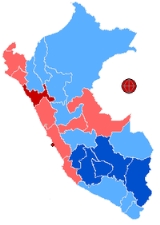
Going into the June 5 runoff election, he was polling in a statistical tie with opponent
Keiko FujimoriKeiko Sofía Fujimori Higuchi is a Peruvian Fujimorista politician, daughter of former Peruvian President Alberto Fujimori and Susana Higuchi. She served as First Lady, from 1994 to 2000, after her parents divorced, becoming the youngest First Lady in the history of the Americas...
. He was elected the 94th president of Peru with 51.5% of the vote.
President
After the news of the election of Ollanta as president the Lima Stock Exchange experienced its largest drop ever, though it later stabilised following Humala's cabinet appointees who were adjudged to be moderate and in line with continuity. However he was also said to have inherited "a ticking time bomb of disputes stemming in large part from objections by indigenous groups to the damage to water supplies, crops and hunting grounds wrought by mining, logging and oil and gas extraction" from Alan Garcia. Though he promised the "poor and disenfranchised" Peruvians with a bigger stake in the rapidly growing national economy his "mandate for change...[was seen as] a mandate for moderate change" with his "orthodox" cabinet appointees and his public oath on the Bible to respect investor rights, rule of law and the constitution. He was officially sworn-in on 28 July 2011.
As part of his "social inclusion" rhetoric during the campaign, his government as led by Prime Minister
Salomon Lerner GhitisSalomón Lerner Ghitis, also known as Siomi Lerner is a Peruvian businessman and politician, who has been Prime Minister of Peru since 28 July 2011. He was appointed prime minister following the 2011 presidential election won by Ollanta Humala.-Early life:Salómon Lerner is of Jewish descent. He...
established the
Ministry of Development and Social InclusionThe Ministry of Development and Social Inclusion in Peru was created on 18 August, 2011, during the presidency of Ollanta Humala and the cabinet of Salomon Lerner Ghitis. The inaugural and incumbent minister in charge of the ministry is Kurt Burneo....
in order to coordinate the efficacy of his social programmes.
Ideology
Ollanta Humala has expressed sympathy for the former government of Juan Velasco, which took power in a bloodless military coup on October 3, 1968 and nationalized various of the country's industries whilst pursuing a favorable foreign policy with
CubaThe Republic of Cuba is an island nation in the Caribbean. The nation of Cuba consists of the main island of Cuba, the Isla de la Juventud, and several archipelagos. Havana is the largest city in Cuba and the country's capital. Santiago de Cuba is the second largest city...
and the
Soviet UnionThe Soviet Union , officially the Union of Soviet Socialist Republics , was a constitutionally socialist state that existed in Eurasia between 1922 and 1991....
.
Foreign policy
During his presidential candidacy in 2006 and his run for the presidency that he ultimately won in 2011, Humala has been closely affiliated with other
pink tidePink tide is a term being used in contemporary 21st century political analysis in the media and elsewhere to describe the perception that Leftist ideology in general, and Left-wing politics in particular, is increasingly influential in Latin America.In 2005, the BBC reported that out of 350...
leaders in Latin America in general and South America in particular. Prior to taking office in 2011 he toured several countries in the Americas where he notably expressed the idea of re-unite the Peru–Bolivian Confederation. He also visited Brazil, Colombia, the United States, Venezuela and Mexico.
External links
Articles
- "Peru Leans Leftward", April 10, 2006 Council on Foreign Relations
- "Breakdown in the Andes", September/October 2004 Foreign Affairs
- "Ollanta Humala's Path to Peruvian Presidency", August 5, 2011 Sounds and Colours
- "Rebellion in Peru", November 1, 2000 NPR's Talk of the Nation
- "Peru Report", October 30, 2000 NPR's Morning Edition
- "Peru's Election: Background on Economic Issues", April 2006 Center for Economic and Policy Research
- "Peru Elections Near: A Look at the Candidates", June 1, 2011 Washington Office on Latin America
|-