


Network model

Encyclopedia
The network model is a database model
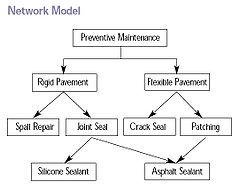
conceived as a flexible way of representing objects and their relationships. Its distinguishing feature is that the schema, viewed as a graph in which object types are nodes and relationship types are arcs, is not restricted to being a hierarchy or lattice.
 The network model's original inventor was Charles Bachman
, and it was developed into a standard specification published in 1969 by the CODASYL
Consortium.
The chief argument in favour of the network model, in comparison to the hierarchic model, was that it allowed a more natural modeling of relationships between entities. Although the model was widely implemented and used, it failed to become dominant for two main reasons. Firstly, IBM chose to stick to the hierarchical model with semi-network extensions in their established products such as IMS
and DL/I. Secondly, it was eventually displaced by the relational model
, which offered a higher-level, more declarative interface. Until the early 1980s the performance benefits of the low-level navigational interfaces offered by hierarchical and network databases were persuasive for many large-scale applications, but as hardware became faster, the extra productivity and flexibility of the relational model led to the gradual obsolescence of the network model in corporate enterprise usage.
) established the first specification of the network database model. This was followed by a second publication in 1971, which became the basis for most implementations. Subsequent work continued into the early 1980s, culminating in an ISO
specification, but this had little influence on products.
Database model
A database model is the theoretical foundation of a database and fundamentally determines in which manner data can be stored, organized, and manipulated in a database system. It thereby defines the infrastructure offered by a particular database system...
conceived as a flexible way of representing objects and their relationships. Its distinguishing feature is that the schema, viewed as a graph in which object types are nodes and relationship types are arcs, is not restricted to being a hierarchy or lattice.
Charles Bachman
Charles William "Charlie" Bachman is an American computer scientist, who spent his entire career as an industrial researcher rather than in academia...
, and it was developed into a standard specification published in 1969 by the CODASYL
CODASYL
CODASYL is an acronym for "Conference on Data Systems Languages". This was a consortium formed in 1959 to guide the development of a standard programming language that could be used on many computers...
Consortium.
Overview
Where the hierarchical database model structures data as a tree of records, with each record having one parent record and many children, the network model allows each record to have multiple parent and child records, forming a generalized graph structure. This property applies at two levels: the schema is a generalized graph of record types connected by relationship types (called "set types" in CODASYL), and the database itself is a generalized graph of record occurrences connected by relationships (CODASYL "sets"). Cycles are permitted at both levels.The chief argument in favour of the network model, in comparison to the hierarchic model, was that it allowed a more natural modeling of relationships between entities. Although the model was widely implemented and used, it failed to become dominant for two main reasons. Firstly, IBM chose to stick to the hierarchical model with semi-network extensions in their established products such as IMS
Information Management System
IBM Information Management System is a joint hierarchical database and information management system with extensive transaction processing capabilities.- History :...
and DL/I. Secondly, it was eventually displaced by the relational model
Relational model
The relational model for database management is a database model based on first-order predicate logic, first formulated and proposed in 1969 by Edgar F...
, which offered a higher-level, more declarative interface. Until the early 1980s the performance benefits of the low-level navigational interfaces offered by hierarchical and network databases were persuasive for many large-scale applications, but as hardware became faster, the extra productivity and flexibility of the relational model led to the gradual obsolescence of the network model in corporate enterprise usage.
Some Well-known Database Systems using the Network Model
- Digital Equipment corporation DBMS-10
- Digital Equipment Corporation DBMS-20
- Digital Equipment Corporation VAX DBMS
- Honeywell IDS (Integrated Data Store)
- IDMSIDMSIDMS is primarily a network database management system for mainframes. It was first developed at B.F. Goodrich and later marketed by Cullinane Database Systems...
(Integrated Database Management System) - RDM EmbeddedRDM EmbeddedRDM Embedded is a high performance, ACID-compliant embedded database management system designed to be linked into C/C++ application programs. RDM Embedded has been designed to utilize multi-core computers, networking , and in-memory or on-disk storage. It provides a low-level C API and a higher...
- RDM ServerRDM ServerRDM Server is an embeddable, heterogeneous, client/server database management system supporting both C/C++ and SQL APIs for programming flexibility. The databases can be disk resident and/or memory resident. RDM Server implements multi-user locking, hot database backup, and a fully ACID compliant...
- TurboIMAGETurboIMAGEIMAGE is the primary reason that the HP3000 was a success. It is a reliable, simple, fast database for MPE. After about a decade of enhancements it was renamed TurboIMAGE, then TurboIMAGE/XL after the PA-RISC migration...
- Univac DMS-1100Unisys OS 2200 databasesThe OS 2200 database managers are all part of the Universal Data System . UDS provides a common control structure for multiple different data models. Flat files , network , and relational data models all share a common locking, recovery, and clustering mechanism...
History
In 1969, the Conference on Data Systems Languages (CODASYLCODASYL
CODASYL is an acronym for "Conference on Data Systems Languages". This was a consortium formed in 1959 to guide the development of a standard programming language that could be used on many computers...
) established the first specification of the network database model. This was followed by a second publication in 1971, which became the basis for most implementations. Subsequent work continued into the early 1980s, culminating in an ISO
International Organization for Standardization
The International Organization for Standardization , widely known as ISO, is an international standard-setting body composed of representatives from various national standards organizations. Founded on February 23, 1947, the organization promulgates worldwide proprietary, industrial and commercial...
specification, but this had little influence on products.
Further reading
- Charles W. Bachman, The Programmer as Navigator. ACM Turing Award lecture, Communications of the ACM, Volume 16, Issue 11, 1973, pp. 653-658, ,
External links
- CODASYL Systems Committee "Survey of Data Base Systems", 1968 (edited and annotated in 2007 by Ken North)