


Naviglio Grande

Encyclopedia
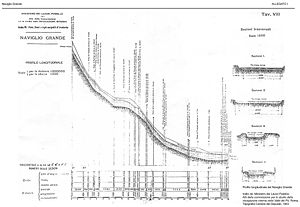
Canal
Canals are man-made channels for water. There are two types of canal:#Waterways: navigable transportation canals used for carrying ships and boats shipping goods and conveying people, further subdivided into two kinds:...
in Lombardy
Lombardy
Lombardy is one of the 20 regions of Italy. The capital is Milan. One-sixth of Italy's population lives in Lombardy and about one fifth of Italy's GDP is produced in this region, making it the most populous and richest region in the country and one of the richest in the whole of Europe...
, northern Italy
Italy
Italy , officially the Italian Republic languages]] under the European Charter for Regional or Minority Languages. In each of these, Italy's official name is as follows:;;;;;;;;), is a unitary parliamentary republic in South-Central Europe. To the north it borders France, Switzerland, Austria and...
, joining the Ticino river near Tornavento (23 km south of Sesto Calende
Sesto Calende
Sesto Calende is a town and comune located in the province of Varese, in the Lombardy region of northern Italy.It is located at the southern tip of Lake Maggiore, where the Ticino River starts to flow towards the Po River. The main historical sights is the Abbey of San Donato, built in the...
) to the Porta Ticinese dock, also known as the Darsena, in Milan
Milan
Milan is the second-largest city in Italy and the capital city of the region of Lombardy and of the province of Milan. The city proper has a population of about 1.3 million, while its urban area, roughly coinciding with its administrative province and the bordering Province of Monza and Brianza ,...
. It drops 34 m over 49.9 km. It varies in width from 22 m to 50 m from Tornavento to Abbiategrasso
Abbiategrasso
Abbiategrasso is a comune and town in the province of Milan, Italian region of Lombardy, situated in the Po valley approximately 22 km from Milan and 38 km from Pavia.- History :The town dates from Roman times...
, dropping to 15 m between there and Milan
Milan
Milan is the second-largest city in Italy and the capital city of the region of Lombardy and of the province of Milan. The city proper has a population of about 1.3 million, while its urban area, roughly coinciding with its administrative province and the bordering Province of Monza and Brianza ,...
. Initially carries 63 m³ per second, 116 outlets take water to irrigate 500 square kilometres leaving the canal 12 m wide and carrying 12 m³ per second as it enters the dock.
History
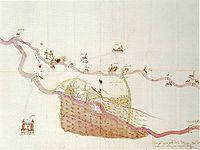
Navigli
The navigli was a system of navigable and interconnected canals around Milan, Italy.The system consisted of five canals: Naviglio Grande, Naviglio Pavese, Naviglio Martesana, Naviglio di Paderno, Naviglio di Bereguardo. The first three were connected through Milan via the Fossa Interna, also known...
”. Probably originating as a ditch dug in 1157 between Abbiategrasso
Abbiategrasso
Abbiategrasso is a comune and town in the province of Milan, Italian region of Lombardy, situated in the Po valley approximately 22 km from Milan and 38 km from Pavia.- History :The town dates from Roman times...
and Landriano
Landriano
Landriano is a comune in the Province of Pavia in the Italian region Lombardy, located about 20 km southeast of Milan and about 15 km northeast of Pavia....
as a defense against Frederick Barbarossa
Frederick I, Holy Roman Emperor
Frederick I Barbarossa was a German Holy Roman Emperor. He was elected King of Germany at Frankfurt on 4 March 1152 and crowned in Aachen on 9 March, crowned King of Italy in Pavia in 1155, and finally crowned Roman Emperor by Pope Adrian IV, on 18 June 1155, and two years later in 1157 the term...
, it was one of the largest post-medieval engineering projects, allowing development of commerce, transport and agriculture.
In 1177, construction began near Tornavento, but problems stopped work almost immediately. In 1179 however, a dam was constructed and water from the Ticino was directed towards Turbigo
Turbigo
Turbigo is a comune in the Province of Milan in the Italian region Lombardy, located about 35 km west of Milan, along the Naviglio Grande canal. As of 31 December 2004, it had a population of 7,486 and an area of 8.5 km²....
, Castelletto di Cuggiono, Bernate and Boffalora reaching Gaggiano
Gaggiano
Gaggiano is a comune in the Province of Milan in the Italian region Lombardy, located about 13 km southwest of Milan. As of 31 December 2004, it had a population of 8,360 and an area of 26.7 km²....
in 1233. This 30 km section, the “Navigium de Gazano” took over 50 years to dig by hand using only pickaxe and shovel. Prisoners from Turbigo were put to work in 1239 to increase the carrying capacity of the canal.
In 1258, the Naviglio Grande reached Milan. New taxes were levied to continue the digging, and although the work stopped again following opposition from the citizens and clergy, the whole canal was navigable from 1272, when the deepening and widening of the canal bed was completed by Giacomo Arribotti and the canal reached the bridge of Sant'Eustorgio (now Porta Ticinese
Porta Ticinese
Porta Ticinese is a former city gate of Milan, Italy. The gate, facing south-west, was first created with the Spanish walls of the city, in the 16th century, but the original structure was later demolished and replaced in the early 19th century...
).
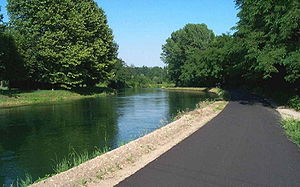
Duomo di Milano
Milan Cathedral is the cathedral church of Milan, Italy. Dedicated to Santa Maria Nascente , it is the seat of the Archbishop of Milan, currently Cardinal Angelo Scola....
, whose construction started in 1386. This confirmed the canal to be the most valuable form of transport of Milan, and proved that the network could be expanded to serve the whole region, especially in transferring troops rapidly between defensive castles.
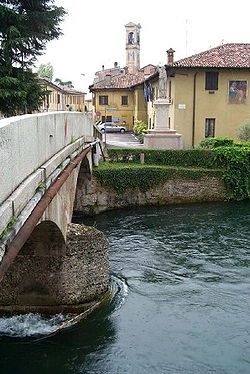
Recently the Istituto per i Navigli has been campaigning for the return of navigation on the canal. The project, called From Switzerland to the Sea promotes the restoration of the canal as part of a long distance waterway linking Lake Maggiore (partly in Switzerland) to Venice (Italy).
External links
The complete text of the book "I Navigli Milanesi" published by Silvana http://www.naviglilive.it/ Associazione Amici dei Navigli/Istituto per i Navigli- Galleria fotografica mostly photos of the 'Darsena' (the old docks in Milan)