
Home      Discussion      Topics      Dictionary      Almanac
Signup       Login
Musical analysis

Musical analysis

Overview
Musical analysis can be defined as an attempt to answer the question
Question
A question may be either a linguistic expression used to make a request for information, or else the request itself made by such an expression. This information is provided with an answer....

 how does this music
Music
Music is an art form whose medium is sound. Common elements of music are pitch , rhythm , dynamics, and the sonic qualities of timbre and texture...

 work?
. The method employed to answer this question, and indeed exactly what is meant by the question, differs from analyst to analyst, and according to the purpose of the analysis. According to Ian Bent (Bent, 1987), analysis is "an approach and method [that] can be traced back to the 1750s ... [though] it existed as a scholarly tool, albeit an auxiliary one, from the Middle Ages
Middle Ages
The Middle Ages of European history is a period of European history covering roughly a millennium in the 5th century through 16th centuries. More specific starting and ending points are sometimes adopted by scholars to suit their respective specializations or current focus...

 onwards."

The principle of analysis has been variously criticized, especially by composers, such as Edgard Varèse
Edgard Varèse
Edgard Victor Achille Charles Varèse, whose name was also spelled Edgar Varèse , was an innovative French-born composer who spent the greater part of his career in the United States....

's claim that, “to explain by means of [analysis] is to decompose, to mutilate the spirit of a work” (quoted in Bernard 1981, 1).

Some analysts, such as Donald Francis Tovey
Donald Francis Tovey
Sir Donald Francis Tovey was a British musical analyst, musicologist, writer on music, composer and pianist. He is best known for his Essays in Musical Analysis.- Career :...

 (whose Essays in Musical Analysis
Essays in Musical Analysis
Donald Francis Tovey's Essays in Musical Analysis are a series of analytical essays on classical music.The "essays" actually came into existence as programme notes written by Tovey to accompany concerts given by the Reid Orchestra in Edinburgh. Between 1935 and 1939 they were published in six...

are among the most accessible musical analyses) have presented their analyses in prose.
Discussion
Ask a question about 'Musical analysis'
Start a new discussion about 'Musical analysis'
Answer questions from other users
Full Discussion Forum
 
Encyclopedia
Musical analysis can be defined as an attempt to answer the question
Question
A question may be either a linguistic expression used to make a request for information, or else the request itself made by such an expression. This information is provided with an answer....

 how does this music
Music
Music is an art form whose medium is sound. Common elements of music are pitch , rhythm , dynamics, and the sonic qualities of timbre and texture...

 work?
. The method employed to answer this question, and indeed exactly what is meant by the question, differs from analyst to analyst, and according to the purpose of the analysis. According to Ian Bent (Bent, 1987), analysis is "an approach and method [that] can be traced back to the 1750s ... [though] it existed as a scholarly tool, albeit an auxiliary one, from the Middle Ages
Middle Ages
The Middle Ages of European history is a period of European history covering roughly a millennium in the 5th century through 16th centuries. More specific starting and ending points are sometimes adopted by scholars to suit their respective specializations or current focus...

 onwards."

The principle of analysis has been variously criticized, especially by composers, such as Edgard Varèse
Edgard Varèse
Edgard Victor Achille Charles Varèse, whose name was also spelled Edgar Varèse , was an innovative French-born composer who spent the greater part of his career in the United States....

's claim that, “to explain by means of [analysis] is to decompose, to mutilate the spirit of a work” (quoted in Bernard 1981, 1).

Analyses


Some analysts, such as Donald Francis Tovey
Donald Francis Tovey
Sir Donald Francis Tovey was a British musical analyst, musicologist, writer on music, composer and pianist. He is best known for his Essays in Musical Analysis.- Career :...

 (whose Essays in Musical Analysis
Essays in Musical Analysis
Donald Francis Tovey's Essays in Musical Analysis are a series of analytical essays on classical music.The "essays" actually came into existence as programme notes written by Tovey to accompany concerts given by the Reid Orchestra in Edinburgh. Between 1935 and 1939 they were published in six...

are among the most accessible musical analyses) have presented their analyses in prose. Others, such as Hans Keller
Hans Keller
Hans Keller was an Austrian-born British musician and writer who made significant contributions to musicology and music criticism, as well as being an insightful commentator on such disparate fields as psychoanalysis and football...

 (who devised a technique he called Functional Analysis
Wordless Functional Analysis
Wordless Functional Analysis is a method of musical analysis developed in the 1950s by the Austrian-born British musician and writer Hans Keller. The method is remarkable in that, unlike other forms of musical analysis, it is designed to be presented in musical sound alone, without any words being...

) used no prose commentary at all in some of their work.

There have been many notable analysts other than Tovey and Keller. One of the best known and most influential was Heinrich Schenker
Heinrich Schenker
Heinrich Schenker was a music theorist, best known for his approach to musical analysis, now usually called Schenkerian analysis....

, who developed Schenkerian analysis
Schenkerian analysis
Schenkerian analysis is a method of musical analysis of tonal music based on the theories of Heinrich Schenker. The goal of a Schenkerian analysis is to reveal the underlying structure of a tonal work; in fact its basic tenets can be viewed as a way of defining tonality in music...

, a method which seeks to reduce all tonal
Tonality
Tonality is a system of music in which specific hierarchical pitch relationships are based on a key "center" or tonic. The term tonalité originated with Alexandre-Étienne Choron and was borrowed by François-Joseph Fétis in 1840...

 classical works to a simple contrapuntal
Counterpoint
In music, counterpoint is the relationship between two or more voices that are independent in contour and rhythm and are harmonically interdependent. It has been most commonly identified in Western music, developing strongly during the Renaissance and in much of the common practice period,...

 sequence. Rudolph Réti
Rudolph Réti
Rudolph Réti was a musical analyst, composer and pianist. He was the older brother of the great chess master Richard Réti....

 is notable for tracing the development of small melodic motifs
Motif (music)
In music, a motif or motive is a short musical idea, a salient recurring figure, musical fragment or succession of notes that has some special importance in or is characteristic of a composition...

 through a work, while Nicolas Ruwet
Nicolas Ruwet
Nicolas Ruwet was a linguist, literary critic and musical analyst.Ruwet was born in Saive in Belgium and studied philology in Liège. Later he studied with Claude Lévi-Strauss and later still with Noam Chomsky and Roman Jakobson at the Massachusetts Institute of Technology...

's analysis amounts to a kind of musical semiology.

Musicologists associated with the new musicology
New musicology
The New Musicology is a term applied to a wide body of musicology with increased focus upon the cultural study, analysis, and criticism of music, with influences from feminism, gender studies, gay and lesbian studies, queer theory, postcolonial studies, the work of some French structuralist and...

 often use musical analysis (traditional or not) along with or to support their examinations of the performance practice and social situations in which music is produced and which produce music, and vice versus. The insights gained from the social considerations may then yield insight into the methods of analysis, and vice versa.

Edward Cone ("Analysis Today") argues that musical analysis lies in between description and prescription
Prescription
Prescription may refer to:Health care*Prescription drug, a drug available only by a medical prescription*Medical prescription, a plan of care written by a physician or other health care professional...

. Description consists of simple non-analytical activities such as labeling chords with Roman numerals or tone-rows with integers or row-form, while the other extreme, prescription, consists of "the insistence upon the validity of relationships not supported by the text." Analysis must, rather, provide insight into listening without forcing a description of a piece that cannot be heard.

Techniques


Many techniques are used to analyze music. Metaphor
Metaphor
A metaphor is a figure of speech concisely comparing two things, saying that one is the other. The English metaphor derives from the 16th c...

 and figurative description may be a part of analysis, and a metaphor used to describe pieces "reifies their features and relations in a particularly pungent and insightful way: it makes sense of them in ways not formerly possible." Even absolute music
Absolute music
Absolute music is a term used to describe musicthat is not explicitly "about" anything, non-representational ornon-objective...

 may be viewed as a "metaphor for the universe" or nature as "perfect form." (Guck cited in Bauer 2004, p.131)

Discretization


The process of analysis often involves breaking the piece down into relatively simpler and smaller parts. Often, the way these parts fit together and interact with each other is then examined. This process of discretization
Discretization
In mathematics, discretization concerns the process of transferring continuous models and equations into discrete counterparts. This process is usually carried out as a first step toward making them suitable for numerical evaluation and implementation on digital computers...

 or segmentation is often considered, as by Jean-Jacques Nattiez
Jean-Jacques Nattiez
Jean-Jacques Nattiez, CM, CQ, FRSC is a musical semiologist or semiotician and professor of Musicology at the Université de Montréal...

 (1990), necessary for music to become accessible to analysis. Fred Lerdahl
Fred Lerdahl
Fred Lerdahl is the Fritz Reiner Professor of Musical Composition at Columbia University, and a composer and music theorist best known for his work on pitch space and cognitive constraints on compositional systems or "musical grammar[s]." He has written many orchestral and chamber works,...

 argues that discretization is necessary even for lay perception, thus making it a basis of his analyses, and finds pieces such as Artikulation by György Ligeti
György Ligeti
György Sándor Ligeti was a composer, born in a Hungarian Jewish family in Transylvania, Romania. He briefly lived in Hungary before later becoming an Austrian citizen...

 unaccessible, while Rainer Wehinger (1970) created a "Hörpartitur" or "score for listening" for the piece, representing different sonorous effects with specific graphic symbols much like a transcription
Transcription (music)
In music, transcription can mean notating a piece or a sound which was previously unnotated, as, for example, an improvised jazz solo. Further examples include ethnomusicological notation of oral traditions of folk music, such as Béla Bartók's and Ralph Vaughan Williams' collections of the national...

.

Composition


Analysis often displays a compositional impulse while composition often expresses "display[s] an analytical impulse" but where "intertextual analyses often succeed through simple verbal description there are good reasons to literally compose the proposed connections. We actually hear how these songs resonate with one another, comment upon and affect one another...in a way, the music speaks for itself" . This analytic bent most obviously in recomposition including the mash-ups
Mashup (music)
A mashup, bootleg or blend is a song or composition created by blending two or more songs, usually by overlaying the vocal track of one song seamlessly over the music track of another.- Synonyms :...

 of popular music.

Analytical situations


Analysis is an activity most often engaged in by musicologists and most often applied to western classical music, although music of non-western cultures and of unnotated oral tradition
Oral tradition
Oral tradition, oral culture and oral lore are messages or testimony transmitted orally from one generation to another. The messages or testimony are verbally transmitted in speech or song and may take the form, for example, of folktales, sayings, ballads, songs, or chants...

s is also often analysed. An analysis can be conducted on a single piece of music, on a portion or element of a piece or on a collection of pieces. A musicologist's stance is his or her analytical situation. This includes the physical dimension or corpus being studied, the level of stylistic relevance studied, and whether the description provided by the analysis is of its immanent structure, compositional (or esthesic) processes, perceptual (or poietic) processes (Nattiez 1990: 135-6), all three, or a mixture.

Stylistic levels may be hierarchized as an inverted triangle:
  • universals of music
    • system (style) of reference
      • style of a genre or an epoch
        • style of composer X
          • style of a period in the life of a composer
            • work
(Nattiez 1990: 136, he also points to Nettl 1964: 177, Boretz 1972: 146, and Meyer)


Nattiez outlines six analytical situations, preferring the sixth:
Poietic processes Immanent
structures of the
work
Esthesic processes
1 x
Immanent
analysis
2 x x
Inductive
poietics
3 x x
External
poietics
4 x x
Inductive
esthesics
5 x x
External
esthesics
6 x = x = x
Communication between the three levels
(Nattiex 1990: 140)


Examples:
  1. "tackles only the immanent configuration of the work." Allen Forte's musical set theory
  2. "proceed[s] from an analysis of the neutral level to drawing conclusions about the poietic." Reti's (1951: 194-206) analysis of Debussy's la Cathédrale engloutie
  3. the reverse of the previous, taking "a poietic document -- letters, plans, sketches -- ... and analyzes the work in the light of this information." Paul Mie's "stylistic analysis of Beethoven
    Ludwig van Beethoven
    Ludwig van Beethoven was a German composer and pianist. He was a crucial figure in the transitional period between the Classical and Romantic eras in Western classical music, and remains one of the most acclaimed and influential composers of all time.Born in Bonn, of the Electorate of Cologne and...

     in terms of the sketches (1929)."
  4. the most common, grounded in "perceptive introspection, or in a certain number of general ideas concerning musical perception ... a musicologist ... describes what he or she thinks is the listener's perception of the passage." Meyer's (1956: 48) analysis of measures 9-11 of Bach
    Johann Sebastian Bach
    Johann Sebastian Bach was a German composer and organist whose ecclesiastical and secular works for choir, orchestra, and solo instruments drew together the strands of the Baroque period and brought it to its ultimate maturity...

    's C minor fugue in Book I of the Well-Tempered Clavier
    Well-Tempered Clavier
    The Well-Tempered Clavier , BWV 846–893, is a collection of solo keyboard music composed by Johann Sebastian Bach...

    .
  5. "Begins with information collected from listeners to attempt to understand how the work has been perceived ... obviously how experimental psychologists would work."
  6. "The case in which an immanent analysis is equally relevant to the poietic as to the esthesic." Schenker
    Schenker
    Schenker is a German family name.Schenker may refer to:* Alexander M. Schenker , American Slavist* Heinrich Schenker , German Music theorist* Rudolf Schenker, German guitarist, founding member of Scorpions...

    ian analysis, which, based on the sketches of Beethoven (external poietics) eventually show through analysis how the works must be played and perceived (inductive esthesics).

Compositional analysis


Jacques Chailley (1951: 104) views analysis entirely from a compositional viewpoint, arguing that, "since analysis consists of 'putting oneself in the composer's shoes,' and explaining what he was experiencing as he was writing, it is obvious that we should not think of studying a work in terms of criteria foreign to the author's own preoccupations, no more in tonal analysis than in harmonic analysis."

Perceptual analysis


On the other hand, Fay (1971: 112) argues that, "analytic discussions of music are often concerned with processes that are not immediately perceivable. It may be that the analyst is concerned merely with applying a collection of rules concerning practice, or with the description of the compositional process. But whatever he [or she] aims, he often fails -- most notably in twentieth-century music -- to illuminate our immediate musical experience," and thus views analysis entirely from a perceptual viewpoint, as does Edward Cone (1960: 36), "true analysis works through and for the ear. The greatest analysts are those with the keenest ears; their insights reveal how a piece of music should be heard, which in turn implies how it should be played. An analysis is a direction for performance," and Thomson (1970: 196): "it seems only reasonable to believe that a healthy analytical point of view is that which is so nearly isomorphic with the perceptual act."

Analyses of the immanent level


Analyses of the immanent level include analyses by Alder, Heinrich Schenker
Heinrich Schenker
Heinrich Schenker was a music theorist, best known for his approach to musical analysis, now usually called Schenkerian analysis....

, and the "ontological structuralism" of the analyses of Pierre Boulez
Pierre Boulez
Pierre Boulez is a French composer of contemporary classical music and conductor.-Early years:Boulez was born in Montbrison, France. As a child he began piano lessons and demonstrated aptitude in both music and mathematics...

, who says in his analysis of The Rite of Spring
The Rite of Spring
The Rite of Spring, commonly referred to by its original French title, Le Sacre du Printemps is a ballet with music by the Russian composer Igor Stravinsky, original choreography by Vaslav Nijinsky, and original set design and costumes by archaeologist and painter Nicholas Roerich, all under...

(1966: 142), "must I repeat here that I have not pretended to discover a creative process, but concern myself with the result, whose only tangibles are mathematical relationships? If I have been able to find all these structural characteristics, it is because they are there, and I don't care whether they were put there consciously or unconsciously, or with what degree of acuteness they informed [the composer's] understanding of his conception; I care very little for all such interaction between the work and 'genius.'"

Again, Nattiez (1990: 138-9) argues that the above three approaches, by themselves, are necessarily incomplete and that an analysis of all three levels is required. Jean Molino
Jean Molino
Jean Molino is professeur ordinaire at the University of Lausanne and a semiologist. His students include Jean-Jacques Nattiez.-Bibliography:*Musical Fact and the Semiology of Music, trans. J. A. Underwood, Music Analysis 9/2 : 113-156....

 (1975a: 50-51) shows that musical analysis shifted from an emphasis upon the poietic vantage point to an esthesic one at the beginning of the eighteenth century (Nattiez 1990: 137).

Nonformalized analyses


Nattiez distinguishes between nonformalized and formalized analyses. Nonformalized analyses, apart from musical and analytical terms, do not use resources or techniques other than language. He further distinguishes nonformalized analyses between impressionistic, paraphrases, or hermeneutic readings of the text (explications de texte). Impressionistic analyses are in "a more or less high-literary style, proceeding from an initial selection of elements deemed characeristic," such as the following description of the opening of Claude Debussy
Claude Debussy
Achille-Claude Debussy was a French composer. Along with Maurice Ravel, he was one of the most prominent figures working within the field of Impressionist music, though he himself intensely disliked the term when applied to his compositions...

's Prelude to the Afternoon of a Faun: "The alternation of binary and ternary divisions of the eighth notes, the sly feints made by the three pauses, soften the phrase so much, render it so fluid, that it escapes all arithmetical rigors. It floats between heaven and earth like a Gregorian chant
Gregorian chant
Gregorian chant is the central tradition of Western plainchant, a form of monophonic liturgical chant in Western Christianity that accompanied the celebration of Mass and other ritual services...

; it glides over signposts marking traditional divisions; it slips so furtively between various keys that it frees itself effortlessly from their grasp, and one must await the first appearance of a harmonic underpinning before the melody takes graceful leave of this causal atonality
Atonality
Atonality in its broadest sense describes music that lacks a tonal center, or key. Atonality in this sense usually describes compositions written from about 1908 to the present day where a hierarchy of pitches focusing on a single, central tone is not used and the notes of the chromatic scale...

." (Vuillermoz 1957: 64)

Paraphrases are a "respeaking" in plain words of the events of the text with little interpretation or addition, such as the following description of the "Bourée" of Bach's Third Suite: "An anacrusis, an initial phrase in D major. The figure
Figure (music)
A musical figure is the shortest idea in music, a short succession of notes, often recurring. It may have melodic pitch, harmonic progression and rhythmic . The 1964 Grove's Dictionary defines the figure as "the exact counterpart of the German 'motiv' and the French 'motif'": it produces a "single...

 marked (a) is immediately repeated, descending through a third, and it is employed throughout the piece. This phrase is immediately elided into its consequent, which modulates from D to A major. This figure (a) is used again two times, higher each time; this section is repeated." (Warburton 1952: 151)

"Hermeneutic reading of a musical text is based on a description, a 'naming' of the melody
Melody
A melody , also tune, voice, or line, is a linear succession of musical tones which is perceived as a single entity...

's elements, but adds to it a hermeneutic and phenomenological depth that, in the hands of a talented writer, can result in genuine interpretive masterworks.... All the illustrations in Abraham's and Dahlhaus's Melodielehre (1972) are historical in character; Rosen's essays in The Classical Style (1971) seek to grasp the essence of an epoch's style; Meyer's analysis of Beethoven's Farewell Sonata (1973: 242-68) penetrates melody from the vantage point of perceived structures." He gives as a last example the following description of Franz Schubert
Franz Schubert
Franz Peter Schubert was an Austrian composer. He wrote some 600 Lieder, nine symphonies , liturgical music, operas, some incidental music, and a large body of chamber and solo piano music...

's Unfinished Symphony: "."

Formalized analyses


Formalized analyses propose models for melodic functions or simulate music. Meyer distinguishes between global models, which "provide an image of the whole corpus being studied, by listing characteristics, classifying phenomena, or both; they furnish statistical evaluation," and linear models which "do not try to reconstitute the whole melody in order of real time succession of melodic events. Linear models ... describe a corpus by means of a system of rules encompassing not only the hierarchical organization of the melody, but also the distribution, environment, and context of events, examples including Chenoweth's (1972, 1979) explanation of "succession of pitches in New Guinean chants in terms of distributional constraints governing each melodic interval," Herndon's (1974, 1975) transformational analysis, and Baroni and Jacoboni's (1976) "grammar for the soprano
Soprano
A soprano is a singing voice with a vocal range from approximately middle C to "high A" in choral music, or to "soprano C" or higher in operatic music...

 part in Bach's chorale
Chorale
A chorale was originally a hymn sung by a christian congregation. In casual modern usage, this term also includes classical settings of such hymns and works of a similar character....

s [which] when tested by computer ... allows us to generate melodies in Bach's style."

Global models are further distinguished as analysis by traits, which "identify the presence or absence of a particular variable, and makes a collective image of the song, genre, or style being considered by means of a table, or classificatory analysis, which sorts phenomena into classes," one example being Helen Roberts' (1955: 222) "trait listing", and classificatory analysis, which "sorts phenomena into classes," examples being Kolinski's (1956) universal system for classifying melodic contours. Classificatory analyses often call themselves taxonomical. "Making the basis for the analysis explicit is a fundamental criterion in this approach, so delimiting units is always accompanied by carefully defining units in terms of their constituent variables."

Intermediary analyses


Nattiez lastly proposes intermediary models "between reductive formal precision, and impressionist laxity." These include Schenker, Meyer (classification of melodic structure in 1973: Chapter 7), Narmour, and Lerdahl-Jackendoff's "use of graphics without appealing to a system of formalized rules," complementing and not replacing the verbal analyses. These are in contrast to the formalized models of Babbitt (1972) and Boretz (1969). According to Nattiez Boretz "seems to be confusing his own formal, logical model with an immanent essence he then ascribes to music," and Babbitt "defines a musical theory as a hypothetical-deductive system ... but if we look closely at what he says, we quickly realize that the theory also seeks to legitimize a music yet to come; that is, that it is also normative ... transforming the value of the theory into an aesthetic norm ... from an anthropological standpoint, that is a risk that is difficult to countenance." Similarly, "Boretz enthusiastically embraces logical formalism, while evading the question of knowing how the data -- whose formalization he proposes -- have been obtained." (167)

Divergent analyses


Typically a given work is analyzed by more than one person and different or divergent analyses are created. For instance, the first two bars of the prelude to Claude Debussy
Claude Debussy
Achille-Claude Debussy was a French composer. Along with Maurice Ravel, he was one of the most prominent figures working within the field of Impressionist music, though he himself intensely disliked the term when applied to his compositions...

's Pelléas et Mélisande
Pelléas et Mélisande (opera)
Pelléas et Mélisande is an opera in five acts with music by Claude Debussy. It was first performed at the Opéra-Comique, Paris on 30 April 1902. The French libretto was adapted from the Symbolist play of the same name by Maurice Maeterlinck...

:

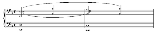
are analyzed differently by Leibowitz, Laloy, van Appledorn, and Christ. Leibowitz analyses this succession harmonically as D minor:I-VII-V, ignoring melodic motion, Laloy analyses the succession as D:I-V, seeing the G in the second measure as an ornament, and both van Appledorn and Christ analyses the succession as D:I-VII.

Nattiez (173) argues that this divergence is due to the analysts' respective analytic situations, and to what he calls transcendent principles (1997b: 853, what George Holton might call "themata"), the "philosophical project[s]", "underlying principles", or a prioris of analyses, one example being Nattiez's use of the tripartitional definition of sign
Sign (semiotics)
In semiotics, a sign is "something that stands for something, to someone in some capacity" It may be understood as a discrete unit of meaning, and includes words, images, gestures, scents, tastes, textures, sounds – essentially all of the ways in which information can be communicated as...

, and what, after epistemological historian Paul Veyne, he calls plots.

Van Appledorn sees the succession as D:I-VII so as to allow the interpretation of the first chord in measure five, which Laloy sees as a dominant seventh on D (V/IV) with a diminished fifth (despite that the IV doesn't arrive till measure twelve), while van Appledorn sees it as a French sixth on D, D-F#-Ab-[C] in the usual second inversion. This means that D is the second degree and the required reference to the first degree, C, being established by the D:VII or C major chord
Chord (music)
In music and music theory a chord is a set of three or more different notes from a specific key that sound simultaneously. Chords constructed of three notes are described as triads and consist of two intervals. The technical name for triad chords is tertian sonorities and is understood to be chords...

. "The need to explain the chord in measure five establishes that C-E-G is 'equally important' as the D-(F)-A of measure one." Leibowitz gives only the bass for chord, E indicating the progression I-II an "unreal" progression in keeping with his "dialectic
Dialectic
Dialectic is a method of argument, which has been central to both Eastern and Western philosophy since ancient times. The word "dialectic" originates in Ancient Greece, and was made popular by Plato's Socratic dialogues...

 between the real and the unreal" used in the analysis, while Christ explains the chord as an augmented eleventh with a bass of Bb, interpreting it as a traditional tertian extended chord
Extended chord
In music, extended chords are tertian chords or triads with notes extended, or added, beyond the seventh. Ninth, eleventh, and thirteenth chords are extended chords...

.

Not only does an analyst select particular traits, "he or she arranges [them] according to a plot [intrigue].... Our sense of the component parts of a musical work, like our sense of historical 'facts,' is mediated by lived experience." (176)

While John Blacking (1973: 17-18), among others, holds that "there is ultimately only one explanation and ... this could be discovered by a context-sensitive analysis of the music in culture," according to Nattiez (1990: 168) and others, "there is never only one valid musical analysis for any given work." Blacking gives as example: "everyone disagrees hotly and stakes his [or her] academic reputation on what Mozart really meant in this or that bar of his symphonies
Symphony
A symphony is an extended musical composition, scored almost always for orchestra. "Symphony" does not necessarily imply a specific form though most are composed according to the sonata principle...

, concerto
Concerto
The term Concerto is usually a three-part musical work in which one solo instrument is accompanied by an orchestra...

s, or quartet
Quartet
In music, a quartet is a method of instrumentation , used to perform a musical composition, and consisting of four parts.-Western art music:...

s. If we knew exactly what went on inside Mozart's mind when he wrote them, there could be only one explanation". (93) However, Nattiez points out that even if we could determine "what Mozart was thinking" we would still be lacking an analysis of the neutral and esthesic levels.

Roger Scruton (1978: 175-76), in a review of Nattiez's Fondements, says one may, "describe it as you like so long as you hear it correctly ... certain descriptions suggest wrong ways of hearing it ... what is obvious to hear [in Pélleas et Mélisande] is the contrast in mood and atmosphere between the 'modal' passage and the bars which follow it." Nattiez counters that if compositional intent were identical to perception, "historians of musical language could take a permanent nap.... Scruton sets himself up as a universal, absolute conscience for the 'right' perception of the Pélleas et Mélisande. But hearing is an active symbolic process (which must be explained): nothing in perception is self-evident."

Thus Nattiez suggests that analyses, especially those intending "a semiological orientation, should ... at least include a comparative critique of already-written analyses, when they exist, so as to explain why the work has taken on this or that image constructed by this or that writer: all analysis is a representation; [and] an explanation of the analytical criteria used in the new analysis, so that any critique of this new analysis could be situated in relation to that analysis's own objectives and methods. As Jean-Claude Gardin so rightly remarks, 'no physicist, no biologist is surprised when he or she is asked to indicate, in the context of a new theory, the physical data and the mental operations that led to its formulation' (1974: 69). Making one's procedures explicit would help to create a cumulative progress in knowledge." (177)

Notations

  • Bauer, Amy (2004). "Cognition, Constraints, and Conceptual Blends in Modernist Music", in The Pleasure of Modernist Music, Ashby, Arved, ed.
  • Bent, Ian (1987). Analysis. London: McMillan Press. ISBN 0-333-41732-1.
  • Bernard, Jonathan. 1981. “Pitch/Register in the Music of Edgar Varèse.” Music Theory Spectrum 3: 1–25.
  • Nattiez, Jean-Jacques (1990). Music and Discourse: Toward a Semiology of Music (Musicologie générale et sémiologue, 1987). Translated by Carolyn Abbate (1990). ISBN 0-691-02714-5.
  • Blacking, John (1973). How Musical Is Man?. Seattle: University of Washington Press. Cited in Nattiez (1990). Cited in Nattiez (1990).
  • Laloy, L. (1902). "Sur deux accords", Revue musicale. Reprinted in La musique retrouvée. Paris: Plon, 1928, pp. 115-18. Cited in Nattiez (1990).
  • Liebowitz, R. (1971). "Pelléas et Mélisande ou les fantômes de la réalité", Les Temps Modernes, no. 305:891-922. Cited in Nattiez (1990).
  • Van Appledorn, M.-J. (1966). "Stylistic Study of Claude Debussy's Opera Pelléas et Mélisande". Ph.D. Diss., Eastman School of Music. Cited in Nattiez (1990). . Cited in Nattiez (1990).
  • Stein, Deborah (2005). Engaging Music: Essays in Music Analysis. New York: Oxford University Press. ISBN 0-19-517010-5.
  • Satyendra, Ramon. "Analyzing the Unity within Contrast: Chick Corea's 'Starlight'". Cited in Stein (2005).
  • Cone, Edward. "Analysis Today", Music: A View from Delft", pp. 39-54. Cited in Satyendra.

Further reading

  • Cook, Nicholas (1992). A Guide to Musical Analysis. ISBN 0-393-96255-5.
  • Hoek, D.J. (2007). Analyses of Nineteenth- and Twentieth-Century Music, 1940-2000. ISBN 0-810-85887-8.
  • Kresky, Jeffrey (1977). Tonal Music: Twelve Analytic Studies. ISBN 0-253-37011-6.

External links