


Mooring (oceanography)

Encyclopedia
Oceanography
Oceanography , also called oceanology or marine science, is the branch of Earth science that studies the ocean...
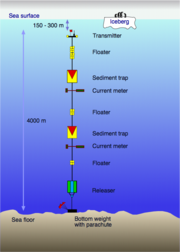
is a collection of devices, connected to a wire and temporarily anchored on the sea floor. The devices are current meters
Ekman current meter
The Ekman current meter is a mechanical flowmeter invented by Vagn Walfrid Ekman a Swedish oceanographer, in 1903. It comprises a propeller with a mechanism to record the number of revolutions, a compass and a recorder with which to record the direction, and a vane that orients the instrument so...
to measure the direction and speed of ocean current
Ocean current
An ocean current is a continuous, directed movement of ocean water generated by the forces acting upon this mean flow, such as breaking waves, wind, Coriolis effect, cabbeling, temperature and salinity differences and tides caused by the gravitational pull of the Moon and the Sun...
s, sediment trap
Sediment trap
Sediment traps are instruments used in oceanography to measure the quantity of sinking particulate organic material in aquatic systems, usually oceans...
s to catch settling particles from the water column or experimental chambers, e.g. to measure the solubility of certain substances in sea water. A mooring can be free floating or anchored for some days to weeks (short-time). Long-time moorings might be deployed for a maximum duration of two years. An acoustic release
Acoustic Release
An acoustic release is an oceanographic device for the deployment and subsequent recovery of instrumentation from the sea floor, in which the recovery is triggered remotely by an acoustic command signal.- Method of Operation :...
connects the mooring to an anchor weight on the sea floor. The weight is released by sending a coded acoustic command signal from a ship. The weight (e.g. old rail wheels) is unrecoverable. Floaters permit the mooring to come up to the surface to be recovered by a research vessel.