
Home      Discussion      Topics      Dictionary      Almanac
Signup       Login
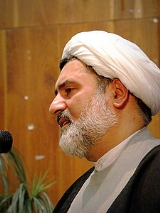
Mohsen Kadivar

Mohsen Kadivar

Overview
Mohsen Kadivar is an Iran
Iran
Iran , officially the Islamic Republic of Iran , is a country in Southern and Western Asia. The name "Iran" has been in use natively since the Sassanian era and came into use internationally in 1935, before which the country was known to the Western world as Persia...

ian philosopher, University lecturer, cleric and activist. A political dissident, Kadivar has been a vocal critic of the doctrine of clerical rule, also known as Velayat-e Faqih (Guardianship of the Islamic Jurist), and a strong advocate of democratic and liberal reforms in Iran. Kadivar has served time in prison in Iran for his political activism and beliefs.
Discussion
Ask a question about 'Mohsen Kadivar'
Start a new discussion about 'Mohsen Kadivar'
Answer questions from other users
Full Discussion Forum
 
Encyclopedia
Mohsen Kadivar is an Iran
Iran
Iran , officially the Islamic Republic of Iran , is a country in Southern and Western Asia. The name "Iran" has been in use natively since the Sassanian era and came into use internationally in 1935, before which the country was known to the Western world as Persia...

ian philosopher, University lecturer, cleric and activist. A political dissident, Kadivar has been a vocal critic of the doctrine of clerical rule, also known as Velayat-e Faqih (Guardianship of the Islamic Jurist), and a strong advocate of democratic and liberal reforms in Iran. Kadivar has served time in prison in Iran for his political activism and beliefs.

Mohsen Kadivar's sister Jamileh Kadivar
Jamileh Kadivar
-Biography:Jamileh Kadivar was born in Fasa, a town near Shiraz in southern Iran. She attended school in Shiraz until she was 16 years old, when she moved to Tehran to get married. Her spouse is former Minister of Culture of Iran Ata'ollah Mohajerani and they have four children: Mohammad Mohsen ,...

 and brother-in-law Ata'ollah Mohajerani
Ata'ollah Mohajerani
Ata'ollah Mohajerani , , is an Iranian historian, politician, journalist, and author. Ata`ollah Mohajerani served as Minister of Culture and Islamic Guidance of Iran under reformist President Mohammad Khatami until 2000 when he was resigned from office for alleged permissiveness."-Overview:Dr...

, are two leading figures in the Iranian reform movement.

Family, education and career


Born in Fasa to a politically active family, Mohsen Kadivar completed his primary and secondary education in Shiraz
Shiraz, Iran
Shiraz is the sixth most populous city in Iran and is the capital of Fars Province, the city's 2009 population was 1,455,073. Shiraz is located in the southwest of Iran on the Roodkhaneye Khoshk seasonal river...

 before being admitted into electronic engineering at Shiraz University
Shiraz University
Shiraz University , formerly known as Pahlavi University, is a public university located in Shiraz, Iran. It is one of the major universities of Iran....

 in 1977. He became politically active as a student and was arrested by the shah's police in May 1978 for his political activities. In 1980 he switched his focus to religious education and began attending Shiraz Seminary. He moved to Qom
Qom
Qom is a city in Iran. It lies by road southwest of Tehran and is the capital of Qom Province. At the 2006 census, its population was 957,496, in 241,827 families. It is situated on the banks of the Qom River....

 in 1981 to pursue his studies in fiqh
Fiqh
Fiqh is Islamic jurisprudence. Fiqh is an expansion of the code of conduct expounded in the Quran, often supplemented by tradition and implemented by the rulings and interpretations of Islamic jurists....

 and philosophy. In Qom
Qom
Qom is a city in Iran. It lies by road southwest of Tehran and is the capital of Qom Province. At the 2006 census, its population was 957,496, in 241,827 families. It is situated on the banks of the Qom River....

, he was taught by prominent teachers like Ayatollah Hossein-Ali Montazeri. Kadivar graduated with a degree in ijtihad in 1997. Then he went on to get his PhD in Islamic philosophy and theology from Tarbiat Modares University
Tarbiat Modares University
Tarbiat Modares University is located in Tehran, Iran, and was founded in 1982. Tarbiat Modares University is the only exclusively graduate university in Iran, and is a highly reputed university, which was actually funded to train university professors.-Faculties and academics:TMU includes seven...

 in Tehran
Tehran
Tehran , sometimes spelled Teheran, is the capital of Iran and Tehran Province. With an estimated population of 8,429,807; it is also Iran's largest urban area and city, one of the largest cities in Western Asia, and is the world's 19th largest city.In the 20th century, Tehran was subject to...

 in 1999.

Kadivar started his career as a teacher teaching fiqh
Fiqh
Fiqh is Islamic jurisprudence. Fiqh is an expansion of the code of conduct expounded in the Quran, often supplemented by tradition and implemented by the rulings and interpretations of Islamic jurists....

 and Islamic philosophy at Qom Seminary. Later he began teaching Islamic philosophy and theology at Imam Sadegh University, Mofid University
Mofid University
Mofid University is a university located in Qum, Iran.It was founded by Abdolkarim Mousavi Ardebili in 1989.Mofid University’s main area of teaching is comparative studies between Islamic sciences and modern humanities. However, departments such as Economics, Law, Philosophy, and Political science...

, and Shahid Beheshti University
Shahid Beheshti University
Shahid Beheshti University was formerly The National University of Iran . The university's name was changed during the cultural revolution in Iranian universities, 1980-82. It is located in Evin District and extends into Velenjak District in northwestern Tehran, Iran, on a main campus of...

. He started a decade of teaching at the department of philosophy at Tarbiat Modarres University. In 2007 political pressures forced Kadivar to leave his teaching appointment for a position at the Research Center of Iranian Institute of Philosophy. He is a faculty member of the Department of Islamic Philosophy at the Iranian Institute of Philosophy and is currently a visiting professor of religious studies at Duke University
Duke University
Duke University is a private research university located in Durham, North Carolina, United States. Founded by Methodists and Quakers in the present day town of Trinity in 1838, the school moved to Durham in 1892. In 1924, tobacco industrialist James B...

 after spending the 2008-2009 academic year at the University of Virginia
University of Virginia
The University of Virginia is a public research university located in Charlottesville, Virginia, United States, founded by Thomas Jefferson...

.

Kadivar married in 1981 and has four children.

Dissent


Kadivar is a prominent critic of the Islamic Republic
Islamic republic
Islamic republic is the name given to several states in the Muslim world including the Islamic Republics of Pakistan, Iran, Afghanistan, and Mauritania. Pakistan adopted the title under the constitution of 1956. Mauritania adopted it on 28 November 1958. Iran adopted it after the 1979 Iranian...

 system in Iran, and wrote a detailed criticism of the Ayatollah's Khomeini's theory of Islamic government as rule by Shia clerics, Government by Mandate (see below).
As punishment for his criticism, Kadivar was sentenced to eighteen months in prison after being convicted by the Special Clerical Court
Special Clerical Court
Special Clerical Court, or Special Court for Clerics is an Iranian court system for examining transgressions within the clerical establishment. It tries Shia Muslim clerics, although it has also taken on cases involving lay people. The court functions independently of the regular Iranian judicial...

 in 1999, on charges of having spread false information about Iran's "sacred system of the Islamic Republic" and of helping enemies of the Islamic revolution, or as another observor put it, "for commenting on the contradiction between the revolution's aims to serve the people and the subsequent concentration of power in the hands of clerics." He spent virtually all of his imprisonment in solitary confinement and was released from Evin Prison
Evin Prison
Evin House of Detention is a prison in Iran, located in Evin, northwestern Tehran. It is noted for its political prisoners' wing, where prisoners have been held both before and after the 1979 Iranian Revolution...

, on July 17, 2000. Kadivar was unrepentant on his release and is currently active within the various reform movements of Iran.

In a 2004 interview Kadivar told a journalist,
"Every member of society and every member of government is subject to the law. No one can be above it. Everyone has the same rights, yet the root of the faqih is inequality. He assumes he is above it. ... It is time for the supreme leader to be subject to the constitution too. After all, the Supreme Leader
Supreme leader
A supreme leader typically refers to a figure in the highest leadership position of an entity, group, organization, or state, who exercises strong or all-powerful authority over it. In religion, the supreme leader or supreme leaders is God or Gods...

 doesn't come from God!"


On the issue of clerics in government he has said:
"Our job as religious people is not politics. ... They are taking Iran backward, not toward the future."

Research works and contributions


Kadivar is a prolific author and has published twelve books. He has also been writing extensively in various Iranian journals and has over 100 articles to his name. Four of Kadivar's books focus on political theology
Political theology
Political theology or public theology is a branch of both political philosophy and practical theology that investigates the ways in which theological concepts or ways of thinking underlie political, social, economic and cultural discourses....

. Of these, three comprise a trilogy - The Theories of State in the Shiite Jurisprudence, Government by Mandate, Government by Appointment.

The Theories of State in the Shiite Jurisprudence


The first volume of this trilogy, The Theories of State in the Shiite Jurisprudence (Nazarrieh haye Doulat dar Figh'h e Shi'eh), which has been translated to Arabic, encompasses a broad typology of religious opinions on the desired or permissible types of government in Shiite theology. Every single instance in this typology is either proposed or endorsed by the highest authorities in Shiite jurisprudence.

According to Kadivar, "Velayat e Motlaghe ye Faghih" reflects a spectrum of authoritative options for Islamic society. There are not one, but "no less than nine distinct possible forms of government all proposed and supported by most revered religious scholars and texts."

A. Theories of State based on Immediate Divine Legitimacy
Four theocratic types, in chronological order:

1. "Appointed Mandate of Jurisconsult" in Religious Matters (Shari'at) along with the Monarchic Mandate of Muslim Potentates in Secular Matters
(Saltanat E Mashrou'eh)
Advocates: Mohammad Bagher Majlesi, Mirza ye Ghomi, Seyed e Kashfi, Sheikh Fadl ollah Nouri, Ayatollah Abdolkarim Haeri Yazdi.

2. "General Appointed Mandate of Jurisconsults"
(Velayat E Entesabi Ye Ammeh)
Advocates: Molla Ahmad Naraghi, Sheikh Mohammad Hassan Najafi (Saheb Javaher) Ayatollahs Borujerdi,Golpayegani, Khomeini, (before the revolution)

3. "General Appointed Mandate of the Council of the 'Sources of Imitation' "
(Velayat E Entesabi Ye Ammeh Ye Shora Ye Marje'eh Taghlid)
Advocates: Ayatollahs: Abdollah Javadi Amoli, Beheshti, Taheri Khorram Abadi

4. "Absolute Appointed Mandate of Jurisconsult"
(Velayat e Entesabi ye Motlaghe ye Faghihan)
Advocate: Ayatollah Khomeini (after revolution)

B. Theories of State Based on Divine-popular Legitimacy
Five democratic types, in chronological order:

5. "Constitutional State" (with the permission and supervision of Jurisprudents)
(Dowlat e Mashrouteh)
Advocates: Sheikh Esma'il Mahallati, Ayatollahs: Mazandarani, Tehrani, Tabataba'i, Khorasani, Na'ini

6. "Popular Stewardship along with Clerical Oversight"
(Khelafat e Mardom ba Nezarat e Marjaiat)
Advocate: Ayatollah Mohammad Bagher Sadr

7. "Elective Limited Mandate of Jurisprudents"
(Velayat e Entekhabi ye Moghayyadeh ye Faghih)
Advocate: Ayatollahs Motahhari, Montazeri

8. "Islamic elective State" (Dowlat e Entekhabi ye Eslami)
Advocate: Ayatollah Mohammad Bagher Sadr

9. "Collective Government by Proxy" (Vekalat e Malekan e Shakhsi ye Mosha)"
Advocate: Ayatollah Mehdi Ha'eri Yazdi

Government by Mandate


Having laid out a spectrum of authoritative options for Islamic society, in his second volume, Government by Mandate (Hokumat e Vela'i), Kadivar criticises Ayatollah Khomeini's theology, the most absolutist thesis among the varieties of "Velayat e Motlaghe ye Faghih" and the one enshrined in the constitution of the Islamic Republic of Iran. Kadivar considers this 432-page opus the heart of his trilogy and the most scholarly book he has written.

The work unfolds in two phases: the first, lays bare the presuppositions of the concept of Velayat, which concerns the meaning of the term, its interpretation in mysticism (Irfan), philosophy (Kalam), jurisprudence (Figh'h), The Qur'an, and Tradition (Sonnat). In every instance, Kadivar discounts political implications of the term. He traces the first indication of the thesis to the writings of eighteenth and nineteenth century jurists namely, Mohaghegh e Karaki, Shahid Thani, and Ahmad Naraghi. Kadivar, thus determines the age of the concept as less than two centuries, a mere blinking of an eye compared to the history of Shiite jurisprudence.

But he reserves his most devastating attacks for the second part of the book that is devoted to the critical analysis of the proofs and confirmations of the principle of government by divine mandate. Here Kadivar proceeds in four sections; following the sources of adjudication in Shiite theology he sets up and knocks down the arguments for the Velayat e Faghih adduced from Quran, Tradition, (Sonnat) consensus of the Ulama, (Ijma') and reason (Aghl), He thus concludes:

"The principle of Velayat e Faqih is neither intuitively obvious, nor rationally necessary. It is neither a requirement of religion (Din) nor a necessity for denomination (Mazhab). It is neither a part of Shiite general principles (Osoul), nor a component of detailed observances (Forou') It is, by near consensus of Shiite Ulama, nothing more than a jurisprudential minor hypothesis."

Government by Appointment


The third volume of Kadivar's trilogy is entitled: Government by Appointment (Hokoumat e Entesabi). It deals with practical consequences, disappointments, and disenchantments that the Government based on divine mandate has brought about

See also

  • Mahmoud Taleghani
    Mahmoud Taleghani
    Ayatollah Mahmoud Taleghani was an Iranian theologian, humanist, Muslim reformer, democracy advocate and a senior Shi'a cleric of Iran. Taleghani was a contemporary of the Iranian Revolutionary leader Ayatollah Ruhollah Khomeini and a leader in his own right of Iran's Shi'a resistance movement...

  • Abdolkarim Soroush
    Abdolkarim Soroush
    Abdolkarim Soroush , born Hosein Haj Faraj Dabbagh , is an Iranian thinker, reformer, Rumi scholar and a former professor at the University of Tehran. He is arguably the most influential figure in religious intellectual movement in Iran. Professor Soroush is currently a visiting scholar at the...

  • Intellectual Movements in Iran
    Intellectual movements in Iran
    Intellectual movements in Iran involve the Iranian experience of modernity and its associated art, science, literature, poetry, and political structures that have been changing since the 19th century.- History of Iranian modernity :...

  • Religious Intellectualism in Iran
    Religious intellectualism in Iran
    Religious intellectualism in Iran reached its apogee during the Persian Constitutional Revolution . The process involved philosophers, sociologists, political scientists and cultural theorists.-Summary:...


External links