

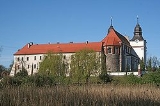
Mogilno

Overview
Poland
Poland , officially the Republic of Poland , is a country in Central Europe bordered by Germany to the west; the Czech Republic and Slovakia to the south; Ukraine, Belarus and Lithuania to the east; and the Baltic Sea and Kaliningrad Oblast, a Russian exclave, to the north...
, situated in the Kuyavian-Pomeranian Voivodeship
Kuyavian-Pomeranian Voivodeship
-Transportation:Transportation infrastructure is of critical importance to the voivodeship's economy. Kuyavia-Pomerania is a major node point in the Polish transportation system. Railway lines from the South and East pass through Bydgoszcz in order to reach the major ports on the Baltic Sea...
(since 1999), previously in Bydgoszcz Voivodeship
Bydgoszcz Voivodeship
Bydgoszcz Voivodeship was a unit of administrative division and local government in Poland in the years 1975–1998, superseded by Kuyavian-Pomeranian Voivodeship. Capital city: Bydgoszcz Area: Statistics : Population: inhabitants...
(1975–1998).
Mogilno belongs to one of the oldest settlements along the border of the Greater Poland
Greater Poland
Greater Poland or Great Poland, often known by its Polish name Wielkopolska is a historical region of west-central Poland. Its chief city is Poznań.The boundaries of Greater Poland have varied somewhat throughout history...
and Kuyavia
Kuyavia
Kujawy , is a historical and ethnographic region in the north-central Poland, situated in the basin of the middle Vistula and upper Noteć Rivers, with its capital in Włocławek.-Etymology:The origin of the name Kujawy was seen differently in history...
historical regions. Since the turn of the 8th and 9th century until the 10th centurym an early-mediaeval settlement existed there, at the long narrow headland
Headlands and bays
Headlands and bays are two related features of the coastal environment.- Geology and geography :Headlands and bays are often found on the same coastline. A bay is surrounded by land on three sides, whereas a headland is surrounded by water on three sides. Headlands are characterized by high,...
surrounded by waters of Mogilno Lake from the west and south and marshes from the east.
