
Home      Discussion      Topics      Dictionary      Almanac
Signup       Login
Minstrel

Minstrel

Overview
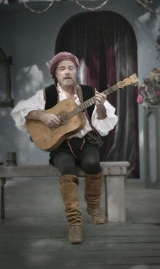
A minstrel was a medieval
Middle Ages
The Middle Ages is a periodization of European history from the 5th century to the 15th century. The Middle Ages follows the fall of the Western Roman Empire in 476 and precedes the Early Modern Era. It is the middle period of a three-period division of Western history: Classic, Medieval and Modern...

 Europe
Europe
Europe is, by convention, one of the world's seven continents. Comprising the westernmost peninsula of Eurasia, Europe is generally 'divided' from Asia to its east by the watershed divides of the Ural and Caucasus Mountains, the Ural River, the Caspian and Black Seas, and the waterways connecting...

an bard
Bard
In medieval Gaelic and British culture a bard was a professional poet, employed by a patron, such as a monarch or nobleman, to commemorate the patron's ancestors and to praise the patron's own activities.Originally a specific class of poet, contrasting with another class known as fili in Ireland...

 who performed songs whose lyrics told stories of distant places or of existing or imaginary historical events. Although minstrels created their own tales, often they would memorize and embellish the works of others. Frequently they were retained by royalty and high society. As the courts became more sophisticated, minstrels were eventually replaced at court by the troubadour
Troubadour
A troubadour was a composer and performer of Old Occitan lyric poetry during the High Middle Ages . Since the word "troubadour" is etymologically masculine, a female troubadour is usually called a trobairitz....

s, and many became wandering minstrels, performing in the streets and became well-liked until the middle of the Renaissance
Renaissance
The Renaissance was a cultural movement that spanned roughly the 14th to the 17th century, beginning in Italy in the Late Middle Ages and later spreading to the rest of Europe. The term is also used more loosely to refer to the historical era, but since the changes of the Renaissance were not...

, despite a decline beginning in the late 15th century. Minstrelsy fed into later traditions of traveling entertainers, which continued to be moderately strong into the early 20th century, and which has some continuity down to today's buskers
Busking
Street performance or busking is the practice of performing in public places, for gratuities, which are generally in the form of money and edibles...

 or street musicians.
Discussion
Ask a question about 'Minstrel'
Start a new discussion about 'Minstrel'
Answer questions from other users
Full Discussion Forum
 
Recent Discussions
Encyclopedia
A minstrel was a medieval
Middle Ages
The Middle Ages is a periodization of European history from the 5th century to the 15th century. The Middle Ages follows the fall of the Western Roman Empire in 476 and precedes the Early Modern Era. It is the middle period of a three-period division of Western history: Classic, Medieval and Modern...

 Europe
Europe
Europe is, by convention, one of the world's seven continents. Comprising the westernmost peninsula of Eurasia, Europe is generally 'divided' from Asia to its east by the watershed divides of the Ural and Caucasus Mountains, the Ural River, the Caspian and Black Seas, and the waterways connecting...

an bard
Bard
In medieval Gaelic and British culture a bard was a professional poet, employed by a patron, such as a monarch or nobleman, to commemorate the patron's ancestors and to praise the patron's own activities.Originally a specific class of poet, contrasting with another class known as fili in Ireland...

 who performed songs whose lyrics told stories of distant places or of existing or imaginary historical events. Although minstrels created their own tales, often they would memorize and embellish the works of others. Frequently they were retained by royalty and high society. As the courts became more sophisticated, minstrels were eventually replaced at court by the troubadour
Troubadour
A troubadour was a composer and performer of Old Occitan lyric poetry during the High Middle Ages . Since the word "troubadour" is etymologically masculine, a female troubadour is usually called a trobairitz....

s, and many became wandering minstrels, performing in the streets and became well-liked until the middle of the Renaissance
Renaissance
The Renaissance was a cultural movement that spanned roughly the 14th to the 17th century, beginning in Italy in the Late Middle Ages and later spreading to the rest of Europe. The term is also used more loosely to refer to the historical era, but since the changes of the Renaissance were not...

, despite a decline beginning in the late 15th century. Minstrelsy fed into later traditions of traveling entertainers, which continued to be moderately strong into the early 20th century, and which has some continuity down to today's buskers
Busking
Street performance or busking is the practice of performing in public places, for gratuities, which are generally in the form of money and edibles...

 or street musicians.

History


Initially, minstrels were simply servants at Court, and entertained the lord and courtiers with chansons de geste or their local equivalent. The term minstrel derives from Old French
Old French
Old French was the Romance dialect continuum spoken in territories that span roughly the northern half of modern France and parts of modern Belgium and Switzerland from the 9th century to the 14th century...

 ménestrel (also menesterel, menestral), which is a derivative from Italian
Italian language
Italian is a Romance language spoken mainly in Europe: Italy, Switzerland, San Marino, Vatican City, by minorities in Malta, Monaco, Croatia, Slovenia, France, Libya, Eritrea, and Somalia, and by immigrant communities in the Americas and Australia...

 ministrello (also menestrello), from Middle Latin ministralis "retainer," an adjective form of Latin
Latin
Latin is an Italic language originally spoken in Latium and Ancient Rome. It, along with most European languages, is a descendant of the ancient Proto-Indo-European language. Although it is considered a dead language, a number of scholars and members of the Christian clergy speak it fluently, and...

 minister, "attendant" from minus, "lesser".

In Anglo-Saxon England
History of Anglo-Saxon England
Anglo-Saxon England refers to the period of the history of that part of Britain, that became known as England, lasting from the end of Roman occupation and establishment of Anglo-Saxon kingdoms in the 5th century until the Norman conquest of England in 1066 by William the Conqueror...

 before the Norman Conquest, the professional poet was known as a scop
Scop
A ' was an Old English poet, the Anglo-Saxon counterpart of the Old Norse .As far as we can tell from what has been preserved, the art of the scop was directed mostly towards epic poetry; the surviving verse in Old English consists of the epic Beowulf, religious verse in epic formats such as the...

("shaper" or "maker"), who composed his own poems, and sang them to the accompaniment of a crude harp
Harp
The harp is a multi-stringed instrument which has the plane of its strings positioned perpendicularly to the soundboard. Organologically, it is in the general category of chordophones and has its own sub category . All harps have a neck, resonator and strings...

. In a rank much beneath the scop, were the gleemen, who had no settled abode, but roamed about from place to place, earning what they could from their performances. Late in the 13th century, the term minstrel began to be used to designate a performer who amused his lord with music and song.

In a complex way involving invasions, wars, conquests, etc., two categories of composers originated. Poets like Chaucer and John Gower
John Gower
John Gower was an English poet, a contemporary of William Langland and a personal friend of Geoffrey Chaucer. He is remembered primarily for three major works, the Mirroir de l'Omme, Vox Clamantis, and Confessio Amantis, three long poems written in French, Latin, and English respectively, which...

 appeared in one category wherein music was not a part. Minstrels, on the other hand, swarmed at feasts and festivals in great numbers with harps, fiddle
Fiddle
The term fiddle may refer to any bowed string musical instrument, most often the violin. It is also a colloquial term for the instrument used by players in all genres, including classical music...

s, bagpipes, flute
Flute
The flute is a musical instrument of the woodwind family. Unlike woodwind instruments with reeds, a flute is an aerophone or reedless wind instrument that produces its sound from the flow of air across an opening...

s, flageolet
Flageolet
The flageolet is a woodwind musical instrument and a member of the fipple flute family. Its invention is ascribed to the 16th century Sieur Juvigny in 1581. There are two basic forms of the instrument: the French, having four finger holes on the front and two thumb holes on the back; and the...

s, cittern
Cittern
The cittern or cither is a stringed instrument dating from the Renaissance. Modern scholars debate its exact history, but it is generally accepted that it is descended from the Medieval Citole, or Cytole. It looks much like the modern-day flat-back mandolin and the modern Irish bouzouki and cittern...

s, and kettledrums.

As early as 1321, the minstrels of Paris
Paris
Paris is the capital and largest city in France, situated on the river Seine, in northern France, at the heart of the Île-de-France region...

 were formed into a guild
Guild
A guild is an association of craftsmen in a particular trade. The earliest types of guild were formed as confraternities of workers. They were organized in a manner something between a trade union, a cartel, and a secret society...

. A guild of royal minstrels was organized in England
England
England is a country that is part of the United Kingdom. It shares land borders with Scotland to the north and Wales to the west; the Irish Sea is to the north west, the Celtic Sea to the south west, with the North Sea to the east and the English Channel to the south separating it from continental...

 in 1469. Minstrels were required to either join the guild or to abstain from practicing their craft. Some minstrels were retained by lords as jesters who, in some cases, also practiced the art of juggling
Juggling
Juggling is a skill involving moving objects for entertainment or sport. The most recognizable form of juggling is toss juggling, in which the juggler throws objects up to catch and toss up again. This may be one object or many objects, at the same time with one or many hands. Jugglers often refer...

. Some were women, or women who followed minstrels in their travels. Minstrels throughout Europe also employed trained animals, such as bear
Bear
Bears are mammals of the family Ursidae. Bears are classified as caniforms, or doglike carnivorans, with the pinnipeds being their closest living relatives. Although there are only eight living species of bear, they are widespread, appearing in a wide variety of habitats throughout the Northern...

s. Minstrels in Europe died out slowly, having gone nearly extinct by about 1700, though isolated individuals working in the tradition existed even into the early 19th century.

External links