

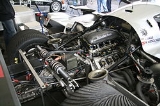
Mercedes-Benz M119 engine

Encyclopedia
The Mercedes-Benz
M119 was a V8 automobile
engine produced from 1989 through 1999. It was available in 4.2 L; 5.0 L; and 6.0 L displacements. It was a double overhead cam design with 4 valves per cylinder and variable valve timing
on the intake side. It was replaced by the 3-valve M113
starting in 1997.
The M119 differed from the M117
in the following ways:
Applications:
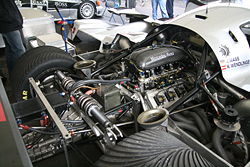 The 5.0 L (4973 cc) version produced 326 PS (322 hp/240 kW) at 5700 rpm and 354 ft·lbf (479 N·m) at 3900 rpm. Later engines had the full throttle enrichment removed and power was a little less, closer to 315 PS (311 hp/235 kW).
The E50 AMG M119.985 produced 352 PS @ 5,550 rpm and 481 newton metre @ 3,200 rpm.
Applications:
The 5.0 L M119 was also adapted for racing with the addition of two turbochargers. It won the 1989 24 Hours of Le Mans
in the Sauber C9 and was further used in the Mercedes-Benz C11
before being replaced by the M291 3.5 L Flat-12 in 1991.
Mercedes-Benz
Mercedes-Benz is a German manufacturer of automobiles, buses, coaches, and trucks. Mercedes-Benz is a division of its parent company, Daimler AG...
M119 was a V8 automobile
Automobile
An automobile, autocar, motor car or car is a wheeled motor vehicle used for transporting passengers, which also carries its own engine or motor...
engine produced from 1989 through 1999. It was available in 4.2 L; 5.0 L; and 6.0 L displacements. It was a double overhead cam design with 4 valves per cylinder and variable valve timing
Variable valve timing
In internal combustion engines, variable valve timing , also known as Variable valve actuation , is a generalized term used to describe any mechanism or method that can alter the shape or timing of a valve lift event within an internal combustion engine...
on the intake side. It was replaced by the 3-valve M113
Mercedes-Benz M113 engine
The Mercedes-Benz M113 engine is a V8 automobile piston engine family used in the 2000s. It was based on the similar M112 V6 introduced in 1998....
starting in 1997.
The M119 differed from the M117
Mercedes-Benz M117 engine
The Mercedes-Benz M117 engine family is an OHC design with 2 valves per cylinder V8 automobile engine made by Mercedes-Benz between 1969 and 1992.-Technical details:-Applications:...
in the following ways:
- The engine block uses asbestos-free gaskets and has better oil flow
- The cylinder head is now a 4-valveMulti-valveIn automotive engineering a multi-valve or multivalve engine is one where each cylinder has more than two valves. A multi-valve engine has better breathing and can operate at higher revolutions per minute than a two-valve engine, delivering more power.- Multi-valve rationale :A multi-valve design...
aluminum unit with dual overhead camshafts - The connecting rods are forged and enable cooling of the pistons with sprayed oil
- The pistons are iron-coated cast aluminum
- An improved vibration damper system is used
- The aluminum oil pan has bolted-on oil baffles to prevent foaming of the engine oil
- The intake camshaft timing is adjusted hydro-mechanicallyMachineA machine manages power to accomplish a task, examples include, a mechanical system, a computing system, an electronic system, and a molecular machine. In common usage, the meaning is that of a device having parts that perform or assist in performing any type of work...
up to 20°:- 0–2000 rpm — retarded for improved idle and cylinder scavenging
- 2000–4700 rpm — advanced for increased torqueTorqueTorque, moment or moment of force , is the tendency of a force to rotate an object about an axis, fulcrum, or pivot. Just as a force is a push or a pull, a torque can be thought of as a twist....
- 4700– rpm — retarded for improved volumetric efficiencyVolumetric efficiencyVolumetric efficiency in internal combustion engine design refers to the efficiency with which the engine can move the charge into and out of the cylinders. More specifically, volumetric efficiency is a ratio of what quantity of fuel and air actually enters the cylinder during induction to the...
4.2
The 4.2 L (4196 cc) version produced 279 PS (275 hp/205 kW) at 5700 rpm and 295 ft·lbf (400 N·m) at 3900 rpm.Applications:
- W124Mercedes-Benz W124W124 is the Mercedes-Benz internal chassis-designation for the 1985 to 1995 version of the Mercedes-Benz E-Class. The W124 models replaced the W123 models after 1985 and were superseded by the W210 E-Class after 1995.-History:...
400E/E420Mercedes-Benz E-ClassThe Mercedes-Benz E-Class is a range of executive-size cars manufactured by Mercedes-Benz in various engine and body configurations. The E initially stood for Einspritzmotor, ; a new feature in volume production vehicles at the time that the E-Class first appeared, with the E as a suffix to the... - W210Mercedes-Benz W210The Mercedes-Benz W210 is a mid-size luxury car–executive car which was produced by the German automaker Mercedes-Benz from 1995 through 2002 . The W210 replaced the W124 model. They were sold under the E-Class model names in both sedan and station wagon body types...
E420Mercedes-Benz E-ClassThe Mercedes-Benz E-Class is a range of executive-size cars manufactured by Mercedes-Benz in various engine and body configurations. The E initially stood for Einspritzmotor, ; a new feature in volume production vehicles at the time that the E-Class first appeared, with the E as a suffix to the... - W140Mercedes-Benz W140The Mercedes-Benz W140 was a series of flagship vehicles manufactured by the German automotive company Mercedes-Benz. The car premiered at the Geneva Motor Show in March 1991, with the first examples rolling off the production line on August 6, 1991. Short and long wheelbase sedans were offered...
400SE/400SEL/S420Mercedes-Benz S-ClassThe Mercedes-Benz S-Class is a series of luxury sedans produced by Mercedes-Benz, a division of Daimler AG. The classification was officially introduced in 1972 with the W116 S-Class, which succeeded previous Mercedes-Benz models dating to the mid-1950s...
5.0
The E50 AMG M119.985 produced 352 PS @ 5,550 rpm and 481 newton metre @ 3,200 rpm.
Applications:
- W124Mercedes-Benz W124W124 is the Mercedes-Benz internal chassis-designation for the 1985 to 1995 version of the Mercedes-Benz E-Class. The W124 models replaced the W123 models after 1985 and were superseded by the W210 E-Class after 1995.-History:...
500E/E500Mercedes-Benz E-ClassThe Mercedes-Benz E-Class is a range of executive-size cars manufactured by Mercedes-Benz in various engine and body configurations. The E initially stood for Einspritzmotor, ; a new feature in volume production vehicles at the time that the E-Class first appeared, with the E as a suffix to the... - W140Mercedes-Benz W140The Mercedes-Benz W140 was a series of flagship vehicles manufactured by the German automotive company Mercedes-Benz. The car premiered at the Geneva Motor Show in March 1991, with the first examples rolling off the production line on August 6, 1991. Short and long wheelbase sedans were offered...
500SEL/500SEC/S500Mercedes-Benz S-ClassThe Mercedes-Benz S-Class is a series of luxury sedans produced by Mercedes-Benz, a division of Daimler AG. The classification was officially introduced in 1972 with the W116 S-Class, which succeeded previous Mercedes-Benz models dating to the mid-1950s... - R129Mercedes-Benz R129The Mercedes-Benz R129 automobiles were produced from 1989 through 2002. They were sold under the SL-Class model names. The R129 replaced the R107 SL-Class in 1989 and was in its turn replaced by the R230 in 2003 .-Models:-Model history:...
500SL/SL500Mercedes-Benz SL-ClassThe Mercedes-Benz SL is a grand tourer manufactured by Mercedes since 1954. The designation SL derives from the German Sport Leicht, or Sport Lightweight — and was first applied to the 300SL 'Gullwing' named also after its gullwing or upward-opening doors.The term SL-Class refers to the... - W210Mercedes-Benz W210The Mercedes-Benz W210 is a mid-size luxury car–executive car which was produced by the German automaker Mercedes-Benz from 1995 through 2002 . The W210 replaced the W124 model. They were sold under the E-Class model names in both sedan and station wagon body types...
E50 AMGMercedes-Benz E-ClassThe Mercedes-Benz E-Class is a range of executive-size cars manufactured by Mercedes-Benz in various engine and body configurations. The E initially stood for Einspritzmotor, ; a new feature in volume production vehicles at the time that the E-Class first appeared, with the E as a suffix to the...
The 5.0 L M119 was also adapted for racing with the addition of two turbochargers. It won the 1989 24 Hours of Le Mans
1989 24 Hours of Le Mans
The 1989 24 Hours of Le Mans was the 57th Grand Prix of Endurance, and took place on June 10 and 11 1989.-Race:The race was the last time the 24 Hours of Le Mans ran without the two chicanes on the Mulsanne Straight; for the interest of safety to reduce speeds after speeds reaching in the previous...
in the Sauber C9 and was further used in the Mercedes-Benz C11
Mercedes-Benz C11
The Mercedes-Benz C11 was a Group C prototype race car introduced in 1990 for the World Sportscar Championship. Built by Sauber as a successor to the Sauber C9, the C11 used the same Mercedes-Benz M119 5.0L Turbocharged V8 from the C9...
before being replaced by the M291 3.5 L Flat-12 in 1991.
6.0
The M119.985 found in AMG models produced around 381 PS to 415 PS and upwards of 580 newton metre of torque.- W124Mercedes-Benz W124W124 is the Mercedes-Benz internal chassis-designation for the 1985 to 1995 version of the Mercedes-Benz E-Class. The W124 models replaced the W123 models after 1985 and were superseded by the W210 E-Class after 1995.-History:...
E60 AMGMercedes-Benz E-ClassThe Mercedes-Benz E-Class is a range of executive-size cars manufactured by Mercedes-Benz in various engine and body configurations. The E initially stood for Einspritzmotor, ; a new feature in volume production vehicles at the time that the E-Class first appeared, with the E as a suffix to the... - R129Mercedes-Benz R129The Mercedes-Benz R129 automobiles were produced from 1989 through 2002. They were sold under the SL-Class model names. The R129 replaced the R107 SL-Class in 1989 and was in its turn replaced by the R230 in 2003 .-Models:-Model history:...
SL60 AMGMercedes-Benz SL-ClassThe Mercedes-Benz SL is a grand tourer manufactured by Mercedes since 1954. The designation SL derives from the German Sport Leicht, or Sport Lightweight — and was first applied to the 300SL 'Gullwing' named also after its gullwing or upward-opening doors.The term SL-Class refers to the... - W210Mercedes-Benz W210The Mercedes-Benz W210 is a mid-size luxury car–executive car which was produced by the German automaker Mercedes-Benz from 1995 through 2002 . The W210 replaced the W124 model. They were sold under the E-Class model names in both sedan and station wagon body types...
E60 AMGMercedes-Benz E-ClassThe Mercedes-Benz E-Class is a range of executive-size cars manufactured by Mercedes-Benz in various engine and body configurations. The E initially stood for Einspritzmotor, ; a new feature in volume production vehicles at the time that the E-Class first appeared, with the E as a suffix to the...