
|
|
|
|
Megalodon
|
| |
|
| |
The megalodon ( or MEG-a-la-dong; meaning "big tooth" in Greek from µ??a? and ?d???), Carcharodon megalodon or Carcharocles megalodon (in dispute), was a giant shark that lived in prehistoric times. The oldest remains of this species found are about 18 million years old and C. megalodon became extinct in the Pleistocene epoch probably about 1.5 million years ago.

Discussion
Ask a question about 'Megalodon'
Start a new discussion about 'Megalodon'
Answer questions from other users
|
Encyclopedia
The megalodon ( or MEG-a-la-dong; meaning "big tooth" in Greek from µ??a? and ?d???), Carcharodon megalodon or Carcharocles megalodon (in dispute), was a giant shark that lived in prehistoric times. The oldest remains of this species found are about 18 million years old and C. megalodon became extinct in the Pleistocene epoch probably about 1.5 million years ago. It was the apex predator of its time and is the largest carnivorous fish known to have existed.
C. megalodon could grow to more than 60 ft long and is also quite possibly the largest shark ever to have lived. From scrutiny of its remains, scientists postulate that C. megalodon belongs to order Lamniformes. However, scientists are still debating that which genus would be most appropriate for C. megalodon, from the two proposed. Fossil evidence has revealed that megalodon fed upon large marine animals.
Taxonomy
The Swiss naturalist, Louis Agassiz, gave this shark its scientific name, Carcharodon megalodon in 1835, in his research work Recherches sur les poissons fossiles (Research on fossil fish), which he completed in 1843. Due to the dental similarities of the teeth of the great white shark, Carcharodon carcharias, Agassiz proposed Carcharodon as the genus. While the scientific name is C. megalodon, it is often informally dubbed the "mega-tooth shark" or "giant white shark."
Classification dispute
There is a major disagreement among scientists as to how C. megalodon should be classified. The controversy is that whether C. megalodon is a close relative of the extant great white shark or whether the two species are distant relatives. Some shark researchers (e.g. D. S. Jordan, H. Hannibal, E. Casier, C. DeMuizon, T. J. DeVries, and
H. Cappetta) dismiss the statement that C. megalodon is a close relative of the great white shark, and cite convergent evolution and heterochrony as the reasons for the dental similarity. Most paleontologists, convinced by the arguments, favor Carcharocles genus more over Carcharodon genus for C. megalodon.
Muizon et al. 1985
*Note: The hastalis hypothesis shows that C. carcharias is more closely related to I. hastalis than C. megalodon.
Megalodon within Carcharodon
The traditional view is that C. megalodon should be classified within the genus Carcharodon along with the great white shark. The Carcharodon proponents suggest that C. megalodon and C. carcharias share a common ancestor, Palaeocarcharodon orientalis.
Megalodon within Carcharocles
Around 1923, the genus, Carcharocles, was proposed by two shark researchers, D. S. Jordan and H. Lecter, to classify a very similar shark C. auriculatus. Many marine biologists and paleontologists are now favoring the Carcharocles genus for C. megalodon. One reason for this shift is that the teeth of C. megalodon are also similar to the teeth of some sharks that belong to Carcharocles lineage. The Carcharocles proponents suggest that the direct ancestor of the sharks belonging to the Carcharocles genus, is an ancient shark called Otodus obliquus, which lived during the Paleocene and Eocene epochs. According to Carcharocles proponents, Otodus obliquus evolved in to Carcharocles aksuaticus, which evolved in to Carcharocles auriculatus, which evolved into Carcharocles augustidens, which evolved into Carcharocles chubutensis, which eventually evolved into megalodon. Hence, the immediate ancestor of C. megalodon is Carcharocles chubutensis, because it serves as the missing link between Carcharocles augustidens and C. megalodon and it bridges the loss of the "lateral cusps" that characterize C. megalodon.
Carcharocles proponents also point out that the great white shark is more closely related to an ancient shark Isurus hastalis, the "broad tooth mako," than C. megalodon. This suggestion is given credence by many scientists due to some convincing evidence. One reason is that the teeth of I. hastalis and C. carcharias are remarkably similar in shape, differing only in that the former lack the characteristic serrations of the latter.
Anatomy and appearance C. megalodon is known primarily from fossil teeth and a few fossilized vertebral centra. As with all other sharks, the megalodon skeleton was formed of cartilage and not bone, resulting in a poor skeletal fossil record. The teeth are in many ways similar to great white shark teeth but are much larger and can measure up to more than 18 cm in slant.
Nevertheless, it is extrapolations from the shape and size of the teeth of C. megalodon when compared with related modern sharks and studies of their physical characteristics, that provide us with our conceptions about what this ancient super predator might have looked like in life. Thus far, the great white shark has been considered the favored model for the basis for the reconstruction of C. megalodon.
Size estimation
Estimating the maximum size of C. megalodon is a highly controversial subject. An early jaw reconstruction of this shark, developed by Professor Bashford Dean in 1909, indicates a length of more than , but that jaw reconstruction is now considered to be inaccurate. One reason is that the teeth used as posteriors in this jaw reconstruction were not true posterior teeth. However, several scientists have tried to solve this issue in later years.
In 1973, the ichthyiologist John E. Randall suggested a method to measure the size of the large sharks. According to Randall, the enamel height of the largest tooth in the upper jaw of the shark can be used to determine its total length. He concluded that C. megalodon could grow to .
However, in 1996, three shark experts, Michael D. Gottfried, Leonard J. V. Compagno and S. Curtis Bowman, questioned the reliability of Randall's method. According to them, shark's tooth enamel height does not necessarily increase in proportion with the animal's total length. Gottfried and his co-workers tried to solve this issue by means of conducting new research and analysis to create a method for measuring the size of large sharks (including C. megalodon) with much greater accuracy, which was published in 1996. The proposed method is: "Megatooth's" Total Length in meters = [− (0.22) + (0.096) × (Slant height of tooth in [mm])]. Using this new method, the maximum size of megalodon was calculated to be with a body mass of about . But this calculation was based on a 168 mm (6? inch) long upper anterior tooth, which was the biggest tooth in the possession of this team at the time. Since then, even larger C. megalodon teeth have been excavated which indicate that the shark could grow to more than .
Shark researcher Cliff Jeremiah also has suggested a method to determine the size of the large sharks, including C. megalodon, and his method is considered to be among the most reliable. He suggested that the jaw perimeter of a shark is directly proportional to its total length, with the width of the roots of the largest teeth being a proxy for estimating jaw perimeter. For every centimeter of root width of the largest tooth, he asserts, there was approximately 4.5 feet of the shark. He concluded that C. megalodon could grow up to , with a body mass of about . Many scientists acknowledge this conclusion.
Hence, from the research of several scientists, it is clear that C. megalodon is the largest macropredatory shark that has ever lived and is among the largest fishes known to have existed.
Jaw dentition
A team of Japanese scientists, T. Uyeno, O. Sakamoto, and H. Sekine, discovered and excavated the partial remains of a C. megalodon, with nearly complete associated set of its teeth, from Saitama, Japan in 1989. Based upon this discovery, two scientists, S. Applegate and L. Espinosa, published an artificial dental formula for C. megalodon in 1996. Several modern C. megalodon jaw reconstructions are based on this dental formula.
The dental formula of C. megalodon is:
As evident from the dental formula, C. megalodon contained four different kinds of teeth in its jaws.
- Anterior - A
- Intermediate - I (In the case of C. megalodon, this tooth appears to be upper anterior and is technically termed as "A3" because it is fairly symmetrical and does not points mesially, but this tooth is still designated as an intermediate tooth. However, in the case of the great white shark, the intermediate tooth does points mesially. This point has often been raised in the Carcharodon vs. Carcharocles debate regarding the megalodon and favors the case of Carcharocles proponents.)
- Lateral - L
- Posterior - P
Paleontologists suggest that C. megalodon had a very robust dentition, and it had a total of about 250 teeth in its jaws.
Skeletal reconstruction
Aside from estimating the size of C. megalodon, Gottfried and his colleagues also have tried to determine what C. megalodon might have looked like in real life. After conducting a comprehensive analysis of the available evidence, they concluded that C. megalodon was a very robust shark and it was more massively proportioned than many modern large sharks including C. carcharias due to several reasons including:
- C. megalodon had a more massive, stouter and more strongly developed chondrocranium and jaws than those of modern macropredatory sharks, in order to functionally support a massive and very robust dentition.
- The fins of C. megalodon were significantly larger and thicker because they needed to be adapted for propulsion and control of movements of such a massive shark.
- It had a higher vertebral count than that of any large shark including C. carcharias.
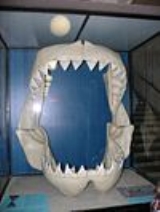
Gottfried and his colleagues eventually developed a model of the entire skeleton of C. megalodon with the above mentioned characteristics, which has been put on display in Calvert Marine Museum at Solomons island, Maryland in USA.
Distribution, range and habitat
C. megalodon was a warm water pelagic fish and it thrived in all the oceans of the world in its time. The teeth of this ancient shark have been excavated from many parts of the world, including Europe, North America, South America, Australia, New Zealand, Japan, South Africa, Malta and India.
The oceans were noticeably warmer during the Miocene and early Pliocene. This would have made it possible for this species to flourish around the world.
Paleoecology
Diet
The teeth of C. megalodon are serrated, which would have improved efficiency in slicing the flesh of prey items. There is evidence that C. megalodon preyed on whales (e.g. sperm whales, bowhead whales, Cetotherium, and Odobenocetops), sirenians, dolphins,, porpoises, pinnipeds, and giant sea turtles. Whales were likely an important prey item for C. megalodon as many whale bones (including vertebrae and flippers) have been found with clear signs of large bite marks made by the teeth that match those of C. megalodon, and various excavations have revealed C. megalodon teeth lying close to the chewed remains of whales.
Like other sharks, C. megalodon was certainly piscivorous as well.
Behavior
Most sharks are opportunistic predators and rely on a broad spectrum of prey coupled with scavenging. C. megalodon was unlikely to have been an exception to this rule. Some large sharks (including the great white shark) employ ambush strategies against their prey during hunting. Such sharks usually attack their prey with great force in the first attempt to inflict maximum possible damage and wait for the prey to get weakened due to massive blood loss, before dispatching the prey without facing any resistance. Some paleontologists suggest that C. megalodon also may have employed a similar hunting strategy against large potential prey such as adult whales. However, remains of a prehistoric baleen whale excavated from Chesapeake Bay suggest that the attacking behavior of C. megalodon may have been more aggressive than that of the great white shark and other large sharks. Based on this first opportunity to quantitatively analyse the feeding behavior of C. megalodon, it appears that the shark focused its attack on the bony portions of the prey, which great white sharks generally avoid.
Additionally, several fossilized flipper bones, and caudal vertebrae of whales have been found with bite marks that were caused by the attacks from C. megalodon. This evidence indicates that C. megalodon most likely injured and immobilized its prey by biting off its propulsive structures, before proceeding to feed on it.
Juvenile C. megalodon would most likely have preferred to attack small-to-medium sized prey, such as porpoises, other sharks, pinnipeds and juvenile whales, proceeding on to larger prey as they reached maturity. In addition, fossil evidence suggests that the preferred breeding grounds of C. megalodon were mostly warm coastal regions.
Extinction
There are several hypotheses as to how an apex predator like C. megalodon suddenly became extinct after millions of years of existence. Scientists believe that C. megalodon disappeared due to combination of a variety of reasons. The extinction of a large-bodied marine predator, Basilosaurus, is instructive as to the possible mechanism involved. Factors such as abrupt global cooling of the Earth's climate coincided with changing ocean circulation, and shortage of food, have been known to cause demise of even dominant marine species. C. megalodon also became a victim of similar events which occurred during the late Pliocene and Pliestocene epochs.
The geological and climatic conditions of the world when C. megalodon existed, were considerably different from those now. It is possible that the major climatic and ecological changes that occurred during the late Pliocene and Pliestocene epochs may have been unfavorable for C. megalodon. Some of those notable climatic, geological and ecological shifts are:
Climatic upheavals
- The Isthmus of Panama closed during the Pliocene around 3 million years ago, partitioned the Atlantic and Pacific oceans and fundamentally changed global ocean circulation. It initially set the stage of glaciation in northern hemisphere, and later on also facilitated in cooling of the entire planet. Consequently, during the late Pliocene and Pleistocene epochs there were significant ice ages, which cooled the oceans significantly along with Earth's climate and caused wide-scale glaciation. The cooling trend in oceans may have spelled doom for the C. megalodon, as it predominantly thrived in warm waters.
- In addition, wide-scale glaciation during the late Pliocene and Pleistocene tied up huge volumes of water in continental ice sheets about 1,500–3,000 m thick, resulting in sea level drops of 100 m or more over the entire surface of the Earth. This lowered sea level may have restricted many of the shallow warm water coastal areas that are thought to have served as C. megalodons breeding grounds.
Shortage of food
- Prolonged disturbance of food chains can wipe out predators with massive metabolic requirements. Fossil records reveal that during the Pliocene, many species of whales and dolphins (e.g. Odobenocetops, Cetotherium, and several unknown taxons) became extinct. Additionally, whale migratory patterns from the end Pliocene have been reconstructed from the fossil record, suggesting that some surviving species migrated to polar regions, effectively "getting out of the range" of C. megalodon. Due to such extinctions and migrations of the main prey of C. megalodon, the food supply for this large bodied predator was drastically shortened, and thus sustaining the dietary requirements of such a predator would have become increasingly difficult.
Consequently, a hypothesis can be constructed that climatic upheavals posed a severe challenge to C. megalodon's survival at the end of the Pliocene. Several species of whales, including cetotheriids, became extinct during this period, while other whale species moved toward cooler polar regions too cold for C. megalodon to successfully breed in. Being unable to follow the surviving whale species into the polar seas reduced C. megalodon's food supply, which over time led to the extinction of this specialized super predator.
In fiction and popular culture
Ever since the remains of C. megalodon were discovered, it has been an object of fascination. It has been portrayed in several works of fiction, including films and novels, and continues to hold its place among the most popular subjects for fictional works involving Sea Monsters. Many of these works of fiction posit that at least some C. megalodon actually survived extinction and lurk in the depths of the ocean, which manage to surface from the vast depths, either as a result of human intervention or through natural means. Some works of fiction (such as Shark Attack 3: Megalodon and Steve Alten's Meg series) incorrectly depict Megalodon as being a species over 70 million years old and to have been alive at the time of Dinosaurs.
The Grammy-nominated metal band Mastodon dedicated a song to C. megalodon, entitled 'Megalodon', in their album Leviathan. Some facets of consumption (e.g. Postage stamps and Necklaces) have also been dedicated to C. megalodon.
In the animated series The Secret Saturdays, the main antagonist "V.V. Argost" wears a megalodon shark skin as a cape that protects him from harm.
See also
External links
- from BBC
- from San Diego Natural History Museum
- from BBC, with pictures and video
-
-
-
- (NOTE: Reconstructed by Vito Bertucci)
Educational videos
|
| |
|
|