
|
|
|
|
Mean free path
|
| |
|
| |
In physics the mean free path of a particle is the average distance covered by a particle (photon, atom or molecule) between subsequent impacts.
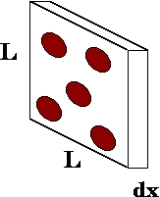
ine a beam of particles being shot through a target, and consider an infinitesimally thin slab of the target (Figure 1).

Discussion
Ask a question about 'Mean free path'
Start a new discussion about 'Mean free path'
Answer questions from other users
|
Encyclopedia
In physics the mean free path of a particle is the average distance covered by a particle (photon, atom or molecule) between subsequent impacts.
Derivation
Imagine a beam of particles being shot through a target, and consider an infinitesimally thin slab of the target (Figure 1). The atoms (or particles) that might stop a beam particle are shown in red. The magnitude of mean free path depends on the characteristics of the system the particle is in:
Where is the mean free path, n is the number of target particles per unit volume, and s is the effective cross sectional area for collision.
The area of the slab is and its volume is . The typical number of stopping atoms in the slab is the concentration n times the volume, i.e., . The probability that a beam particle will be stopped in that slab is the net area of the stopping atoms divided by the total area of the slab.
where is the area (or, more formally,
the "scattering cross-section") of one atom.
The drop in beam intensity equals the incoming beam intensity
multiplied by the probability of being stopped within the slab
This is an ordinary differential equation
whose solution is known as Beer-Lambert law and has form ,
where is the distance traveled by the
beam through the target and is the beam
intensity before it entered the target.
is called the mean free path because
it equals the mean distance traveled by a beam particle
before being stopped. To see this, note that the probability that the a particle is absorbed between x and x+dx is given by
Thus the expectation value (or average, or simply mean) of x is
Fraction of particles that were not stopped (attenuated) by the slab is called transmission where x is equal to the thickness of the slab .
Mean free path in kinetic theory
In kinetic theory mean free path of a particle, such as a molecule, is the average distance the particle travels between collisions with other moving particles. The formula still holds for a particle with a high velocity relative to the velocities of an ensemble of identical particles with random locations. If, on the other hand, the velocities of the identical particles have a Maxwell distribution of velocities, the following relationship applies:
and it may be shown that:
where k is the Boltzmann constant, T is temperature, p is pressure, and d is the diameter of the gas particles.
Following table lists some typical values for different pressures.
| Vacuum range | Pressure in hPa (mbar) | Molecules / cm3 | Molecules / m3 | mean free path | Ambient pressure | 1013 | 2.7*1019 | 2.7*1025 | 68 nm | Low vacuum | 300 - 1 | 1019 - 1016 | 1025 - 1022 | 0.1 - 100 µm | Medium vacuum | 1 - 10-3 | 1016 - 1013 | 1022 - 1019 | 0.1 - 100 mm | High vacuum | 10-3 - 10-7 | 1013 - 109 | 1019 - 1015 | 10 cm - 1 km | Ultra high vacuum | 10-7 - 10-12 | 109 - 104 | 1015 - 1010 | 1 km - 105 km | Extremely high vacuum | <10-12 | <104 | <1010 | >105 km |
In gamma-ray radiography mean free path of a pencil-beam of mono-energetic photons, is the average distance a photon travels between collisions with atoms of the target material. It depends on material and energy of the photons:
where µ is linear attenuation coefficient, µ/? is mass attenuation coefficient and ? is density of the material. Mass attenuation coefficient can be looked up or calculated for any material and energy combination using NIST databases
In x-ray radiography the calculation of mean free path is more complicated since photons are not mono-energetic, but have some distribution of energies called spectrum. As photons move through the target material they are attenuated with probabilities depending on their energy, as a result their distribution changes in process called Spectrum Hardening. Because of Spectrum Hardening mean free path of x-ray spectrum changes with distance.
Sometimes people measure thickness of material in number of mean free paths. Material with thickness of one mean free path will attenuate 37% (1/e) of photons. This concept is closely related to Half-Value Layer or (HVL) material with thickness of one HVL will attenuate 50% of photons. Standard x-ray image is a transmission image, a minus log of it is sometimes referred as number of mean free paths image.
In particle physics the concept of mean free path is not commonly used, replaced instead by the similar concept of attenuation length. In particular, for high-energy photons, which mostly interact by electron-positron pair production, the radiation length is used much like the mean free path in radiography.
Examples A classic application of mean free path is to estimate the size of
atoms or molecules. Another important application is in estimating
the resistivity of a material from the mean free path of its electrons.
For example, for sound waves in an enclosure, the mean free path is the average distance the wave travels between reflections off the enclosure's walls.
See also
External links
- Calculate mean free path for mixtures of gases using VHS model
|
| |
|
|