
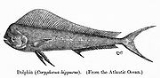
The
mahi-mahi or
common dolphinfish (
Coryphaena hippurus) is a surface-dwelling ray-finned fish found in off-shore
temperateIn geography, temperate or tepid latitudes of the globe lie between the tropics and the polar circles. The changes in these regions between summer and winter are generally relatively moderate, rather than extreme hot or cold...
, tropical and subtropical waters worldwide. It is one of only two members of the
CoryphaenidaeThe Coryphaenidae are a family of marine ray-finned fish belonging to the Order Perciformes. The family contains only one genus, Coryphaena, which contains two species, both of which have compressed heads and single dorsal fins that run the entire length of the fish's bodies...
family, the other being the
pompano dolphinfishThe pompano dolphinfish is a species of surface-dwelling ray-finned fish found in tropical and subtropical waters. They are one of only two members of the Coryphaenidae family, the other being the mahi-mahi or common dolphinfish....
. It is also known as the
dolphin, which causes confusion with the more widely-known marine mammals called
dolphinDolphins are marine mammals that are closely related to whales and porpoises. There are almost forty species of dolphin in 17 genera. They vary in size from and , up to and . They are found worldwide, mostly in the shallower seas of the continental shelves, and are carnivores, mostly eating...
s. Mahi-mahi means
very strong in Hawaiian. In other languages the fish is known as
lampuga,
lampuka,
rakingo,
calitos,
maverikos or
dorado.
Nomenclature
The common English name of
dolphin causes much confusion. This fish is not related to the marine mammals also known as
dolphins (family Delphinidae). Additionally, two species of dolphinfish exist, the common dolphinfish (
Coryphaena hippurus) and the pompano dolphin (
Coryphaena equiselis). Both these species are commonly marketed by their Pacific name, mahi-mahi.
The fish is called mahimahi in the
Hawaiian languageThe Hawaiian language is a Polynesian language that takes its name from Hawaii, the largest island in the tropical North Pacific archipelago where it developed. Hawaiian, along with English, is an official language of the state of Hawaii...
. The word was adopted into the English language without consistent spelling.
The American Heritage Dictionary, fourth edition, cites the preferred spelling (occurring “more frequently”) as the hyphenated
mahi-mahi. The secondary spelling is the single word
mahimahi, with the identical Hawaiian word given as the derivative source. But
Webster’s Unabridged Dictionary, second edition, reverses this preference order, preferring the single word to the hyphenated version, as does the
Oxford English DictionaryThe Oxford English Dictionary , published by the Oxford University Press, is the self-styled premier dictionary of the English language. Two fully bound print editions of the OED have been published under its current name, in 1928 and 1989. The first edition was published in twelve volumes , and...
(2000 draft entry).
FishbaseFishBase is a comprehensive database of information about fish species . It is the largest and most extensively accessed online database on adult finfish on the web...
records
mahi-mahi as being used in the US,
mahi mahi in Australia and New Zealand, and
mahimahi in some Pacific islands.
Linnaeus named the genus, derived from the Greek word,
koryphe, meaning top or apex, in 1758. Synonyms for the species include
Coryphaena argyrurus,
Coryphaena chrysurus and
Coryphaena dolfyn.
General characteristics
Mahi-mahi live 4 to 5 years. Catches average 7 to 13 kg (15.4 to 28.7 lb). They seldom exceed 15 kilograms (33.1 lb), and mahi-mahi over 18 kilograms (39.7 lb) are exceptional.
Mahi-mahi have compressed bodies and long
dorsal finA dorsal fin is a fin located on the backs of various unrelated marine and freshwater vertebrates, including most fishes, marine mammals , and the ichthyosaurs...
s extending nearly the entire length of their bodies. Their caudal fins and anal fins are sharply concave. They are distinguished by dazzling colors: golden on the sides, and bright blues and greens on the sides and back. Mature males have prominent foreheads protruding well above the body proper. Females have a rounded head. Females are also usually smaller than males.
Out of the water, the fish often change color among several hues (giving rise to their
SpanishSpanish , also known as Castilian , is a Romance language in the Ibero-Romance group that evolved from several languages and dialects in central-northern Iberia around the 9th century and gradually spread with the expansion of the Kingdom of Castile into central and southern Iberia during the...
name,
dorado maverikos, "golden maverick"), finally fading to a muted yellow-grey upon death.
Mahi-mahi are among the fastest-growing fish. They spawn in warm ocean currents throughout much of the year, and their young are commonly found in seaweed. Mahi-mahi are carnivorous, feeding on flying fish,
crabTrue crabs are decapod crustaceans of the infraorder Brachyura, which typically have a very short projecting "tail" , or where the reduced abdomen is entirely hidden under the thorax...
s,
squidSquid are cephalopods of the order Teuthida, which comprises around 300 species. Like all other cephalopods, squid have a distinct head, bilateral symmetry, a mantle, and arms. Squid, like cuttlefish, have eight arms arranged in pairs and two, usually longer, tentacles...
,
mackerelMackerel is a common name applied to a number of different species of fish, mostly, but not exclusively, from the family Scombridae. They may be found in all tropical and temperate seas. Most live offshore in the oceanic environment but a few, like the Spanish mackerel , enter bays and can be...
, and other
forage fishForage fish, also called prey fish or bait fish, are small fish which are preyed on by larger predators for food. Predators include other larger fish, seabirds and marine mammals. Typical ocean forage fish feed near the base of the food chain on plankton, often by filter feeding...
. They have also been known to eat
zooplanktonZooplankton are heterotrophic plankton. Plankton are organisms drifting in oceans, seas, and bodies of fresh water. The word "zooplankton" is derived from the Greek zoon , meaning "animal", and , meaning "wanderer" or "drifter"...
and
crustaceanCrustaceans form a very large group of arthropods, usually treated as a subphylum, which includes such familiar animals as crabs, lobsters, crayfish, shrimp, krill and barnacles. The 50,000 described species range in size from Stygotantulus stocki at , to the Japanese spider crab with a leg span...
s.
Males and females are sexually mature in their first year, usually by 4-5 months old. Spawning can occur at body lengths of 20 cm. Females may spawn two to three times per year, and produce between 80,000 and 1,000,000 eggs per event.
In waters above 34° C, larvae are found all year, with greater numbers detected in spring and fall. In one study, seventy percent of the youngest larvae collected in the northern Gulf of Mexico were found at a depth greater than 180 meters. Spawning occurs normally in captivity, with 100,000 eggs per event. Problems maintaining salinity, food of adequate nutritional value and proper size, and dissolved oxygen are responsible for larval mortality rates of 20-40%.
Recreational fishing
Mahi-mahi are highly sought for sport fishing and commercial purposes. Sport fishermen seek them due to their beauty, size, food quality, and healthy population. Mahi-mahi is popular in many restaurants.
Mahi-mahi can be found in the
Caribbean SeaThe Caribbean Sea is a sea of the Atlantic Ocean located in the tropics of the Western hemisphere. It is bounded by Mexico and Central America to the west and southwest, to the north by the Greater Antilles, and to the east by the Lesser Antilles....
, on the west coast of North and South America, the Pacific coast of
Costa RicaCosta Rica , officially the Republic of Costa Rica is a multilingual, multiethnic and multicultural country in Central America, bordered by Nicaragua to the north, Panama to the southeast, the Pacific Ocean to the west and the Caribbean Sea to the east....
, the
Gulf of MexicoThe Gulf of Mexico is a partially landlocked ocean basin largely surrounded by the North American continent and the island of Cuba. It is bounded on the northeast, north and northwest by the Gulf Coast of the United States, on the southwest and south by Mexico, and on the southeast by Cuba. In...
, the Atlantic coast of
FloridaFlorida is a state in the southeastern United States, located on the nation's Atlantic and Gulf coasts. It is bordered to the west by the Gulf of Mexico, to the north by Alabama and Georgia and to the east by the Atlantic Ocean. With a population of 18,801,310 as measured by the 2010 census, it...
,
Southeast AsiaSoutheast Asia, South-East Asia, South East Asia or Southeastern Asia is a subregion of Asia, consisting of the countries that are geographically south of China, east of India, west of New Guinea and north of Australia. The region lies on the intersection of geological plates, with heavy seismic...
,
HawaiiHawaii is the newest of the 50 U.S. states , and is the only U.S. state made up entirely of islands. It is the northernmost island group in Polynesia, occupying most of an archipelago in the central Pacific Ocean, southwest of the continental United States, southeast of Japan, and northeast of...
and many other places worldwide.
Fishing charters most often look for floating debris and
frigatebirdThe frigatebirds are a family, Fregatidae, of seabirds. There are five species in the single genus Fregata. They are also sometimes called Man of War birds or Pirate birds. Since they are related to the pelicans, the term "frigate pelican" is also a name applied to them...
s near the edge of the reef in about 120 feet (36.6 m) of water. Mahi-mahi (and many other fish) often swim near debris such as floating wood, palm trees and fronds, or sargasso weed lines and around fish buoys.
SargassoSargassum is a genus of brown macroalga in the order Fucales. Numerous species are distributed throughout the temperate and tropical oceans of the world, where they generally inhabit shallow water and coral reefs. However, the genus may be best known for its planktonic species...
is floating seaweed that sometimes holds a complete ecosystem from microscopic creatures to seahorses and baitfish. Frigatebirds dive for food accompanying the debris or sargasso. Experienced fishing guides can tell what species are likely around the debris by the birds' behavior.
Thirty- to fifty-pound gear is more than adequate when trolling for mahi-mahi. Fly-casters may especially seek frigatebirds to find big mahi-mahis, and then use a bait-and-switch technique.
BallyhooThe ballyhoo or bally, Hemiramphus brasiliensis, is a baitfish of the halfbeak family . It is similar to the Balao halfbeak . Ballyhoo are frequently used as cut bait and for trolling purposes by saltwater sportsmen.Ballyhoo can also be seen above the waters skimming the surface to escape from...
or a net full of live
sardineSardines, or pilchards, are several types of small, oily fish related to herrings, family Clupeidae. Sardines are named after the Mediterranean island of Sardinia, around which they were once abundant....
s tossed into the water can excite the mahi-mahis into a feeding frenzy. Hookless teaser lures can have the same effect. After tossing the teasers or live
chumChumming is the practice of luring animals, usually fish or sharks, by throwing "chum" into the water. Chum often consists of fish parts and blood, which attract fish, particularly sharks due to their keen sense of smell....
, fishermen throw the fly to the feeding mahi-mahi. Once on a line, mahi-mahi are fast, flashy and acrobatic, with beautiful blue, yellow, green and even red dots of color.
Commercial fishing
The
United StatesThe United States of America is a federal constitutional republic comprising fifty states and a federal district...
and the
CaribbeanThe Caribbean is a crescent-shaped group of islands more than 2,000 miles long separating the Gulf of Mexico and the Caribbean Sea, to the west and south, from the Atlantic Ocean, to the east and north...
countries are the primary consumers of this fish, but many European countries are increasing their consumption every year. It is a popular eating fish in Australia, usually caught and sold as a by-product by tuna and swordfish commercial fishing operators.
JapanJapan is an island nation in East Asia. Located in the Pacific Ocean, it lies to the east of the Sea of Japan, China, North Korea, South Korea and Russia, stretching from the Sea of Okhotsk in the north to the East China Sea and Taiwan in the south...
and Hawaii are significant consumers. The
Arabian SeaThe Arabian Sea is a region of the Indian Ocean bounded on the east by India, on the north by Pakistan and Iran, on the west by the Arabian Peninsula, on the south, approximately, by a line between Cape Guardafui in northeastern Somalia and Kanyakumari in India...
, particularly the coast of
OmanOman , officially called the Sultanate of Oman , is an Arab state in southwest Asia on the southeast coast of the Arabian Peninsula. It is bordered by the United Arab Emirates to the northwest, Saudi Arabia to the west, and Yemen to the southwest. The coast is formed by the Arabian Sea on the...
, also has mahi-mahi. At first, mahi-mahi were mostly
bycatchThe term “bycatch” is usually used for fish caught unintentionally in a fishery while intending to catch other fish. It may however also indicate untargeted catch in other forms of animal harvesting or collecting...
(incidental catch) in the tuna and swordfish longline fishery. Now they are sought by commercial fishermen on their own merits.
In
French PolynesiaFrench Polynesia is an overseas country of the French Republic . It is made up of several groups of Polynesian islands, the most famous island being Tahiti in the Society Islands group, which is also the most populous island and the seat of the capital of the territory...
, fishermen use
harpoonA harpoon is a long spear-like instrument used in fishing to catch fish or large marine mammals such as whales. It accomplishes this task by impaling the target animal, allowing the fishermen to use a rope or chain attached to the butt of the projectile to catch the animal...
s, using a specifically designed boat, the
poti marara, to pursue it, because mahi-mahi do not dive. The
poti marara is a powerful motorized V-shaped boat, optimized for high agility and speed, and driven with a stick so the pilot can hold his harpoon with his right hand.
Environmental and food safety concerns
The
Monterey Bay AquariumThe Monterey Bay Aquarium is located on the former site of a sardine cannery on Cannery Row of the Pacific Ocean shoreline in Monterey, California. It has an annual attendance of 1.8 million visitors. It holds thousands of plants and animals, representing 623 separate named species on display...
classifies mahi-mahi, when caught in the US Atlantic, as a "Best Choice", the top of its three environmental impact categories. The Aquarium advises to "Avoid" imported mahi-mahi harvested by long line but rates troll and pole-and-line caught as a "Good Alternative."
The
Natural Resources Defense CouncilThe Natural Resources Defense Council is a New York City-based, non-profit, non-partisan international environmental advocacy group, with offices in Washington DC, San Francisco, Los Angeles, Chicago, and Beijing...
(NRDC) classifies mahi-mahi as a "moderate
mercuryMercury is a chemical element with the symbol Hg and atomic number 80. It is also known as quicksilver or hydrargyrum...
" fish or shellfish (its second lowest of four categories), and suggests eating six servings or fewer per month.
The mahi-mahi is also a common vector for
ciguateraCiguatera is a foodborne illness caused by eating certain reef fishes whose flesh is contaminated with toxins originally produced by dinoflagellates such as Gambierdiscus toxicus which lives in tropical and subtropical waters. These dinoflagellates adhere to coral, algae and seaweed, where they are...
poisoning.
The Environmental Defense Fund (EDF) classifies mahi-mahi caught by line/pole in the US as "Eco-Best" in its three-category system, but classifies all mahi-mahi caught by longline as only "Eco-OK" or "Eco-Worst" due to longline "high levels [of] bycatch, injuring or killing seabirds, sea turtles and sharks."
External links