
Home      Discussion      Topics      Dictionary      Almanac
Signup       Login
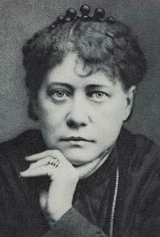
Madame Blavatsky

Madame Blavatsky

Overview
Helena Petrovna Blavatsky , (born as Helena von Hahn
Von Hahn
von Hahn is the name of the German-Baltic-Russian noble family with the coat of arms: Striding red rooster on the silver shield.-Origin:...

; 8 May 1891) was a theosophist, writer and traveler. Between 1848 and 1875 Blavatsky had gone around the world three times. In 1875, Blavatsky together with Colonel H. S. Olcott established the Theosophical Society
Theosophical Society
The Theosophical Society is an organization formed in 1875 to advance the spiritual principles and search for Truth known as Theosophy. The original organization, after splits and realignments has several successors...

. One of the main purposes of this Society was “to form a nucleus of the Universal Brotherhood of Humanity, without distinction of race, creed, sex, caste or color”.
Discussion
Ask a question about 'Madame Blavatsky'
Start a new discussion about 'Madame Blavatsky'
Answer questions from other users
Full Discussion Forum
 
Unanswered Questions
Encyclopedia
Helena Petrovna Blavatsky , (born as Helena von Hahn
Von Hahn
von Hahn is the name of the German-Baltic-Russian noble family with the coat of arms: Striding red rooster on the silver shield.-Origin:...

; 8 May 1891) was a theosophist, writer and traveler. Between 1848 and 1875 Blavatsky had gone around the world three times. In 1875, Blavatsky together with Colonel H. S. Olcott established the Theosophical Society
Theosophical Society
The Theosophical Society is an organization formed in 1875 to advance the spiritual principles and search for Truth known as Theosophy. The original organization, after splits and realignments has several successors...

. One of the main purposes of this Society was “to form a nucleus of the Universal Brotherhood of Humanity, without distinction of race, creed, sex, caste or color”.

Lineage


Maternally H.P. Blavatsky’s lineage goes back through the prince Michael of Chernigov to Ryurick, founder of statehood in Russia. Maternally the direct ancestor of H. Blavatsky was Sergey Grigor’yevich Dolgoruky, well-known diplomat of his time, brother of Aleksey Grigor’evich Dolgoruky, a member of Supreme Secret Council under Peter the Second. Sergei Grigor’evich was great grandfather of Helena Pavlovna Fadeyeva-Dolgorukaya (H.P. Blavatsky’s grandmother) and great-great-great-grandfather of Helena Petrovna Blavatsky.

H.P. Blavatsky’s grandfather, Prince Pavel Vasilyievich Dolgorukov (1755-1837) was Major General in time of Ekaterina the Great. He was decorated with a higher army award, Order of St. George and was a companion in arms of Kutuzov . His wife was Henrietta de Bandre Plessy Duc de, a daughter of Adolf Frantcevich, which had command by army corps during Crimea campaign and, according to A.M. Fadeyev, was a favorite of Suvorov .

A daughter of Pavel Vasilievich and Henrietta Adolfovna was Princess Helena Pavlovna, H.P. Blavatsky’s grandmother. She got a versatile home education, speak in five languages, was occupied with archeology, numismatics, botanic. Fadeyev’s herbariums and pictures of various plants aroused admiration of many scientists. Helena Pavlovna was in scientific correspondence with well-known German scientist Alexander Humboldt, English geologist, founder of Geographic Society R. Merchison, Sweden botanist Christian Steven, researcher of Caucasus flora and fauna. According to H.F. Pisareva, botanist Homer de Hel named found by him shell Venus-Fadeyeff in honor of Helena Pavlovna.
In 1813, princess married Andrew Mikhailovich Fadeyev which was the state officer and later the secret councilor, governor of Saratov and Tiflice. His lineage goes back to Russian hereditary nobleman and Germans von Krause. Andrew Mikhailovich’s grandfather Peter Mikhailovich Fadeyev was captain in the army of Peter the Great. Helena Pavlovna and Andrew Mikhailovich had four children. Elder daughter Helena Hahn was well-known writer; she had a name Russian George Sand. She was a mother of Helena Petrovna Blavatsky, Vera Petrovna Jelihovsky and Leonid Hahn. Next, son Rostislav Fadeyev, was general, army writer and reformer. Daughter Ekaterina Andreevna was mother of well-known Russian statesman Sergey Witte. And the last, daughter Nadejda Andreevna was active member of Theosophical Society.

Sergei Witte
Sergei Witte
Count Sergei Yulyevich Witte , also known as Sergius Witte, was a highly influential policy-maker who presided over extensive industrialization within the Russian Empire. He served under the last two emperors of Russia...

 wrote that his grandfather P.V. Dolgorukov during his daughter’s marring had blessed daughter and son-in-law by ancient cross which according to family legend belongs to the Grand Prince of Kiev St. Michael of Chernigov. Later this cross passed into the hands of Helena Pavlovna and further to Sergei Witte
Sergei Witte
Count Sergei Yulyevich Witte , also known as Sergius Witte, was a highly influential policy-maker who presided over extensive industrialization within the Russian Empire. He served under the last two emperors of Russia...

.

According to lineage of her father Peter Alekseevich Hahn, Helena Petrovna belongs to Baltic-German family Hahn. Boris Zirkoff, a editor and active promoter of theosophy, in introduction to H.P. Blavatsky’s collected works pointed to that Hahn's family (H.P. Blavatsky’s forefathers from father’s side) belongs to count’s family von Hahn from Basedov (Mecklenburg). According to information from another source, this family goes back to Caroling’s dynasty and German knights and crusaders. Meanwhile, any documents supporting a relationship between H.P. Blavatsky’s family and the Mecklenburg’s counts are still not found. In the record of service of “Aleksey Fedorov Hahn’s son” (1751-1815) (H.P.Blavatsky’s grandfather, governor of fortress Kamenets-Podolsk) is mentioned as descended from “Eastland’s inhabitants. His father had foreign citizenship and was Kraits-commissioner in the Eastland”. The archives contain the documents supporting the existence of “Kraits-commissioner” Johann Friedrich (Fyodor) Hahn which was born in 1719 at Narva and died May 31, 1803, in the same place. The documents do not contain any information about the lineage or ties of relationship of the family. Note that B. Zirkoff himself belongs to Hahn's family from female side, not Johann Friedrich but Johann August von Hahn, which is not connected with H.P. Blavatsky’s family by documents.

Childhood and youth


Helena Petrovna Blavatsky was born on July 31 (August 12 for new style) 1831 at Yekaterinoslav (from 1926 Dnepropetrovsk) in the family of well-known writer Helena Andreevna Hahn (Fadeyeva) and an officer of horse-artillery battery Peter Alekseevich Hahn.

Because of father’s profession, the family often chooses the place of abode. A year later after Helena’s birth, the family moved to Romankovo (now it enters Dneprodzerzhinsk), and in 1835 they moved to Odessa, where Helena’s sister Vera (future writer Jelihovsky) was born. Further the family lived in Tula and Kursk and in spring 1836 arrived to St. Petersburg where lived up to May 1837. From Petersburg Helena Petrovna with her sister, mother and grandfather Andrei Mikhailovich Fadeyev moved to Astrakhan. There Andrei Mikhailovich worked a main relieving officer over Kalmyk people and local German colonists . In 1838, mother with the little girls moved to Poltava where Helena began to take the dance lessons and learned to play the piano with the mother.

In spring 1839, the family moved to Odessa because of Helena’s wealth aggravation. There Helena Andreevna found the governess for her children which had taught them English . In November, Helena’s Grandfather Andrei Mikhailovich was assigned for a governor of Saratov by approval of Emperor’s Nikolai I. After this, Helena Andreevna with her children moved to him. In June 1840, at Saratov her son Leonid was born. Then Helena Petrovna was nine years old. Nadejda Fadeyeva, Helena’s aunt, wrote to A.Sinnett her memory about the niece:
“In childhood, all [Helena’s] the likings and interests were concentrated on the people from lower estates. She preferred to play with domestic’s children but not with equals. <…> She always needs for attention to prevent her escape from home and meetings with street ragamuffins. And at mature age she irrepressibly reached out to them whose status was lower than her own, and displayed a marked indifference to the “nobles”, to which she belongs by birth” .


Ten years old, Helena began to study German. A progress was so appreciable that, according to V. Jelihovsky, the father “complemented her and in jest called a worthy heiress of her glorious ancestors, German knights Hahn-Hahn von der Rother Hahn, knew no another language besides German."

In 1841, the family returned to Ukraine. On July 6, 1842 Helena Andreevna Hahn, Helena’s mother and at that time well-known writer, died at the age of 28 because of galloping consumption.

According to Vera Jelihovsky, the mother at the time, was worried about a destiny of an elder daughter, “gifted from childhood by outstanding features” . Before her death, the mother said: “Well! Perhaps it is for the better that I am dying: at least, I will not suffer from seeing Helena’s hard lot! I am quite sure that her destiny will be not womanly, that she will suffer much” .

After her mother’s death, Helena’s grandfather Andrei Mikhailovich and Grandmother Helena Pavlovna had taken the children to Saratov, where they had quite a different life. Fadeyev’s house was visited by Saratov’s intellectuals. A known historian Kostomarov and writer Mary Zhukova were among them . Her grandmother and three teachers were occupied with the children’s upbringing and education, therefore, Blavatsky got a solid home education .

Helena’s favorite place in the house was grandmother’s library which Helena Pavlovna inherited from her father . In this voluminous library, Helena Petrovna paid a special attention to the books on medieval occultism .
In 1847, the family had moved from Saratov to Tiflis (now Tbilisi, Georgia), where Andrei Mikhailovich get a proposition to work in the Council of senior Governance of Transcaucasia region . H.F. Pisareva wrote in her biographic essay “Helena Petrovna Blavatsky”:

“They who knew her … in youth remember with delight her inexhaustibly merry, cheerful, sparkling with wit talk. She liked jokes, teasing and to cause a commotion” [26].


Nadejda Andreevna Fadeyeva, Helena’s aunt, remembered the following:

“As a child, as a young woman, as a woman, she always was so higher than her surroundings that she never was could not appreciated at its true value. She was trained as a girl from good family … Extraordinary wealth of her intellectual faculties, fineness and quickness of her thoughts, amazing lightness of her understanding and learning of most difficult disciplines, unusually developed mind together with chivalrous, direct, energetic and open character – this is what raised her so high over the level of conventional society and could not help attracting the common attention and therefore the envy and hostility from these who with their nonentity can not stand of luster and gifts of this wonderful nature” .


In youth, Helena had a high life, often was in society, danced at the balls and visited the parties. But when she reached 16, she has experienced sudden inner change, and she began to study the books from great grandfather’s library more deeply .
In 1910 H.F.Pisareva, in her essay dedicated to H.P. Blavatsky, cited the reminiscences of Mary Grigor’evna Yermolova, Tiflis governor’s wife: “Simultaneously with Fadeev’s family, in Tiflis lived a relation of the Caucasian Governor-general, prince Golitsin. He often visited Fadeyevs and was greatly interested by an original young woman”. Just due to Golitsin (Yermolova did not cited his name) which, as it was rumored, was “either mason or magician or soothsayer” Blavatsky tried “to come into contact with a mysterious sage of the East where prince Golitsin was going to” . This version was further supported by many biographers of H. Blavatsky . According to A.M.Fadeyev and V.P. Jelihovsky, at the end of 1847, an old friend of Andrei Mikhailovich prince Vladimir Sergeevich Golitsin (1794-1861), Major General, Head of the Caucasian line centre and further privy councilor , arrived to Tiflis and lived there a few months. He almost daily visited Fadeyevs, and often with his young sons Sergei (1823-1873) and Alexander (1825-1864) . Therefore, some researchers of H.P. Blavatsky consider the information from M. Yermolova about prince Golitsin improbable because the young Golitsin’s sons did not correspond to Yermolova’s description because of age, and aged prince Golitsin could not be “strongly interested for an original young woman” because of moral reasons. In addition, according to his biographers, prince Golitsin never was going to the East .

Striving for full independence during the winter of 1848/1849 at Tiflis, Helena Petrovna entered into a sham marriage with vice-governor of Erevan Nikifor Vladimirovich Blavatsky, who was much older than Helena. In June 7, 1849 their wedding ceremony took place. Soon after their wedding, Helena escaped from the husband and returned to her relatives . Further, she was going to Odessa and sailed away from Poti to Kerch at English sailboat “Commodore”. Then she moved to Constantinople. There she met a Russian countess Kiseleva, and together they leaved to travel over Egypt, Greece and Eastern Europe .

Years of travels


Next period of H.P. Blavatsy’s life is difficult for her biographers as she did not keep diaries and there was nobody with her to tell about these events. In general, a picture of a route and course of the travels is based mainly on Blavatsky’s own memories which sometimes contain the chronological contradictions. N.A. Fadeyeva reported that over all her relatives the father only knows where his daughter is, and from time to time he sent money to her.
It is known that Helena Blavatsky met Albert Rawson at Cairo. At that time he was the student learned the art. After H. Blavatsky’s death, A. Rawson, already a doctor of theology and doctor of law in Oxford described their meeting at Cairo. According to her memory, Blavatsky told him about her future participation in the work which some day will serve to liberation of the human mind. Rawson wrote:
According to H. Blavatsky’s reminiscences, after she leaved Middle East she together with her father began to travel over the Europe. It is known, that at this time she learned to play piano with I. Mosheles, well-known composer and virtuoso pianist. Later she gave several concerts in England and other countries.
In 1851, on her birthday (August 12), Blavatsky for the first time met her Teacher in Hide-Park at London. Previously, she saw the Teacher in her dreams. Countess Konstanz Wahtmeister, widow of Sweden ambassador at London, remembered the details of this talk in which Teacher said that he "needs her participation in the work he is going to undertake" and "she will live three years at Tibet to prepare for carrying out of this important mission".
When leaved England, H.P. Blavatsky had gone to Canada, then to Mexico and Central and Southern America. In 1852 she arrived to India. Helena Petrovna remembered: "I lived there about two years and monthly received money from unknown person. I honestly followed the pointed route. I received the letters from this Hindu but not once seen him during these two years".

Before leaving India, Blavatsky tried to pass to Tibet through Nepal but Britain representative broken her plans.

From India, H.P. Blavatsky came back to London, where, according to V. Jelihovsky, "acquiring a fame by her music talent. She was a member of philharmonic society". Here, according to H.P. Blavatsky, she met her Teacher another time. After this meeting she came to New York, where resumed to met A. Rawson. Then, according to A.P. Sinnett, H.P. Blavatsky came to Chicago, and further, together with settler caravans, to Far West through the Rocky Mountains. After this, she stayed some time at San Francisco. In 1855 (or 1856), she sailed through the Pacific Ocean to the Far East. Then she via Japan and Singapore arrived to Calcutta.

In 1856, H. Blavatsky’s memories about her living in India were published in the book "From caves and jungles of Hindustan". In that book Blavatsky has displayed an eminent literature talent. The book was composed from essays written from 1879 to 1886 under the pen name "Radda-Bay". In Russian, the essays firstly published in newspaper “Moskovskie vedomosti” which was edited by known publicist M.N. Katkov. The essays attracted a great interest of the readership so Katkov republished them at attachment to "Russkii vestnik" and then published new letters written specially for this journal. In 1892, the book was partially translated into English; in 1975 it was fully translated into English.

The book "From the caves and jungles of Hindustan" in a literature style describes the travels of H. Blavatsky and her Teacher which she named Takhur Gulab-Singh. In spite of that the book was considered as novel, Blavatsky asserted that "the facts and persons that I cited are true. I simply collected to time interval in three-four months the events and cases occurring during several years just like the part of the phenomena that the Teacher has shown".

In 1857, Blavatsky repeatedly tried to pass to Tibet from India via Kashmir but shortly before the Mutiny she got the instructions from her Teacher and sailed at a Holland ship from Madras to Java. Later she returned to Europe.

Further Blavatsky during several months was in France and Germany, and then she moved to Pskov to her relatives. She arrived to him in the Christmas night of 1858. According to V. Jelihovsky, H.P. Blavatsky returned from the travels as "a human gifted by exceptional features and forces amazing all the people around her".

On May, 1859 Blavatsky with her family moved to village Rugodevo of Novorzhev district where Blavatsky lived almost one year. This period finished by her strong illness. On spring 1860, when she got well she, together with her sister, moved to Caucasus to visit her grandparents.

As V. Jelihovsky has reported, on the way to Caucasus, at Zadonsk, Blavatsky met the former exarch of the Georgia Isidor. Further he was the metropolitan of Kiev and then Novgorod, St-Petersburg and Finland. Isidor gave one’s blessing to H.P. Blavatsky. (Details see below).
From Russia, Blavatsky began to travel again. Although her further route is not known for certain, probably, she visited Persia, Syria, Lebanon, Jerusalem and more than once was at Egypt, Greece and Italy.

In 1867, she traveled through Hungary and Balkans during a few months. Then she visited Venice, Florence and Mentan. According to N. Fodor’s biography, in November 17, 1867 she took part in the battle near Mentan on Garibaldi’s side. Her left hand was twice broken by saber stabs; in addition, she got two hard missile wounds in right shoulder and leg. Initially, she was considered as killed but further she was picked up at the battlefield. Blavatsky told Olcott that she was a volunteer at Mentan together with other European women.

On the beginning of 1868, when Blavatsky recovered from the wounds she moved to Florence. Then she traveled to North Italy and Balkans and further to Constantinople, India and Tibet.

Later, when she answered to the question why she traveled to Tibet, H.P. Blavatsky wrote:

According to biographers, H.P. Blavatsky’s path laid to Tashilunpo monastery (near Shigatse). A book "The Voice of the Silence", published for the request of Panchen Lama IX in 1927 by Chinese society for Buddhism study at Peking, reports that H. Blavatsky during several years was studied in Tashilunpo and knew well Panchen Lama VIII Tenpay Vangchug. Blavatsky also confirmed her living at Tashilunpo and Shigatse. In a letter, she depicted her correspondent a solitary temple of Tashi Lama near Shigatse.

S. Cranston asserts that, according to H.P. Blavatsky, it is not known would she was at Lhasa in that time, but V. Jelihovsky affirmed the follows: "It is reliably that she (Blavatsky) sometimes was at Lhasa, capital of Tibet, and also at Shigatse, main Tibetan religious centre … and at Karakoram mountains in Kunlun Shan. Her living stories about this proved that for me many times".

According to the biographers, last period of her living at Tibet H.P. Blavatsky has conducted in the home of her Teacher Koot Hoomi (K.H.). He helps Blavatsky to get to several lamaseries where any European was not before her. In the letter from October 2, 1991 she wrote to M. Hillis-Billing that the house of Teacher K.H. "is in the region of Karakoram mountains beyond Ladakh which is at minor Tibet and related now to Kashmir. This is a large wooden building in China style looking like to pagoda located between lake and a nice river".

Researchers believe that just at this time (during living in Tibet) Blavatsky began to study the texts which later will come to the book "The Voice of the Silence".

In 1927, one of the eminent explorers of Tibet and its philosophy W.Y. Evans-Wentz wrote in introduction to his translation of "The Tibetan Book of the Dead": "As concerning an esoteric meaning of forty ninth day of Bardo, please see about this in H.P. Blavatsky’s “The Secret Doctrine” (London, 1888, v.1, P.238, 411; v.2, p. 617,628). Late lama K.D. Samdup believed that in spite of malevolent critics of Blavatsky’s works, this author has undisputable proofs that she was well acquainted with the highest lamaist teaching, and for this she needs to get an initiation". Doctor Malalasekera, founder and President of the World Buddhist brotherhood, wrote about Blavatsky in a monumental "Buddhism Encyclopedia": "Her acquaintance with Tibetan Buddhism and also with esoteric Buddhism practices is indubitable". Thus, Japan philosopher and Buddhologist D. T. Suzuki supposes that

After almost three years living at Tibet, Blavatsky began to travel through Middle East. Then she visited Cyprus and Greece.

In 1871, during the travel from Piraeus to Egypt at the ship "Evnomia" the powder magazine blew up and the ship was destroyed. Thirty passengers died. H.P. Blavatsky escaped but lost her luggage and money.

In 1871, Blavatsky arrived to Cairo where she has founded a Spiritualistic society (Societe Sirite) aimed on studying of mental phenomena. However, soon the society turned out in centre of financial scandal and was disbanded.

On July of 1872, after leaving of Cairo, Blavatsky came to Odessa through Syria, Palestine and Constantinople where she lived during nine months.

S.Yu. Witte remembered that Blavatsky "when settled at Odessa, <…> firstly opened a shop and factory for ink and then a flower shop (for artificial flowers). At this time she often visited my mother. … When I make the acquaintance of her, I was surprised by her colossal talent to grasp any thing very quickly. … Many times before my very eyes she wrote the longest letters to her friends and relatives. … In the main, she was very not unkindly woman. She has so huge blue eyes that I never see in my life".

On April of 1873, Blavatsky moved from Odessa to Bucharest to visit her friend. Then she came to Paris where she lived with her first cousin Nikolai Hahn. In the end of July, she purchased a ticket to New York. H. Olcott and Countess K. Vahtmeister reported that when H.P. Blavatsky saw a poor woman with two children which can not to pay the fare, she have changed her first-class ticket for four third-class tickets and traveled through the Pacific Ocean during two weeks under third-class.

Main creative period


In 1873, Blavatsky moved to Paris and further to USA where she met a colonel Henry Steel Olcott. In 1875, they established the Theosophical Society [100].
In April 3, 1875, in New York, Blavatsky formally has married with a Georgian living in America Michael Betanelly. The marriage had broken after several months [78]. In July 8, 1878 she became an American citizen [101].

In February of 1879, Blavatsky and Olcott leaved for Bombay. In 1882, they founded a headquarters of the Theosophical Society in Adyar near Madras [100].

Soon they met Alfred Sinnett, editor of the government Allahabad’s newspaper “The Pioneer”. Sinnett was seriously interested in activity of the Society. Using H. Blavatsky’s mediation, he began to correspond with Mahatmas. Sinnett was against the publication of the letters in total volume. He selected for publication some fragments which, as he believed, reflected the Mahatmas thoughts exactly enough. For all that, the correspondence was published by Alfred Barker in 1923, after the Sinnett’s death. [102].

The Theosophical Society has many followers in India [96].

From 1879 to 1888 Blavatsky edited the magazine “The Theosophist” [96].

In 1885, Blavatsky left India because of the aggravation. After this, she lived some time in Germany and Belgium. Then she moved to London where she was occupied with writing of the books [96]. Then she wrote “The Voice of the Silence” (1889), “The Secret Doctrine” (1888), “The Key to Theosophy” (1889). On May 8, 1891 Blavatsky died after she was down with flu. Her body was burned and the ashes were divided between three centers of the theosophical movement: London, New York and Adjar (near Madras). The day of her death is observed by the followers as “day of the white lotus”.

Criticism


Well-known and controversial during her life, Blavatsky was influential on spiritualism
Spiritualism
Spiritualism is a belief system or religion, postulating the belief that spirits of the dead residing in the spirit world have both the ability and the inclination to communicate with the living...

 and related subcultures: "The western esoteric tradition has no more important figure in modern times." She wrote prolifically, publishing thousands of pages and debate continues about her work. She taught about very abstract and metaphysical principles, but also sought to denounce and correct superstitions that, in her view, had grown in different esoteric religions. Some of these statements are controversial. For example, she quotes Dr. A. Kingsford’s book "Perfect Way" (section "The Secret of Satan"): "It is Satan who is the god of our planet and the only god" and adds "and this without any allusive metaphor to its wickedness and depravity." In this reference Blavatsky explains that he whom the Christian dogma calls Lucifer was never the representative of the evil in ancient myths but, on the contrary, the light-bringer (which is the literal meaning of the name Lucifer). According to Blavatsky the church turned him into Satan (which means "the opponent") to misrepresent pre-Christian beliefs and fit him into the newly framed Christian dogmas. A similar view is also shared by the Christian Gnostics, ancient and modern.

Throughout much of Blavatsky's public life her work drew harsh criticism from some of the learned authorities of her day, as for example when she said that the atom was divisible, that the Bodhisattvas choose to give up Nirvana in order to help humanity and other controversial statements that were later found true. There are, however, many statements that remain to be verified.

Critics pronounced her claim of the existence of masters of wisdom to be utterly false, and accused her of being a charlatan, a false medium, evil, a spy for the Russians, a smoker of cannabis, a spy for the English, a racist and a falsifier of letters. Most of the accusations remain undocumented.

H. P. Blavatsky herself said, that one of the main reasons for the many attacks on her and on the Theosophical Society, which she was a co-founder of was:

"you must bear in mind how many powerful adversaries we have aroused ever since the formation of our Society. As I just said, if the Theosophical movement were one of those numerous modern crazes, as harmless at the end as they are evanescent, it would be simply laughed at― as it is now by those who still do not understand its real purport ― and left severely alone. But it is nothing of the kind. Intrinsically, Theosophy is the most serious movement of this age; and one, moreover, which threatens the very life of most of the time-honoured humbugs, prejudices, and social evils of the day ― those evils which fatten and make happy the upper ten and their imitators and sycophants, the wealthy dozens of the middle classes, while they positively crush and starve out of existence the millions of the poor. Think of this, and you will easily understand the reason of such a relentless persecution by those others who, more observant and perspicacious, do see the true nature of Theosophy, and therefore dread it."


In The New York Times
The New York Times
The New York Times is an American daily newspaper founded and continuously published in New York City since 1851. The New York Times has won 106 Pulitzer Prizes, the most of any news organization...

Edward Hower wrote, "Theosophical writers have defended her sources vehemently. Skeptics have painted her as a great fraud." The authenticity and originality of her writings were questioned. Blavatsky was accused of having plagiarized a number of sources, copying the texts crudely enough to misspell the more difficult words. See: The Sources of Madame Blavatsky's Writings by William Emmette Coleman from Modern Priestess of Isis by Vsevolod Sergyeevich Solovyoff (author), Walter Leaf
Walter Leaf
Walter Leaf was an English banker and scholar.Walter Leaf was born at on 26 November 1852 and educated at Harrow and Trinity College, Cambridge. In 1877 he entered the family firm, becoming in 1888 chairman of Leaf & Company Ltd. Later he became chairman of the Westminster Bank...

 (translator). However, the cosmogony and anthropogenesis described in her major work, the Secret Doctrine, contains many important elements not to be found in any other philosophy currently known.

In his 1885 report to the Society for Psychical Research
Society for Psychical Research
The Society for Psychical Research is a non-profit organisation in the United Kingdom. Its stated purpose is to understand "events and abilities commonly described as psychic or paranormal by promoting and supporting important research in this area" and to "examine allegedly paranormal phenomena...

 (SPR), Richard Hodgson concluded that Blavatsky was a fraud. However, in a 1986 press release to the newspapers and leading magazines in Great Britain, Canada and the USA, the same SPR retracted the Hodgson report, after a re-examination of the case by the Fortean
Fortean Society
The Fortean Society was started in the United States in 1931 during a meeting held in the New York flat of Charles Hoy Fort in order to promote the ideas of American writer Charles Fort. The Fortean Society was primarily based in New York City. Its first president was Theodore Dreiser, an old...

 psychic Dr. Vernon Harrison, past president of The Royal Photographic Society and formerly Research Manager to Thomas De La Rue, an expert on forgery, as follows: "Madame Blavatsky, co-founder of the Theosophical Society, was unjustly condemned, new study concludes."

Racial theories


Blavatsky used the compounded word Root-race to describe each of the seven successive stages of human evolution that take place over large time periods in her cosmology
Cosmology
Cosmology is the discipline that deals with the nature of the Universe as a whole. Cosmologists seek to understand the origin, evolution, structure, and ultimate fate of the Universe at large, as well as the natural laws that keep it in order...

. A Root-race is the archetype
Archetype
An archetype is a universally understood symbol or term or pattern of behavior, a prototype upon which others are copied, patterned, or emulated...

 from which spring all the races that form humanity in a particular evolutionary cycle. She called the current Root-race, the fifth one, "Aryan
Aryan
Aryan is an English language loanword derived from Sanskrit ārya and denoting variously*In scholarly usage:**Indo-Iranian languages *in dated usage:**the Indo-European languages more generally and their speakers...

,".

The present Root-race was preceded by the fourth one, which developed in Atlantis, while the third Root-race is denominated "Lemurian". She described the Aryan Root-race in the following way:
Her evolutionary view admits a difference in development between various ethnic groups:
She also states that:
Blavatsky's teachings talk about three separate levels of evolution: physical, intellectual, and spiritual. Blavatsky states that there are differences in the spiritual evolution of the Monads (the "divine spark" in human beings), in the intellectual development of the souls, and in the physical qualities of the bodies. These levels of evolution are independent. A highly evolved Monad may incarnate, for karmic reasons, in a rather crude personality. Also, a very intellectual person may be less evolved at the spiritual level than an illiterate.

She also states that cultures follow a cycle of rising, development, degeneration, and eventually disappear. Also, according to her there is a fixed number of reincarnating souls evolving, all of which are beyond sex, nationality, religion, and other physical or cultural characteristics. In its evolutionary journey, every soul has to take birth in every culture in the world, where it acquires different skills and learns different lessons.

Even though she declares that at this point of their cultural evolutionary cycle the Semites, especially the Arabs, are "degenerate in spirituality and perfected in materiality," she also stated that there were wise and initiated teachers among the Jews and the Arabs, some of them were Blavatsky's teachers early in her life.

Blavatsky does not claim that the present Aryan Root-race is the last and highest of them all. The Indo-European races will also eventually degenerate and disappear, as new and more developed races and cultures develop on the planet:
The first aim of the Theosophical Society she founded is "To form a nucleus of the Universal Brotherhood of Humanity, without distinction of race, creed, sex, caste or colour", and her writings also include references emphasizing the unity of humanity: "all men have spiritually and physically the same origin" and that "mankind is essentially of one and the same essence".

Works


The books written by Madame Blavatsky included:
Her many articles have been collected in the Collected Writings of H. P. Blavatsky. An alternative link is: http://collectedwritings.net This series has 15 numbered volumes including the index.

See also

  • Anthroposophy
    Anthroposophy
    Anthroposophy, a philosophy founded by Rudolf Steiner, postulates the existence of an objective, intellectually comprehensible spiritual world accessible to direct experience through inner development...

  • Coulomb Affair
    Coulomb Affair
    The Coulomb Affair refers to a conflict between Emma and Alexis Coulomb and Blavatsky and the Theosophical Society.Blavtsky met Emma and Alex in 1871 in Cairo. They founded the short-lived Société Spirite. In August 1879, Emma and Alex contacted Blavatsky because they had financial problems...

  • Hodgson Report
    Hodgson Report
    The Hodgson Report was a report by the Society for Psychical Research on Madam Blavatsky and the Mahatma Letters.-History:Richard Hodgson, a member of the SPR and a research worker of paranormal phenomena, was sent to India. Hodgson's task was to examine if the mode of appearance attributed to the...

  • Isis Unveiled
    Isis Unveiled
    Isis Unveiled, published in 1877, is a book of esoteric philosophy, and was Helena Petrovna Blavatsky's first major work.The book discusses or quotes, among others, Plato, Plotinus, the Chaldean Oracles, the Egyptian Book of the Dead, the Bible, Pythagoras, Ammonius Saccas, Porphyry, Iamblichus,...

  • Jiddu Krishnamurti
    Jiddu Krishnamurti
    Jiddu Krishnamurti or J. Krishnamurti or , was a renowned writer and speaker on philosophical and spiritual subjects. His subject matter included: psychological revolution, the nature of the mind, meditation, human relationships, and bringing about positive change in society...

  • Koot Hoomi
  • Morya
    Morya
    Morya, one of the "Masters of the Ancient Wisdom" spoken of in modern Theosophy and in the Ascended Master Teachings is considered one of the "Ascended Masters." He is also known as the "Chohan of the First Ray" . Morya first became known to the modern world when H. P...

  • Schola Philosophicae Initiationis
    Schola Philosophicae Initiationis
    The Schola Philosophicae Initiationis was a philosophical-initiatic organization of theosophical cutting created in Madrid in 1928 by the Spaniards Eduardo Alfonso and Mario Roso de Luna in response to the doctrinal deviations of the Theosophical Society especially in reference to the proclamation...

  • Thevetat
  • Tulpa
    Tulpa
    Tulpa is an upaya concept in Tibetan Buddhism and Bon, discipline and teaching tool. The term was first rendered into English as 'Thoughtform' by Evans-Wentz :...

  • Violet Tweedale
    Violet Tweedale
    Violet Tweedale, née Chambers , was a Scottish author, poet, and spiritualist.-Life and work:Violet Chambers was born in Edinburgh, the eldest daughter of Robert Chambers, editor of Chambers' Journal, and the granddaughter of Robert Chambers, the publisher and founder of W & R Chambers...

    , close associate of Blavatsky.

External links