Home      Discussion      Topics      Dictionary      Almanac
Signup       Login
Luna 24

Luna 24

Overview


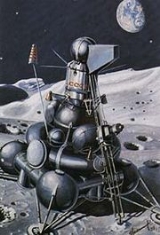
Luna 24 (Ye-8-5M series) was an unmanned space mission of the Luna program, also called Lunnik 24. The last of the Luna series of spacecraft, the mission of the Luna 24 probe was the third Soviet mission to retrieve Lunar soil
Lunar soil
Lunar soil is the fine regolith found on the surface of the Moon. Its properties can differ significantly from those of terrestrial soil. It is essentially devoid of moisture and air, two important components found in soil on Earth....

 samples (the first two missions returning samples were Luna 16
Luna 16
Luna 16 was an unmanned space mission of the Luna program, also called Lunnik 16 .Luna 16 was the first robotic probe to land on the Moon and return a sample to Earth...

 and Luna 20
Luna 20
Luna 20 was an unmanned space mission of the Luna program, also called Lunik 20.Luna 20 was placed in an intermediate Earth parking orbit and from this orbit was sent towards the Moon. It entered lunar orbit on February 18, 1972...

).
  • On-orbit dry mass: 4800 kg


The probe landed in the area known as Mare Crisium
Mare Crisium
Mare Crisium is a lunar mare located in the Moon's Crisium basin, just northeast of Mare Tranquillitatis. This basin is of the Pre-Imbrian period, 4.55 to 3.85 billion years ago. This mare is 376 miles in diameter, and 176,000 km2 in area. It has a very flat floor, with a ring of...

 (Sea of Crisis).
Discussion
Ask a question about 'Luna 24'
Start a new discussion about 'Luna 24'
Answer questions from other users
Full Discussion Forum
 
Encyclopedia
Luna 24
Organization: Soviet Union
Soviet Union
The Union of Soviet Socialist Republics was a constitutionally socialist state that existed in Eurasia from 1922 to 1991. The name is a translation of the , tr. Soyuz Sovetskikh Sotsialisticheskikh Respublik, abbreviated СССР, SSSR. The common short name is Soviet Union, from , Sovetskiy Soyuz...

Major Contractors: NPO Lavochkin
Mission Type: Lunar Science
Lunar Sample Return
Satellite of: Moon
Moon
The Moon is Earth's only natural satellite and the fifth largest satellite in the Solar System. The average centre-to-centre distance from the Earth to the Moon is , about thirty times the diameter of the Earth. The common centre of mass of the system is located at about —a quarter the Earth's...

Launch: August 9, 1976 at
15:04:12 UTC
Coordinated Universal Time
Coordinated Universal Time , ) is a time standard based on International Atomic Time with leap seconds added at irregular intervals to compensate for the Earth's slowing rotation...

Launch Vehicle: Proton 8K82K + Blok D
Proton rocket
Proton is an expendable launch system used for both commercial and Russian government space launches. The first Proton rocket was launched in 1965 and the launch system is still in use as of 2009, which makes it one of the most successful heavy boosters in the history of spaceflight...

Mission Highlight: 170 gram Lunar sample
returned to earth on
August 22, 1976,
17:55 UTC 200 km Southeast of
Surgut, western Siberia.
Mission Duration: 13 days
Mass
Mass
In physics, mass commonly refers to any of three properties of matter, which have been shown experimentally to be equivalent: inertial mass, active gravitational mass and passive gravitational mass...

:
5,800 kg
NSSDC ID: 1976-081A
Webpage: NASA NSSDC Master Catalog
Orbital elements
Orbital elements
Orbital elements are the parameters required to uniquely identify a specific orbit. In celestial mechanics these elements are generally considered in classical two-body systems, where a Kepler orbit is used...

Semimajor Axis: 6,492.8 km
Eccentricity: 0
Inclination
Inclination
Inclination in general is the angle between a reference plane and another plane or axis of direction.- Orbits :The inclination is one of the six orbital parameters describing the shape and orientation of a celestial orbit...

:
120°
Orbital Period: 119 minutes
Apogee: 115 km
Perigee: 115 km
Orbits: ~48
Entered Lunar orbit: August 14, 1976
Lunar Landing: August 18, 1976,
06:36 UTC
Landing
coordinates:
12° 45' N, 62° 12' E .
Lunar liftoff: August 19, 1976,
05:25 UTC
Instruments
Stereo imaging system : Lunar photography
Improved Drill/Remote arm for sample collection : collect lunar material
Radiation detector : Lunar radiation environment
Radio-altimeter : Lunar surface composition


Luna 24 (Ye-8-5M series) was an unmanned space mission of the Luna program, also called Lunnik 24. The last of the Luna series of spacecraft, the mission of the Luna 24 probe was the third Soviet mission to retrieve Lunar soil
Lunar soil
Lunar soil is the fine regolith found on the surface of the Moon. Its properties can differ significantly from those of terrestrial soil. It is essentially devoid of moisture and air, two important components found in soil on Earth....

 samples (the first two missions returning samples were Luna 16
Luna 16
Luna 16 was an unmanned space mission of the Luna program, also called Lunnik 16 .Luna 16 was the first robotic probe to land on the Moon and return a sample to Earth...

 and Luna 20
Luna 20
Luna 20 was an unmanned space mission of the Luna program, also called Lunik 20.Luna 20 was placed in an intermediate Earth parking orbit and from this orbit was sent towards the Moon. It entered lunar orbit on February 18, 1972...

).
  • On-orbit dry mass: 4800 kg


The probe landed in the area known as Mare Crisium
Mare Crisium
Mare Crisium is a lunar mare located in the Moon's Crisium basin, just northeast of Mare Tranquillitatis. This basin is of the Pre-Imbrian period, 4.55 to 3.85 billion years ago. This mare is 376 miles in diameter, and 176,000 km2 in area. It has a very flat floor, with a ring of...

 (Sea of Crisis). The mission successfully returned 170 grams of lunar samples to the Earth on 22 August 1976.
Lunar
Mission
Sample
Returned
Year
Luna 16
Luna 16
Luna 16 was an unmanned space mission of the Luna program, also called Lunnik 16 .Luna 16 was the first robotic probe to land on the Moon and return a sample to Earth...

101 g 1970
Luna 20
Luna 20
Luna 20 was an unmanned space mission of the Luna program, also called Lunik 20.Luna 20 was placed in an intermediate Earth parking orbit and from this orbit was sent towards the Moon. It entered lunar orbit on February 18, 1972...

55 g 1972
Luna 24
Luna 24
Luna 24 was an unmanned space mission of the Luna program, also called Lunnik 24. The last of the Luna series of spacecraft, the mission of the Luna 24 probe was the third Soviet mission to retrieve Lunar soil samples .*On-orbit dry mass: 4800 kgThe probe landed in the area known as Mare Crisium...

170 g 1976

Luna 24 was the third attempt to recover a sample from the unexplored Mare Crisium (after Luna 23
Luna 23
Luna 23 was an unmanned space mission of the Luna program, also called Lunnik 23.Luna 23 was a Moon lander mission which was intended to return a lunar sample to Earth. Launched to the Moon by a Proton SL-12/D-1-e booster, the spacecraft was damaged during landing in Mare Crisium...

 and a launch failure in October 1975), the location of a large lunar mascon
Mass concentration
Mass concentration can have different meaning in astronomy or chemistry.In astronomy or astrophysics mass concentration or mascon is a region of a planet or moon's crust that contains a large positive gravitational anomaly...

. After a trajectory
Trajectory
A trajectory is the path a moving object follows through space. The object might be a projectile or a satellite, for example. It thus includes the meaning of orbit - the path of a planet, an asteroid or a comet as it travels around a central mass...

 correction on 11 August 1976, Luna 24 entered orbit around the Moon three days later. Initial orbital parameters were 115 x 115 kilometers at 120° inclination
Inclination
Inclination in general is the angle between a reference plane and another plane or axis of direction.- Orbits :The inclination is one of the six orbital parameters describing the shape and orientation of a celestial orbit...

. After further changes to its orbit, Luna 24 set down safely on the lunar surface at 06:36 UT on 18 August 1976 at 12°45' north latitude and 62°12' east longitude, not far from where Luna 23 had landed. After appropriate commands from ground control, the lander deployed its sample arm and pushed its drilling head about 2 meters into the nearby soil. The sample was safely stowed in the small return capsule, and after nearly a day on the Moon, Luna 24 lifted off successfully from the Moon at 05:25 UT on 19 August 1976. After an uneventful return trip, Luna 24’s capsule entered Earth’s atmosphere and parachuted down to Earth safely at 17:55 UT on 22 August 1976, about 200 kilometers southeast of Surgut
Surgut
Surgut is a city in Russia, the largest in Khanty-Mansi Autonomous Okrug and second largest in Tyumen Oblast. Its population according to the 2002 Census was 285,027 .Surgut is one of the oldest Siberian cities...

 in western Siberia
Siberia
Siberia , is the vast region constituting almost all of Northern Asia and for the most part currently serving as the massive central and eastern portion of the Russian Federation, having served in the same capacity previously for the USSR from its beginning, and the Russian Empire beginning in the...

. Study of the recovered 170.1 grams of soil indicated a laminated type structure, as if laid down in successive deposits. Tiny portions of the sample were shared with NASA
NASA
The National Aeronautics and Space Administration is an agency of the United States government, responsible for the nation's public space program. NASA was established by the National Aeronautics and Space Act on July 29, 1958, replacing its predecessor, the National Advisory Committee for...

 in December 1976.

Luna 24 was the last lunar spacecraft to be launched by the Soviet Union
Soviet Union
The Union of Soviet Socialist Republics was a constitutionally socialist state that existed in Eurasia from 1922 to 1991. The name is a translation of the , tr. Soyuz Sovetskikh Sotsialisticheskikh Respublik, abbreviated СССР, SSSR. The common short name is Soviet Union, from , Sovetskiy Soyuz...

. It is also the last spacecraft from any country to have made a soft landing
Soft landing (rocketry)
A soft landing is any type of aircraft or rocket landing that does not result in the destruction of the vehicle or anything onboard. Unlike a hard landing, soft landings are very smooth and steady. They are often called 'good landings' because of the smooth way the aircraft lands....

 on the Moon.

External links