
|
|
|
|
Lost in Space
|
| |
|
| |
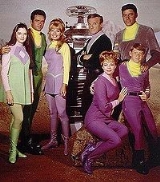
Lost in Space is a science fiction TV series created and produced by Irwin Allen, produced by 20th Century Fox Television, and broadcast on CBS. The show ran for three seasons, with 83 episodes airing between September 15, 1965 and March 6, 1968. The first season was shot with black and white film, the rest in color. In 1998, a film based on the series was released. The show focused primarily on Jonathan Harris as Dr. Zachary Smith, whose cowardly character provides comic relief of the show.
series is a space-age adaptation of the novel Swiss Family Robinson.

Discussion
Ask a question about 'Lost in Space'
Start a new discussion about 'Lost in Space'
Answer questions from other users
|
Quotations
The Robot:
Warning! Warning! Alien spacecraft approaching!
Dr. Smith:
We're doomed!
Dr. Smith:
Crepes suzette!

Encyclopedia
Lost in Space is a science fiction TV series created and produced by Irwin Allen, produced by 20th Century Fox Television, and broadcast on CBS. The show ran for three seasons, with 83 episodes airing between September 15, 1965 and March 6, 1968. The first season was shot with black and white film, the rest in color. In 1998, a film based on the series was released. The show focused primarily on Jonathan Harris as Dr. Zachary Smith, whose cowardly character provides comic relief of the show.
Production
The series is a space-age adaptation of the novel Swiss Family Robinson. The astronaut family Robinson, accompanied by a military pilot and a robot, set out to colonize Alpha Centauri from overpopulated Earth. Their 1997 mission is immediately sabotaged by Dr. Zachary Smith, who slips aboard the spaceship Jupiter 2 and reprograms the robot to destroy the ship and crew. Smith is trapped aboard, saving himself by prematurely reviving the crew from suspended animation. They save the ship, but consequent damage leaves them lost in space. Eventually they crash on an alien world, later identified as Priplanis, where they must survive a host of adventures. Smith (whom Allen intended to kill) remains through the series as a source of comedic cowardice and villainy, exploiting the forgiving (or forgetful) nature of the Robinsons.
At the start of the second season, the repaired Jupiter 2 launches again, but after two episodes the Robinsons crash on another planet and spend the season there. In the third season, they travel to other worlds in attempt to return to Earth or to settle Alpha Centauri.
Following the format of Allen's first TV series, Voyage to the Bottom of the Sea, fantasy-oriented adventure stories were emphasized. The show delivered a visual assault of special effects, explosions, monstrous aliens, spaceships, and exotic sets and costumes drenched in the bright, primary colors that were typical of early color television.
Unlike Star Trek, character development, deep philosophical discussion, dramatic depth, and coherent storyline between episodes were secondary. "Don't get logical with me!" was Allen's frequent retort to writers who objected to changes to their scripts.
Plot
In 1997, the Earth suffers from overpopulation and natural resource depletion. Professor John Robinson (Guy Williams), his wife, Maureen (June Lockhart), their children, Judy (Marta Kristen), Penny (Angela Cartwright), Will (Billy Mumy), and their friend and pilot, Major Don West (Mark Goddard), are chosen to travel on the Jupiter 2 to Alpha Centauri to search for a habitable planet for mankind to colonize.
After the Robinsons are placed in suspended animation, but before the launch, foreign agent Dr. Zachary Smith (Jonathan Harris) sneaks aboard on a sabotage mission. He reprograms the ship's robot (voiced by Dick Tufeld) to destroy the ship shortly after it leaves Earth. He becomes trapped during launch, however, and his extra weight throws the Jupiter 2 off course, causing it to encounter a meteor storm. The robot's rampage causes the ship to become lost.
The Robinsons are often placed in danger by Smith, who is by turns a villain or an indigent. In the second and third seasons, Smith's role assumes a less evil overtone - although he continues to display many character defects. In "The Time Merchant", Smith travels back in time to before the Jupiter 2 launch, changing his fate. He learns that without his weight altering the ship's course, it would be destroyed. In an act of redemption, Smith elects to remain on board, thus saving the Robinsons' lives.
Cast
- Doctor John Robinson: (Guy Williams) The expedition commander, a pilot, and the father of the Robinson children. He is an astrophysicist who also specializes in applied planetary geology.
- Doctor Maureen Robinson: (June Lockhart) John's biochemist wife. Her role in the series is often to prepare meals, tend the garden and help with light construction, while adding a voice of compassion. Her status as a doctor is mentioned only in the first episode.
- Major Don West : (Mark Goddard) The military pilot of the Jupiter 2, he is Smith's intemperate and intolerant adversary. His mutual romantic interest with Judy was not developed beyond the first few episodes. In the un-aired pilot, "Doctor Donald West" was a graduate student astrophysicist and expert in interplanetary geology, rather than a military man.
- Judy Robinson: (Marta Kristen) The oldest child, about 19 years old at the outset of the series. She planned a career in musical theater but went with her family instead.
- Penny Robinson: (Angela Cartwright) A 13-year-old, she loves animals and classical music. She acquires an alien pet she names Debbie (To viewers, quite obviously a chimpanzee wearing a fur hat). The chimp made one sound, "Bloop", and is sometimes remembered by that name. Penny, however, named the creature Debbie. Most of Penny's adventures have a fairy tale quality, underscoring her innocence.
- Will Robinson. (Billy Mumy) A 9-year-old child prodigy in electronics. Often, he is a friend to Smith when no one else is. Will is also the member of the family closest to the Robot.
- Doctor Zachary Smith: (Jonathan Harris) A specialist in environmental and intergalactic psychology, and an enemy agent, roles that are rarely mentioned after the initial episodes. His attempt to sabotage the mission strands him aboard the Jupiter 2 and results in its becoming lost. By the middle of the first season, the character becomes permanently established as a foolish, self-serving, impulsive, scheming coward. However, his maudlin ways and clever dialogue add a unique dimension. His best lines are in response to the "straight man" Robot.
- The Robot: The Robot is a Model B-9, Class M-3 General Utility Non-Theorizing Environmental Control Robot, which had no given name (Harris once jokingly suggested the robot be named "Clawed"). Although a machine endowed with superhuman strength and futuristic weaponry, he often displayed human characteristics such as laughter (usually at Smith, thus provoking the latter's rage), sadness, and mockery. The Robot was designed by Robert Kinoshita (whose other cybernetic claim to fame is as the designer of Forbidden Planet's Robby the Robot) and was performed by Bob May in a prop costume built by Bob Stewart. The voice was dubbed by Dick Tufeld, who was also the series' narrator.
Episodes
Technology & Equipment
One of the most vital pieces of equipment was their environmental control robot. The Robot was extremely strong, able to discharge strong electrostatic charges from his claws, could detect threats with his scanner, and could even detect faint smells (in "One of Our Dogs is Missing"). He could both understand speech as well as speak.
The crew had a variety of methods of transportation. First, there was the three-deck, nuclear powered Jupiter 2 flying saucer spacecraft. One critical technology aboard the Jupiter 2 was the suspended animation "freezing tubes" which made interstellar space travel feasible. When they were on a planet, the crew used an amphibious tracked exploration vehicle called the "Chariot" that had clear body panels and roof, seismograph, scanner, solar batteries, a gun rack and "gun hatch." The space "Pod" -- a small spacecraft modeled on the Apollo Lunar Module -- was used to travel from its bay in the Jupiter 2 to destinations either on land or in space. On occasion, Prof. Robinson or Major West used what was then an exciting new invention: the jet pack.
For self-defense, the crew of the Jupiter 2 (including Will Robinson on occasion against his parents' wishes) had an "arsenal" of laser guns at their disposal, both rifles and handguns. The crew also employed a force field around the Juipter 2 for protection while landed on alien planets. They also used small transceivers to keep in touch with each other when away from the ship.
The Jupiter 2 had technology that simplified or did away with mundane tasks. The "washing machine" took seconds to work cleaning, ironing, folding, and packaging the clothes in plastic bags. The ship had no light bulbs. Maureen said the lights were "transistorized," perhaps meaning they were electroluminescent. "Protein pills" (a complete nutritional emergency substitute for whole foods) were featured in "The Hungry Sea" (air date: 31 Oct 1965) and "The Space Trader" (air date: 9 March 1966). In this, Lost in Space was ahead of NASA and Pillsbury which later developed "Space Food Sticks." Space blankets, a then new invention developed by NASA in 1964, were used in "The Hungry Sea" (air date: 13 Oct 1965) and "Attack of the Monster Plants" (air date: 15 Dec 1965).
On the other hand, sound and voice recording was less advanced, for example, using reel-to-reel tape recorders, and Prof. Robinson often put pen to paper to write journal entries in early episodes.
Series history Allen produced a series pilot, "No Place to Hide." After CBS accepted the series, the characters Smith and the Robot were added. The ship was redesigned with a second deck, and named the Jupiter 2. (It had been the Gemini 12.) For budget considerations, a good part of the pilot episode was reworked into the early series episodes. According to Lockhart, the show was intended to be called "Space Family Robinson", but Disney would not release the copyright.
The first season emphasized adventure. It chronicled the daily adventures that a pioneer family might well experience if marooned on an alien world. These included dealing with dangerous native plants and animals, and off-world visitors. In the first season, only the special effects shots were filmed in color, in anticipation of reusing shots in color seasons.
The show aired in the same time slot as Batman, and it has been suggested that the camp tone was adopted to compete with Batman. There was a growing emphasis on Smith, Will and the Robot at the expense of the other characters. Smith's change in character was not appreciated by the other actors. According to Billy Mumy, Mark Goddard and Guy Williams disliked the shift from serious science fiction.
The third season had more adventure, but episodes like "The Great Vegetable Rebellion" — with actor Stanley Adams as Tybo, the talking carrot — still demonstrated humorous fantasy. Other episodes were whimsical and emphasized humor, including fanciful space cowboys, space hippies, pirates, and a beauty pageant.
During the first two seasons, episodes concluded in a "live action freeze" anticipating the following week, with the cliff-hanger, "To be continued next week!." There was little ongoing plot continuity between episodes, except in larger goals; for example, to get enough fuel to leave the planet. For the third season, the episode would conclude and then a "teaser" for "next week's exciting adventure!" would show highlights from the next episode just before the closing credits began.
After cancellation, the show was successful in reruns, and syndication for many years, most recently on FX and Sci-Fi Channel.
Stylistically, the series was of high quality, featuring what was expected for space travel at the time; eye-catching silver, tapered space-suits, laser guns and spectacular props and sets.
Ratings and popularity
Although it retains a following, the science-fiction community often points to Lost in Space as an example of television's perceived bad record at producing science-fiction (perhaps overlooking the series' deliberate fantasy elements), comparing it to its supposed rival, Star Trek. However, Lost In Space was a mild ratings success, unlike Star Trek, which received very poor ratings during its original network TV run, often not placing any higher than 60th place, while Lost in Space finished season one with a rating of 32nd, second season in 35th place, and the third and final season rating 33rd.
Star Trek creator Gene Roddenbery insisted that the two shows could not be compared. He was more of a philosopher, while understanding that Irwin Allen was a storyteller. When asked about Lost in Space, Roddenberry acknowledged, "That show accomplishes what it sets out to do. Star Trek is not the same thing."
The final primetime episode to be broadcast across the USA was a cast and crew favorite, a repeat from the second season, "A Visit to Hades."
Lost In Space is remembered, at least, from oft-repeated lines of the Robot, such as "Warning! Warning!", "That does not compute", and "Danger, Will Robinson!" Smith's frequent put-downs of the Robot are also still popular ("You bubble-headed booby!") as are his trademark lines: "Oh, the pain...the pain!" and "Never fear, Smith is here!" One of Jonathan Harris's last roles was providing the voice of the illusionist praying mantis "Manny" in Disney's "A Bug's Life," where Harris used "Oh, the pain...the pain!" while drenched in Boysenberry "blood" to embellish a faux bird-attack near the end of the film.
Lost In Space was the favorite show of the son of the late President John F. Kennedy, the late John F. Kennedy, Jr. while growing up in the 1960s.
Cancellation
It is unclear why Lost in Space was cancelled. Several theories have been suggested:
Budget too high
The show had ratings to ensure a fourth season, but it was expensive. The budget for season one per episode was $130,980, and for Season Three, $164,788. During that time, the actors' salaries increased, in the case of Harris, Kristen and Cartwright, nearly doubling. There is other evidence that at least a part of the cost problems were the actors themselves, for example director Richardson saying of Williams requiring that there be frequent closeups of him:
- "This costs a fortune in time, it's a lot of lighting and a lot of trouble and Irwin succumbed to it. It got to be that bad."
Also, the cost of the set itself was extremely high for its time, about $600,000.00. The producers had, in fact, spent far more money on the Jupiter II than Gene Roddenberry had spent on the starship Enterprise. For example, the Robot suit cost $30,000.00. A full-scale wooden mock-up of the Jupiter II (used on those rare occasions when the ship actually landed properly) cost $70,000.00, as well as taking up an awful lot of studio space. The landings themselves were very costly, which is why Gene Roddenberry came up with a "transporter."
Furthermore, the "control room" set was technically superior, using transistors, as opposed to the Enterprise bridge, which used vacuum tubes. Although more realistic-looking and more energy-efficient, these sets were very costly. As a result, Irwin Allen had to struggle to play catch-up during the entire run of the series.
Budget cut
According to Mumy, the show had already been picked up for the fourth season, but with a cut budget, Allen said he couldn't continue the show under those circumstances. In fact, at the fourth season renewal meeting with CBS chief executive Bill Paley, Allen got up and walked out when being told that the budget was being cut 15% from season 3, thereby sealing the show's cancellation.
Disliked by an executive
Robert Hamner, one of the show's writers, states (in Starlog, #220, November 1995) that Paley despised the show so much that the budget dispute was used as an excuse to terminate the series. In 1997 Paley stated this was incorrect and that he was a fan of "the Robot."
Declining ratings and escalating costs
The Lost in Space Forever DVD cites declining ratings and escalating costs as the reasons for cancellation.
Diminishing Interest
Probably not the main reason, but a contributing factor, at least, was that Lockhart and director Don Richardson were no longer excited about the show. Lockhart is quoted as saying in response to being told about its cancellation by Perry Lafferty, the head of CBS programming, "I think that's for the best at this point..." (although she goes on to say that she would have stayed if there had been a fourth season). Richardson had been tipped off that the show was canceled, was looking for another series, and had decided not to return to Lost in Space, even if it continued.
Harris (Smith) and Bob May (the man inside the Robot) had started out as friends to begin with - but, by the time the series eventually ended, a bit of a rot had set in - it eventually got to the stage where the older actor would not let the younger actor into his dressing room.
Music The theme music for the opening and closing credits was written by John Williams, who was listed in the credits as "Johnny Williams."
For season three, the opening theme was revised (again by Williams) to a more exciting and faster tempo score, accompanied by live action shots of the cast, featuring a pumped-up countdown from seven to one to launch each week's episode. Seasons 1 and 2 had animated figures "life-roped" together drifting "hopelessly lost in space" and set to a dizzy and comical score.
Much of the incidental music in the series was written by Williams and other notable film and television composers, including Alexander Courage, who contributed six scores to the series. His most recognizable ("Wild Adventure") included his key theme for "Lorelei" composed for organ, woodwinds, and harp – thus cementing this highly recognizable theme with Williams' own "Chariot" and main theme for the series.
A series of soundtrack CDs were released containing only background and incidental music from the original TV series.
Legal questions In 1962 Gold Key comics (formerly Dell Comics), a division of Western Publishing Company, began publishing a series of comic books under the title, Space Family Robinson. The story was largely inspired by The Swiss Family Robinson but with a space-age twist. The movie and television rights to the comic book were then purchased by noted television writer Hilda Bohem (The Cisco Kid), who created a treatment under the title, Space Family 3000.
In July 1964, science fiction writer and filmmaker Ib Melchior began pitching a treatment for a feature film, also under the title Space Family Robinson. There is debate as to whether or not Allen was aware of the Melchior treatment. It is also unknown whether Allen was aware of the comic book or the Hilda Bohem treatment.
As copyright law only protects the actual expression of a work, and not titles, general ideas or concepts, in 1964 Allen moved forward with his own take on Space Family Robinson, with characters and situations notably different from either the Bohem or the Melchior treatments (It is interesting to note that none of these versions contained the characters of Smith or the Robot).
Intended as a follow up to his first successful television venture, Voyage to the Bottom of the Sea, Allen quickly sold his concept for a television series to CBS. Concerned about confusion with the Gold Key comic book, CBS requested that Allen come up with a new title. Nevertheless, Hilda Bohem filed a claim against Allen and CBS Television shortly before the series premiered in 1965.
A compromise was struck as part of a legal settlement. In addition to an undisclosed sum of money, Western Publishing would be allowed to change the name of its comic book to Lost in Space.
There were no other legal challenges to the title until 1995, when New Line Cinema announced their intention to turn Lost in Space into a big budget motion picture. New Line had purchased the screen rights from Prelude Pictures (which had acquired the screen rights from the Irwin Allen Estate in 1993). At that time, Melchior contacted Prelude Pictures and insisted that Lost in Space was directly based upon his 1964 treatment. Melchior was aided in his efforts by Ed Shifres, a fan who had written a book entitled Space Family Robinson: The True Story. (Later reprinted with the title, Lost in Space: The True Story). The book attempts to show how Allen allegedly plagiarized Melchior's concept, with two outlines presented side-by-side.
To satisfy Melchior, Prelude Pictures hired the 78-year-old filmmaker as a consultant on their feature film adaptation. This accommodation was made without the knowledge or consent of the Irwin Allen Estate or Space Productions, the original copyright holder of Lost in Space. Melchior's contract with Prelude also guaranteed him 2% of the producer's gross receipts, a provision that was later the subject of a suit between Melchior and Mark Koch of Prelude Pictures. Although an Appellate Court ruled partly in Melchior's favor, on November 17, 2004, the Supreme Court of California denied a petition by Melchior to further review the case.
It is significant that no further claim was made and that Space Productions now contends that Allen was the sole creator of the TV series Lost in Space.
Guest stars
During its three season run, many actors have made guest appearances, including familiar actors and/or actors who went on to become well-known. Among them appearing in Lost In Space episodes: Joe E. Tata, Alan Hewitt, Francine York, Don Matheson, Kurt Russell, Ford Rainey, Warren Oates, Norman Levitt, Tommy Farrell, Lew Wagner, Lyle Waggoner, Albert Salmi, Royal Dano, Strother Martin, Michael Fox, Byron Morrow, Arte Johnson, Fritz Feld, Lew Gello, John Carradine, Al Lewis, Hans Conried, Dennis Patrick, among many others. Future Hill Street Blues stars, Daniel J. Travanti and Michael Conrad, made some guest appearances on separate episodes. While Mark Goddard was playing Maj. West, he had a guest-appearance as well.
Spin-offs
Comics
Bill Mumy scripted an authorized Lost in Space comic book for Innovation Comics. The company continued the series for some time, at one point focusing on a time many years after the end of series, the children had long ago grown up.
Prior to the appearance of the TV series, a comic book named Space Family Robinson was published by Gold Key Comics, written by Gaylord Du Bois and illustrated by Dan Spiegle. (Du Bois did not create the series, but he became the sole writer of the series once he began chronicling the Robinsons' adventures with Peril on Planet Four in issue #8, and he had already written the Captain Venture second feature beginning with Situation Survival in issue #6). Due to a deal worked out with Gold Key, the title of the comic later incorporated the "Lost in Space" sub-title. The comic book is not a spinoff of the TV series but was in print prior to the conception of the show. Also, there is an unlicensed comic in which Will Robinson meets up with Friday the 13th character Jason Voorhees.
Cartoon
In the 1972-73 television season, ABC produced The ABC Saturday Superstar Movie, a weekly collection of 60-minute animated movies, pilots and specials from various production companies, such as Hanna-Barbera, Filmation, and Rankin-Bass -- Hanna-Barbera Productions contributed animated work based on such TV series as Gidget, Yogi Bear, Tabitha, Oliver Twist, Nanny and the Professor, The Banana Splits, and most importantly, Lost in Space. Dr. Smith (voiced by Jonathan Harris) was the only character from the original program to appear in the special, along with the Robot (who was named Robon and employed in flight control rather than a support activity). The spacecraft was launched vertically by rocket, and Smith was a passenger rather than a saboteur. The pilot for the animated Lost in Space series was not picked up as a series, and only this episode was produced.
Feature film
In 1998, New Line Cinema produced a Lost in Space feature film. It included numerous nods, homages and cameos related to the series, including:
- Dick Tufeld as The Robot's voice;
- Mark Goddard played the General who gives Major West his orders for the mission;
- June Lockhart played the principal of Will Robinson's school;
- Angela Cartwright and Marta Kristen appeared as reporters.
- The film's Jupiter II was launched into orbit by a vehicle called the Jupiter I, which closely mimics the series' spacecraft, complete with rotating propulsion lights.
- Reference is made to the Chariot and Space Pod, both of which are reported wrecked.
Additional cameo appearances from the original series were considered, but did not make it to the film:
Harris was offered a cameo appearance (as the Global Sedition businessman who hires, then betrays, Smith). He turned down the role (which eventually went to Edward Fox), and is even reported to have said "I play Smith or I don't play." Harris appeared on an episode of Late Night with Conan O'Brien mentioning that he was offered a role: "Yes, they offered me a part in the new movie--six lines!" Bill Mumy was offered a key role in the film, that of an aged Will Robinson who appears in the "Spider Smith" sequences, but due to a scheduling conflict, Jared Harris was cast instead. Guy Williams had died years earlier.
Novel
In 1967, a novel based on the series with significant changes to the personalities of the characters, and a redesign of the Jupiter 2 was published by Pyramid Books. Written by Dave Van Arnam and Ron Archer (as Ted White), the book was three short stories woven together. In one scene, where a character is randomly speaking English to provide data for translation, the book correctly predicted Richard Nixon winning the presidency after Lyndon Johnson (but also predicted a Kennedy winning after Nixon).
Second TV series In late 2003, a new TV series, with a somewhat changed format, was in development in the U.S. It was intended to be originally closer to the original pilot with no Smith, but including a robot. The pilot (entitled, The Robinsons: Lost in Space) was commissioned by the The WB Television Network. It was directed by John Woo and produced by Synthesis Entertainment, Irwin Allen Productions, Twentieth Century Fox Television and Regency Television.
The Jupiter 2 interstellar flying-saucer spacecraft of the original series was changed to a non-saucer planet-landing craft, dispensed from a larger inter-stellar mothership.
The pilot script featured the characters of John and Maureen, but an elder son, David, was added, as well as Judy, an 'infant' Penny, and ten-year-old Will. There was no Dr. Smith character, but the character of Don West was described as a "dangerous, lone wolf type."
The confirmed cast included Brad Johnson as John Robinson, Jayne Brook as Maureen Robinson, Adrianne Palicki as Judy Robinson, Ryan Malgarini as Will Robinson and Mike Erwin as Don West.
It was not among the network's series pick-ups confirmed later that year.
The producers of the new Battlestar Galactica show bought the sets. They were redesigned the next year and used for scenes on the Battlestar Pegasus.
DVD releases
20th Century Fox has released the entire series on DVD in Region 1.
| DVD Name | # of Ep | Release Date | Additional Information |
|---|
| Season 1 | 30 | January 13, 2004 |
- Un-Aired Pilot "No Place To Hide" included (see above)
- CBS Network Presentation (5.5 minutes)
| | Season 2 Volume 1 | 16 | September 14, 2004 | | | Season 2 Volume 2 | 14 | November 30, 2004 | Original 1966 Lost In Space Interviews 17 stills from the Guy Williams and June Lockhart interview 15 stills from the Jonathan Harris interview | | Season 3 Volume 1 | 15 | March 1, 2005 | "Lost in Space" memories - 20 nostalgic video clips with cast members offering a fond look back at favorite episodes and highlights of the show! | | Season 3 Volume 2 | 9 | July 19, 2005 | Next on Lost in Space: Princess of Space, The Time Merchant, The Promised Planet, Fugitives in Space, Space Beauty, The Flaming Planet, The Great Vegetable Rebellion, Junkyard of Space and The Condemned of Space Target Earth Act Break Interstitial Blooper / Bill Mumy Interview Clips (from 1995): Resolving the show, Bob May and The Robot, Thoughts on the cast / Jonathan Harris, Getting the role, Comedic Villain and Motivation for Dr. Zachary Smith |
Title in other languages
Trivia
- Comedy Series Fast Forward sent-up Lost In Space In Series 1 (1989).
- Although the Robot had no name, in the third-season episode entitled "The Time Merchant," it was shown in its packing crate, and the crate was labelled "ONE
color=red>General Utility Non-Theorizing Environmental ROBOT" with the G, U, N, T, E, and all letters in "ROBOT" in red capital letters, while all the other letters were black; some have suggested that this was supposed to convey the acronym "GUNTER."
- Dr. Smith and the Robot did not appear in the unaired pilot episode (which has since been made available on VHS tapes, iTunes and on the DVD release of the entire series). Story editor Anthony Wilson came up with the idea of including a "Long John Silver" type villain to act as a constant irritant to compensate for the lack of conflict within the Robinson family. Writer Shimon Wincelberg fleshed out the character, giving him an exotic foreign-sounding name. Irwin Allen wanted a plain all-American name for the doctor so it was changed to the generic "Smith."
- According to Lost in Space: The Ultimate Unauthorized Trivia Challenge for the Classic TV Series, by James Hatfield and George "Doc" Burt, the role of Dr. Smith was originally written for Carroll O'Connor (who turned it down). Character actor Jack Elam was also considered before Jonathan Harris was chosen for the role.
- In early episodes Dr. Smith is a purely evil, cold-hearted saboteur who makes repeated attempts to murder the Robinsons. He was even given eye-liner to make him look more sinister and cat-like. Harris hated playing the snarling, unappealing villain and knew his character would soon be killed off unless changes were made. To that end he saved his role by gradually transforming him into a sympathetic comedic-villain. The revamped Smith was really a composite of previous roles. On The Bill Dana Show Harris played the pompous, irritable manager of a snooty hotel—imperious to his employees and obsequious toward his guests. On The Third Man he played a fussy, cowardly, eager-to-please accountant. Combine the two and add some childlike flaws (lazy, selfish, and deceitful) and there is Smith. In fact, Harris played a variety of Smith-like characters, or characters with one or more of those traits, throughout his long career.
- The Forbidden Planet character Robby the Robot guest starred in two episodes: War of the Robots, and Condemned of Space. Robby was also designed by Robert Kinoshita, who designed the Lost in Space robot nearly ten years later.
- The Robot has inspired a dedicated fan base, many striving to build their own Robot. Since the series conclusion, hobbyists around the world have built at least 15 detailed full-size replicas of the Robot. Two versions of the robot were used during filming: a 'hero' costume worn by Bob May, and a static, 'stunt' robot used for distance or hazardous shots. Both versions fell into disrepair after the series, but have since been discovered and restored. The 'hero' is in the private ownership of Kevin Burns, who commissioned a replica in the early 1990s for touring and conventions. The 'stunt' robot is on display at the Science Fiction Museum and Hall of Fame in Seattle, Washington.
- Jonathan Harris, Billy Mumy and Mark Goddard are the only actors to appear in every episode of the series. Marta Kristen and Angela Cartwright appeared in 81 of the 83 episodes produced, missing only 1 episode.
- Harris was supposed to reprise his role as Dr. Zachary Smith on a TV movie, Lost In Space: The Journey Home, but became ill and died late in 2002; hence, production was scrapped.
- In 2005 a replica of The Robot was featured in an ANZ Bank advertisement in Australia along with a Dalek from Doctor Who.
- The show was re-aired in the United Kingdom in the late 1980s and early 1990s on Channel 4 in a Sunday lunchtime slot, which brought a new generation of fans to the show.
External links
- (The Irwin Allen News Network's Lost in Space site)
-
-
- at the
-
-
|
| |
|
|