

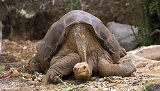
Lonesome George

Encyclopedia
Lonesome George is a tortoise, the last known individual
of the Pinta Island tortoise (Chelonoidis nigra abingdoni), which is one of eight to fifteen extant subspecies of Galápagos tortoise
, all of which are native to the Galápagos Islands
. He has been labeled the rarest creature
in the world, and he is a potent symbol for conservation efforts in the Galápagos and conservation efforts internationally. It is thought that he was named after a character played by American
actor George Gobel
.
George was first seen on the island of Pinta
on 1 December 1971 by Hungarian malacologist József Vágvölgyi. The island's vegetation had been devastated by introduced
feral
goats, and the indigenous C. n. abingdoni population had been reduced to a single individual. Relocated for his safety to the Charles Darwin Research Station
, George was penned with two females of a different subspecies, and although eggs have been produced, none have hatched.
George is estimated to be about 100 years of age, and he is in good health. A prolonged effort to exterminate goats introduced to Pinta is now complete, and the vegetation of the island is starting to return to its former state.
The presence of mixed race Pinta ancestry tortoises around Wolf Volcano
, on neighbouring Isabela island, suggests the recent presence of at least one Pinta individual near Wolf Volcano. A possible purebreed Pinta candidate, male and dubbed "Tony", lives in a Prague
zoo.
There is a reward of $10,000 for the discovery of a Pinta female, which is necessary to save the subspecies. Should this animal not be discovered, the Pinta tortoise will become functionally extinct
in captivity, and then, upon Lonesome George's death, completely extinct.
Until January 2011, George was penned with two females of the subspecies Geochelone nigra becki, from the Wolf Volcano region of Isabela island, in the hope that his genotype
would be retained in any resulting progeny. This subspecies was then thought to be genetically closest to George's; however, any offspring successfully hatched from George and his consorts would be intergrades, not purebreds of the Pinta subspecies.
On July 21, 2008, it was reported that George had unexpectedly mated with one of his female companions. A total of thirteen eggs were collected and placed in incubators. However, on November 11, 2008, the Charles Darwin Foundation
reported that 80% of the eggs showed weight loss characteristic of being inviable. To the disappointment of the Darwin Center, by December 2008, the remaining eggs had failed to hatch and x-rays showed them to be inviable.
On July 21, 2009, exactly one year after first announcing George had mated, the Galápagos National Park
announced that a second clutch of five eggs had been laid by one of George's female companions. The park authority expressed its hope for the second clutch of eggs, which it described as being in perfect condition, saying: "Now we have to wait for the incubation period of 120 days to find out whether they are fertile". The eggs were moved to an incubator, but on December 16, it was announced that the incubation period had ended, and the eggs were shown to be inviable, as were a second batch of 6 eggs laid by the other female.
sequences) suggested that other individuals of Geochelone nigra abingdoni may still exist in the wild at the Galápagos. Researchers have identified one male tortoise from the Volcano Wolf region of neighboring Galápagos island of Isabela which has half his genes in common with George's subspecies. This animal must be a first generation intergrade between the subspecies of the islands Isabela and Pinta. It is possible that a pure Pinta tortoise lives among the 2,000 tortoises on Isabela.
, one of the world’s foremost authorities on Galápagos tortoises (and of tortoises and turtles in the world, more generally), has found the shell on Tony to be extremely similar to that of George and Pinta museum specimens. Research is still currently being processed to confirm this match, and Tony is still being cared for at the Prague zoo.
giant tortoise (Geochelone hoodensis) after genetic studies appeared positive. On January 20, 2011, two individual Geochelone hoodensis female partners were imported to the CDRS where George lives.
Endling
An endling is the name given to an individual animal that is the last of its species. Once the endling dies, the species becomes extinct."On 7 September 1936 an endling died in Hobart Zoo...
of the Pinta Island tortoise (Chelonoidis nigra abingdoni), which is one of eight to fifteen extant subspecies of Galápagos tortoise
Galápagos tortoise
The Galápagos tortoise or Galápagos giant tortoise is the largest living species of tortoise, reaching weights of over and lengths of over . With life spans in the wild of over 100 years, it is one of the longest-lived vertebrates...
, all of which are native to the Galápagos Islands
Galápagos Islands
The Galápagos Islands are an archipelago of volcanic islands distributed around the equator in the Pacific Ocean, west of continental Ecuador, of which they are a part.The Galápagos Islands and its surrounding waters form an Ecuadorian province, a national park, and a...
. He has been labeled the rarest creature
Rare species
A rare species is a group of organisms that are very uncommon or scarce. This designation may be applied to either a plant or animal taxon, and may be distinct from the term "endangered" or "threatened species" but not "extinct"....
in the world, and he is a potent symbol for conservation efforts in the Galápagos and conservation efforts internationally. It is thought that he was named after a character played by American
United States
The United States of America is a federal constitutional republic comprising fifty states and a federal district...
actor George Gobel
George Gobel
George Leslie Gobel was an American comedian and actor. He was best known as the star of his own weekly NBC television show, The George Gobel Show, which ran from 1954 to 1960 .-Early years:He was born George Leslie Goebel in Chicago, Illinois, His father, Hermann Goebel, was a...
.
George was first seen on the island of Pinta
Pinta Island
Pinta Island is an island located in the Galapagos Islands group, Ecuador. It has an area of 60 km² and a maximum altitude of 777 meters....
on 1 December 1971 by Hungarian malacologist József Vágvölgyi. The island's vegetation had been devastated by introduced
Introduced species
An introduced species — or neozoon, alien, exotic, non-indigenous, or non-native species, or simply an introduction, is a species living outside its indigenous or native distributional range, and has arrived in an ecosystem or plant community by human activity, either deliberate or accidental...
feral
Feral
A feral organism is one that has changed from being domesticated to being wild or untamed. In the case of plants it is a movement from cultivated to uncultivated or controlled to volunteer. The introduction of feral animals or plants to their non-native regions, like any introduced species, may...
goats, and the indigenous C. n. abingdoni population had been reduced to a single individual. Relocated for his safety to the Charles Darwin Research Station
Charles Darwin Research Station
The Charles Darwin Research Station is a biological research station operated by the Charles Darwin Foundation. It is located in Puerto Ayora on Santa Cruz Island in the Galapagos Islands, with satellite offices on Isabela and San Cristóbal islands.- Background :In Puerto Ayora, Santa Cruz Island,...
, George was penned with two females of a different subspecies, and although eggs have been produced, none have hatched.
George is estimated to be about 100 years of age, and he is in good health. A prolonged effort to exterminate goats introduced to Pinta is now complete, and the vegetation of the island is starting to return to its former state.
The presence of mixed race Pinta ancestry tortoises around Wolf Volcano
Volcán Wolf
Volcán Wolf is the highest peak in the Galapagos Islands and is situated on Isabela Island and reaches and is the highest point in the Galapagos Islands...
, on neighbouring Isabela island, suggests the recent presence of at least one Pinta individual near Wolf Volcano. A possible purebreed Pinta candidate, male and dubbed "Tony", lives in a Prague
Prague
Prague is the capital and largest city of the Czech Republic. Situated in the north-west of the country on the Vltava river, the city is home to about 1.3 million people, while its metropolitan area is estimated to have a population of over 2.3 million...
zoo.
There is a reward of $10,000 for the discovery of a Pinta female, which is necessary to save the subspecies. Should this animal not be discovered, the Pinta tortoise will become functionally extinct
Functional extinction
Functional extinction is the extinction of a species or other taxon such that:#it disappears from the fossil record, or historic reports of its existence cease;#the reduced population no longer plays a significant role in ecosystem function; or...
in captivity, and then, upon Lonesome George's death, completely extinct.
Reproduction attempts
Attempts at mating Lonesome George have been unsuccessful for several decades, possibly due to the lack of any females of his own subspecies, and have prompted researchers at the Darwin Station to offer a $10,000 reward for a suitable mate.Until January 2011, George was penned with two females of the subspecies Geochelone nigra becki, from the Wolf Volcano region of Isabela island, in the hope that his genotype
Genotype
The genotype is the genetic makeup of a cell, an organism, or an individual usually with reference to a specific character under consideration...
would be retained in any resulting progeny. This subspecies was then thought to be genetically closest to George's; however, any offspring successfully hatched from George and his consorts would be intergrades, not purebreds of the Pinta subspecies.
On July 21, 2008, it was reported that George had unexpectedly mated with one of his female companions. A total of thirteen eggs were collected and placed in incubators. However, on November 11, 2008, the Charles Darwin Foundation
Charles Darwin Foundation
The Charles Darwin Foundation was founded in 1959, under the auspices of UNESCO and the World Conservation Union. The Foundation is dedicated to the conservation of the Galapagos Islands ecosystems. The Charles Darwin Research Station serves as headquarters for The Foundation, and is used to...
reported that 80% of the eggs showed weight loss characteristic of being inviable. To the disappointment of the Darwin Center, by December 2008, the remaining eggs had failed to hatch and x-rays showed them to be inviable.
On July 21, 2009, exactly one year after first announcing George had mated, the Galápagos National Park
Galapagos National Park
Galápagos National Park, established in 1959, is Ecuador's first national park. The government of Ecuador designated 97% of the land area of Galápagos as the country's first National Park...
announced that a second clutch of five eggs had been laid by one of George's female companions. The park authority expressed its hope for the second clutch of eggs, which it described as being in perfect condition, saying: "Now we have to wait for the incubation period of 120 days to find out whether they are fertile". The eggs were moved to an incubator, but on December 16, it was announced that the incubation period had ended, and the eggs were shown to be inviable, as were a second batch of 6 eggs laid by the other female.
In the wild
In May 2007, analysis of genomic microsatellites (DNADNA
Deoxyribonucleic acid is a nucleic acid that contains the genetic instructions used in the development and functioning of all known living organisms . The DNA segments that carry this genetic information are called genes, but other DNA sequences have structural purposes, or are involved in...
sequences) suggested that other individuals of Geochelone nigra abingdoni may still exist in the wild at the Galápagos. Researchers have identified one male tortoise from the Volcano Wolf region of neighboring Galápagos island of Isabela which has half his genes in common with George's subspecies. This animal must be a first generation intergrade between the subspecies of the islands Isabela and Pinta. It is possible that a pure Pinta tortoise lives among the 2,000 tortoises on Isabela.
At Prague Zoo
In 2009, another male tortoise by the name of Tony, who currently resides in a Prague zoo, was discovered as most likely being an additional pure breed, native, Pinta tortoise. Believed to be born around 1960, Tony has been housed in the zoo since 1972. Peter PritchardPeter Pritchard
Dr. Peter Pritchard is a leading turtle zoologist. Educated at Oxford University and the University of Florida, where he earned his Ph.D. in Zoology, he is most commonly known for his campaign of almost 40 years for the conservation of turtles...
, one of the world’s foremost authorities on Galápagos tortoises (and of tortoises and turtles in the world, more generally), has found the shell on Tony to be extremely similar to that of George and Pinta museum specimens. Research is still currently being processed to confirm this match, and Tony is still being cared for at the Prague zoo.
With Geochelone hoodensis
In January 2011, it was reported that scientists believe he had a better possibility of breeding with members of the Hood IslandEspañola Island
Española Island is part of the Galápagos Islands. The English named it Hood Island after Viscount Samuel Hood. It is located in the extreme southeast of the archipelago and is considered, along with Santa Fe, one of the oldest, at approximately four million years...
giant tortoise (Geochelone hoodensis) after genetic studies appeared positive. On January 20, 2011, two individual Geochelone hoodensis female partners were imported to the CDRS where George lives.