


London Steam Carriage

Encyclopedia
Richard Trevithick
Richard Trevithick was a British inventor and mining engineer from Cornwall. His most significant success was the high pressure steam engine and he also built the first full-scale working railway steam locomotive...
in 1803 and the world's first self-propelled passenger-carrying vehicle. Cugnot
Nicolas-Joseph Cugnot
Nicolas-Joseph Cugnot was a French inventor. He is believed to have built the first self-propelled mechanical vehicle...
had built a steam vehicle thirty years previously, but that had been a slow-moving artillery tractor, not built to carry passengers.
History
In 1801, after James WattJames Watt
James Watt, FRS, FRSE was a Scottish inventor and mechanical engineer whose improvements to the Newcomen steam engine were fundamental to the changes brought by the Industrial Revolution in both his native Great Britain and the rest of the world.While working as an instrument maker at the...
's earlier patent on "a carriage propelled by a steam engine" had expired, Richard Trevithick
Richard Trevithick
Richard Trevithick was a British inventor and mining engineer from Cornwall. His most significant success was the high pressure steam engine and he also built the first full-scale working railway steam locomotive...
constructed an experimental steam-driven vehicle (Puffing Devil) at Camborne
Camborne
Camborne is a town and civil parish in west Cornwall, England, United Kingdom. It is at the western edge of a conurbation comprising Camborne, Pool and Redruth....
, Cornwall
Cornwall
Cornwall is a unitary authority and ceremonial county of England, within the United Kingdom. It is bordered to the north and west by the Celtic Sea, to the south by the English Channel, and to the east by the county of Devon, over the River Tamar. Cornwall has a population of , and covers an area of...
. It was equipped with a firebox enclosed within the boiler, with one vertical cylinder, the motion of the single piston being transmitted directly to the driving wheels by means of connecting rod
Connecting rod
In a reciprocating piston engine, the connecting rod or conrod connects the piston to the crank or crankshaft. Together with the crank, they form a simple mechanism that converts linear motion into rotating motion....
s. It was reported as weighing 1520 kg fully loaded, with a speed of 14.5 km/h (9 mph) on the flat. Trevithick ran this for several hundred yards up a hill with several people hanging on to it. Unfortunately, while the driver and passengers were in a pub celebrating the event, it set fire to a shed in which it had been left unattended, and was destroyed.
The following year, Trevithick and his partner, his cousin Andrew Vivian
Andrew Vivian
Andrew Vivian was a British mechanical engineer, inventor, and mine captain of the Dolcoath mine in Cornwall, England.In partnership with his cousin Richard Trevithick, the inventor of "high pressure" steam engines, and the entrepreneur Davis Giddy, Vivian financed the production of the first...
, patented a steam coach, the patent also describing other uses for Trevithick's new high-pressure engines. The vehicle was assembled at Felton's carriage works at Leather Lane, London, the engine components having been brought from Falmouth where they were made.
Description
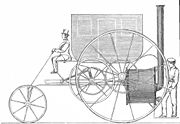
Not all the details of the carriage are known but the drawings which accompanied the original patent have survived, as have contemporary drawings made by a naval engineer who was sent to examine it. Further information has also been obtained from eyewitness accounts.The carriage had 8-ft-diameter driving wheels which were intended to smooth out the road surfaces of the time, to help the fire from being extinguished by shaking. A forked piston rod reduced the distance between the single cylinder and the crankshaft and was considered a singular innovation at the time. Spring-operated valve gear
Valve gear
The valve gear of a steam engine is the mechanism that operates the inlet and exhaust valves to admit steam into the cylinder and allow exhaust steam to escape, respectively, at the correct points in the cycle...
was used to minimise the weight of the flywheel, overcoming one of the drawbacks of industrial steam engines.
The engine had a single horizontal cylinder which, along with the boiler and firebox, was placed behind the rear axle. The motion of the piston was transmitted to a separate crankshaft via the forked piston rod. The crankshaft drove the axle of the driving wheel (which was fitted with a flywheel) via a spur gear. The steam cocks (used to blow out water condensate from the steam chest), the force pump and the firebox bellows were also driven by the crankshaft.
The patent shows two features which may have been incorporated by Trevithick to discourage unlicensed copies: if the engine had been assembled as per the patent drawing
Patent drawing
A patent application or patent may contain drawings, also called patent drawings, illustrating the invention, some of its embodiments , or the prior art...
s it would have been able to run only backwards; and if the water pump had been arranged to be driven by the valve spring as shown, it would have run unevenly if at all.
It is reported that the cost of building the coach (not including the engine) was £207 and that the cost of transporting the engine from Falmouth to London was £20 14s 11d. The cost of the engine is unknown.
Operation
Following its completion, the London Steam Carriage was driven about 10 miles through the streets of London to Paddington and back via Islington, with seven or eight passengers, at a speed of 4–9 mph, the streets having been closed to other traffic.On a subsequent evening, Trevithick and his colleague crashed the carriage into some house railings and, as a result of this, plus lack of interest in the carriage by potential purchasers, and its demonstrations having exhausted the inventors' financial resources, it was eventually scrapped, the engine being used in a mill which made hoops for barrels.