


Littlejohn adaptor

Encyclopedia
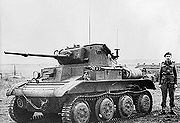
Ordnance QF 2 pounder
The Ordnance QF 2-pounder was a British anti-tank and vehicle-mounted gun, employed in the Second World War. It was actively used in the Battle of France, and during the North Africa campaign...
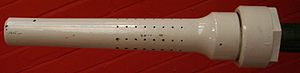
(40 mm) anti-tank gun. It was used to extend the service life of the 2-pounder during the Second World War by converting it to squeeze bore operation. "Littlejohn" came from the literal anglicization of the name of František Janeček
František Janeček
František Janeček was the founder of Jawa motorcycles and an important figure in the development of the Czech motorcycle industry. He died on 4 June 1941.-Early life:...
, the Czech designer and factory owner who had been working on the squeeze-bore principle in the 1930s and who had brought his know-how to Britain after he fled from the Nazi-occupied Czechoslovakia.
Design
Tungsten
Tungsten , also known as wolfram , is a chemical element with the chemical symbol W and atomic number 74.A hard, rare metal under standard conditions when uncombined, tungsten is found naturally on Earth only in chemical compounds. It was identified as a new element in 1781, and first isolated as...
) inside a softer metal casing - the armour-piercing, composite non-rigid (APCNR) design.
The round upon firing travelled the first part of the bore as normal. On entering the tapering portion the softer and malleable metal of the outer shell of the round was compressed - from 40 mm to around 30 mm. The round when it emerged from the adaptor now had a smaller cross-section compared to its weight. Together with the higher pressure developed in the barrel of diminishing internal volume compared to standard cylindrical bore, the APCNR round, called APSV (from armour-piercing super velocity), travelled faster, over a flatter trajectory. The higher velocity at impact was concentrated in the hard core alone. The Littlejohn adaptor/APCNR combination gave the 2 pounder a similar enhancing effect as the APDS round gave to the larger QF 6 pounder
Ordnance QF 6 pounder
The Ordnance Quick-Firing 6-pounder 7 cwt, or just 6 pounder, was a British 57 mm gun, their primary anti-tank gun during the middle of World War II, as well as the main armament for a number of armoured fighting vehicles...
gun.
The muzzle velocity of the APSV Mark II shell was 1,143 m/s compared to the 792 m/s of the normal 1.2 kg APCBC shell. The lighter Mark I APSV shell was capable of penetrating 88 mm of armour.
In 1942 US Ordnance
Ordnance Corps
The United States Army Ordnance Corps is a Sustainment branch of the United States Army, headquartered at Fort Lee, Virginia.-Mission Statement:The U.S...
tested the Littlejohn adaptor in an attempt to develop taper bore adaptor for the 37 mm Gun M3
M3 37 mm gun
The 37 mm Gun M3 was the first dedicated anti-tank gun fielded by United States forces. Introduced in 1940, it became the standard anti-tank gun of the U.S. infantry with its size enabling it to be pulled by a jeep...
. The adaptor distorted after a few shots.
Combat Use
The adaptor was chiefly used on British armoured cars e.g. the DaimlerDaimler Armoured Car
The Daimler Armoured Car was a British armoured car of the Second World War.-History:The Daimler Armoured Car was a parallel development to the Daimler Dingo "Scout car", a small armoured vehicle for scouting and liaison roles. It was another Birmingham Small Arms design...
which had been designed and built earlier in the war and could not be readily fitted with a larger gun. As an adaptor to the existing gun it could be removed at any time so that normal rounds could be fired.
See also
- 2.8 cm sPzB 412.8 cm sPzB 412.8 cm schwere Panzerbüchse 41 or "Panzerbüchse 41" was a German anti-tank weapon working on the squeeze bore principle. Officially classified as heavy anti-tank rifle , it would be better described, and is widely referred to, as a light anti-tank gun.-Description:Although the sPzB 41 was...
- German anti-tank weapon working on the squeeze bore principle. - 7.5 cm PaK 417.5 cm PaK 41The 7.5 cm PaK 41 was one of the last German anti-tank guns brought into service and used in World War II and notable for being one of the largest anti-tank guns to rely on the Gerlich principle to deliver a higher muzzle velocity and therefore greater penetration in...
- Another German anti-tank weapon working on the squeeze bore principle.