
All Topics  
Lenticular cloud

 
Lenticular Cloud

   Email Print
   Bookmark   Link


Lenticular cloud


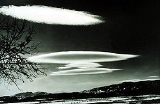
Lenticular clouds are stationary lens-shaped cloud
Cloud

A cloud is a visible mass of Drop or frozen crystals floating in the Celestial body atmosphere above the surface of the Earth or another planetary body....
s that form at high altitudes, normally aligned at right-angles to the wind direction. Lenticular clouds can be separated into altocumulus standing lenticularis (ACSL), stratocumulus standing lenticular (SCSL), and cirrocumulus standing lenticular (CCSL).

e stable moist air flows over a mountain or a range of mountains, a series of large-scale standing waves
Lee waves

In meteorology, lee waves, are Earth's atmosphere standing waves. The most common form is mountain waves, which are atmospheric internal gravity waves....
 may form on the downwind side.


Discussion
Ask a question about 'Lenticular cloud'
Start a new discussion about 'Lenticular cloud'
Answer questions from other users
Full Discussion Forum


Encyclopedia


Wea00010
Lenticular clouds are stationary lens-shaped cloud
Cloud

A cloud is a visible mass of Drop or frozen crystals floating in the Celestial body atmosphere above the surface of the Earth or another planetary body....
s that form at high altitudes, normally aligned at right-angles to the wind direction. Lenticular clouds can be separated into altocumulus standing lenticularis (ACSL), stratocumulus standing lenticular (SCSL), and cirrocumulus standing lenticular (CCSL).

Formation

Where stable moist air flows over a mountain or a range of mountains, a series of large-scale standing waves
Lee waves

In meteorology, lee waves, are Earth's atmosphere standing waves. The most common form is mountain waves, which are atmospheric internal gravity waves....
 may form on the downwind side. If the temperature at the crest of the wave drops to or below the dewpoint, moisture in the air may condense to form lenticular clouds. As the moist air moves back down into the trough of the wave, the cloud may evaporate back into vapor. Under certain conditions, long strings of lenticular clouds can form near the crest of each successive wave, creating a formation known as a 'wave cloud'. The wave systems cause large vertical air movements and so enough water vapor may condense to produce precipitation. The clouds have been mistaken for UFOs (or "visual cover" for UFOs) because these clouds have a characteristic lens appearance and smooth saucer-like shape. Bright colors (called Irisation
Irisation

In meteorology, Irisation, a type of photometeor, is multiple mixed Iridescence colors caused by sunlight being diffraction in clouds. The colours are often brilliant and mingled together, sometimes similar to mother-of-pearl....
) are sometimes seen along the edge of lenticular clouds.

Flight

Power pilots tend to avoid flying near lenticular clouds because of the turbulence of the rotor systems that accompany them, but sailplane pilots
Gliding

Gliding refers to the descending flight of heavier-than-air craft, principally gliders s, hang gliders and paragliders. Technically, gliders, hang-gliders and paragliders are just different styles of glider used to pursue gliding and soaring for recreation, in the same way that sailboats and windsurfers share the lake and the wind....
 actively seek them out. The precise location of the rising air mass is fairly easy to predict from the orientation of the clouds. "Wave lift" of this kind is often very smooth and strong, and enables glider
Glider

Heavier-than-air unpowered aircraft do not need propulsion once airborne. Gliders, balloons and kites are unpowered aircraft.Gliders such as gliders, hang gliders and paragliders gain their initial flying speed from some launch mechanism, and then gain additional energy from gravity and from updrafts such as thermal currents....
s to soar to remarkable altitudes and great distances. The current gliding world records for both distance (over 3,000 km; 1,864 mi) and altitude (15,460 m; 50,721 ft) were set using such lift.

Gallery


See also

  • Cap Cloud
  • Helm Wind
    Helm Wind

    The Helm Wind is a named wind in Cumbria, England, a north-easterly wind which blows down the south-west slope of the Cross Fell escarpment. It is the only named wind in the British Isles....


External links

  • - Gallery of lenticular clouds
  • - Altocumulus Lenticular Clouds, Wastach Mountains, Utah
  • - lenticular cloud above Mt Fuji.
  • - Picture of the Day 2009-01-21: A Lenticular Cloud over New Zealand