


Leading edge inflatable kite

Encyclopedia
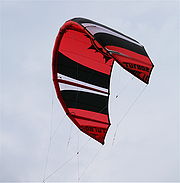
Power kite
A power kite or traction kite is a large kite designed to provide significant pull to the user.They come in three main forms: foils, leading edge inflatables and supported leading edge. There are also rigid-framed kites and soft single skin kites. There are several different control systems used...
or traction kite. These kites are flown using 2, 4 or 5 control lines and a bar. (See also: kite control systems
Kite control systems
Kite types, kite mooring, and kite applications result in a wide variety of kite control systems. Contemporary manufacturers, kite athletes, kite pilots, scientists, and engineers are expanding the possibilities....
) A LEI is a great kite for water use because the inflated bladders cause it to float on the water surface. A LEI can sit on the water for an indefinite time and still be relaunched because, unlike a foil kite
Foil kite
Foil kites are soft kites based on the design of the parafoil. They consist of a number of cells running fore to aft, some or all of which are open at the front to allow air to inflate the kite so it takes on an aerofoil section...
, there are no chambers that can fill with water. Generally used for kitesurfing
Kitesurfing
Kitesurfing or Kiteboarding is an adventure surface water sport that has been described as combining wakeboarding, windsurfing, surfing, paragliding, and gymnastics into one extreme sport. Kitesurfing harnesses the power of the wind to propel a rider across the water on a small surfboard or a...
, leading edge inflatable kites come in many different sizes from approximately 5-18 square metres.
Based on their design Leading Edge Inflatable kites can be broken down into four categories: C-
kites, Hybrid kites, Delta kites, and Bow kite
Bow kite
Bow kites are leading edge inflatable kites that incorporate a bridle on the leading edge. They can be identified by a flat, swept-back profile and concave trailing edge allowing the kite greater depower...
s.
C Kites
C Kites are the oldest style of LEI used for traction kiting. They come with four lines, and have the option of an additional 5th line for safety. The main difference between C kites and other LEI styles is that they do not have any lines that support the leading edge of the kite (called bridles). The lines on a C- kite attach to the four corners of the kite. Hybrid kites, together with bow kiteBow kite
Bow kites are leading edge inflatable kites that incorporate a bridle on the leading edge. They can be identified by a flat, swept-back profile and concave trailing edge allowing the kite greater depower...
s and later Delta kites are all subtypes of a SLE-kite (Supported Leading Edge), defined by having a bridle which supports the leading edge.
Bow Kites
All of the Bow kites advantages are because of its concave trailing edge. This design feature changes the shape of the kite's trailing edge as it flies, requiring that the leading edge flatten to match, resulting in a much flatter looking kite. The bridles on the kite restrict the leading edge and hold it in line with the rest of the kite. In addition, the concave trailing edge enables the kite to be sheeted out further than a traditional C- kite, which is why a Bow kite can be nearly 100% depowered.The inflatable and Bow kite
Bow kite
Bow kites are leading edge inflatable kites that incorporate a bridle on the leading edge. They can be identified by a flat, swept-back profile and concave trailing edge allowing the kite greater depower...
designs were invented by Dominique and Bruno Legaignoux.
Hybrid Kites
Hybrid kites are a cross between C- kites and Bow kiteBow kite
Bow kites are leading edge inflatable kites that incorporate a bridle on the leading edge. They can be identified by a flat, swept-back profile and concave trailing edge allowing the kite greater depower...
s. Like bow kites, they incorporate bridles to support their leading edge. These bridles support the kite and enable designers to experiment with different arc profiles - some Hybrids can have a very flat arc, while some can look similar to a C- kite. Individual characteristics of the Hybrid kites vary depending on how similar they represent one of the other two kite styles. The defining difference between a Hybrid and Bow kite is the shape of the trailing edge. The trailing edge on a Hybrid kite is convex, whereas that of a Bow is concave.
Delta Kites
Delta kites are a refinement of the hybrid design. Their shape (when flattened out) is more triangular, which places more of the kite's canopy in the middle. This increases the amount of "projected area" that is exposed to the wind, resulting in more power. These kites still use a bridle (though it's often extremely simplified), and so could still be called SLE kites. (They are often called C-shaped, but they aren't C-kites as they are traditionally known.) Delta C-kites are a new breed of hybrid which combines the high-performance of a C-kite with the depowerable fast-turning triangular Delta kites.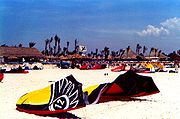
See also
- KitesurfingKitesurfingKitesurfing or Kiteboarding is an adventure surface water sport that has been described as combining wakeboarding, windsurfing, surfing, paragliding, and gymnastics into one extreme sport. Kitesurfing harnesses the power of the wind to propel a rider across the water on a small surfboard or a...
- SnowkitingSnowkitingSnowkiting is an outdoor winter sport where people use kite power to glide on snow or ice. The sport is similar to kitesurfing, but with the footwear used in snowboarding or skiing. In the early days of snowkiting, foil kites were the most common type; nowadays some kitesurfers use their water gear...
- Power kitePower kiteA power kite or traction kite is a large kite designed to provide significant pull to the user.They come in three main forms: foils, leading edge inflatables and supported leading edge. There are also rigid-framed kites and soft single skin kites. There are several different control systems used...
- Bow kiteBow kiteBow kites are leading edge inflatable kites that incorporate a bridle on the leading edge. They can be identified by a flat, swept-back profile and concave trailing edge allowing the kite greater depower...
- Foil kiteFoil kiteFoil kites are soft kites based on the design of the parafoil. They consist of a number of cells running fore to aft, some or all of which are open at the front to allow air to inflate the kite so it takes on an aerofoil section...
- Kite typesKite typesKites are tethered flying objects which fly by using aerodynamic lift, requiring wind, , for generation of airflow over the lifting surfaces.-Kite types:...
- Kite applicationsKite applicationsThe kite is used to do certain things; one kite or many kites are applied to achieve certain purposes, objectives, or tasks, that is: applications. Humans have applied the kite to bring perceived benefits during peace and war alike. New applications for the kite continue to be found...
- Kite lineKite lineKites have a wing and a kite line , or sometimes more than one line. Kite systems may have more than one kite and more than one kite line....
- Kite mooringKite mooringKites are given mooring by many methods. Watercraft and aircraft traditionally have the term "mooring" applied to making the watercraft or aircraft fast to some external object...
- Kite control systemsKite control systemsKite types, kite mooring, and kite applications result in a wide variety of kite control systems. Contemporary manufacturers, kite athletes, kite pilots, scientists, and engineers are expanding the possibilities....
- Kite books