


Le Mans Prototype

Encyclopedia
Sports prototype
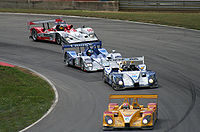
A sports prototype, also referred to as simply a prototype, is a form of racing car that is used as a top category in sports car racing. These purpose-built racing cars differ from street-legal and production-based racing cars that also compete in sports car racing.Prototype racing cars have...
race car most notably used in the 24 Hours of Le Mans
24 Hours of Le Mans
The 24 Hours of Le Mans is the world's oldest sports car race in endurance racing, held annually since near the town of Le Mans, France. Commonly known as the Grand Prix of Endurance and Efficiency, race teams have to balance speed against the cars' ability to run for 24 hours without sustaining...
, American Le Mans Series
American Le Mans Series
The American Le Mans Series presented by Tequila Patrón is a sports car racing series based in the United States and Canada. It consists of a series of endurance and sprint races, and was created in the spirit of the 24 Hours of Le Mans. Teams compete in one of five classes: LMP1, LMP2 and LMPC...
and Le Mans Series
Le Mans Series
The Le Mans Series is a European sports car racing endurance series based around the 24 Hours of Le Mans race and run by the Automobile Club de l'Ouest . The series was originally named the Le Mans Endurance Series, but changed its name prior to the 2006 season...
. Created by the Automobile Club de l'Ouest
Automobile Club de l'Ouest
The Automobile Club de l'Ouest , sometimes abbreviated to ACO, is the largest automotive group in France. It was founded in 1906 by car building and racing enthusiasts, and is most famous for being the organising entity behind the annual Le Mans 24 Hours race...
(ACO), they are the fastest closed-wheel racing cars used in circuit racing today, considered a class above production-based grand tourer
Grand tourer
A grand tourer is a high-performance luxury automobile designed for long-distance driving. The most common format is a two-door coupé with either a two-seat or a 2+2 arrangement....
cars which compete alongside them in sports car racing
Sports car racing
Sports car racing is a form of circuit auto racing with automobiles that have two seats and enclosed wheels. They may be purpose-built or related to road-going sports cars....
. Their cost and technology makes them comparable to Formula One car
Formula One car
A modern Formula One car is a single-seat, open cockpit, open wheel racing car with substantial front and rear wings, and an engine positioned behind the driver. The regulations governing the cars are unique to the championship...
s, including reaching higher maximum speeds than Formula One.
Although most commonly known as Le Mans Prototypes, these types of cars have used various names depending on the series in which they compete. The FIA's equivalent cars were referred to as Sports Racers (SR) or Sports Racing Prototypes (SRP). The American IMSA GT Championship
IMSA GT Championship
IMSA GT was a sports car racing series organized by International Motor Sports Association. Races took place primarily in the United States and occasionally in Canada.-History:...
termed their cars World Sports Cars (WSC), while the short-lived United States Road Racing Championship
United States Road Racing Championship
The United States Road Racing Championship was created by the Sports Car Club of America in 1962. It was the first SCCA series for professional racing drivers. SCCA Executive Director John Bishop helped to create the series to recover races that had been taken by rival USAC Road Racing...
used the classic Can-Am (CA) name for their prototypes. Since 2004, all series have switched to referring to these cars as Le Mans Prototypes.
History
The first use of what would become Le Mans Prototypes was at the 1992 24 Hours of Le Mans1992 24 Hours of Le Mans
The 1992 24 Hours of Le Mans was the 60th Grand Prix of Endurance, and took place on June 20 and 21 1992. It was also the third round of the Sportscar World Championship...
. In an attempt to increase the number of entrants beyond the small field of Group C
Group C
Group C was a category of motorsport, introduced by the FIA in 1982 for sports car racing, along with Group A for touring cars and Group B for GTs....
competitors that the World Sportscar Championship
World Sportscar Championship
The World Sportscar Championship was the world series run for sports car racing by the FIA from 1953 to 1992.The championship evolved from a small collection of the most important sportscar, endurance and road racing events in Europe and North America with dozens of gentleman drivers at the grid,...
had to offer, older Porsche 962
Porsche 962
The Porsche 962 was a sports-prototype racing car built by Porsche as a replacement for the 956 and designed mainly to comply with IMSA's GTP regulations, although it would later compete in the European Group C formula as the 956 had...
s were allowed entry in Category 3. To further increase the size of the field, small open-cockpit race cars using production road car engines which were raced in small national championships were allowed in Category 4. Only three cars (a Debora-Alfa Romeo, a Ren-Car Peugeot and a WR-Peugeot) were entered, with all failing to run more than a few hours.
However at the end of 1992, the World Sportscar Championship as well as the All Japan Sports Prototype Championship
All Japan Sports Prototype Championship
The , abbreviated as JSPC, formed by the Japanese Automobile Federation, was a domestic championship which took place in Japan for Group C and IMSA GTP prototype cars and also featured cars that were eligible for touring car racing in its earlier years...
collapsed, leaving the expensive Group C prototypes little competition outside of Le Mans. With Group C being phased out, the ACO chose to allow production-based race cars to enter for the first time in many years, while at the same time creating the Le Mans Prototype (LMP) class. The cars continued to use the same formula as they had in 1992, but the ACO later announced their intentions to completely replace the Group C cars with Le Mans Prototypes in 1994. Two classes were created, with LMP1s running large displacement custom-built engines that were usually turbocharged, and LMP2 using the smaller displacement production-based engines. Both classes were required to have open cockpits. At the same time, the IMSA GT Championship
IMSA GT Championship
IMSA GT was a sports car racing series organized by International Motor Sports Association. Races took place primarily in the United States and occasionally in Canada.-History:...
announced the end of their closed cockpit GTP and Lights classes, deciding as well to replace them with a single open-cockpit class of World Sports Cars equivalent to LMP1.
Ferrari
Ferrari S.p.A. is an Italian sports car manufacturer based in Maranello, Italy. Founded by Enzo Ferrari in 1929, as Scuderia Ferrari, the company sponsored drivers and manufactured race cars before moving into production of street-legal vehicles as Ferrari S.p.A. in 1947...
, Porsche
Porsche
Porsche Automobil Holding SE, usually shortened to Porsche SE a Societas Europaea or European Public Company, is a German based holding company with investments in the automotive industry....
, and Mazda
Mazda
is a Japanese automotive manufacturer based in Fuchū, Aki District, Hiroshima Prefecture, Japan.In 2007, Mazda produced almost 1.3 million vehicles for global sales...
. In 1997, the first European series based around Le Mans Prototypes were launched, known as the International Sports Racing Series. Using classes similar to LMP1/WSC and LMP2, these cars were known as SR1 and SR2 by the FIA. 1998 saw the creation of another series of Le Mans Prototypes, with the new United States Road Racing Championship
United States Road Racing Championship
The United States Road Racing Championship was created by the Sports Car Club of America in 1962. It was the first SCCA series for professional racing drivers. SCCA Executive Director John Bishop helped to create the series to recover races that had been taken by rival USAC Road Racing...
attempting to break away from the IMSA GT Championship
IMSA GT Championship
IMSA GT was a sports car racing series organized by International Motor Sports Association. Races took place primarily in the United States and occasionally in Canada.-History:...
. To differ from IMSA'S WSC class, the USRRC named their open-cockpit prototypes as Can-Am in an attempt to resurrect the sportscar championship of the 1970s. However the USRRC collapsed before the end of 1999, with the series becoming the Rolex Sports Car Series
Rolex Sports Car Series
The Rolex Sports Car Series is the premier series run by the Grand American Road Racing Association. It is a North American-based sports car series that was founded in 2000 under the name Grand American Road Racing Championship to replace the failed United States Road Racing Championship...
who chose to use the FIA's SR1 and SR2 formula instead.
1999 saw a great expansion for the ACO's LMP classes. Following the cancellation of the IMSA GT Championship at the end of 1998, the ACO would allow for the creation of the American Le Mans Series
American Le Mans Series
The American Le Mans Series presented by Tequila Patrón is a sports car racing series based in the United States and Canada. It consists of a series of endurance and sprint races, and was created in the spirit of the 24 Hours of Le Mans. Teams compete in one of five classes: LMP1, LMP2 and LMPC...
. This series used the same class structure as the 24 Hours of Le Mans, meaning it was the first championship to use the LMP name. At the same time, the ACO greatly altered their LMP classes. The smaller LMP2 class were briefly eliminated, while a new class of closed-cockpit prototypes were allowed in, known as LMGTP (Le Mans Grand Touring Prototype). These cars were actually evolutions of production-based road cars that the ACO considered too advanced and too fast to fall under the GT class regulations, forcing the ACO to promote them to prototypes.
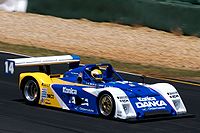
2000 saw changes to the LMP regulations, as the ACO once again split the open-cockpit LMP class. The two new classes became known as LMP900 and LMP675, with the numbers denoting the minimum weight requirements (in kilograms) for each class. LMP900s were to be more powerful and faster in top speed, but also heavier and more cumbersome. LMP675s on the other hand were to be smaller and more nimble, yet lack the top speed of their larger cousins. Both classes were intended to be able to compete for overall wins. Audi
Audi
Audi AG is a German automobile manufacturer, from supermini to crossover SUVs in various body styles and price ranges that are marketed under the Audi brand , positioned as the premium brand within the Volkswagen Group....
, Chrysler
Chrysler
Chrysler Group LLC is a multinational automaker headquartered in Auburn Hills, Michigan, USA. Chrysler was first organized as the Chrysler Corporation in 1925....
, Cadillac
Cadillac
Cadillac is an American luxury vehicle marque owned by General Motors . Cadillac vehicles are sold in over 50 countries and territories, but mostly in North America. Cadillac is currently the second oldest American automobile manufacturer behind fellow GM marque Buick and is among the oldest...
, and Panoz
Panoz
Panoz Auto Development is an American manufacturer of high-performance automobiles founded in 1989 by Dan Panoz, son of pharmaceutical and motorsport mogul Don Panoz. The company is located in Braselton, GA. Panoz products have included the Panoz Roadster and AIV Roadster, and the Panoz Esperante...
opted to use the LMP900 class, while MG
MG (car)
The MG Car Company is a former British sports car manufacturer founded in the 1920s by Cecil Kimber. Best known for its two-seat open sports cars, MG also produced saloons and coupés....
were the only major manufacturer to attempt the LMP675 class. The LMGTP class also continued, with Bentley
Bentley
Bentley Motors Limited is a British manufacturer of automobiles founded on 18 January 1919 by Walter Owen Bentley known as W.O. Bentley or just "W O". Bentley had been previously known for his range of rotary aero-engines in World War I, the most famous being the Bentley BR1 as used in later...
being the only manufacturer to build a closed-cockpit prototype after the regulation changes in 2000.
Outside of Le Mans, the FIA SR classes would suffer from these rule changes. The SR2 class no longer aligned perfectly with the new LMP675 class, with more powerful and durable racing engines being allowed in the latter. The SR1 and LMP900 classes also did not use the same rules, although engines were mostly similar. This meant that teams competing in the newly renamed FIA Sportscar Championship
FIA Sportscar Championship
The FIA Sportscar Championship was a sports car racing series created by John Mangoletsi and was eventually taken control of by the Fédération Internationale de l'Automobile . It was a series similar to the FIA GT Championship, concentrating on two classes of open-cockpit sports prototypes in...
required modifications to their cars to be able to compete at Le Mans or in the new European Le Mans Series, a second series split from the American Le Mans Series. With FIA Sportscar Championship teams unwilling to modify their cars to run in the ELMS, that series was canceled due to lack of participants. However the demand to race at Le Mans eventually forced the FIA Sportscar Championship itself to be canceled in 2003, with most competitors choosing to comply with the ACO's regulations instead of the FIA's. With the Rolex Sports Car Series also abandoning their SR classes at the end of 2003 for their own unique Daytona Prototype
Daytona Prototype
A Daytona Prototype is a type of sports prototype racing car developed specifically for the Grand American Road Racing Association's Rolex Sports Car Series as their top class of car, replacing contemporary open cockpit sports cars, specifically Sports Racing Prototypes...
s, this meant that the ACO LMPs were the only open-cockpit prototypes left.
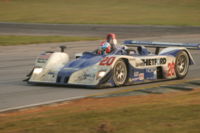
The LMP1 and LMP2 classes continue to be used at the 24 Hours of Le Mans and in the newer championships that were created by the ACO: the Le Mans Series
Le Mans Series
The Le Mans Series is a European sports car racing endurance series based around the 24 Hours of Le Mans race and run by the Automobile Club de l'Ouest . The series was originally named the Le Mans Endurance Series, but changed its name prior to the 2006 season...
in 2004 and the Japan Le Mans Challenge
Japan Le Mans Challenge
The Japan Le Mans Challenge was an endurance sportscar series based in Japan built around the 24 Hours of Le Mans that began in 2006. It was run by the Sports Car Endurance Race Operation sanctioning body and ran under the rules laid out by the Automobile Club de l'Ouest...
in 2006. In 2004, the ACO renamed LMP900 back to LMP1, and with this they limited the rear wing to 1.9m and reduced the fuel tank capacity from 90L to 80L. This is done in an effort to promote new "hybrid" LMP1 cars whilst putting more restrictions on the aging LMP900 cars like the Audi R8. New safety measures were also brought in, and prototypes are now required to have 2 rollover bars instead of just 1. 2006 was the final year that LMP900 chassis are allowed to be entered.
From 2006 to 2010, the regulations were as follow:
LMP1
No limits on the amount of cylinders in an engine. Naturally aspirated petrol engines have a maximum engine capacity of 6000cc. Diesel engines are allowed a maximum of 5500cc with two-stage charging device. Turbocharged petrol engines (limited to only a single stage charging device) are allowed 4000cc with a maximum of 8 cylinders. All prototypes have a minimum weight of 900kg and 90L of fuel capacity.
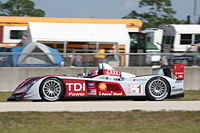
Following the Audi R10 TDI's superior performance at the 2006 Le Mans 24 Hours, the ACO reduced the restrictor and turbo boost on diesel engines, as well as imposing a 81L fuel capacity limit on diesel prototypes. The ACO also opened a "production-based engine" loophole, allowing 47.8mm of restrictor for any production-based engine instead of the normal 45.5mm. Engine capacities allowed up to 7000cc. The Lola B08/60 Aston Martin was the first car to take advantage of this loophole.
The turbo boost pressure on diesel engines continue to be progressively decreased by the year. Later on the ACO raised the minimum weight of diesel engines to 930kg. In 2009, all LMP rear wing width limit was reduced from 2.00m to 1.60m.
LMP2
Naturally aspirated engines have a maximum engine capacity of 3400cc, with a maximum of 8 cylinders. Single-staged turbocharged engines allowed 2000cc with a maximum of 6 cylinders. Production-based diesel engines are allowed 4400cc, although no car took this engine choice. All prototypes have a minimum weight of 775kg and fuel tank capacity of 90L.
With the ALMS's P2-favouring track nature, the Penske racing Porsche RS Spyder outperformed the Audi R10 TDI in the 2007 American Le Mans Series season, scoring 8 overall wins against Audi's 4. For 2008, the minimum weight of LMP2 cars were raised to 825kg, and fuel tank capacity limit was brought down to 80L.
In 2009, LMP2 restrictors were brought down from 45.5mm to 43.5mm.
Technical regulations
.As of 2011, the main technical regulations for the LMP class cars are as listed below:
- LMP1 - intended especially for manufacturersFactory-backedFactory-backed is a term commonly used in motorsports to describe a sponsored racing team, car, motorcycle or driver that competes with official sanction and financial support, or "backing" from a manufacturer. As motorsports competition is an expensive endeavor, some degree of factory support is...
: minimum weight of 900 kg (1984 lbPound (mass)The pound or pound-mass is a unit of mass used in the Imperial, United States customary and other systems of measurement...
). Naturally aspirated engines limited to 3400 cc (207.5 ci). TurbochargerTurbochargerA turbocharger, or turbo , from the Greek "τύρβη" is a centrifugal compressor powered by a turbine that is driven by an engine's exhaust gases. Its benefit lies with the compressor increasing the mass of air entering the engine , thereby resulting in greater performance...
s and superchargerSuperchargerA supercharger is an air compressor used for forced induction of an internal combustion engine.The greater mass flow-rate provides more oxygen to support combustion than would be available in a naturally aspirated engine, which allows more fuel to be burned and more work to be done per cycle,...
s allowed for petrol engines with a maximum displacement of 2000 cc (122 ci) and for diesel engineDiesel engineA diesel engine is an internal combustion engine that uses the heat of compression to initiate ignition to burn the fuel, which is injected into the combustion chamber...
s with a maximum displacement of 3700 cc (225.8 ci). No limits on the number of cylindersCylinder (engine)A cylinder is the central working part of a reciprocating engine or pump, the space in which a piston travels. Multiple cylinders are commonly arranged side by side in a bank, or engine block, which is typically cast from aluminum or cast iron before receiving precision machine work...
for any type of engine. Fuel tank size of 75 litres (16.5 gallons) for petrol engines, 73 litres (16 gallons) for hybridHybrid electric vehicleA hybrid electric vehicle is a type of hybrid vehicle and electric vehicle which combines a conventional internal combustion engine propulsion system with an electric propulsion system. The presence of the electric powertrain is intended to achieve either better fuel economy than a conventional...
petrol engines, 65 litres (14.3 gallons) for diesel engines and 71 litres (15.6 gallons) for hybrid diesel engines. Wheel size (maximum diameter) of 28.5 inches (723.9 mm) and maximum width of 16 inches (406.4 mm). LMP1 cars are generally the most powerful, with faster straightaway speeds.
- LMP2 - intended especially for privateersPrivateer (motorsport)In motor sport, a privateer is usually an entrant into a racing event that is not directly supported by an automobile manufacturer. Privateers teams are often found competing in rally and circuit racing events, and often include competitors who build and maintain their own vehicles...
: minimum weight of 900 kg (1984 lb) or 920 kg (2028 lb) for 2010 cars in 2011 configuration. Only production-based engines are allowed in LMP2 with diesel engines banned. Naturally aspirated engines limited to 5000 cc (305.1 ci) with a maximum of eight cylinders. Turbocharging and supercharging are allowed for petrol engines with a maximum displacement of 3200 cc (195.3 ci) and a maximum of six cylinders. Fuel tank size of 75 litres (16.5 gallons) all type of engines. Wheel size (maximum diameter) of 23 inches (584.2 mm) and maximum width of 14 inches (355.6 mm). - LMPC - Formula Le Mans
Biofuel
Biofuel
Biofuel is a type of fuel whose energy is derived from biological carbon fixation. Biofuels include fuels derived from biomass conversion, as well as solid biomass, liquid fuels and various biogases...
s, specifically petrol with 10% ethanol and biodiesel
Biodiesel
Biodiesel refers to a vegetable oil- or animal fat-based diesel fuel consisting of long-chain alkyl esters. Biodiesel is typically made by chemically reacting lipids with an alcohol....
(BTL
Biomass to liquid
Biomass to Liquid or BMtL is a multi-step process which produces liquid biofuels from biomass:The process uses the whole plant to improve the carbon dioxide balance and increase yield....
), are allowed in both categories.
Both classes allow open or closed-cockpit designs (closed car must have a windscreen, a roof and doors on each side). New for 2011, all closed-cockpit cars must have fins on the rear bodywork to prevent them from rolling over in the air during crashes. Although a passenger seat is not used, cars have to be designed to carry two people. The empty area of the cockpit is therefore usually used to hold electronic devices and cooling equipment.
Dimensions are limited to a maximum of 4650 mm (183.1 in) in length, 2000 mm (78.7 in) in width, and 1030 mm (40.6 in) in height (from the bottom of the bodywork, not the ground). Bodywork is also required to cover all mechanical elements of the car, so that it cannot be visible when the car is viewed directly from the front, side, or top.
See also
- Formula Le Mans
- Group CGroup CGroup C was a category of motorsport, introduced by the FIA in 1982 for sports car racing, along with Group A for touring cars and Group B for GTs....
- GTP
- WSC
- Daytona PrototypeDaytona PrototypeA Daytona Prototype is a type of sports prototype racing car developed specifically for the Grand American Road Racing Association's Rolex Sports Car Series as their top class of car, replacing contemporary open cockpit sports cars, specifically Sports Racing Prototypes...
Racing series
LMP analysis
- Le Mans Series - Explanation of LMP classes
- Mulsanne's Corner